The viral short drama didn't use SenseTime's model, yet SenseTime still leveraged it to promote its ecosystem
The viral short drama didn't use SenseTime's model, yet SenseTime still leveraged it to promote its ecosystem

2026-11-19 14:06
Introduction: The industrial base binds computing power, orders, and creators into long-term invocation. A short-form drama blockbuster praised by central media has become a coveted brand in the competitive ecosystem of short-form drama chains.
A short-form drama blockbuster lauded by central media has become a sought-after flagship across various short-form drama ecosystems.
Around November 10, SenseTime released an official announcement stating: "SenseTime Seko ecosystem renews the hit series, 'Armed Entry to Song Dynasty' tops the charts."
The content indicates that the series was produced by “Xuebao Studio”, a partner within the SenseTime Seko ecosystem. A core team of 10 members operated in five parallel groups, leveraging the systematic capabilities of Seko Agent to achieve stable weekly updates—one season per week, with 100 episodes per season.
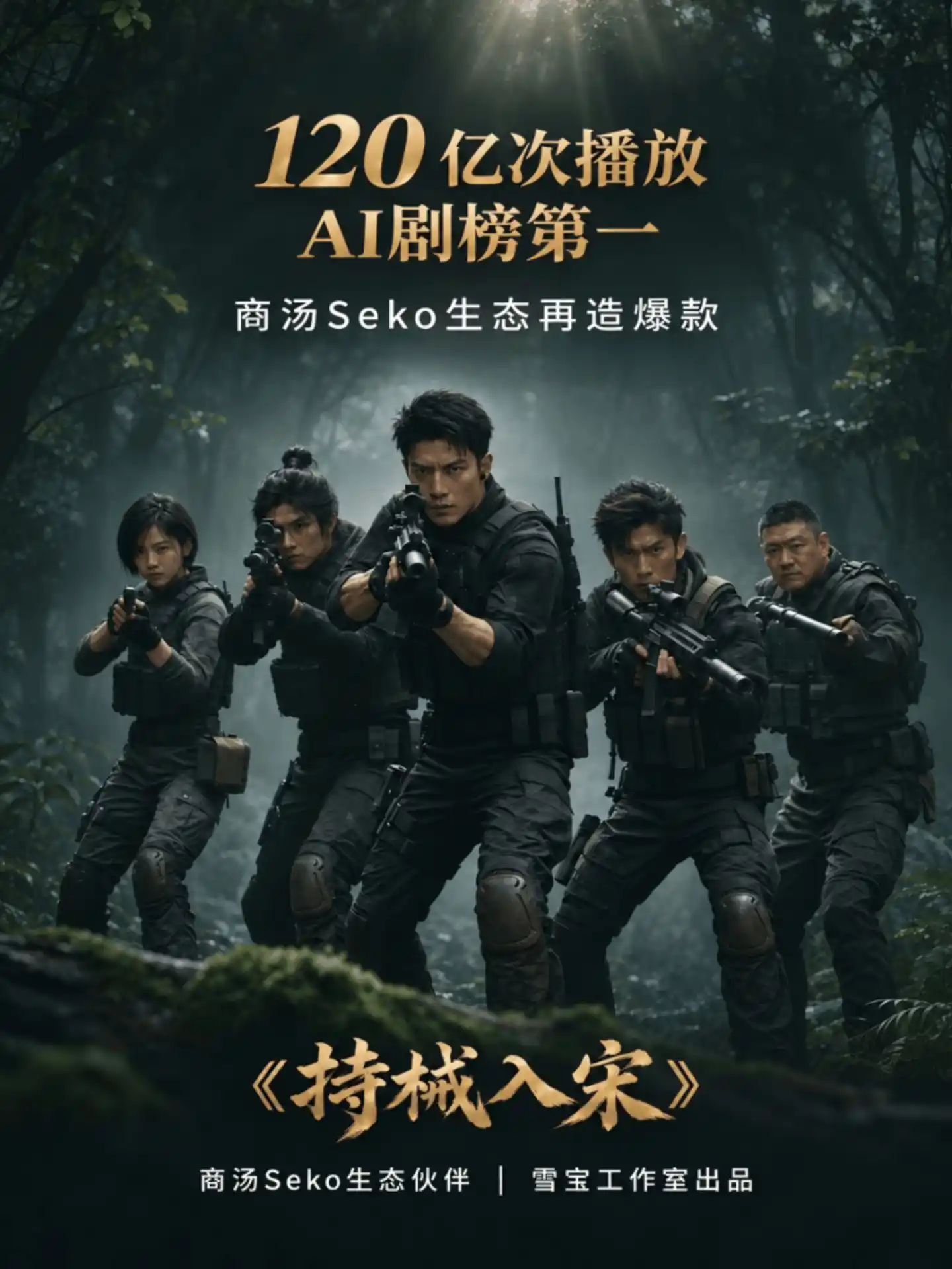
Image source: SenseTime official account
Reading only this official release, audiences might easily assume the entire series emerged from SenseTime’s video model system. However, just one week prior, during intensive interviews with multiple media outlets, SenseTime had virtually no visibility.
According to the team’s introduction, the core team behind "Armed Entry to Song Dynasty" consisted of six individuals scattered across different regions nationwide, collaborating entirely online. When discussing tools used, they mentioned Seedance 2.0 and 2.5, Douba, as well as Tomato Novel and Hongguo—yet notably omitted any reference to SenseTime or Seko.
Shortly after SenseTime’s post went live, it was quickly set to private view. While external media such as Shangguan News still retain copies of the original coverage, the official post has since vanished.
It is not inaccurate for SenseTime to include "Armed Entry to Song Dynasty" within its Seko ecosystem. Its AI short-form drama strategy extends beyond mere video generation models. Over the past two years, SenseTime has rolled out AI video generation models and Agents, established production bases, recruited studios, and integrated computing power, office space, and creator support into a cohesive pipeline.
"Transforming blockbusters into sustainable production capacity is what Seko consistently does," says Hongguo. The continuous stream of hits from Hongguo provides the most accessible window into SenseTime’s long-term investment.

Xuebao Studio is the sole intersection point between the two narratives.
The production entity behind "Armed Entry to Song Dynasty" is "Lao Shiyi Theater." Although there is no corporate, project, or labor affiliation between Lao Shiyi Theater and Xuebao Studio, its founder Zhang Hansheng was the 11th student in Xuebao Studio’s 2025 online short-form drama training program—the origin of the theater’s name.
Moreover, many core team members were trained under Xuebao. They first learned AI production techniques and took on contract work through Xuebao before transitioning to selecting novels, producing series, and managing their own accounts independently.
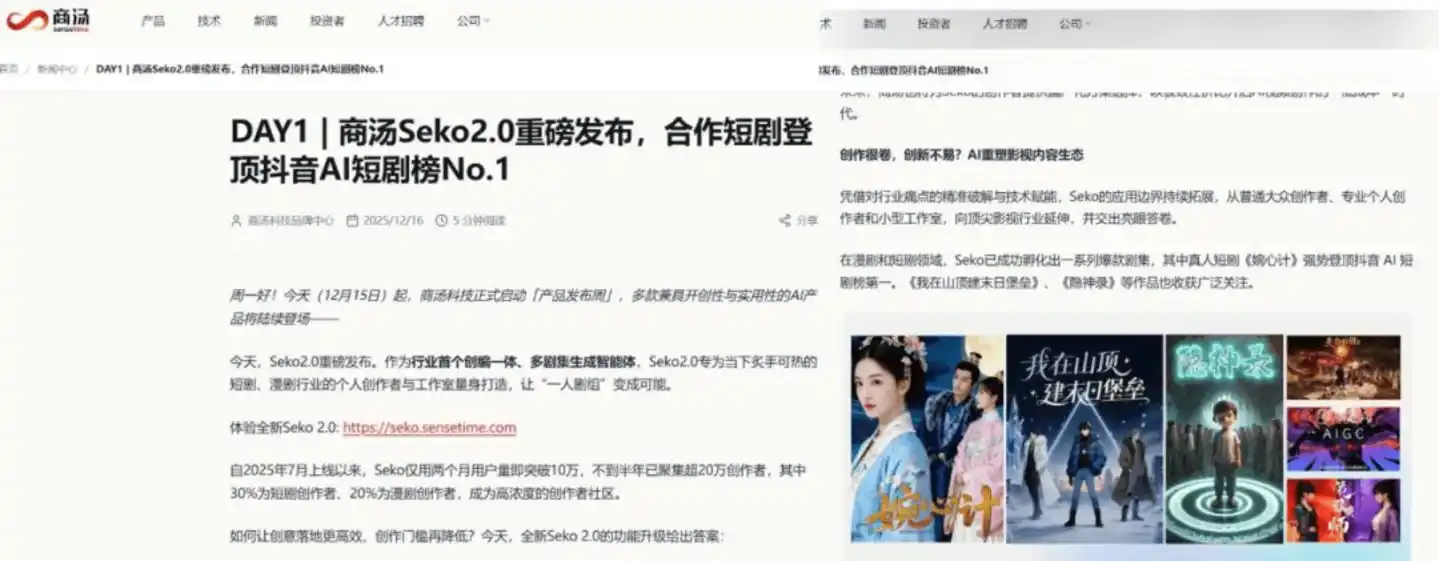
Xuebao Studio’s connection with SenseTime dates back to December 2025. At the time, the Seko 2.0 launch announcement carried the headline “Partnered Short Drama Tops TikTok AI Short Drama Chart No. 1,” referring precisely to “Wanxin Ji,” produced by Xuebao Studio.
In May this year, Xuebao Studio was among the first cohort to officially join the SenseTime Seko Industrial Base launch event.
Following this mentorship lineage, it is understandable why SenseTime claims "Armed Entry to Song Dynasty" as part of its ecosystem. Yet, the promotional poster labeling the series as “produced by Xuebao Studio,” along with phrases like “10 people, 5 teams working in parallel” and “systematic production capability based on Seko,” clearly contradict statements made by the creative team in interviews.
In all public interviews, the creative team never mentioned Xuebao Studio or the SenseTime Seko Industrial Base.
Observation Network’s recorded conversation on November 10 reveals that lead planner Zhang Hansheng, chief editor Li Chaohua, and head director He Xiushan arrived from Hebei, Jilin, and Hubei respectively. When asked about team composition, He Xiushan stated, “Currently, including me, the core team of 'Armed Entry to Song Dynasty' consists of six people.” Among them are a mother, former ride-hailing dispatcher, wholesale store owner, and company employee—none with formal film or television training backgrounds.
In a 36Kr article, Zhang Hansheng noted that the team has long collaborated remotely without video calls, recognizing each other only by voice. “I met them both for the first time at the train station on November 5—I almost didn’t recognize them.” He also clarified that the rumored 30-person team refers to the total scale across multiple productions, not a single project.
When questioned about workflows and tools, the name "Seko Agent" did not appear anywhere in their production process.
Regarding workflow, Zhang Hansheng explained: reading novels, deconstructing scripts, writing prompts, generating videos, and post-production editing—each member handled assigned episodes independently. They then unified access to character, scene, and prop assets, submitted works to group chat for cross-review, and returned for rework if requirements weren’t met.
Asked about which text model was used for scriptwriting, he replied, “I use Douba.” For generation tools, he said, “We currently mainly use Seedance 2.5; the initial part of Season 1 used Seedance 2.0. We switched to 2.5 because it produces more realistic results.”

SenseTime’s investment in AI short-form dramas predates the breakout success of "Armed Entry to Song Dynasty."
In August 2025, Seko 1.0 launched; in December 2025, Seko 2.0 followed; and in July 2026, Seko 3.0 debuted at the World Artificial Intelligence Conference. SenseTime defines Seko as the “world’s first AI video creation agent integrating ideation and production,” rather than a dedicated visual generation model.
SenseTime does have proprietary models, but their placement within Seko already signals their role.
In March this year, Seko ecosystem lead Zhang Zhen listed a self-developed model inventory: image model Seko IDX, video model Seko 1.5, lip-sync model Seko Talk, and inference framework LightX2V.
Seko IDX ensures character consistency across shots; Seko Talk enables digital avatars to sync lip movements with audio; LightX2V serves as an inference framework that does not generate visuals directly—this is where SenseTime’s externally validated technical impact lies.
LightX2V has been officially integrated into ComfyUI, with approximately 3,000 stars on GitHub. According to third-party testing by Jarvislabs in November, its four-step LoRA reduced the time to generate a 5-second video using Wan2.2 by 85%. However, the trade-off is reduced motion intensity, leading to weaker dynamic changes in characters and camera movement.
Seko 1.5, which should be a direct competitor to Seedance, has the least public documentation. No model cards, technical reports, or mainstream blind test results are available in open channels.
This may stem from the model not being offered via independent API, making it difficult for external parties to conduct standalone comparisons like those with Seedance or Ke Ling. It also reflects SenseTime’s positioning: Seko 1.5 emphasizes response speed and computational cost efficiency over maximum visual quality.
Zhang Zhen once said, “Model capability is not the final delivery of value.” Seko’s overall lead Wang Zibin echoed this in a Southern Weekly interview, stating, “The lifecycle of a model is roughly half a year.” This likely explains why SenseTime has placed its bets beyond the model layer.
On one hand, SenseTime wants Seko to manage end-to-end workflow orchestration for long-form series.
Beyond resolving challenges like character consistency, scene and prop continuity, and narrative style persistence across episodes, Seko Agent also integrates planning, storyboarding, generation, and editing. Infinite canvas preserves character, scene, and context data. Skill ecosystem encapsulates proven creator methodologies into reusable modules.
Additionally, the Seko platform does not mandate exclusive use of SenseTime’s proprietary models. It has progressively integrated domestic AI video generation platforms such as Seedance, Ke Ling, and others.
SenseTime openly acknowledges this. During his model inventory presentation, Zhang Zhen listed self-developed Seko series alongside Ji Meng, Vidu, Wan, and Ke Ling. Chief Scientist Lin Dahua disclosed publicly in August, “We won’t make cinematic-grade visuals our primary competitive edge.”
On the other hand, SenseTime aims to dominate the backend of the AI short-form drama pipeline through the Seko Industrial Base.
On May 26, Shanghai’s “AI Micro-Drama Hub 8 Measures” were officially unveiled during the construction promotion meeting of the Xuhui District AI + Micro-Drama Industry Cluster. The policy includes support for computing power leasing, third-party model integration, corpus procurement, and digital asset library development.
Under accompanying district-level incentives, eligible Agent projects can receive up to RMB 10 million in support. Xuhui District also committed to incubating over 200 startup teams and launching more than 1,000 original works within three years.
On the same day “Hub 8 Measures” were announced, SenseTime Seko OPC Industrial Base officially launched in Xuhui District’s West Bund Smart Tower. The sole entry criterion: companies involved in upstream and downstream of AI micro-dramas.
SenseTime offers highly favorable support: the base is located in Xuhui, Shanghai. Participating teams receive free workspaces, with additional resources including up to RMB 200,000 in computing power discounts, up to RMB 50,000 in corpus discounts, and up to RMB 5 million in investment matching. Each team receives at least 50,000 Seko credits.
Beyond that, the base facilitates connections to production contracts, co-production resources, and prioritized distribution channels across platforms like TikTok, Kuaishou, and Xiaohongshu. It also provides business registration, accounting, policy applications, and one-on-one technical operations support for startups.
SenseTime exchanges its tools, computing power, services, and industry connectivity in hopes that creators and their projects remain entrenched in the Seko production chain.
Since the base launched in May, early reports indicated around 20 initial teams; by September, the number grew to 62 enterprises, with workspace utilization reaching 97%; by October, government figures showed the OPC team count expanded further to 82.
The rapid expansion of participating teams confirms the viability of this public-private collaboration model. “Ecosystem” thus becomes SenseTime’s best product narrative—and tangible proof of local industrial policy execution.
Aside from "Armed Entry to Song Dynasty," the Seko ecosystem has previously delivered hits including "Farewell," "Wutong Ling," "Jubao Xianpen," and "Wanxin Ji."
While viewership cannot directly convert into SenseTime revenue, sustained production of a series on Seko generates model invocations, credit consumption, subscriptions, and enterprise service fees. The market is large—and fiercely competitive.
QuestMobile data shows that Hongguo’s daily active users reached 168 million by the end of July, a 107% year-on-year increase. According to China Network Audiovisual Association statistics, AI-generated micro-dramas accounted for over 95% of new micro-dramas launched in Q1 2026.
DataEye reports that 221,900 AI dramas were launched on TikTok in the first half of the year, yet fewer than 0.5% exceeded one billion views. Thus, a breakout hit becomes exceptionally valuable to tool platforms—it proves to creators that continuous production, consistent characters, and cost control are not abstract promises in product manuals, but empirically validated methods confirmed by audience metrics.
SenseTime’s marketing strategy revolves around this very narrative. According to its latest disclosure, Seko now has 1.3 million registered users and approximately 3,000 registered enterprise clients, with paying users averaging over one hour of daily creative output.
This aligns perfectly with SenseTime’s current financial storytelling.
In the first half of 2026, SenseTime’s generative AI revenue reached RMB 2.33 billion, accounting for nearly 80% of group revenue; for the first time under IFRS, the company achieved profitability of RMB 620 million.
The company also separately reported recurring revenue of RMB 1.145 billion, up 124.4% year-on-year, attributing the shift to client collaborations evolving from one-time project deliveries toward ongoing usage, continuous renewals, and deep workflow integration.
SenseTime doesn’t need to capture Hongguo’s revenue share. What it truly seeks is to ensure the next “Armed Entry to Song Dynasty” runs as extensively as possible on the Seko production line—capturing the ongoing revenue generated from future, and subsequent, series on this pipeline.
Source: Shuzhi Benliu
Disclaimer: Contains third-party opinions, does not constitute financial advice


Douyin Releases 220,000 AI Animated Series in Half a Year, Most Creators Earn Less Than $10 Monthly
07-29
ByteDance's Douyin Beans priced at 68 RMB—worth it for 382 million monthly active users?
07-25
62 Yuan AI Community Collected 248,000 in 4 Days—First Lesson? Recruiting Referrals
07-23
Ditching Salesforce? U.S. Small Businesses Save $100K Annually with AI
07-23
The AlphaGo Moment in Cybersecurity, or Starting from These 466 Agent Matchups
14 days ago
The Trump administration plans to offer Constellation Nuclear a $5 billion loan for capacity expansion, with the additional power mostly pre-allocated to AI giants such as Google
21 days agoSilicon Valley Executives Spark Controversy Over Using AI for Household Tasks; Survey Reveals Half of American Adults Worry About Impact on Relationships
21 days ago


