Chain-of-Thought lead researcher departs Meta to join Mercor, which recently raised $750 million
Chain-of-Thought lead researcher departs Meta to join Mercor, which recently raised $750 million

2026-11-18 12:06
Lead: General corpora nearing exhaustion, expert tacit judgment becomes the new battleground for AI. Damn it! Last year, Zuckerberg dropped over $100M in a mega annual contract to poach Jason Wei—the creator of "Chain-of-Thought" from OpenAI—only to see him bolt just over a year later!
Damn it! Jason Wei, the author of "Chain-of-Thought," who was acquired by Zuckerberg’s $100M+ annual deal last year—has just left Meta after less than a year.
And his next stop? Not a tech giant—but a fledgling data startup...
Just now, Jason Wei announced on X:
He will depart Meta’s TBD Lab and join startup Mercor as Chief Scientist.
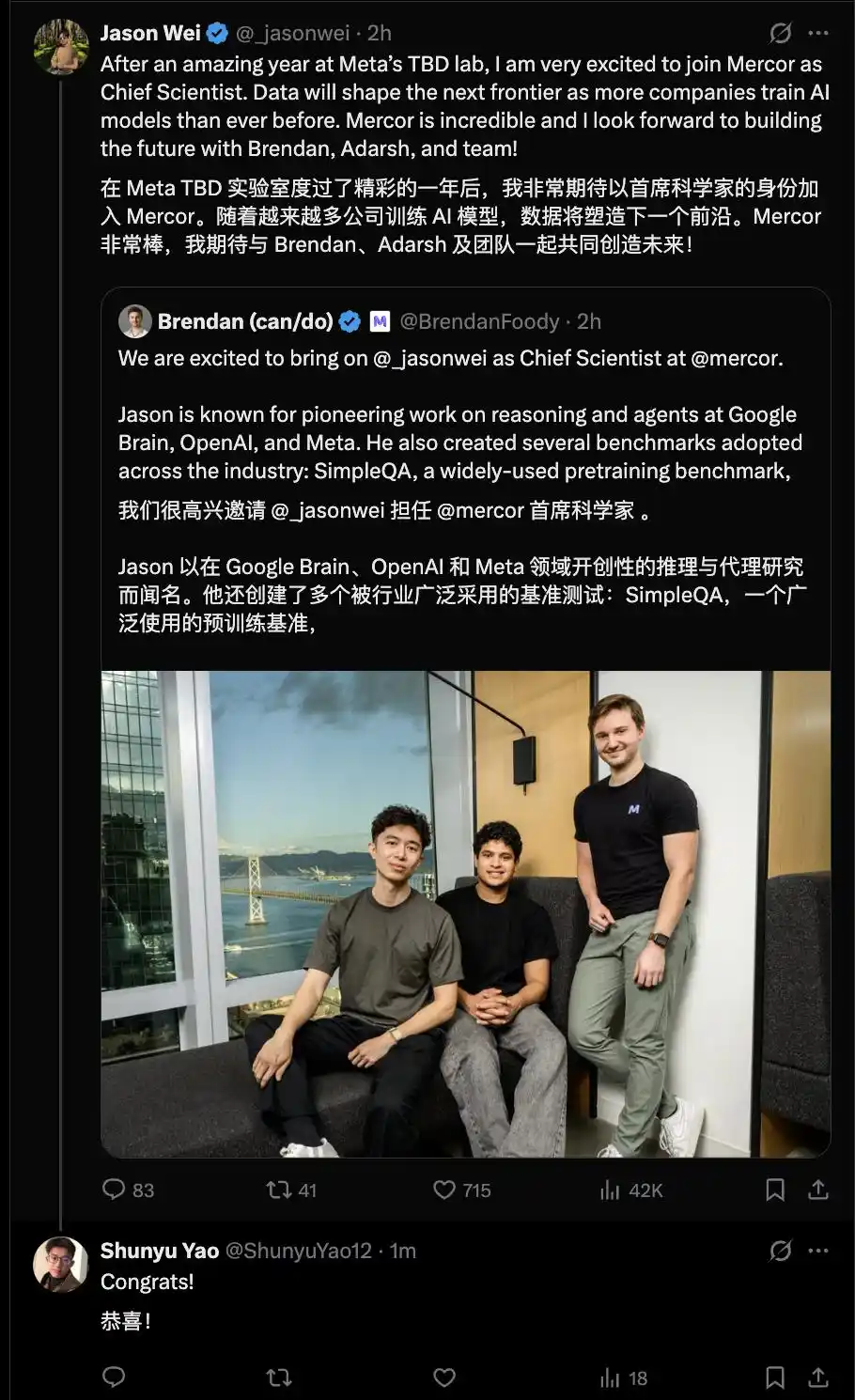
Meanwhile, in his post, he shared his outlook on the next phase of AI: As more companies train their own models, data will shape the next frontier.
Mercor co-founder and CEO Brendan Foody further revealed in his welcome post that Jason will help build the research team and oversee all data pipelines and evaluation workflows.
Notably, Edward Hu—the first author of the LoRA paper—will join him, taking charge of model training.
Though sudden, this move wasn’t entirely out of the blue. Even Jason hadn’t updated his X profile before announcing the departure.
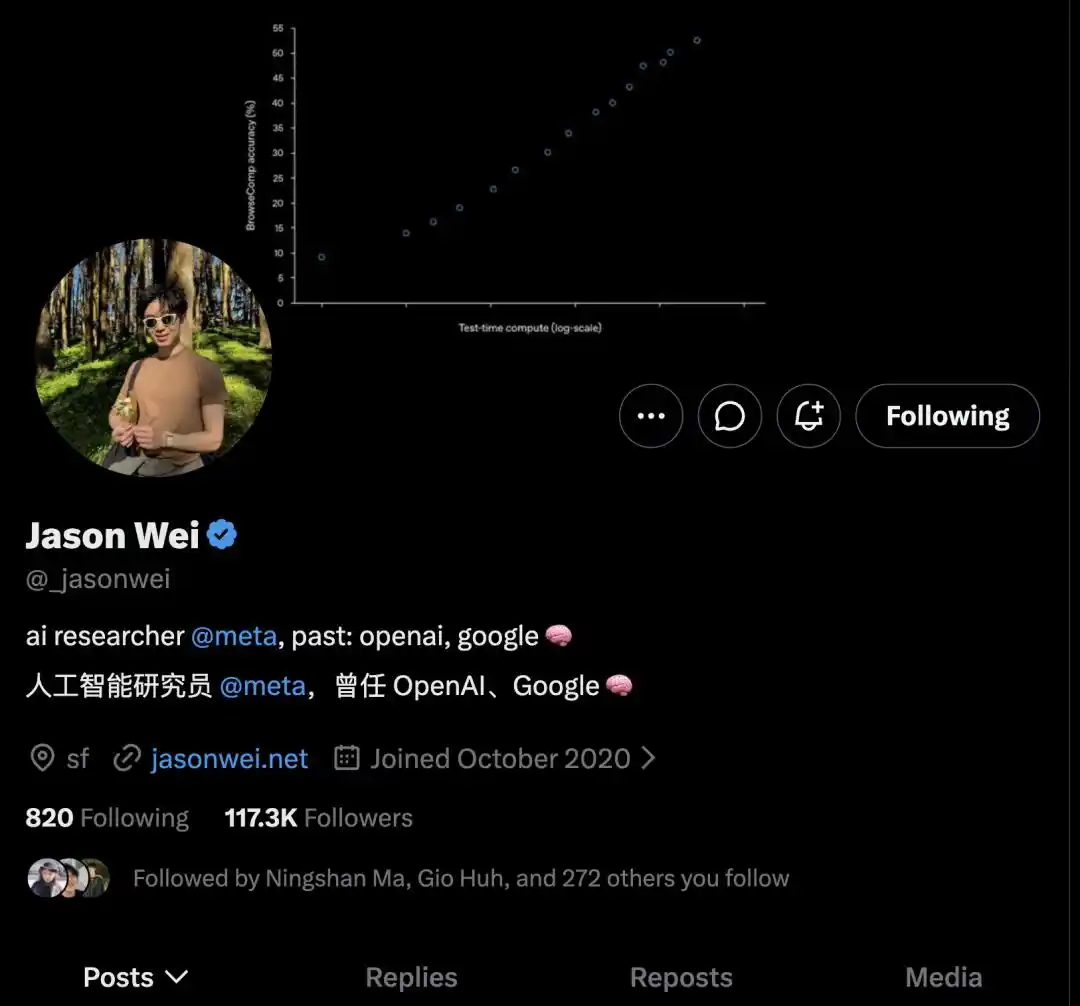
Reports indicate Meta has been a client of Mercor for years, and Jason’s TBD Lab previously used Mercor’s data annotation services.
Moreover, Mercor’s CEO stated they’ve maintained close communication with Jason for several years.
It’s safe to say: Big tech pays startups for data—and then startups quietly recruit the very people who bought the data.
Going forward, big companies should definitely keep an extra eye when partnering with startups.
Who is Jason Wei?
Jokes aside.
Jason Wei’s move has drawn massive attention—not just because he authored foundational works like "Chain-of-Thought," but also because he’s a rare prodigy who entered the core of AI without a PhD, straight out of undergraduate studies.
(Though no official confirmation exists, based on his past posts, he’s likely only 27 or 28 years old.)
After graduating with a B.S. in Computer Science from Dartmouth College in 2020, Jason skipped grad school and joined Google Brain directly.
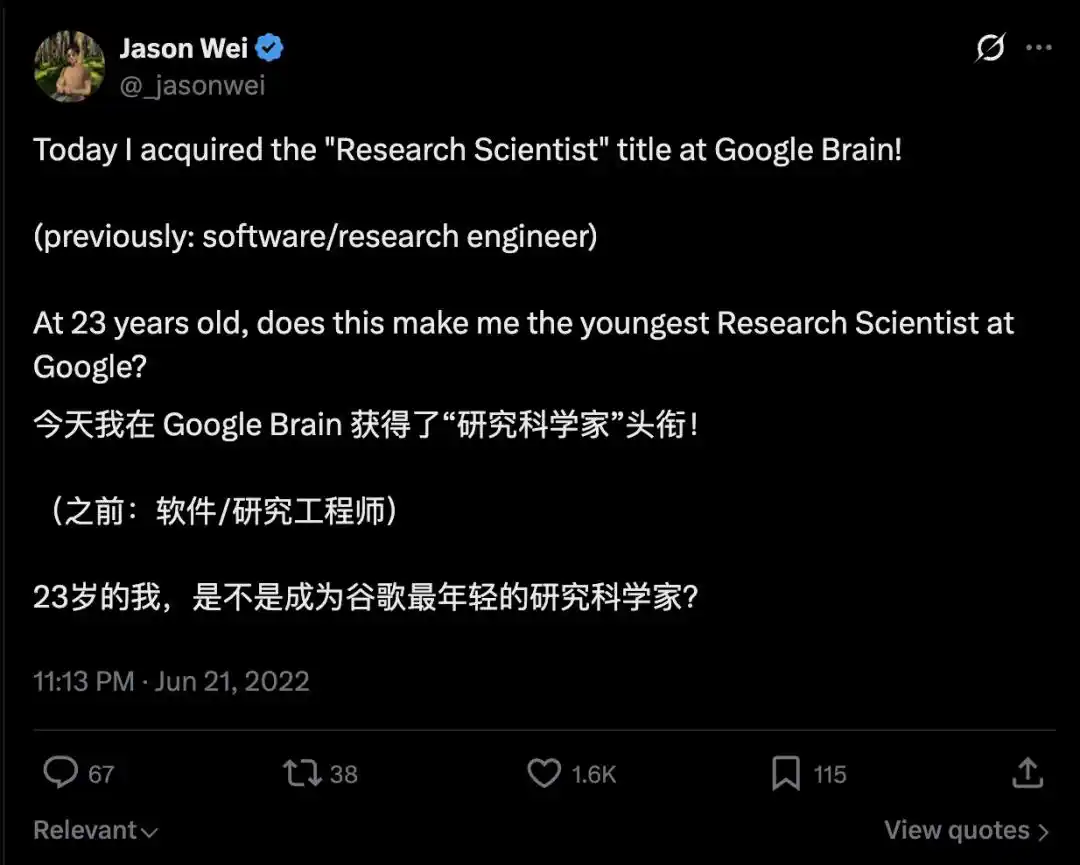
In 2022, at just 23, he earned the title of Google Research Scientist—possibly one of the youngest ever in company history.
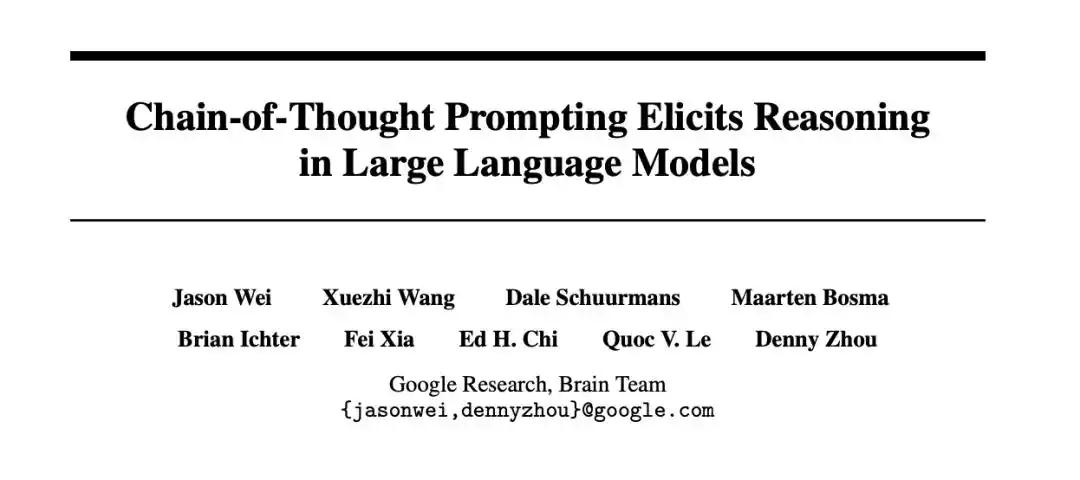
That same year, he published the seminal work on Chain-of-Thought (CoT) as lead author.
He also led the foundational FLAN work on instruction tuning.
In essence, the ability of today’s large models to “reason step-by-step” traces back to him.
Then, in 2023, he joined OpenAI, playing a key role in the development of the original reasoning model o1 and Deep Research, and single-handedly built SimpleQA, BrowseComp, and HealthBench—a medical benchmark co-developed with 262 physicians.
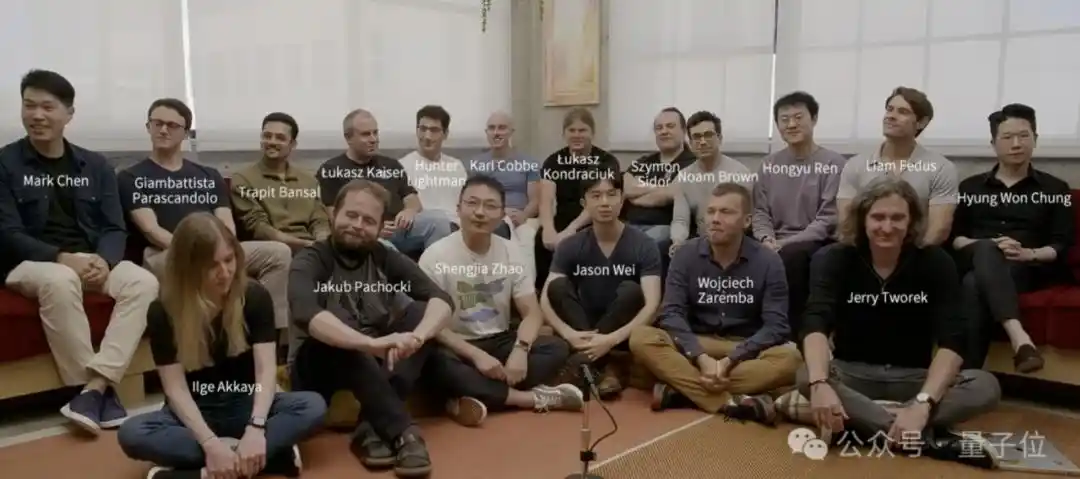
(At the 2024 o1 “public meetup,” Jason Wei sat front row center—next to another key figure, Shengjia Zhao, who remains at Meta.)
To date, Jason Wei’s Google Scholar citations exceed 160,000.
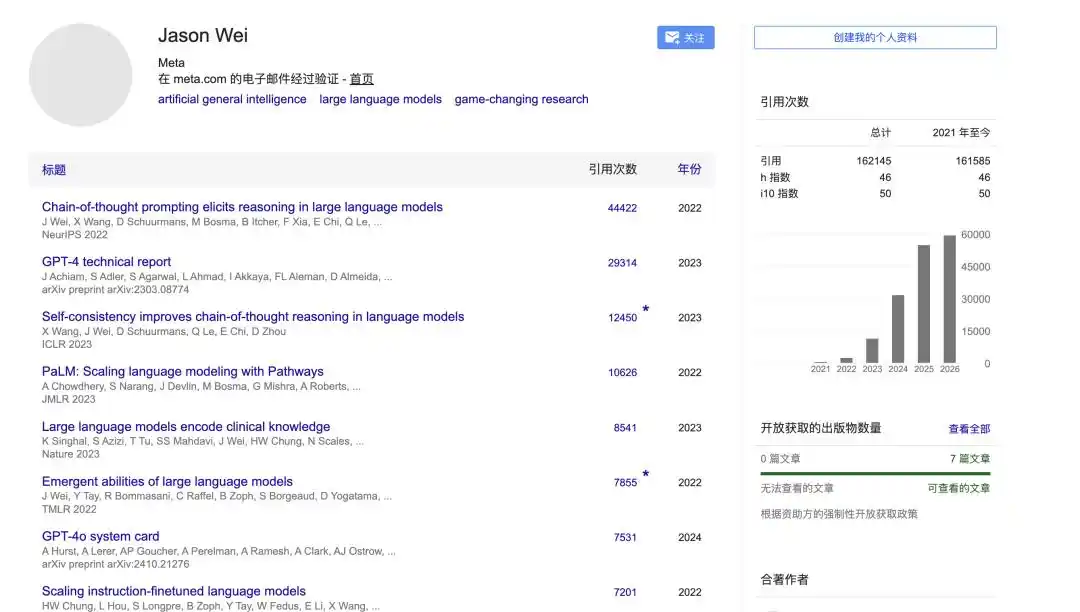
Last July, after being lured by Zuckerberg’s multi-million-dollar offer, he joined the Superintelligence Lab’s TBD Lab, leading the development of the Muse Spark series and driving LLM applications into cutting-edge medical research.
Just one month before leaving, he shared a case study where the team used Muse to analyze approximately 5 million de-identified electronic health records via a code-generation tool powered by Muse Spark 1.3 and Muse Wonder.
Physicians posed questions; models wrote code and ran analyses. Within four weeks, the team produced ten research manuscripts.
Jason made a crucial observation: While models enabled doctors to test hypotheses faster and explore multiple directions, real-world EHR data is riddled with noise—identifying which variables matter and interpreting what results truly mean still ultimately requires domain experts.
And Mercor, his new employer, happens to be a company deeply focused on high-barrier professional data.
What is Mercor?
Mercor was founded in January 2023, headquartered in San Francisco.
The three founders—Brendan Foody, Adarsh Hiremath, and Surya Midha—were long-time debate teammates from high school, even working out of dorm rooms at Harvard and Georgetown during early days.

Today, the young company has assembled top-tier researchers like Jason Wei and Edward Hu, backed by a vast network of doctors, lawyers, investment bankers, and senior engineers.
According to its website, Mercor specializes in AI training data and evaluation services. It enlists subject-matter experts across industries to decompose real-world tasks into complex, high-difficulty training challenges, establishing rigorous scoring rubrics to help AI labs and enterprises train models capable of solving intricate professional problems.
Beyond that, Mercor helps companies monetize proprietary datasets and integrate AI into daily workflows.

Following funding rounds led by Felicis in both Series B and C, just eight days before Jason’s announcement (November 10), Mercor closed a $750M Series D round, achieving a valuation of $20B.
Investors include top-tier VCs like Benchmark, General Catalyst, and Sapphire Ventures, alongside industrial giants such as NVIDIA, Salesforce, and Zoom.
Market speculation centers on a core thesis: general internet corpora are nearly exhausted. Only the tacit judgment of seasoned experts—such as a veteran lawyer instantly spotting a contractual risk—can teach AI how to truly perform real-world tasks.
Currently, Mercor’s clientele spans from foundational model labs to vertical leaders like legal AI firm Harvey and financial software Ramp.
As Jason once noted on X: Crafting a high-quality question for a top-tier benchmark may now carry as much influence as publishing in Nature or Science.

As more enterprises train proprietary models, companies like Mercor aim to define the next frontier of AI evolution by controlling the gateways of high-quality data and evaluation standards.
One more thing
Speaking of which, Jason Wei’s departure reinforces a growing trend: “Don’t stay at Meta longer than a year” seems to be becoming a curse.
Previously, Pang Ruoming, former head of Apple’s foundational model team, walked away from a $200M+ compensation package after just seven months to join OpenAI.
Even earlier, OpenAI researchers Ethan Knight and Avi Verma—both lured by massive offers—departed within mere weeks, quickly returning to their former employers.
Within the industry, there’s widespread jest about the “one-year cliff” common in big-tech talent acquisition: the bulk of signing bonuses and stock grants unlock only after a full year. Once that milestone passes, it’s effectively a “player option”—retention depends entirely on the lab’s real technical strength and vision.
Of course, the AI luminaries come and go—the Alexander King remains steadfast.
Meta’s 1997-born Chief AI Officer Alexander King continues to thrive, maintaining strong favor with Zuckerberg.
Steady.
Source: Quantum Bit
Disclaimer: Contains third-party opinions, does not constitute financial advice


The AlphaGo Moment in Cybersecurity, or Starting from These 466 Agent Matchups
13 days ago
AI is not a search bar—it's a supercomputer costing just a few dozen dollars
08-05
Anthropic Locks in 6 Years of Compute with $10 Billion Commitment
08-05Not building robots—why is it worth $14 billion?
07-31AI is no longer competing on benchmark scores, but on profitability
07-25
ByteDance's Douyin Beans priced at 68 RMB—worth it for 382 million monthly active users?
07-25
Fields Medalist Concerned About AI Extinction Heads to OpenAI
07-25


