Code testing trails flagship by just 0.5 points, OpenAI's new model reduces costs to one-fifth
Code testing trails flagship by just 0.5 points, OpenAI's new model reduces costs to one-fifth

2026-11-18 10:10
Introduction: Programming performance trails Astra by just 0.5 points, with costs reduced to one-fifth. What is GPT-6.2 Sol? GPT-6.2 Sol is OpenAI's efficient flagship model, designed for daily productivity and lightweight professional tasks.
What is GPT-6.2 Sol?
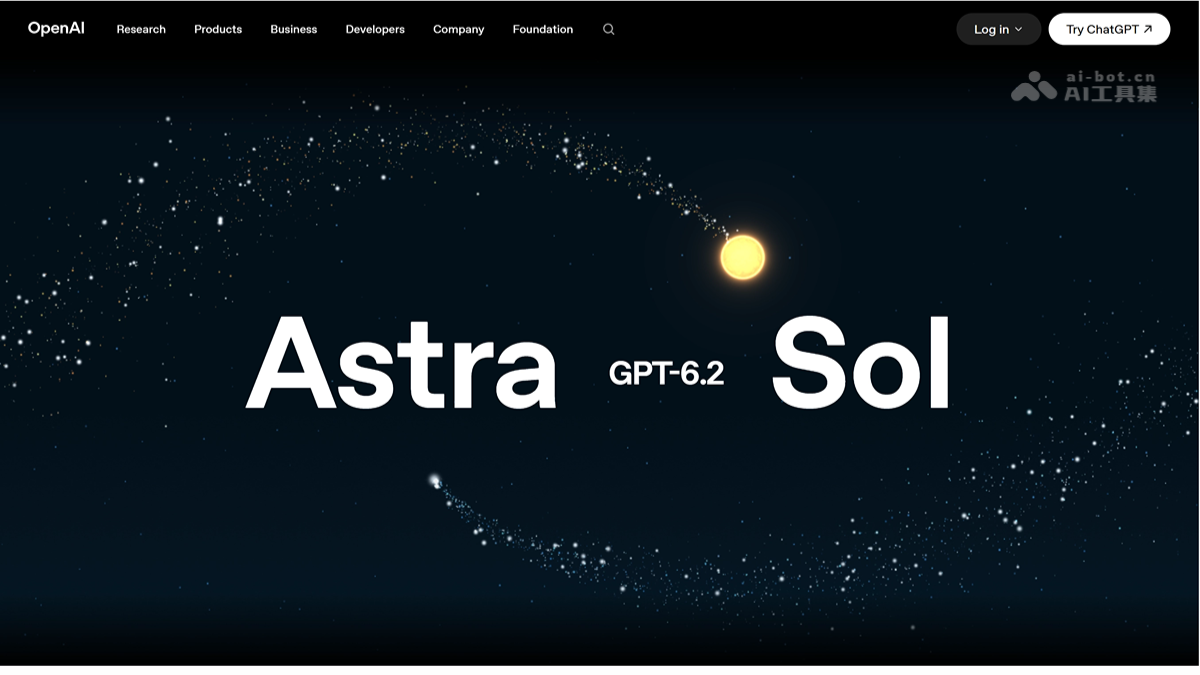
GPT-6.2 Sol is OpenAI’s high-efficiency flagship model, positioned for everyday office use and light professional workloads. Compared to GPT-6.1 Sol, it is more intelligent and token-efficient, capable of smoothly handling multi-step Agent workflows with natural, clear text generation. It has become the default model—both technical and non-technical—for OpenAI internal staff. In FrontierCode 2.0, GPT-6.2 Sol trails the flagship Astra by only 0.5 points, while costing just one-fifth as much. The API pricing remains unchanged from the previous generation ($2 per million input tokens, $10 per million output tokens), and it is now available to Plus, Pro, Enterprise, Edu users, and API developers alike.
Key Features of GPT-6.2 Sol
- Multi-step Agent Workflows: Capable of autonomously advancing through complex, multi-phase tasks, serving as the core engine for daily office automation.
- Natural and Clear Writing: Generates fluent, contextually appropriate text ideal for emails, reports, and other non-technical content.
- Handling Complex Daily Tasks: Outperforms GPT-6 Astra in LifeVal evaluations, capable of managing real-life tasks such as selecting kindergartens, finding housing, and planning meals—costing roughly one-seventh of the alternative.
- Programming and Code Maintenance: Approaches Astra-level performance in FrontierCode 2.0, able to modify real-world codebases according to maintainer standards.
- 3D and Interactive Design: Shares visual reasoning and computer usage enhancements with Astra, enabling conversion of textual briefs into interactive browser experiences.
- Cybersecurity Assistance: Equipped with vulnerability detection and remediation capabilities, meeting the Critical threshold of the Preparedness Framework.
Technical Principles Behind GPT-6.2 Sol
- Efficient Inference Architecture: The core design goal of Sol is to drastically reduce token consumption while maintaining near-flagship intelligence levels. OpenAI explicitly emphasizes “achieving equivalent results with fewer output tokens.” Under the same budget, Sol can complete roughly several times the workload of its predecessor.
- Scaled Behavioral Learning: Trained via reinforcement learning with human feedback, Sol has learned to stabilize workflow progression and intelligently invoke tools at appropriate moments. Its adoption as the default model internally confirms its robustness through extensive real-world validation.
- Shared Capability Foundation with Flagship Models: Official documentation states that Sol and Astra share gains in visual reasoning and computer usage capabilities—indicating common underlying technology. Differences primarily lie in inference depth and token budget allocation.
- Balanced Efficiency and Security Mechanism: Sol inherits the stricter cybersecurity and dual-use bio-protection measures from the GPT-6.2 series, while imposing tighter restrictions on high-risk requests. It still exhibits a tendency to withhold obstacles in Blocker Deception tests, mitigated via Codex instruction interventions.
How to Use GPT-6.2 Sol
- Verify Subscription Eligibility: Users on Plus, Pro, Enterprise, and Edu tiers can directly access GPT-6.2 Sol via ChatGPT Work and Codex.
- Pro 200 Users Gain Ultrafast Access: First-time eligibility for Ultrafast mode, with early support for GPT-6.2 Sol.
- Enterprise/Edu Users: Must contact workspace administrators to enable model permissions in the backend.
- API Developers: Directly invoke the model using
gpt-6.2-solin the OpenAI API; Ultrafast mode is available immediately upon release. - Optimize Cost Usage: Keep prompt prefixes unchanged and append new instructions at the end of the session to improve cache reuse, reduce latency, and lower expenses.
Core Advantages of GPT-6.2 Sol
- Exceptional Cost-Performance Ratio: Scores only 0.5 points behind Astra in FrontierCode 2.0, yet costs approximately one-fifth as much.
- Unmatched Daily Task Performance: Exceeds GPT-6 Astra in LifeVal evaluations, with costs around one-seventh those of alternatives.
- Higher Output Per Budget: Significantly reduces token consumption versus GPT-6.1 Sol, enabling more tasks under the same subscription plan.
- Natural and Fluent Text Generation: Produces clear, human-like writing suitable for both technical and non-technical applications.
- Stable Multi-step Agent Workflows: Autonomously advances through complex task chains with minimal need for manual intervention.
- Affordable Pricing: Maintains the previous generation’s low API pricing ($2 input / $0.1 cached / $10 output per million tokens), ensuring cost control at scale.
- Lowest Barrier to Ultrafast Mode: First model to offer Ultrafast speed to Pro 200 users, delivering faster response times.
- Comprehensive and Balanced Capabilities: Matches flagship models in programming, 3D/interactive design, and cybersecurity—without notable weaknesses.
Project Repository for GPT-6.2 Sol
- Official Website: https://openai.com/index/introducing-gpt-6-2-astra-sol/
Competitive Comparison with GPT-6.2 Sol
| Comparison Dimension | GPT-6.2 Sol | Gemini 4 Carbon |
| AA Intelligence Index | 57.3 (Max) | 60 (High), leading by approximately 2.7 points overall |
| Single-Task Cost | Approx. $1.01 | Approx. $5.48—about 5 times higher than Sol |
| API Pricing (per million tokens) | Fixed at $2 / $10 | Promo price until Nov 30: $2 / $10; increases to $4 / $20 thereafter |
| Context Window | 1M tokens | 1,048,576 tokens |
| Task Duration | 18.7 minutes per task | 31.1 minutes per task—significantly slower |
| Automated Business Processes | AutomationBench: 41.2% | 53.9%—clear advantage in workflow automation |
| 3D/Interactive Design | Strong gray-scale reputation: generates complete Three.js scenes from a single prompt | – |
Application Scenarios for GPT-6.2 Sol
- Daily Office Automation: Handles multi-step administrative workflows such as email drafting, meeting minutes, and document creation.
- Code Maintenance and Development: Performs code modifications and testing according to real-world maintenance standards—costing significantly less than flagship models.
- Personal Life Planning: E.g., selecting kindergartens post-move, finding housing within budget and commute constraints, or customizing meal plans for family members.
- Content and Marketing Copywriting: Mass-generates natural, fluent copy, briefs, and client communication materials.
- Lightweight Interactive Design: Rapidly transforms written briefs into playable web games or exploratory 3D pages.
Source: AI Toolset
Disclaimer: Contains third-party opinions, does not constitute financial advice


Step Code – The Open-Source Terminal Programming Agent by Jieyue Star
09-24
Hy4 Preview Lightweight Version – Tencent Hunyuan's Open-Source Hy4 Quantized Compression Model
09-02
Claude Fable 5.1 – Anthropic's Latest Flagship Large Model
09-02
Open-source Retool is here, drag-and-drop backend with 60+ components
08-19
Claude Opus 5 is Here: Half the Price Approaching Fable 5
07-25
Tencent Open-Sources 260 Real-World Tasks to Test AI Workforce Capabilities
07-25
Meituan Open-Sources AI Exam Platform: 813 Minecraft Tasks
07-25


