TAL Education's operating profit surges 237%, but AI investments turn it loss-making in a single quarter
TAL Education's operating profit surges 237%, but AI investments turn it loss-making in a single quarter

2026-11-17 22:07
Lead: Learning device growth has peaked, with layoffs and heavy bets on large models intensifying simultaneously. Companies seeking profits from AI in education were first taught a lesson by AI itself.
Companies hoping to profit from AI in education were first taught a lesson by AI itself.
In June this year, Zhang Xiaolong, founder of Fenbi, delivered a lecture at Renmin University where he boasted about returns from investing in tech stocks and criticized students present as having “no real skills beyond securing government jobs.”
The controversy ended with an apology and his resignation. Yet his actions remained consistent. In the first half of the year, Fenbi’s equity investments surged from nearly zero to $47.9 million, including leveraged U.S. semiconductor ETFs with two times leverage.
The reversal came swiftly. Early July saw a sharp drop in U.S. semiconductor stocks; despite rapid liquidation, Fenbi still incurred an $8.3 million investment loss. Zhang Xiaolong appeared more like a prophet—except the prophecy targeted another education company: TAL Education Group.
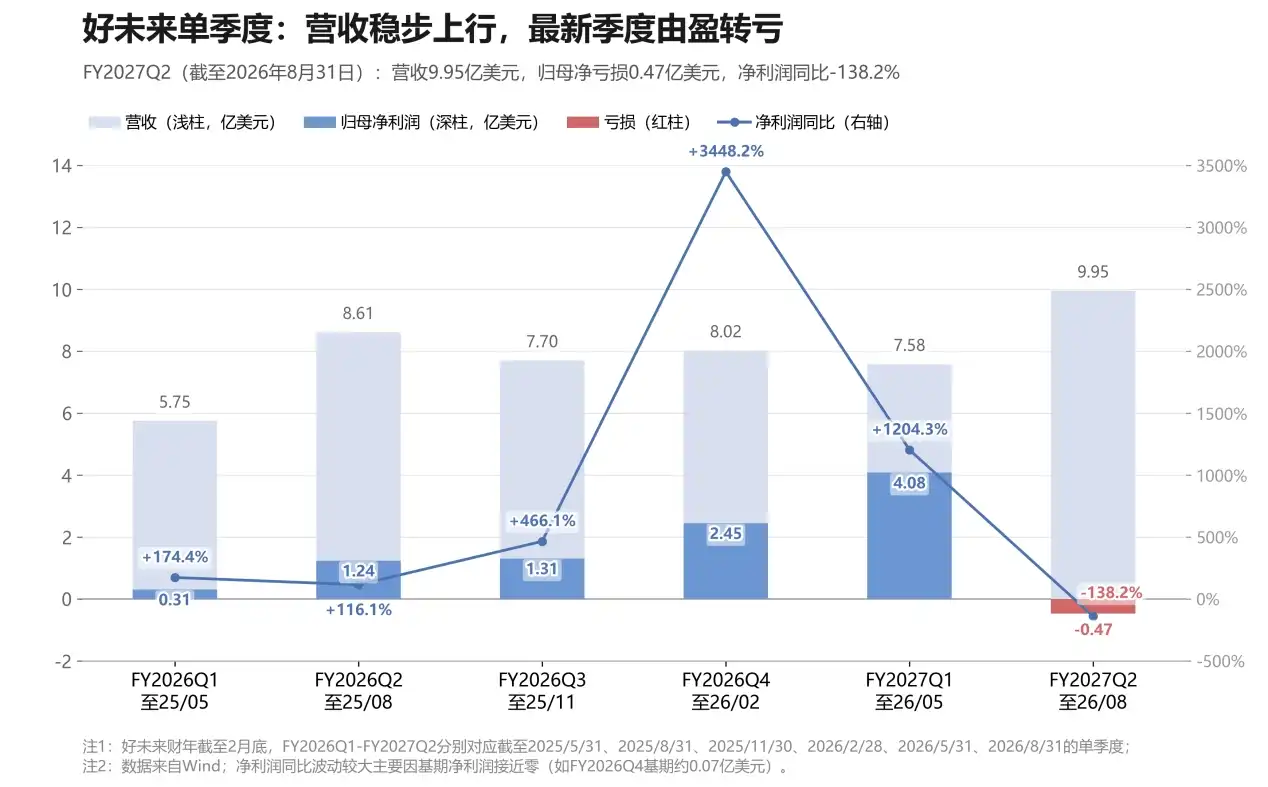
In its Q2 earnings report released on October 29, TAL Education reported revenue of $995 million, up 15.5% YoY; operating profit reached $236 million, surging 145.4% YoY; gross margin improved to 59.8%.
Entering fiscal year 2027, TAL’s performance continued to climb. Beneath the warmth, two subtle but critical undercurrents emerged.
One was internal. Multiple TAL employees told 36Kr that in April and May this year, the company underwent a round of “workforce optimization,” affecting departments including front-end development and enrichment programs, with some teams experiencing layoff rates between 30% and 50%.
The other was financial. TAL’s attributable net profit stood at -$47.44 million—not due to core operations, but from investment losses. This investment, precisely tied to AI, dragged down profitability.
Since the “Double Reduction” policy five years ago, the entire education industry has sought to reverse course through AI. Is technological iteration a path to the future—or a trap for practitioners? TAL’s latest earnings report has thrust this question into the spotlight.
36Kr chart based on Wind data
The Life-or-Death Turnaround in the Financial Statements
Few today remember how close this company came to collapse just five years ago.
In 2021, immediately after the “Double Reduction” policy took effect, TAL shut down its K9 business and identified three exit routes: quality education courses, vocational training, and learning hardware.
To everyone’s surprise, the company not only survived—but became more profitable than ever.
In fiscal year 2026, TAL generated $3.009 billion in revenue, with net profit increasing over fivefold. In fiscal year 2027, growth continued. For the first half of the fiscal year, revenue reached $1.753 billion, up 22% YoY; operating profit hit $373 million, up 237.8% YoY; attributable net profit was $361 million, up 132.1% YoY.
Breaking down the six-month performance into two quarters reveals starkly different pictures.
In Q1, TAL’s attributable net profit soared to $408 million, up 1,204.3% YoY. Operating profit stood at $137.2 million, while “other income” from investment gains reached approximately $405.2 million—nearly three times the operating profit.
By Q2, this trend reversed: “other income” transformed into $189.7 million in “other expenses.” The shift caused a quarterly transition from profit to loss.
Management explained during the earnings call: “This quarter, the fair value of certain investments declined” and “investment values may fluctuate with market conditions.”
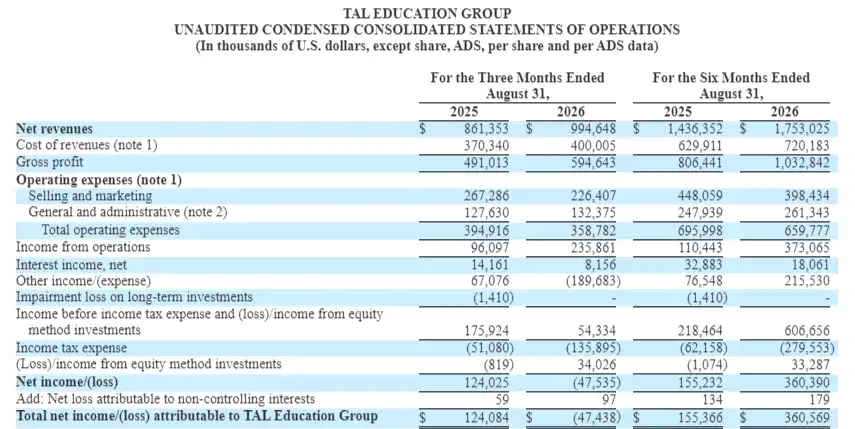
Image sourced from TAL Education Group’s financial statements
“Certain investments” clearly refer to specific assets. In October 2023, TAL participated in Zhipu AI’s funding round; the following year, it added another round via “Xinxin Xiangrong.”
On January 8, 2026, Zhipu AI listed on HKEX, rising 13.17% on debut, with an IPO valuation of approximately HK$51.1 billion. The rally had barely peaked. On June 22, Zhipu’s share price touched HK$2,980, pushing its market cap past HK$1 trillion.
In contrast, TAL’s stake in Zhipu via Xinxin Xiangrong represented only 0.79% of total shares, yet the paper gains were staggering. And TAL’s investment in Zhipu was not an isolated case.
According to Tianyancha, TAL’s strategic investment portfolio includes companies such as Qiangnao Tech, BaiChuan Intelligence, Jiequ Star, and Shenyan Tech. Over the past five years since “Double Reduction,” this education giant quietly morphed into a shadow shareholder of an AI-focused fund.
Notably, if we strip out the volatility of investment gains, TAL’s core operations remain robust, with quality education courses serving as the primary growth driver.
“Mathematics is ‘scientific thinking,’ language is ‘humanistic creation.’” To most parents, these quality education courses bypass the sensitive label of academic tutoring and remain the optimal solution for supporting children’s studies.
As of the end of Q1, TAL operated over 600 physical learning centers across 44 cities in China and overseas markets. By Q2, revenue from physical learning services maintained double-digit year-on-year growth, with enrollment retention rates for enrichment courses stable above 80%.
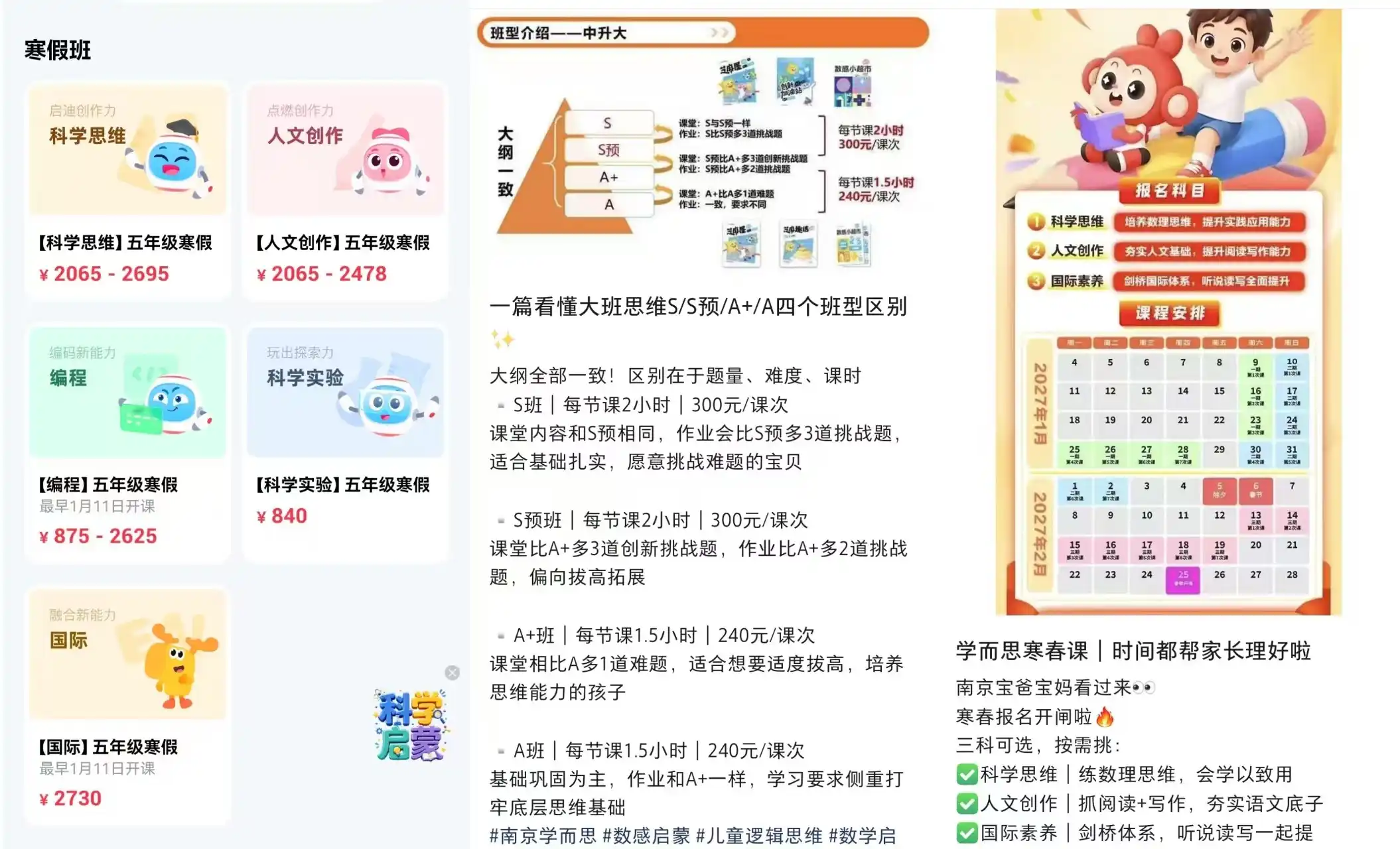
Image sourced from TAL Education Group and Xiaohongshu App
Learning Devices Are No Longer Selling
Yet, TAL continues to heavily bet on its learning device business.
This is understandable. Quality education remains fundamentally a people-centric business—each additional student requires dedicated teaching resources, making marginal cost reduction impossible. Vocational training is already crowded with established players like Fenbi and Huatu, leaving little room for new entrants.
Thus, hardware remains the last frontier. From an industry perspective, after eliminating low-recurring products like smart desks and smart lamps, devices capable of embedding pedagogical expertise into fixed hardware have emerged as the standout winners in home education.
TAL indeed turned this into a second curve: over 2 million active learning devices weekly, with an 80% weekly active rate, averaging nearly one hour of daily usage per device. But this growth trajectory is nearing its ceiling.
In Q3 this year, total sales volume of Chinese learning tablets dropped 30.8% YoY across all channels, with revenue down 17.1%. LOOTech forecasts that full-channel sales declines for learning devices could reach 21.3% in 2026.
At the Q2 earnings call for fiscal year 2027, TAL’s President and CFO Peng Zhuangzhuang openly admitted that intensified competition, shifting consumer preferences, and rising component costs—including chips—had made the learning device business “a drag on our overall revenue growth,” with expected future growth turning more moderate.
With shrinking market size, manufacturers resort to price hikes to preserve performance—TAL is no exception.
During the first half of this year, flagship models from major brands including TAL Education Group and iFLYTEK launched at prices exceeding RMB 8,000, even surpassing RMB 10,000. The question remains: where is the price threshold for parents?
A widely cited article from Xinhua News Agency last year revealed: the hardware cost for a mainstream 14-inch learning device is roughly RMB 1,000–1,200, with content costs—textbooks, question banks, and courses—amounting to around RMB 200–400 per unit.
In short, the entry barrier for learning devices is low. This explains why every brand is racing to integrate AI: hardware differentiation is minimal, so pricing must be driven by “intelligence” instead.
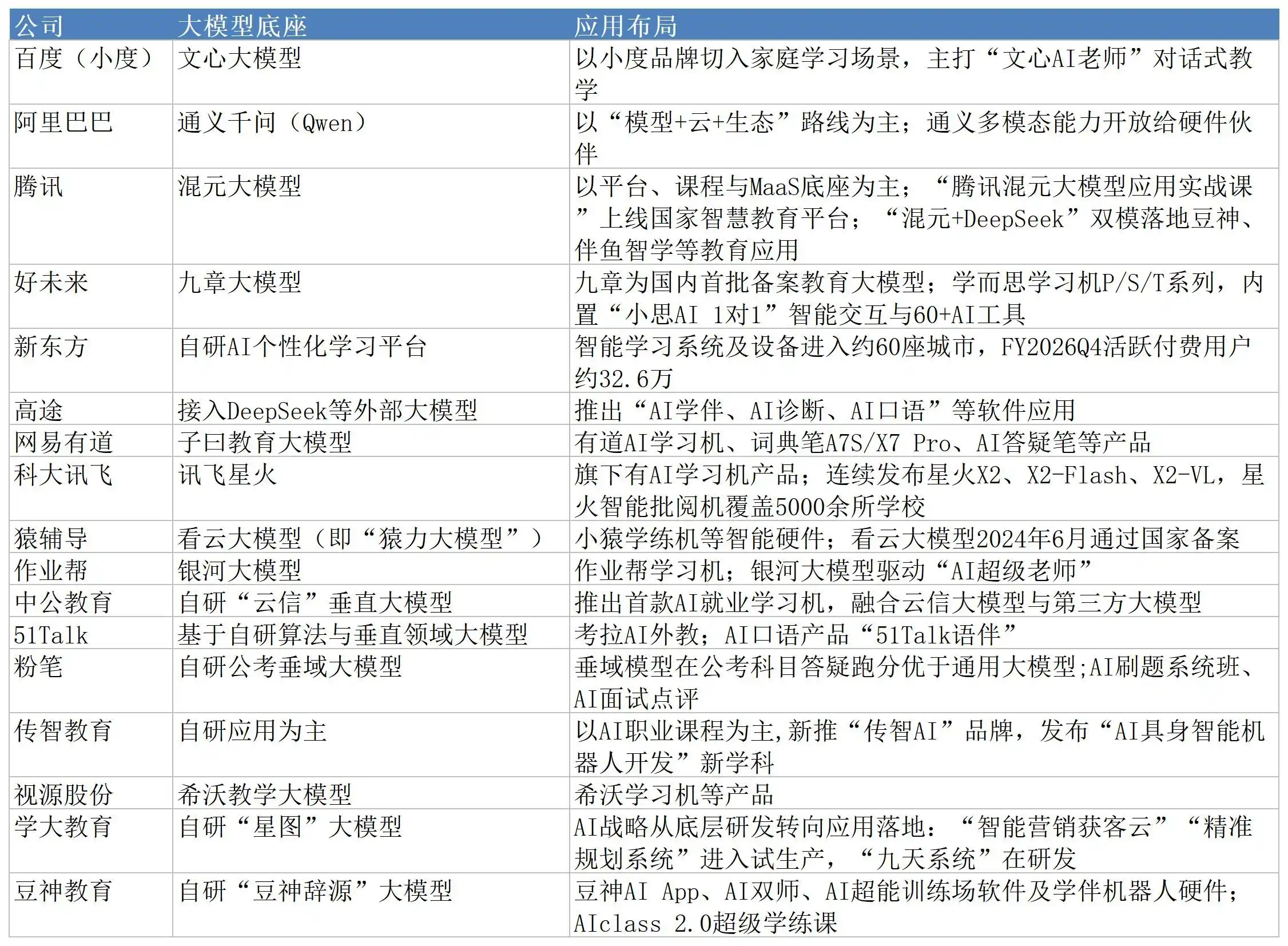
In May 2023, iFLYTEK launched its “Spark Large Model,” marking the dawn of educational large models. Soon after, NetEase Youdao introduced “Ziyue,” TAL rolled out “Jiu Zhang,” and Yuanfudao launched “Kan Yun.”
Brands aim to convince parents that the machine houses a tireless, continuously evolving teacher. The trouble is, general-purpose large models are leveling the technical playing field.
In February this year, NetEase Youdao’s Lobster AI openly released its model; months later, Tencent officially launched its educational AI agent, Learn Buddy; Baidu also unveiled “Wenxin Teacher.”
Imagine a parent stuck on a math problem, opening a free AI chat interface, receiving a complete answer and derivation steps within minutes. Once such services become low-cost or free, the product’s value reduces to mere hardware.
36Kr table based on public data
The Invisible Cost
Beyond the inflows from various businesses, deeper scrutiny should focus on cost discipline.
At the earlier Q1 meeting, TAL’s management explicitly prioritized “disciplined execution.” By Q2, “discipline” remained a frequent term—spanning expansion of learning centers, cost control of learning devices, and resource allocation across the entire organization.
This wasn’t empty rhetoric. In Q1, sales and marketing expenses declined 4.8% YoY; in Q2, the decline widened to 15.3%. Revenue rose while expenses fell—opposite the usual trend.
The flip side of “discipline” manifests in human terms—visible only indirectly in reports.
In August, users experienced login failures on TAL’s “TAL Learning Device” app center. The official explanation cited backend maintenance upgrades. Internal sources told 36Kr the real cause might be laid-off staff. “Many issues seem accidental—they’re actually inevitable.”
Multiple employees confirmed that TAL tightened performance evaluations starting in 2022; in 2024, it introduced the “991 Policy”: 90% of new hires come via campus recruitment, 10% via social hiring, with 10% reserved for mandatory elimination of bottom performers.
“Compensation is N+1. Those who refuse receive a unilateral termination notice within one or two months.”
One employee described a higher-than-usual layoff rate in April and May this year, with even full-time staff being forced to reassign. Some offline enrichment teachers were reassigned to online “LeDu Courses”—effectively transitioning from full-time to part-time roles, amounting to de facto pay cuts.
An alternative option exists: take severance and return as outsourced contractors. But few choose this path.
Official disclosures offer another perspective.
Financial statements show TAL’s full-time workforce has grown continuously over the past three years: ~15,000 in FY2024, ~23,000 in FY2025, ~26,100 in FY2026. While headcount rises, it may reflect replacement of “old hands” with new talent.
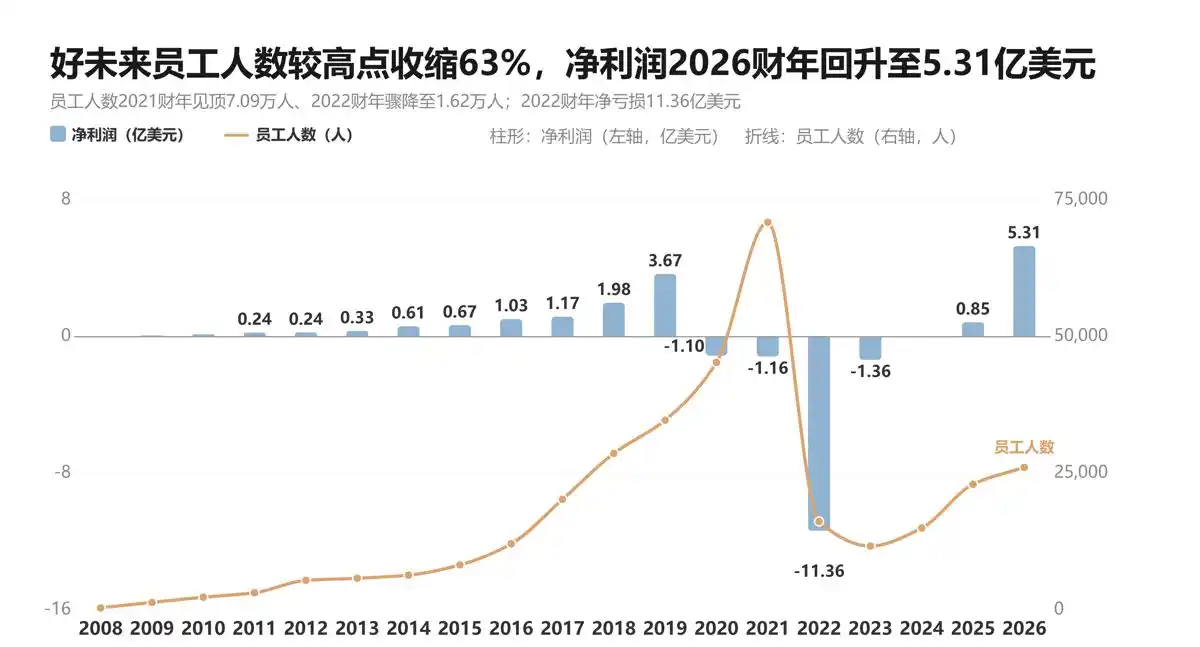
36Kr chart based on Wind data
“After Double Reduction in 2022, Zhang Bangxin (founder and CEO) personally held face-to-face meetings with many frontline employees, asking for feedback on company reforms. I never thought I’d survive the hardest times—only to face layoffs myself.”
According to this employee, TAL’s corporate culture has undergone several shifts—from initial openness and authenticity (“not teaching well is stealing”) to current emphasis on “stronger over bigger” and “love + technology enabling lifelong growth.” To him, post-Double Reduction TAL is no longer the same company.
Similarly surviving “Double Reduction,” New Oriental adopted a different approach. Employees in its study-abroad division noted that while overall headcount decreased due to department consolidation and shrinking business volume, there was no mass layoff.
Compared to the bitter sentiment “leaving TAL means a better future,” departing New Oriental employees often recall Yu Minhong’s words: “When together, we are a blazing fire; when apart, we are stars scattered across the sky.”
A Magic Trick That Was Never Revealed
Finally, returning to the capital markets.
Entering 2026, nearly every education company faced the same question: after “Double Reduction,” what will retain investor confidence?
Among the three education giants, New Oriental prefers distributing profits to shareholders. In July 2025, the board approved a three-year shareholder return plan: starting fiscal year 2026, at least 50% of prior year’s attributable net profit will be allocated to dividends or share buybacks annually.
TAL, however, favors betting cash reserves on AI and future growth. Alongside its Q2 earnings release, TAL announced its first-ever cash dividend since listing.
Between these two giants, Gaotu appears engaged in a war of attrition.
At the end of 2022, Gaotu imitated Dongfang Zhenxuan by launching “Gaotu Jiapin,” but failed to convert traffic into business. In early 2025, CEO Chen Xiangdong declared “All with AI, Always AI,” yet the company still lacks a proprietary large model, and its hardware has seen no significant traction.
In Q1 2026, Gaotu reported revenue of RMB 1.69 billion, up 13.2% YoY, but net profit dropped to RMB 34.51 million, down 72.2% YoY. In Q2, revenue grew 20.2% to RMB 1.67 billion, yet returned to loss—net loss of RMB 136 million.
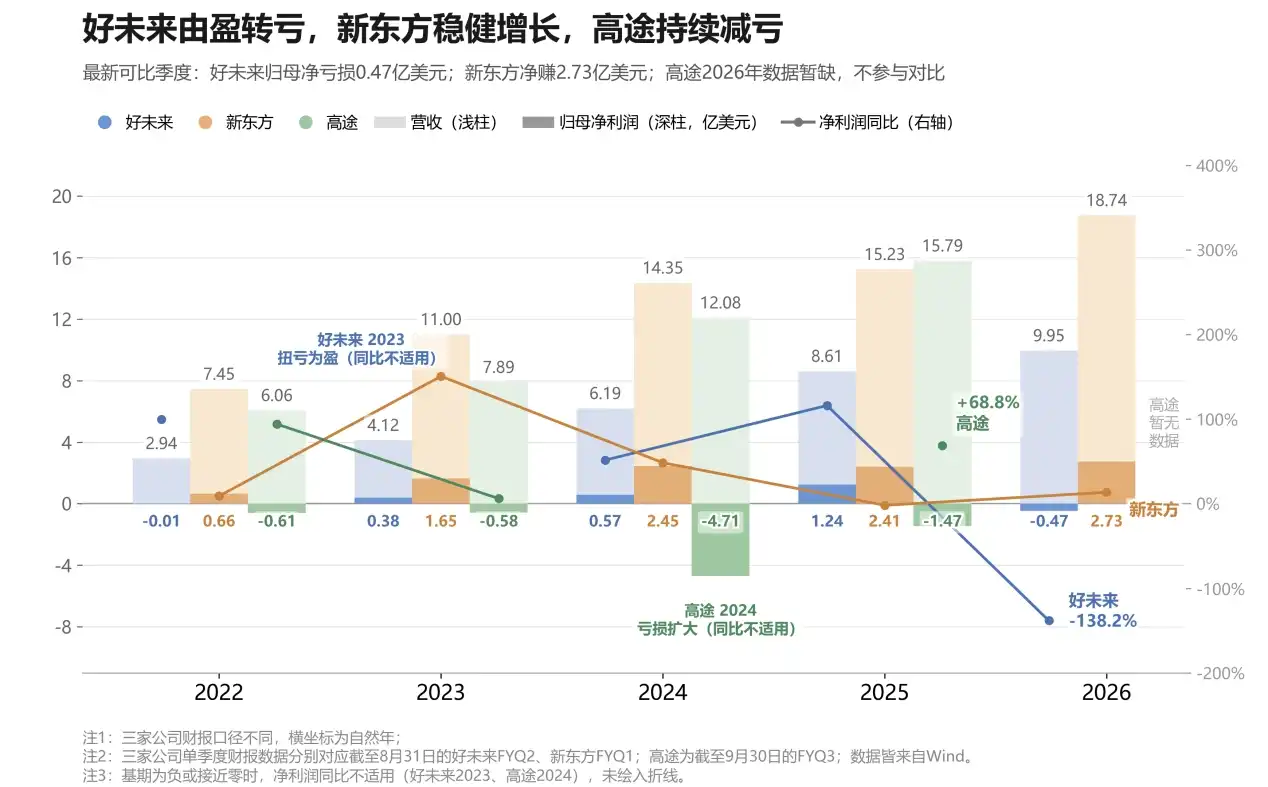
36Kr table based on Wind data
Meanwhile, many mid-tier companies have yet to turn their AI narratives into financial results.
An industry insider told 36Kr that in 2024, his company launched an AI clothing-changing product.
“The boss tested the new business almost right before employees’ probation periods ended. They copied whatever was trending—initial investment reached tens of millions.”
Indeed, some education companies’ innovation strategies remain bewildering.
Yuanfudao’s parent company ventured into consumer goods, producing down jackets, the moderately popular Grid Coffee, and a postpartum care service called “Moli Wisdom.”
Zuoyebang, focused on companionship, launched a dating game. According to some employees, this education firm with Baidu backing also experimented with “AI pets, food delivery, and aesthetic medicine”—projects entirely unrelated to its core business.
When the core education business can’t sustain growth narratives, these companies scatter money into any potentially viable sector. But outcomes vary greatly.
Starting in July, Chuanzhi Education launched embodied intelligence courses and six tiered teaching robots, triggering eight consecutive daily limit-ups in the stock market.
CEO Li Huoming once shared on WeChat Moments: “For the past two years, the entire IT training industry nearly vanished—this was our darkest period as entrepreneurs. Thankfully, in 2024 we made a desperate pivot toward building talent for the AI ecosystem, reclaiming our rebirth. The next twenty years belong to AI—the demand for talent will be dozens of times that of the internet era.”
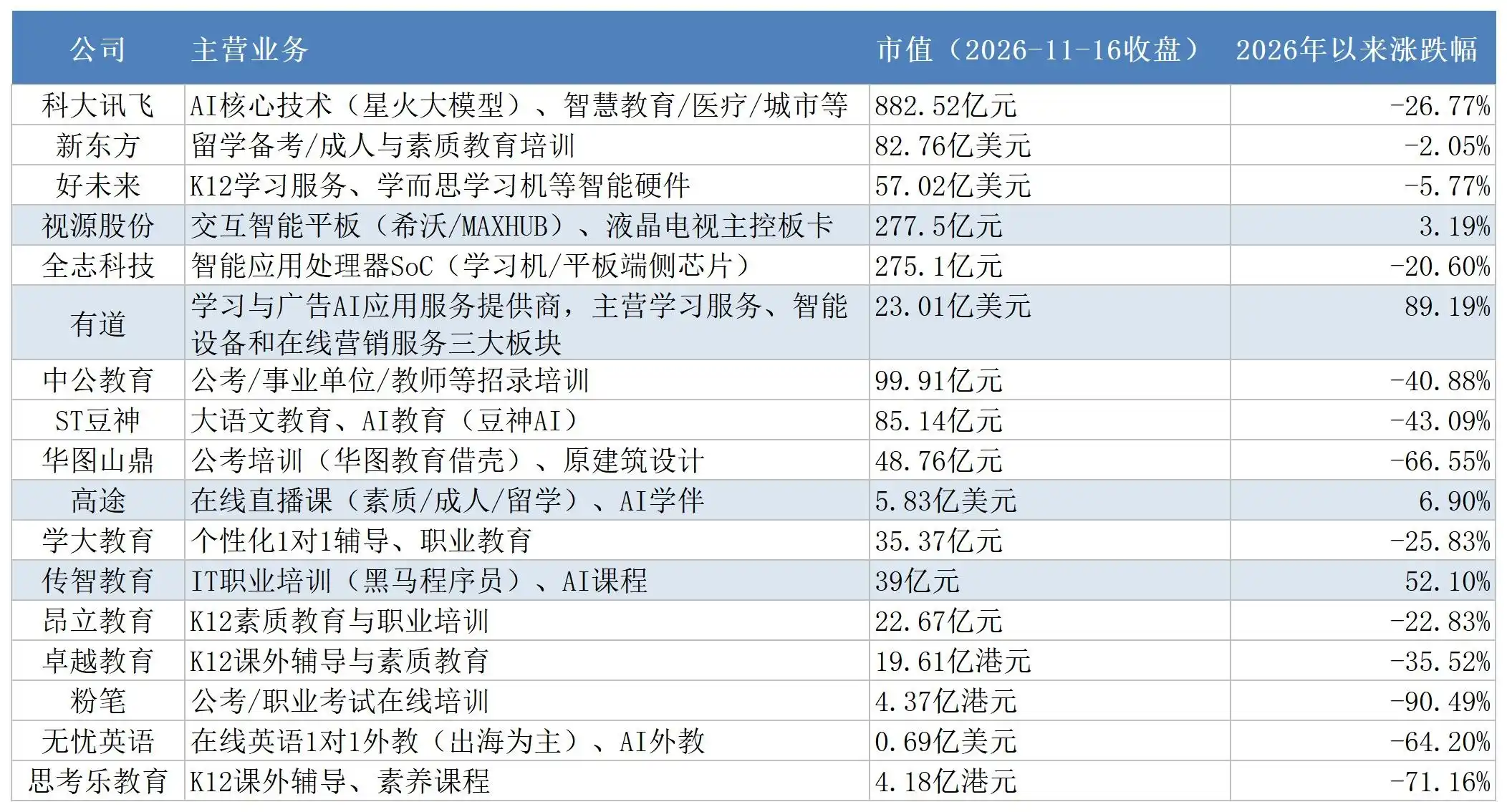
36Kr table based on Wind data
Meanwhile, the world continues moving in two directions on how to solve the “AI + Education” equation.
Lately, New York City announced that beginning in the 2026–2027 academic year, generative AI will be banned in classrooms from kindergarten through grade 8—covering about 600,000 students—and teachers cannot use AI to grade assignments.
In China, schools are mandated to establish a “white list” system for generative AI; the goal is to achieve deep integration between AI and education by 2030.
Policies may bring opportunities. What truly warrants inquiry is: how should AI be applied so that education remains education? At minimum, what real users need isn’t just scores—it’s the enhancement of learning ability.
Until this question finds an answer, even the most dazzling short-term returns remain nothing more than an unbroken digital magic trick.
(Contributions from analyst Huang Yida)
*Disclaimer:
The content of this article reflects the author’s personal views.
Markets carry risks; investment decisions require caution. Under no circumstances should the information or opinions expressed herein constitute investment advice for any individual. Investors must consult professionals and make prudent decisions before investing. We do not offer underwriting services or any other services requiring specific licenses or qualifications.

Follow us for more updates
Source: Xie Yunzi
Disclaimer: Contains third-party opinions, does not constitute financial advice


Yushu Surges 629% on First Day of Trading, Humanoid Robots Sell 5,500 Units
08-19
Yushu's 61 Billion IPO: Who Will Make Money?
08-07
AI stocks down 40%-60%, yet NVIDIA's valuation is at a 10-year low
08-06
HBM Bottleneck Migration, NVIDIA Also Aims to Downgrade
08-06
AI Servers Fuel Demand for Minor Metals: Prices Surge Over 70% in Half a Year
08-06
Cloud vendors first declined then surged—why the divergence in AI assets?
08-05"Out-of-Control Assault" Hits 120 Million Views, Domestic Robotics Hit Minefield on Overseas Expansion
08-05


