Why Meta Chose Fourier: This Company Focuses Solely on the "Body" of Robots
Why Meta Chose Fourier: This Company Focuses Solely on the "Body" of Robots

2026-11-17 20:06
Lead-in: Decade of Healthtech Realization, Mass Production and Human-Robot Interaction Become Scarce Leverage. Produced by | Huxiu Tech Team Featured Image | AI-generated “We don’t build toys.”
Produced by | Huxiu Tech Team
Featured Image | AI-generated
“We don’t build toys.” Gu Jie, founder of Fourier Intelligence, told Huxiu.
Shortly after Huxiu’s conversation with Gu Jie, Fourier Intelligence announced a collaboration with Meta to develop humanoid robots. According to disclosures, Meta and Fourier jointly developed a humanoid robot approximately 1.5 meters tall and weighing around 48 kilograms, with prototype development completed in roughly three months. The robot is powered by NVIDIA Jetson Thor as its core computing unit. Fourier Intelligence confirmed to Huxiu that no further details are available at this time.
This news of the Meta partnership has brought the healthtech robotics company back into public view. In terms of valuation, Fourier Intelligence was established a year earlier than Unitree Robotics, with a current valuation of 8 billion RMB—clearly not among today’s top-tier players. However, within the specific medical robotics sector, its valuation ranks among the global leaders, serving approximately 2,000 clients worldwide.
So why did Meta specifically choose Fourier Intelligence?
In the current wave of embodied intelligence entrepreneurship, capital and talent are flooding into models and “brains.” Yet, the body remains equally critical for robotics companies. Whether it's supply chain orchestration or sustained delivery capability, these factors are decisive determinants of how far an embodied company can scale.
When meeting Gu Jie in Kangqiao, Pudong, Shanghai, he repeatedly emphasized concrete use cases. “First category: teaching aids, used in research, education, or academic publication; second: toys, such as performances or entertainment; third: display units, used in exhibitions, showcases, or retail roles like sales assistants; fourth: tools, such as remotely operated robots working in hazardous environments or collecting data.” This, according to Gu Jie, is his framework for classifying robots amid the current embodied intelligence surge.
Embodied intelligence is now at the peak of hype. Companies founded just six months ago, without any product form or commercial traction, have seen valuations multiply dozens of times. Among them, only a handful can actually mass-produce robots. Even among so-called “Tier 1” embodied intelligence firms, few possess fully integrated supply chains.
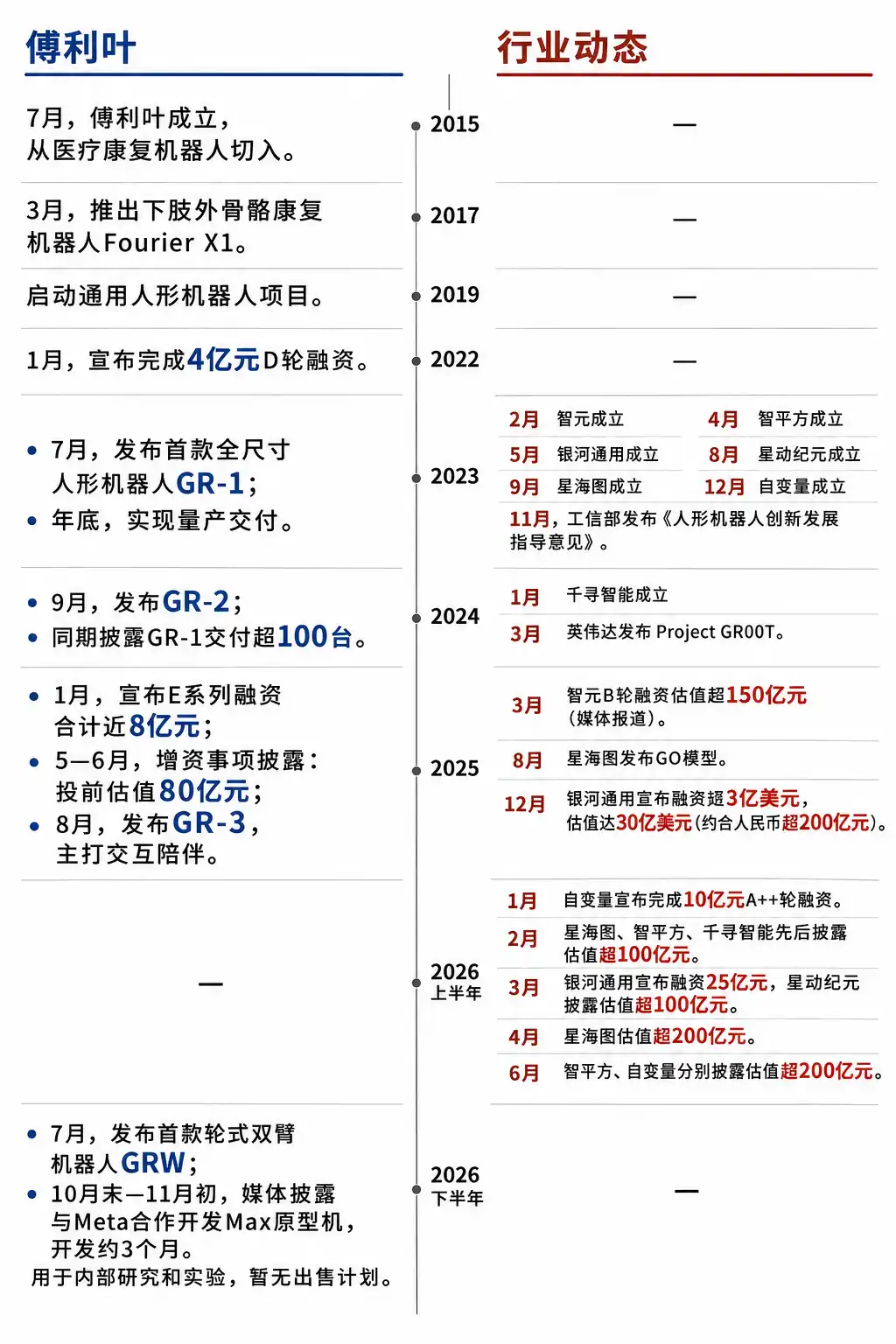
Yet as one of the rare embodied companies with actual mass production capacity, Fourier Intelligence still faces internal challenges. Today, a truly viable embodied intelligence company should possess strong hardware capabilities while also having strategic software positioning—i.e., a robust “embodied brain.” Few currently meet both criteria. For Fourier Intelligence, Gu Jie maintains clear boundaries: historically, he outsourced the “brain” to suppliers; today, he chooses to invest in young teams.
Because in today’s embodied startup wave, there exists a cohort of 95s and even 00s entrepreneurs—deeply idealistic, highly attuned to cutting-edge developments in neural modeling. Gu Jie acknowledges that these young founders daily write code, train models, and track frontier research papers, giving them an intuitive grasp of technological evolution. Some concepts discussed by young teams may be beyond Fourier Intelligence’s full comprehension. And this sensitivity to new paradigms cannot be replicated simply by hiring more engineers at a mature hardware firm.
If we were to categorize embodied entrepreneurs, I’d divide them into two types: those gazing at the stars, and those firmly grounded in reality. Gu Jie clearly belongs to the latter.
Each type bears distinct traits. The former often harbors an almost obsessive fascination with robots or technology itself; the latter begin from real-world problems—they may not care about how a robot looks, but instead prioritize identifying authentic use cases and turning technology into tangible products.
Gu Jie remains committed to the healthcare and wellness domain, believing the journey is far from over. To him, robots ultimately exist to interact with humans. Rehabilitation robots guiding patients’ limbs through repetitive training sessions embody a force-feedback human-robot interaction. It is precisely this human-robot interaction that defines Gu Jie’s vision of the ultimate end-state of robotics.
Below is an edited transcript of Huxiu’s interview with Gu Jie, founder and CEO of Fourier Intelligence:
Stay Within Boundaries, Delegate to Young Talent
Huxiu: Compared to other early-stage embodied startups, Fourier Intelligence has been operating for ten years. Looking back, how did your initial choices shape the path you’re on today?
Gu Jie: I believe early founders in robotics share common backgrounds. We all loved robotics and participated in competitions during university. When founding our company, our intent was unequivocal: to build a robotics company. In college, we imagined whether robots could one day enter everyday life, as portrayed in sci-fi films, to assist humanity. But at that time, when a prototype was built, its practical application remained unclear. No one could predict whether the humanoid robotics paradigm would evolve as it has today—or even imagine such changes ten years ago.
Thus, the only viable entry point was a specialized scenario. At that time, we couldn’t access today’s level of funding or talent pool. The term “robot brain” didn’t even exist. Everyone had to ground themselves in a real-world use case, transforming technology into a product, then into a commodity. Whether the robot looked human, was called embodied intelligence, or had a “brain”—none of that mattered initially. What mattered was whether it met customer needs.
Huxiu: So, for robotics startups founded a decade ago, the first step wasn’t pursuing generalization, but finding a viable survival scenario?
Gu Jie: Exactly. The first phase is the “product game”: understand your users, their needs, product positioning, and leverage technology to create differentiation. Most surviving companies succeeded because they cleared this stage. Fourier Intelligence first established a closed-loop product ecosystem in rehabilitation robotics.
Only after mastering the product game does the larger “business game” begin: revenue, profitability, scalability, and organizational management. Capital enters only later. Product, business, and capital represent three distinct mindsets. Without a solid product foundation, business closure is impossible—and certainly no capital loop can be achieved.
Huxiu: You’ve described a very healthy progression: product → business → capital. If we set aside today’s overheated fundraising environment, how long would it typically take a company to complete all three loops normally?
Gu Jie: For a genuine startup starting with just two or three people, completing the product and business loops takes at least two to three years. Product development and iteration require time, along with building a sales team, gaining market and customer recognition, before achieving full closure. Medical robotics, with higher technical barriers, requires even longer—not just product development, but also regulatory certification and clinical validation before becoming a true commodity. Without thousands of customers in the wellness space validating our solution, generating revenue and profit, Fourier Intelligence wouldn’t be where it is today.
Huxiu: Yet many recent embodied intelligence startups have been founded only one or two years ago, raising funds every six months, sometimes consecutively. Based on your earlier point, they may already be entering the “capital game” before even finishing the “product game.” Is this sustainable? Or have these three stages become fused?
Gu Jie: A major shift in recent years has been the emergence of new technical paradigms driven by AI. Over the past decades—from PC to internet to mobile internet—each technological leap gave rise to new giants. Now, many believe AI requires a new carrier, and robotics may be that very carrier. The market could eventually spawn companies worth tens of billions or even trillions. Investment logic has thus evolved: capital is willing to bet earlier on young teams and frontier technologies.
I don’t see this as necessarily a bubble—it’s more a re-pricing driven by a new paradigm. Companies previously focused on industrial robots, robotic arms, or mechanical bodies spent five to ten years refining supply chains, actuators, and sensors, but their pricing remained low. Now, with expanded technical ceilings and market potential, they command higher valuations. Naturally, some will fail, others will succeed. But as long as a group of companies truly grow, the industry will thrive.
Huxiu: What’s the essential difference between older pioneers like Fourier Intelligence and Unitree Robotics versus the star startups emerging over the past two years?
Gu Jie: There are now many excellent professors, students, and entrepreneurs from autonomous driving and model companies entering robotics. They lean toward the “intelligence-first” school, believing a single model or new AI capability can dramatically enhance a robot’s generalization ability, enabling it to perform more tasks. This isn’t wrong—the current robotics landscape indeed lacks strong model capabilities.
But on the other hand, no matter how intelligent, a robot still needs a capable body. That body must be agile, capable of load-bearing; if interacting with humans, it must include force feedback, safety protection, tactile sensing, and other foundational systems. Embodiment and intelligence aren’t opposing forces—they are complementary.
Huxiu: But isn’t the difference between these two types of companies more than just “body vs. brain”? Are their organizational structures fundamentally different?
Gu Jie: Embodied hardware manufacturers generally require larger, more balanced organizations, with no glaring weaknesses. A significant gap in any area undermines overall capability. Take Fourier Intelligence: we handle mechanics, electronics, embedded software, industrial design, as well as supply chain, manufacturing, finance, marketing, and sales.
Conversely, model-focused companies tend to be “technology pioneer-type” organizations—requiring exceptional, trailblazing individuals to lead innovation and break through bottlenecks. This cultural dynamic differs significantly from companies tasked with real-world delivery, large-scale production, and supply chain integration. Both models are necessary. The era calls for heroes, but also demands young, brilliant, ambitious minds pushing the frontiers of robotics’ generalization capabilities forward.
Huxiu: You mentioned that some young founders discuss things Fourier Intelligence doesn’t fully grasp. Where exactly lies this knowledge gap?
Gu Jie: Cutting-edge technology demands “hands-on intuition,” akin to a master craftsman. Someone actively engaged in frontline R&D—writing code daily, researching algorithms, reading the latest papers—develops a deeper sense of what paradigm shifts lie ahead. They know what data, compute power, and optimization techniques are needed to train models, because they’re doing it firsthand.
They may lack deep experience in enterprise operations or organizational culture—but that’s okay. Their mastery of emerging tech directions is sufficient. Conversely, a company delivering thousands or even tens of thousands of robots requires constant organizational evolution. These are two distinct capabilities.
Huxiu: Do these two types of companies share the same mission or purpose?
Gu Jie: Company missions vary. Training robots involves setting reward functions—like minimizing falls, maximizing speed. A company’s vision acts like this reward function. Some prioritize revenue and profit; others aim for an IPO; others focus on widespread adoption and helping real people. Fourier Intelligence’s reward function is to make robots true companions to humans.
Huxiu: Why has Fourier Intelligence recently started investing in young teams, bringing new groups into your ecosystem? Why now?
Gu Jie: For robots to truly become human companions—moving from hospitals to nursing homes, and eventually into homes—is a massive industrial undertaking. Trying to do everything yourself leads to mediocrity. Years ago, the industry lacked clear division of labor; Fourier Intelligence had to manage joints, sensors, algorithms, and more internally. Now, specialization is emerging—so we must redefine our own “positioning.”
Fourier Intelligence will focus on system-level design of the whole machine and embodiment, defining reliable, producible bodies tailored to specific scenarios, particularly in wellness. As for better sensors, haptic materials, aesthetic finishes, or the “brain”—these can be entrusted to partners. Collaboration creates a broader pool. If investment accelerates technology maturity and generates financial returns, we’ll selectively invest in partners.
Huxiu: How do you assess whether a young team is worthy of collaboration—or even investment?
Gu Jie: Evaluation criteria differ by domain. For sensors and controllers, we examine performance, innovation potential, and scalability. For model teams, we prioritize paradigm innovation and foresight into frontier directions. Model and AI work involve experimentation—so whether the team stands at the global cutting edge and can anticipate future trends is crucial.
Huxiu: Let me ask the reverse: why would these young founders want to join Fourier Intelligence’s ecosystem?
Gu Jie: We hope the entire robotics industry matures. We offer real-world scenarios, hardware infrastructure, physical platforms, components, and foundational support. We’re here—whether founders choose us or another company is their decision. Some need use cases; others seek hardware platforms; some value that Fourier Intelligence has navigated ten years of challenges and can help them avoid pitfalls. Many partnerships emerge from long-term trust-building—eventually, the timing just clicks.
Huxiu: Does this mean their work must align closely with Fourier Intelligence’s customers and scenarios?
Gu Jie: Not necessarily. While Fourier Intelligence focuses heavily on wellness, our core long-term strength lies in systemic capabilities centered on “human-robot interaction” and “human-robot collaboration.” Rehabilitation robots guiding patient limbs through motion exercises constitute force-feedback interaction. Guided tours and reception require robots to perceive human behavior and exhibit situational awareness. Even in factories, robots must collaborate with humans.
A robot moving objects from point A to B, disassembling or assembling parts, operates differently from one designed to coexist and cooperate with humans. Any team interested in human-robot interaction and service environments centered on people may find synergy with Fourier Intelligence.
“We Don’t Build Toys”
Huxiu: Many companies now boast “ten thousand units produced,” yet real-world deployment seems limited. How much has the actual demand for robots increased compared to a few years ago?
Gu Jie: Demand has grown significantly—undoubtedly. Today, research institutions, end-users, and various scenarios are open to trying robotics. The currently viable applications remain relatively well-defined.
First: “teaching aids” for research, education, or publishing; second: “toys” for performances or entertainment; third: “display units” for exhibitions, showcases, or retail roles; fourth: “tools” for remote operation in hazardous environments or data collection. Current demand is still largely confined to these categories.
But a robot being able to move doesn’t mean it can work. The gap between functional capability and true human interaction remains vast. The first three categories can accept basic mobility; achieving actual task execution represents a new benchmark—one that most are now striving to overcome.
Huxiu: So, can robots really work now?
Gu Jie: In scenarios not requiring high generalization or extreme reliability, robots can already perform certain tasks. But once reliant on VLA or world models to execute tasks, they struggle to achieve the 99%+ success rate typical of rule-based automation systems.
Initial deployment scenarios must allow some tolerance. Just as GPT launched as ChatGPT—a conversational tool with imperfect accuracy, which users accepted—imagine if it had debuted as DoctorGPT or LawyerGPT, with far stricter accuracy expectations. Robots follow a similar trajectory: they start with non-generalized, error-tolerant operations, gradually advancing toward generalized, high-reliability tasks.
Huxiu: Before this wave, the challenges Fourier Intelligence faced were entirely different from today’s. How has the external environment changed, and what are you experiencing now?
Gu Jie: With shifting external conditions, corporate strategy (policy) must adapt—but the vision (reward function) should remain stable. Five years ago, Fourier Intelligence’s policy prioritized getting rehabilitation robots into hospitals as genuinely useful tools—so focus was on mass production, compliance, clinical efficacy, and hospital acceptance. Today, with advances in AI, talent availability, and market expectations, our pace of iteration must accelerate.
I view the company as a large agent. Its reward remains unchanged, but policy must continuously iterate and optimize. Market feedback, product output, and expectations diverging generate loss—prompting rapid adjustments. Organizational change mirrors the process of training a robot to perform a complex action.
Huxiu: Previously, a medical-grade robot entering a hospital took two to three years; now, the cycle has compressed to half a year or one year. Has faster product velocity resulted from mature supply chains, improved AI-driven R&D efficiency, or widespread anxiety across the industry?
Gu Jie: Personally, I’m not overly anxious, but the industry-wide pressure to iterate quickly is undeniable. Domestic and international companies alike are accelerating—including Tesla’s robotics efforts. Meanwhile, AI tools are shortening cycles for programming, mechanical design, circuit design, and product feedback—making R&D processes faster.
Huxiu: But medical robots require reliability verification, and hardware needs durability testing. Can these timelines truly be compressed despite external speed?
Gu Jie: Some fundamental physical laws cannot be bypassed. Reliability testing, durability trials, batch consistency validation, and clinical proof—all require time. Industry acceleration and improved tools help, but robotics remains a physical product. Respect for underlying physical principles is non-negotiable.
Huxiu: If wellness is only Fourier Intelligence’s first step, what are the next phases?
Gu Jie: Even within wellness, many urgent needs remain unmet. Can robots accompany patients daily, guiding them through exercises hand-in-hand? Can they monitor, provide cognitive training, and offer companionship for Alzheimer’s or Parkinson’s patients? Later, can they assist elders with turning, walking, eating, drinking—performing basic caregiving tasks? These challenges are far from resolved. Only as these issues are progressively addressed will the technology platform and product converge sufficiently to envision the next steps.
Huxiu: When might we see such robots?
Gu Jie: We hope to see truly useful robots deployed in more nursing homes and rehabilitation hospitals within the next two to three years.
Huxiu: Fourier Intelligence rarely emphasizes its “brain” publicly.
Gu Jie: We maintain collaborative relationships with brain companies, aiming to provide them with an excellent physical platform.
Huxiu: But with software and hardware handled by separate teams, integration inevitably brings friction. What specific challenges arise from such collaborations?
Gu Jie: This is precisely where Fourier Intelligence adds value. We understand what kind of embodiment structure, data types, and remote-control mechanisms brain companies need. Where to place sensors, whether to use depth cameras or standard RGB cameras—these are highly specific engineering decisions. Converging on product specifications requires extensive joint effort. Fourier Intelligence began collaborating with multiple brain companies two to three years ago.
Huxiu: Given such high integration costs, why doesn’t Fourier Intelligence develop its own “brain” in-house?
Gu Jie: Because we believe the “brain” is a distinct domain—requiring massive compute, vast datasets, and visionary technical leaders. Future business models may also differ significantly from hardware-focused companies. This is a deliberate strategic choice.
Huxiu: So the core DNA of brain companies and embodiment companies is fundamentally different?
Gu Jie: They share some similarities—both are engineering-led. But product direction, implementation focus, and R&D priorities differ. Rather than saying their DNA is entirely different, it’s better to say they occupy different ecological niches.
Huxiu: Over the past two years, policy and capital environments for embodied intelligence have shifted dramatically. Many companies rush to go public, and industry anxiety is rising. Is Fourier Intelligence feeling anxious?
Gu Jie: We have our own rhythm and plan, and we’re not overly anxious. Having survived ten years and undergone multiple funding rounds, we understand that going public transforms private, closed-market financing into open-market fundraising—raising standards for corporate governance and sustainable operations. The core remains scene, product, and commercial value. Once product and business games are mastered, an IPO is merely one round in the capital game.
Huxiu: Many still strongly associate “healthcare and wellness” with Fourier Intelligence. Is this beneficial for the company today?
Gu Jie: I’d prefer people focus on whether our robots can genuinely help people. What labels others attach to us? I’m not particularly concerned.
Source: Song Sihang
Disclaimer: Contains third-party opinions, does not constitute financial advice


HuggingFace's "AI Duck" Goes Viral, Boosting Chinese Chip Supplier Rockchip
09-02
Yushu Surges 629% on First Day of Trading, Humanoid Robots Sell 5,500 Units
08-19
14 Executives Depart, Horizon Unleashes a Robot Legion
08-11
Yushu's 61 Billion IPO: Who Will Make Money?
08-07
Former Huawei Genius Youth: Building 5,000 Reliable Robots This Year Won't Exceed 3 Companies
08-05
China's climbing robotic vacuum cleaner captures 70% of the global market
08-05Musk spent nearly half of the Tesla earnings call discussing AI and robotics, with automotive business accounting for less than one-third of total revenue
08-05


