Fed Models Worst-Case Scenarios for AI, Triggering Sell-Off in Nvidia Ahead of Earnings Release
Fed Models Worst-Case Scenarios for AI, Triggering Sell-Off in Nvidia Ahead of Earnings Release

2026-11-17 14:06
Lead: Capital expenditure expectations downgraded by up to 41% over three years. From Monday to Friday mornings, focusing on macroeconomic trends, U.S. equities, AI, precious metals, and crude oil, using data to replay market movements and capturing early momentum through trend analysis, brought to you by PANews.

From Monday to Friday mornings, focusing on macroeconomic trends, U.S. equities, AI, precious metals, and crude oil, using data to replay market movements and capturing early momentum through trend analysis, brought to you by PANews.
U.S. Equities Plunge into Technical Correction, Fed Warns of AI Financial Risks
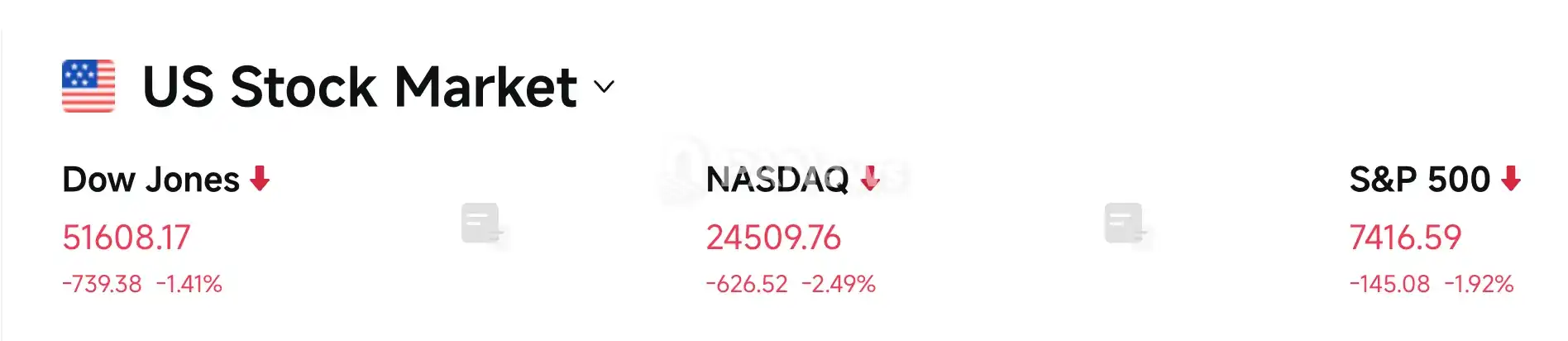
U.S. stocks suffered their worst three-day decline since June this year, with 5,393 stocks falling versus just 1,588 rising. The Nasdaq Composite plunged 2.49%, retracting over 10% from its October 6 peak and entering technical correction; the S&P 500 dropped 1.92%; the Dow Jones Industrial Average fell sharply by 1.41%; the Nasdaq 100 plummeted 2.67% and breached the 200-day moving average—the bull-bear dividing line.
Traders once believed that “the Fed would always rescue when markets bottom out,” but now the Federal Reserve has not only dismantled the “put option” narrative but actively entered the arena, labeling AI as a systemic financial stability risk. Fed Chair Wash announced a paradigm shift, introducing multi-expert simulations of three potential outcomes from "Superintelligence (SI)": productivity boom, structural unemployment driven by automation (Wash even likened it to the “China shock” of 2001 that led to the loss of 2.4 million U.S. jobs, now replayed in services), and massive capital expenditures leading to failed returns, triggering equity valuation collapse and economic recession.
Fed Governor Barr warned that autonomous AI agents could accelerate bank runs, noting that the on-balance-sheet debt of the seven major AI giants will exceed $80 billion by year-end, while off-balance-sheet obligations may reach up to $3 trillion in nominal value. A market reversal could trigger destructive deleveraging. IMF Managing Director Georgieva cautioned that the global economy stands “on one leg—AI”—over $1 trillion in AI circular financing is mostly debt-financed, with significant risk of capital flight.
The U.S. Dollar Index surged to 103.58, reaching a 19-month high and fully reclaiming all ground lost since Trump’s April 2, 2025, “Liberation Day” tariff announcement, pressuring EUR/USD below the 1.10 threshold to a 19-month low of 1.1003 (Danske Bank’s August Hyldgaard attributes this to robust U.S. data and a hawkish Fed stance). Deutsche Bank strategist Mallika Sachdeva proposed the “Chip Dollar” thesis, highlighting that over $1 trillion annually flows into U.S. equities from Asia’s expanding chip trade surplus, with chips replacing oil as the new pillar of dollar hegemony. However, given the tech sector’s volatility—ten times higher than U.S. Treasuries—this capital flow cycle will further amplify dollar volatility.
Geopolitical and policy-wise, the U.S. Department of Commerce’s Bureau of Industry and Security issued an emergency final rule blocking Chinese firms’ remote access to advanced U.S. AI chip compute via third countries, imposing new licensing requirements for exports of advanced chips to Indonesia, Malaysia, Singapore, Thailand, and Brazil. Despite Trump endorsing Huang Renxun’s return to CEO amid claims he was enduring “hellish torment,” CNBC uncovered that after Trump’s return to office, his independent advisors managed accounts that traded NVIDIA stock at least 103 times (cumulative transaction value up to $97.5 million), precisely timing H200 chip export relaxations and intelligence briefings on Huang’s alleged confidential relationships. Meanwhile, despite Zelenskyy holding virtual talks with U.S. envoy Witkoff, Kushner, and European envoys and warning of large-scale Russian air strikes, Russia’s Ushakov refused to confirm Europe’s participation qualification.
Despite Iran’s hardline posture, claiming a fourth oil tanker mine incident in the Strait of Hormuz and asserting the strait will never revert to pre-war status, oil prices faced merciless sell-offs. WTI crude near-month contract dropped 3.21% to close at $85.72/barrel; Brent crude tumbled 3.55% to $92.44/barrel; European benchmark Dutch TTF natural gas fell 7.8%, U.S. natural gas dropped 3.3%, and U.S. retail diesel broke below $6 per gallon for the first time since September.
Capital Economics and the International Energy Agency both issued warnings confirming a turning point in global crude supply in October, with oversupply re-emerging at over 1 million barrels per day in Q4. Goldman Sachs lowered its 2027 forward oil price forecast to $78. Mizuho commodity expert Robert Yawger added that markets recognize U.S. military action against Iran is losing steam—Trump has signaled advisers to delay strikes—and combined with China’s 8% YoY drop in refining throughput in October, the imbalance between supply and demand has completely shattered the long-side position.
The myth of hard asset safe haven crumbled: COMEX silver futures plunged 4.50% to $46.91/oz, spot gold declined ~0.88% to $3,853.06/oz, retreating 31.5% from this year’s peak and heading toward its worst annual performance since 2015. Goldman Sachs downgraded gold price outlook for the second time in a month, warning ETF selling pressure will weigh on prices, cutting its 2027 year-end target to $4,650 and asserting gold won’t regain $5,600 until late 2028, following Fed rate cuts.
AI Compute Demand Forecast Severely Downgraded, Top Wall Street Firms’ Q3 Portfolio Reallocations Revealed
U.S. equities experienced a “de-risking storm” on Monday, with nine of the S&P 11 sectors declining and two rising. Information Technology and Communication Services led the selloff, while only Consumer Staples and Utilities posted slight gains (Procter & Gamble, Coca-Cola, Costco hitting new all-time highs). Vanda Research and Nomura Asset Management’s chief strategist noted that AI exposure has permeated every corner of the economy; the current VIX spike isn’t a systemic liquidity crisis but a market shift from “reckless compute betting” to stringent “capital expenditure ROI validation.” Overcrowded AI long positions are now being rapidly liquidated.
SemiAnalysis drastically slashed long-term AI compute forecasts, reducing capital expenditure projections for 2028, 2029, and 2030 by 28%, 41%, and 40% respectively, erasing $60.8 billion in projected investment for 2030 down to $92.3 billion. Additionally, five-year silicon wafer shipment area forecast was cut by 17%, HBM shipments for 2028 and power demand for 2030 were reduced by 30% and 34% respectively. SemiAnalysis explicitly warned that slowing ARR growth in frontier AI labs, inability to cover token costs, tightened financing for data center projects lacking long-term procurement commitments, and U.S. regulatory and grid constraints will cause delays of up to 5.8 GW in data center capacity from second half 2027 to mid-2028.
Bernstein’s Q3 AI server tracking report revealed that all 13 segments of the AI supply chain collapsed within the past 30 days (substrates, PCBs, test equipment, optical connectivity dropped 29%-30%; memory and CPUs fell 19%-24%). Poor earnings results stemmed largely from widespread shortages in memory, ABF substrates, CPUs, power semiconductors, and DSP chips in optical modules. More critically, although the five top cloud providers’ 2028 capex consensus remains elevated at $1.6 trillion, only Microsoft shows positive free cash flow among them in 2026; Q3 AI primary market fundraising reached $102 billion but has declined for two consecutive quarters. Furthermore, 57% of the planned 265 GW of U.S. data center capacity lies in states opposed to expansion, forcing cloud providers to raise their “behind-the-meter power” (in-house gas, fuel cell, or aircraft engine retrofits) share to 43%. Meanwhile, more cost-effective custom ASICs are acceleratingly eroding general-purpose GPU market share, expected to grow from 11% in 2025 to 27% by 2028.
Aberdeen analyst pointed out that the Nasdaq 100 and several core semiconductor stocks have broken below the 200-day moving average, shifting from uptrend to range-bound consolidation, with the 200-day MA now acting as a heavy resistance. Investors are advised to sell on strength in Applied Materials, Lam Research, KLA, Teradyne, Amkor Technology, Onto Innovation, FormFactor, and SiTime, retaining only AMD and Texas Instruments.
Amid the bloodshed in secondary markets, Q3 13F filings reveal extreme portfolio rebalancing by top institutions:
Berkshire Hathaway: Holding $352.3 billion in cash and repurchasing $9.6 billion in shares, increased positions in Lennar (+98.6%), Delta Air Lines (+12.4%), and newly established Bending Spoons, reduced financial holdings including Bank of America (-5.7%), Capital One (-61.7%), and Visa (-34.1%), while maintaining unchanged positions in Apple, Google, and other top ten holdings.
BlackRock: Managing $23 billion, significantly reduced exposure to SPY, IVV, VOO—all S&P 500 ETFs (cutting over $2.7 billion collectively), Google Class A, and Amazon, liquidated industrial stocks like Union Pacific Railroad, increased positions in Qualcomm, Micron, Lam Research, and newly established Western Oil, Dominion Energy, Medtronic, Jazz Pharmaceuticals, Cisco, and Fortinet.
Legendary fund managers displayed distinct strategies: “Wall Street’s Bottom Hunter” David Tepper’s Appaloosa newly acquired Oracle, Applied Materials, and PG&E, heavily increased stakes in SpaceX (from 225,000 to 3.88 million shares), NVIDIA, and Micron, but exited AMD, Broadcom, and Qualcomm; “Legendary Trader” Daniel Loeb’s Third Point newly acquired Meta and NVIDIA, increased SpaceX holdings, liquidated Amazon and Warner Bros. Discovery; Paul Tudor Jones’ Tudor Investment newly acquired Iridium Communications, SK Hynix, and Salesforce, heavily increased exposure to utilities ETFs and 20-year Treasury ETFs, liquidated Teck Resources, Texas Instruments, and Chevron, and substantially reduced Microsoft and Micron positions; Duquesne Capital, managed by Druckenmiller, liquidated Google Class A, United Airlines, and SanDisk, significantly reduced TSMC and STMicroelectronics, shifted focus to bedding firm Somnigroup and mining stocks Newmont and Barrick Gold, and increased stakes in Seagate and Unity; 3G Capital newly acquired Nu Holdings, Amazon, and Coupang, increased TSMC holdings, reduced Intel and exited Texas Instruments, Nebius, and GlobalFoundries; Corvex exited Microsoft, increased Amazon and utility stock Vistra, reduced Disney and Illumina.
The “AI Kingmaker” myth shattered: Leopold Aschenbrenner’s fund Situational Awareness, once famed for its AI declaration, saw its public portfolio plunge from $20.24 billion to $1.58 billion by end-Q3 after narrowly avoiding bankruptcy in July (forced to sell all public equity to Citadel, shrinking peak size from $45 billion to $10 billion). It liquidated over $11 billion in SanDisk, Micron, TSMC, CoreWeave, and other common stocks, betting 73.7% of its remaining capital on call options for Australian new cloud company SharonAI, Bloom Energy, Nebius, SanDisk, and DRAM ETFs. However, these bottom-fishing bets were again massacred in October: SharonAI plunged 58% in October and another 11% this month; IREN and Nebius dropped 41% and 35% respectively in October.
Specific Project Moves and Stock Volatility:
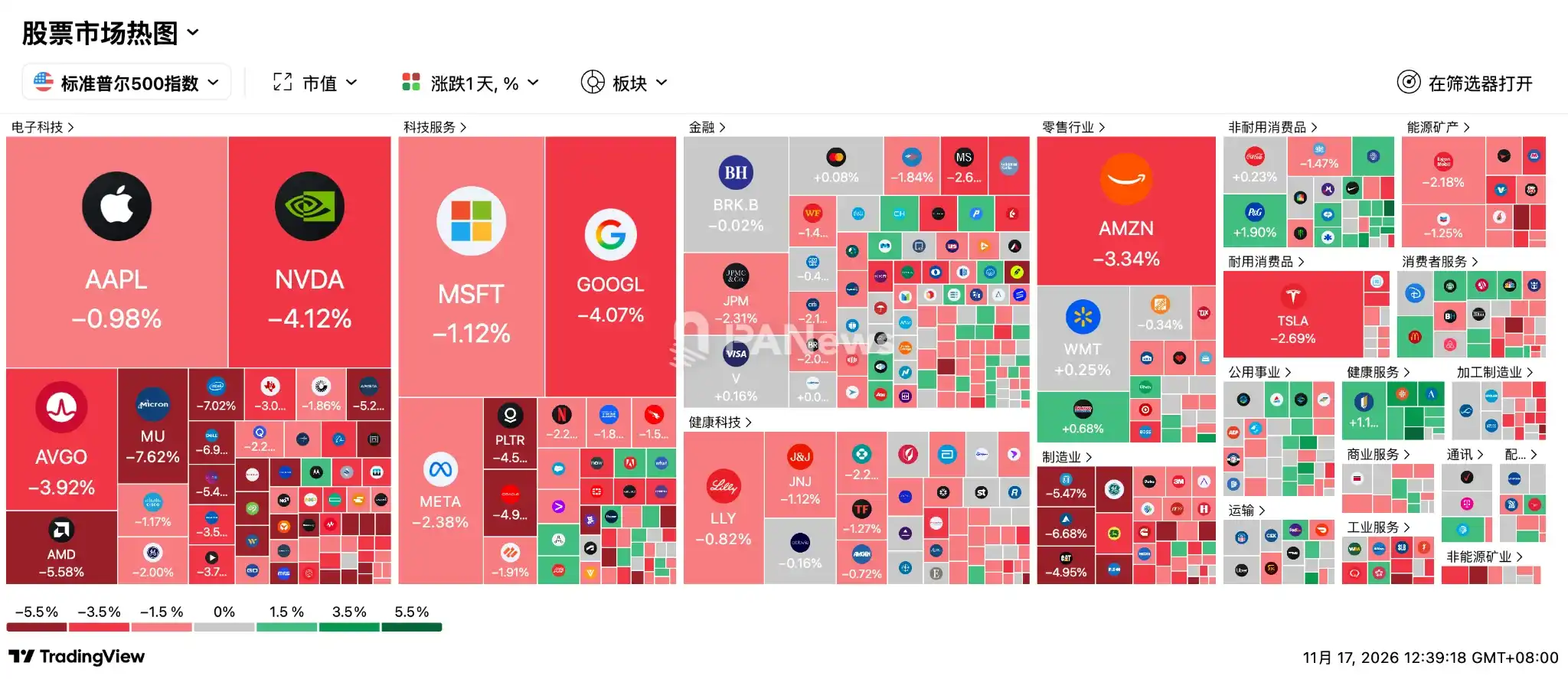
AMD closed down 5.58%: Despite strong fundamentals—first, the company completed its ~$8.2 billion acquisition of spatial intelligence firm World Labs, AI expert Fei-Fei Li officially joined as Executive Vice President and Chief Scientist; second, AI cloud provider TensorWave announced a six-year agreement with OpenAI to deploy dedicated compute powered by AMD Instinct MI455X accelerators and Helios racks starting mid-2027. Affected by sector-wide selling pressure, AMD experienced catch-up depreciation, yet Oppenheimer notes it still holds above the 200-day moving average.
General semiconductor slump: Philadelphia Semiconductor Index tumbled 5.28%, with all 30 components down. Intel fell 7.02% after NVIDIA's massive 25% stake reduction, constrained by ABF substrate shortages and weak PC demand; Arm dropped 8.12%; TSMC slid 6.34%; ASML lost 5.91%; Applied Materials declined 5.47%; Broadcom dipped 3.92%.
Memory chip crash: SemiAnalysis slashed 2028 global HBM shipment forecast by 30%, shattering the one-sided expectation of infinite memory scarcity and perpetual price hikes. Meanwhile, Bernstein reported market concerns over slowing memory price growth and new supply releases, causing the strongest compression in P/E valuations for cyclical memory stocks. Combined with institutional sell-offs in memory stocks by Aschenbrenner and Tudor Investment during Q3, a wave of short covering ensued. SanDisk dropped 8.58%, Micron Technology fell 7.62%, DRAM plunged 7.38%; SK Hynix crashed 7.89%; Seagate Technology declined 5.54%; Western Digital dropped 4.98%.
Optical communications sector suffered widespread losses, with multiple stocks reversing full-year gains: Despite Mellanox announcing collaboration with Penguin Solutions to develop next-gen memory expansion cards to alleviate HBM bottlenecks, selling pressure overwhelmed sentiment. Analysts note that module pricing had already priced in excessive future expectations, compounded by revised compute capex, DSP chip shortages, and potential FCC policy risks, weighing on sector valuations. AAOI dropped 9.48%, Astera Labs fell 8.79%, Mellanox lost 7.27%, LYTE plunged 9.29%, Lumentum declined 8.48%, Credo slipped 8.21%.
Compute leasing and server sector battered: High-leverage compute firms came under scrutiny due to Fed rate hike expectations and leadership changes at NVIDIA. Morgan Stanley data showed $38 billion in market cap evaporated across CoreWeave, Nebius, and IREN combined. Despite Dell Technologies and GE Vernova unveiling new products at SC26, market fears over infrastructure financing breakdown persisted. NEBIUS dropped 7.55%, Supermicro fell 6.85%, CoreWeave declined 6.12%.
Mag 7
NVIDIA closed down 4.12%, marking its lowest closing since July 1, 2025: Since its October peak, NVIDIA’s market cap has shed over $2 trillion, dropping to third-largest in the U.S. ($3.76 trillion), and endured its longest six-week losing streak since 2012. The company faces a triple threat: last Thursday, CEO Huang Renxun abruptly resigned after intelligence agency investigation into confidential relationships with women; the board confirmed no immediate plans for his return; same day, U.S. Commerce Department introduced new regulations restricting overseas compute leasing; latest 13F filings show NVIDIA’s Q3 holdings value fell 23.8% to $48.331 billion (including 25% reduction in Intel shares to 161.1 million, 6.3% increase in key GPU client SpaceX to 130.5 million shares). Despite launching Rubin HPC GPU and other new products at SC26, selling pressure remained overwhelming. UBS cut target price to $240, Morgan Stanley downgraded 2028 fiscal revenue forecast to $623 billion, warning that the probability of the stock dropping below $130 within one year is as high as 24.2%. Market attention now focuses on whether interim CEO Colette Kress can provide FY2027 guidance post-market Tuesday.
Google fell 4.07%: Despite Google Cloud excelling in MLPerf v6.1 benchmarks, demonstrating seventh-generation Ironwood TPU’s superior large-scale scalability, and Bernstein projecting TPU market size could reach $184 billion by 2028, the stock’s positioning weakened. Within Q3, top hedge funds including BlackRock, Appaloosa, Third Point, Duquesne, and 3G Capital all reduced or exited positions; Berkshire Hathaway also halted its accumulation, triggering market-wide selling.
Amazon dropped 3.34%: Despite Blackstone’s newly listed BXDC announcing a ~$5 billion deal to acquire 75% majority stake in AWS-owned 13 electrified data centers in Indiana and Mississippi, with AWS leasing back for 12–32 years, the stock was hit by BlackRock and Third Point selling and growing skepticism over AI capex ROI.
Tesla declined 2.69%: Company announced plans to invest €3 billion to expand its Berlin Gigafactory, targeting production of driverless Cybercab taxis by 2029 (long-term annual capacity up to 1 million units) and hiring 2,000 additional employees to support Model Y production; additionally, prediction platform Kalshi showed probability of “Tesla and SpaceX merging before March 2027” surged from 27% on Thursday to 62% (SpaceX also closed down 1.26% on the same day), yet high-valuation growth stock traits made it vulnerable to profit-taking.
Meta fell 2.38%: Previously raised its capital expenditure floor from $35 billion to $37 billion, facing pressure under headwinds from market scrutiny on cash flow returns.
Microsoft dropped 1.12%: Company disclosed that the recent global outage was caused by a latent vulnerability introduced in July, with Teams traffic switching exhausting shared gateway memory with Exchange; over 80% of gateways became unresponsive, taking 30 hours to begin deploying fixes. However, Morgan Stanley noted its diversified cloud business structure, smooth AI capex amortization (land/building ratio down from 60% to 25%), and being the only cloud giant with positive free cash flow in 2027 make it relatively resilient.
Apple declined 0.98%: Protected by Berkshire’s largest holding (holding value of $75.9 billion unchanged) and lower AI-heavy capital expenditure exposure, it emerged as the least affected among the seven tech giants.
What to Watch Next:
November 17 (Tuesday)
Microsoft’s annual developer and IT conference in San Francisco, running through November 20, features CEO Nadella’s keynote on November 17: covering Azure, AI Foundry, Copilot, and full-stack developer tools. Given last week’s global outage and heightened skepticism over AI capex ROI, Nadella’s guidance on Q4 Copilot and AI Agent toolchain updates, as well as enterprise software spending intent, will directly determine whether Microsoft, SaaS software, and AI application segments can take over the baton from hardware.
Bank of America releases its November global fund manager survey: BoA Chief Strategist Hartnett views this as the key barometer for whether U.S. equities have hit bottom. If the survey shows a sharp decline in fund managers’ expectations for economic “prosperity” next year and cash allocation surges above 4.2%, it triggers a contrarian “buy” signal; if prosperity expectations remain high and cash levels fall below 3.7%, it indicates insufficient panic, meaning the U.S. equity correction is far from over.
Confirmation from Trump administration agencies on NVIDIA data preservation directive deadline: Per Democratic senators' request, agencies must confirm by November 17 whether they’ve issued data preservation directives regarding NVIDIA’s compliance with Asian chip sales. Harsher regulatory language would further intensify NVIDIA’s compliance clouds.
Earnings: NVIDIA and Chilean Mining Chemicals report after market close; JD.com, Walt Disney, Home Depot report before market open. NVIDIA’s earnings this time mark the debut of its interim CEO; the quarterly billion-dollar revenue expectation and data center guidance will be the sole pillar sustaining global AI supply chain valuations; the all-hands meeting will set tone for internal turbulence.
November 18 (Wednesday)
APEC’s 33rd Informal Leaders’ Meeting held in Shenzhen, lasting through November 19: The first time in 12 years China hosts the summit, theme “Building an Asia-Pacific Community, Promoting Shared Prosperity.” Signals of regional geopolitical easing and free trade zone progress will directly boost risk appetite for Chinese A-shares, Hong Kong stocks, and emerging markets in Asia-Pacific.
Huang Renxun’s confrontation with U.S. Congress committees: Originally scheduled for Huang to appear before a joint hearing of the House Foreign Affairs, Intelligence, and China Issues Committees on November 18, the latest congressional letter now requires him to undergo closed-door written questioning on December 1 (Senate Banking Committee separately demands public testimony on December 3). However, dense disclosures around his correspondence with former Megaspeed executives in Singapore, chip transfer compliance investigations, and political maneuvering in Silicon Valley to lobby for his reinstatement will continue to emerge around November 18, potentially triggering intraday volatility in NVIDIA’s stock.
Anthropic confirms IPO final pricing: Company plans to issue 825 million shares at $70–78 per share (maximum IPO fundraising $64.4 billion, plus $26 billion in private placement from tech giants including NVIDIA and Micron, total fundraising up to $90.4 billion, fully diluted valuation reaching $1.4–1.5 trillion). With over sixfold oversubscription, if final pricing exceeds the upper end of the range, it may uplift AI model valuation anchors—but also intensify market fear of hundreds of billions of dollars in “liquidity bleed” in the secondary market the following day.
2026 China 5G+Industrial Internet Conference in Wuhan, running through November 20: Focuses on “Connecting Everything, Empowering Thousands of Industries.” If policies on industrial AI models, compute networks, and smart manufacturing are unveiled, it could catalyze A-share industrial internet, telecom equipment, and edge computing sectors.
Earnings: Tencent Holdings, Sinopharm Group, Dechang Motor Holdings report after market close in Hong Kong; Palo Alto Networks reports after market close in U.S.; Lowe’s, Target, Pony.ai, Bullish report before market open in U.S.
Source: Wall Street Morning Report
Disclaimer: Contains third-party opinions, does not constitute financial advice


HuggingFace's "AI Duck" Goes Viral, Boosting Chinese Chip Supplier Rockchip
09-02
Yushu Surges 629% on First Day of Trading, Humanoid Robots Sell 5,500 Units
08-19
14 Executives Depart, Horizon Unleashes a Robot Legion
08-11
Nokia Snatches AI Optical Chip Race, Stock Soars 52%
08-07
Yushu's 61 Billion IPO: Who Will Make Money?
08-07
AI stocks down 40%-60%, yet NVIDIA's valuation is at a 10-year low
08-06
HBM Bottleneck Migration, NVIDIA Also Aims to Downgrade
08-06


