Open-source 321B model, Nex-N2.6 enables direct computer operation
Open-source 321B model, Nex-N2.6 enables direct computer operation

2026-11-17 10:10
Introduction: Repetition rate reduced to 1.6%, zero-error cross-framework tool invocation. What is Nex-N2.6? Nex-N2.6 is an open-source multimodal agentic model developed by Shanghai Creative Intelligence Institute (Nex-AGI)
What is Nex-N2.6?
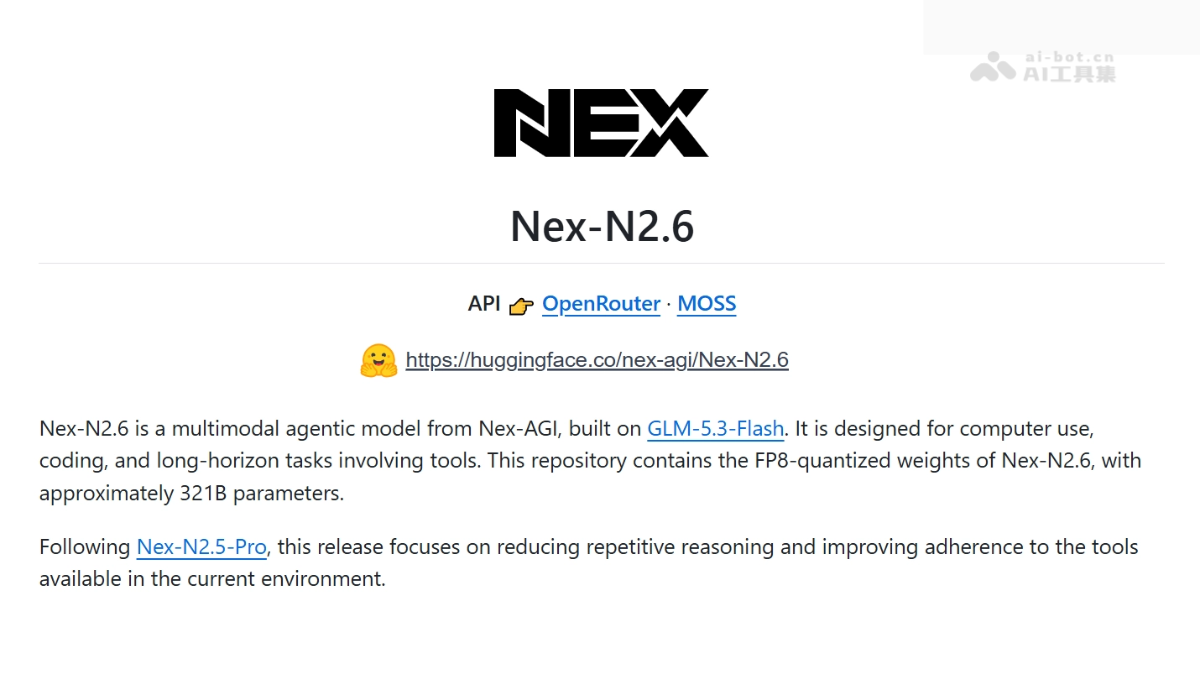
Nex-N2.6 is an open-source multimodal agentic model developed by Shanghai Creative Intelligence Institute (Nex-AGI), post-trained on GLM-5.3-Flash, with approximately 321B parameters and support for a 256K context window. It specializes in computer interface control, programming, and long-haul tool invocation tasks. Compared to its predecessor N2.5, Nex-N2.6 achieves a 90% reduction in reasoning repetition rate and significantly lowers token consumption; it attains 100% cross-Harness tool matching accuracy and scores 83.0 on the OSWorld desktop operation benchmark, placing it among the top tier. Nex-N2.6 provides FP8 quantized weights and can be deployed locally via SGLang.
Main Features of Nex-N2.6
- Computer User Interface Control (CUA): Directly interprets screen captures and operates real desktop applications; achieves an OSWorld benchmark score of 83.0, ranking among the top performers.
- Tool and Function Invocation: Supports multi-step toolchain invocations and strictly adheres to the declared tool list in the current environment, enabling zero-error cross-framework tool calls.
- Long-Haul Task Execution: Specifically designed for extended tasks, with a reasoning repetition rate reduced to 1.6%, minimizing token waste caused by "looping" behavior, resulting in higher end-to-end success rates.
- Programming Capabilities: Equipped with code generation and software engineering abilities, building upon Nex series' proven performance in benchmarks like SWE-bench.
- Multimodal Input: Supports both text and image inputs, capable of recognizing UI elements and describing available controls.
- Long Context Handling: Offers an open 256K context window API, ideal for long-trajectory agent workflows.
- Open Source and Local Deployment: Open-sourced with 321B-parameter FP8 quantized weights under Apache 2.0 license, deployable via self-hosted SGLang.
- Multi-Platform Integration: Compatible with OpenAI interfaces and callable through OpenRouter and MOSS platform APIs.
Technical Principles of Nex-N2.6
- Post-Training Architecture Based on GLM-5.3-Flash: Nex-N2.6 is post-trained on Zhipu AI’s GLM-5.3-Flash foundation model, resulting in a final model with ~321B total parameters and FP8 quantization. The base architecture (hybrid attention layers + MoE) is preserved, with enhanced agentic behaviors added on top. This allows reuse of existing inference stacks compatible with GLM-5.3-Flash, while FP8 configuration reduces GPU memory footprint, enabling 8-card distributed deployment.
- Repetition Rate Optimization: Fault-fix training driven by bad cases. The team collected 698 real-world bad cases from internal and partner usage to construct a “repetition problem benchmark.” Combined with a “checkpoint replay” mechanism, the model freezes all historical context and tool responses prior to errors or crashes in the previous model version, allowing continuation from the same failure point.
- Cross-Harness Tool List Alignment: Different agent frameworks (Claude Code, Codex, Cursor, etc.) use varying tool names, leading models to misinvoke tools due to outdated names in prior dialogues. Nex-N2.6 leverages mixed-context training across multiple frameworks, anchoring attention to the “current request’s declared tool list.” In 956 real-context tests, it achieved 100% precise match within the declared tool list, eliminating overfitting to specific training environments.

Follow WeChat and reply "open source" to join the AI Open Source Project Community
How to Use Nex-N2.6
- Method One: Local Deployment (SGLang)
-
Download Weights: Use ModelScope CLI to download FP8 quantized weights:
modelscope download --model nex-agi/Nex-N2.6 --local_dir nex-agi/Nex-N2.6. - Pull Image: After installing Docker, pull the official SGLang image:
docker pull lmsysorg/sglang:latest. - Launch Service: Mount the model directory as read-only into the container, start the service with 8-card TP/EP and FP8 compatibility settings, and set
--served-model-name Nex-N2.6,--reasoning-parser glm45, and--tool-call-parser glm47. - Text Inference: Call the OpenAI-compatible endpoint at
http://127.0.0.1:8000/v1/chat/completions, setting"model": "Nex-N2.6","reasoning_effort": "max", and"stream": truefor streaming output. - Image Input: Pass screenshots using the
image_urlcontent block in messages; the model will describe the UI and identify controls. - Tool Invocation: Include a
toolsdeclaration in the request specifying available tools in the current environment. The model returns invocation instructions, which are executed by the client or agent framework and results are returned back.
-
- Method Two: Cloud API (No Deployment Required)
- Call via OpenRouter: On the OpenRouter platform, select the
nex-agi/nex-n2.6model and invoke it using OpenAI-compatible SDK with your API key; supports 256K context. - Call via MOSS Platform: Visit the MOSS open platform at https://platform.moss.cn/docs/models/nex, obtain your API key per documentation, and send requests using the same interface format.
- Call via OpenRouter: On the OpenRouter platform, select the
Core Advantages of Nex-N2.6
- Dramatically Reduced Reasoning Repetition Rate: Internal checkpoint replay evaluation shows repetition rate dropped from 16.0% to 1.6%, eliminating "in-place looping" in long tasks and significantly reducing token consumption.
- Zero Cross-Harness Misinvocation: Regardless of Claude Code, Codex, Cursor, or custom frameworks, tool list matching accuracy reaches 100%, on par with GPT-6-Sol, achieving true plug-and-play functionality.
- Top-Tier Computer Control Capability: Scores 83.0 on OSWorld (a +5.0 improvement over base model), surpassing DeepSeek-V4.1-Flash and ranking among the elite in desktop operation performance.
- Uncompromised Terminal Capabilities: Achieves 84.1 on Terminal-Bench 2.1, retaining full automation and operations power from the base model without sacrificing general performance during post-training.
- High Long-Task Success Rate: Overall non-circular invocation rate reaches 97.8%, combined with 256K context window, ensuring more stable end-to-end delivery of long-haul tasks.
Project Repository for Nex-N2.6
- GitHub Repository: https://github.com/sii-nex/Nex-N2.6
- HuggingFace Model Hub: https://huggingface.co/nex-agi/Nex-N2.6
Comparison with Competitors
| Dimension | Nex-N2.6 | GPT-6-Sol |
|---|---|---|
| Openness | Open-source FP8 weights (~321B parameters), self-hostable | Closed-source, API-only access |
| Context Window | 256K | Approx. 1,050K (premium pricing applies beyond 272K) |
| Computer Control (OSWorld) | 83.0 (team-reported) | 60.5%–64.4% (OSWorld 2.0 offline set, vendor-reported) |
| Terminal Capability (Terminal-Bench) | 84.1 (v2.1) | No report on this version |
| Cross-Harness Tool Compatibility | 100% precise match within tool list | 100% (reference score in Nex team's internal benchmark) |
| Long-Task Stability | Repetition rate 1.6%, non-circular rate 97.8% | Internal repetition rate data not publicly disclosed |
| Data & Compliance | Weights run locally, data stays within internal network—ideal for sensitive environments | Data passes through OpenAI API; compliance assessment required |
| Deployment Barrier | High (requires 8-GPU-level hardware + SGLang) | Zero barrier—ready to use immediately |
| Interface Compatibility | OpenAI-compatible, supports three reasoning_effort levels | Responses API-centric; Chat Completions does not support tool calling (from 6.1 Sol onward) |
Application Scenarios of Nex-N2.6
- Desktop Software Automation: Directly operate GUI applications such as LibreOffice, web browsers, and file managers by interpreting screen captures to perform multi-step tasks like form filling, cross-application data transfer, and system configuration.
- Professional Design/Engineering Workflows: Control professional software without APIs such as FreeCAD and Blender to automate parametric modeling, batch rendering, and other complex workflows.
- Operations & Terminal Automation: Leverage terminal capabilities comparable to Terminal-Bench 2.1 level to execute server inspections, log analysis, and bulk script-based operations.
- Long-Haul Software Engineering: Serve as a core component in coding frameworks like Claude Code, Codex, and Cursor, handling multi-file edits, cross-module refactoring, and other development tasks requiring dozens of tool invocations.
- Enterprise Process Automation: Integrate legacy systems with only graphical interfaces—such as email, forms, and ERP—to automate business processes including approvals, data entry, and report generation.
Source: AI Tools Collection
Disclaimer: Contains third-party opinions, does not constitute financial advice


Step Code – The Open-Source Terminal Programming Agent by Jieyue Star
09-24
Hy4 Preview Lightweight Version – Tencent Hunyuan's Open-Source Hy4 Quantized Compression Model
09-02
Claude Fable 5.1 – Anthropic's Latest Flagship Large Model
09-02
Open-source Retool is here, drag-and-drop backend with 60+ components
08-19
Claude Opus 5 is Here: Half the Price Approaching Fable 5
07-25
Tencent Open-Sources 260 Real-World Tasks to Test AI Workforce Capabilities
07-25
Meituan Open-Sources AI Exam Platform: 813 Minecraft Tasks
07-25


