Anthropic Revenue Surpasses OpenAI, 30 AI Unicorns Valued Over $10 Billion
Anthropic Revenue Surpasses OpenAI, 30 AI Unicorns Valued Over $10 Billion

2026-11-17 08:06
Executive Summary: The Global Unlisted AI Companies Valuation and Revenue Ranking shows OpenAI and Anthropic leading with trillion-dollar valuations, while Anthropic achieves revenue reversal
November 15, Menlo Ventures partner Deedy Das (@deedydas) shared on social media a ranking of global AI company valuations and revenues from the veteran Silicon Valley venture capital firm.
Founded in 1976, Menlo Ventures is one of the oldest venture capital firms in Silicon Valley, having invested in well-known tech companies such as Uber and Chime. In recent years, the firm has focused heavily on AI investments and released its widely circulated report “State of Generative AI in the Enterprise” at the end of 2024. Menlo Ventures was also an early investor in Anthropic, participating in its Series C funding in 2023 and co-establishing the $100 million AI investment fund Anthology Fund with Anthropic in 2024.
The ranking covers unlisted AI companies globally with valuations exceeding $10 billion and annualized revenue surpassing $100 million as of November 14. A total of 30 companies meet both criteria.
The dominant "duopoly" gap continues to widen. OpenAI leads with an estimated valuation of $1.25 trillion, followed closely by Anthropic at approximately $965 billion. The two companies have already established a trillion-dollar valuation gap over their competitors.
However, when ranked by annualized revenue, the positions have reversed: Anthropic now exceeds OpenAI. While both maintain a massive valuation lead, revenue competition has taken a new turn.
Among Chinese companies, DeepSeek and Moonshot have entered the global top ten. DeepSeek ranks fifth with a valuation of $89 billion, while Moonshot ranks seventh at $50 billion. According to the data disclosed in the ranking, both companies have achieved annualized revenue of approximately $1 billion.
Nevertheless, the U.S. still holds an overwhelming advantage overall. Out of the 30 companies listed, 23 are based in the U.S., spanning foundational models, AI programming, compute cloud services, and more. China accounts for two entrants, while the remaining five come from Canada, France, Germany, and the UK.
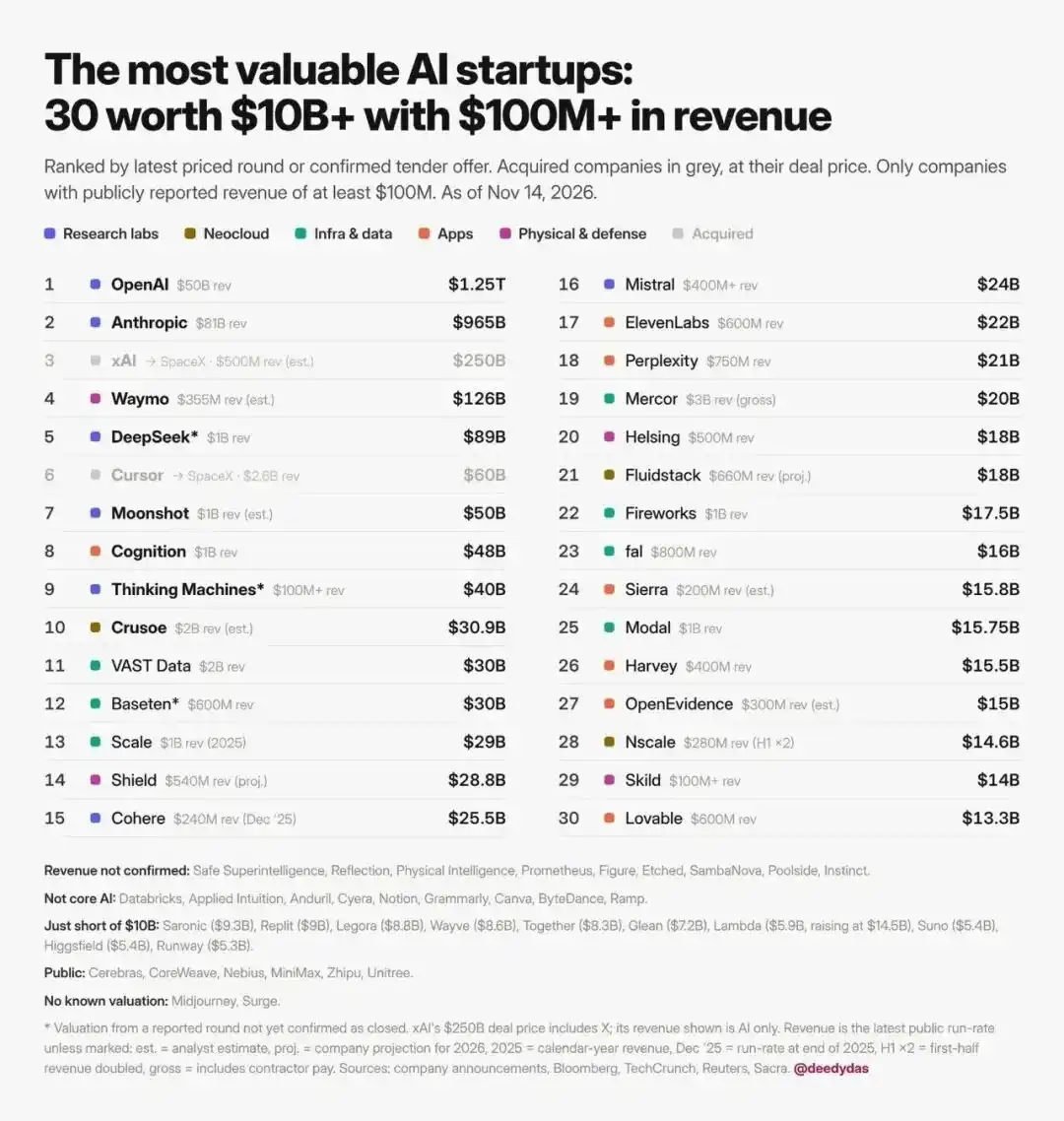
Figure: Global Top Unlisted AI Companies with Valuations Over $10 Billion
"Duopoly" Leadership Gap Widens
If we rewind just one year, OpenAI still had a clear and decisive lead.
By the end of 2025, OpenAI’s annualized revenue reached around $20 billion, while Anthropic stood at only $9 billion. At that time, the revenue gap between the two was more than double.
But entering 2026, Anthropic’s growth rate began significantly outpacing OpenAI’s. By the end of September this year, OpenAI’s annualized revenue was approximately $50 billion; by the end of October, Anthropic’s had surged to $65 billion, overtaking OpenAI.
This shift is evident in actual revenue figures as well. In Q3 2026, Anthropic reported revenue of about $17 billion, compared to OpenAI’s $10 billion. Although there remain discrepancies in how cloud platform revenues are calculated—such as whether Anthropic includes portions of managed revenue hosted on Amazon Bedrock or Google Cloud—the rapid market penetration into enterprise segments is clearly reflected in the revenue curve.
Both companies’ leadership remains solid. The head-to-head competition in the foundational model market has entered the trillion-dollar valuation phase.
More notably, Anthropic is leveraging this momentum to push toward an IPO. On November 10, Anthropic announced an IPO price range of $70 to $78 per share, with plans to list on Nasdaq on November 19 under the ticker “ANT.” If priced at the upper end, its fully diluted valuation would reach $965 billion, making it one of the largest technology IPOs globally this year.
OpenAI has chosen a different path. Previously, OpenAI stated it would not go public in 2026, postponing its IPO plans until 2027. On November 6, OpenAI completed the first tranche of its latest round of financing, amounting to approximately $11 billion, resulting in a post-money valuation of $1.25 trillion. This round was led by SoftBank, with follow-on investments from Microsoft, Coatue, and Thrive Capital. The funding not only set a record for the largest single fundraising round by a startup globally but also temporarily alleviated OpenAI’s financial pressure on compute expenditures.
A year ago, OpenAI held a clear advantage in model performance, user base, and commercial revenue. Now, Anthropic has already achieved revenue reversal and is preparing to go public ahead of schedule.
Chinese Firms Break Through
Chinese AI companies have successfully entered this global high-valuation AI company ranking.
DeepSeek ranks fifth with a valuation of $89 billion and revenue of approximately $1 billion; Moonshot (Moonshot) ranks seventh with a valuation of $50 billion and similar revenue. Both companies have entered the top ten, and are the only two Chinese firms on this list.
Although DeepSeek and Moonshot both report annualized revenue of roughly $1 billion, their respective forward-looking P/E multiples stand at 89x and 50x, indicating that market pricing reflects more than current revenue—it incorporates technical roadmaps, commercialization strategies, and future profitability potential.
Beyond U.S. and Chinese firms, Canada’s Cohere has a valuation of $25.5 billion with annual revenue of about $240 million; France’s Mistral has a valuation of $24 billion with annual revenue exceeding $400 million.
Germany-based defense AI firm Helsing has a valuation of $18 billion, ranking 20th, with annual revenue of about $500 million; UK-based compute infrastructure provider Nscale ranks 28th with a valuation of $14.6 billion and annual revenue of approximately $280 million.
Super M&A Activity Underway
Two companies highlighted in gray on the list attract particular attention: xAI and Cursor.
They are valued at $250 billion and $60 billion respectively, both marked as being integrated into the SpaceX ecosystem. The $250 billion valuation for xAI includes the value of the social platform X, though the $500 million revenue figure listed excludes X’s advertising income. For xAI, integration with SpaceX means access to the latter’s vast satellite internet and energy infrastructure, enabling the construction of large-scale data center clusters.
The other acquired company, Cursor, is a fast-growing AI coding tool provider. Its transaction valuation reaches $60 billion, with revenue of about $2.6 billion. According to the ranking data, Cursor’s revenue volume exceeds many compute service providers and vertical application firms. Leveraging extremely high adoption among developers, it rapidly converted users into frequent paying customers.
These two transactions involve foundational models and AI application products, reflecting how leading players are expanding their business boundaries through capital consolidation. The interconnection between model development, application products, and commercial channels is strengthening, and AI industry competition is evolving from singular technological superiority to ecosystem scale.
Compute & Data Infrastructure Booms
While foundational model companies dominate the top tiers of the valuation list, another group of companies deserves close attention: infrastructure providers offering compute power, data management, and inference services for the entire AI industry. As demand for model training and deployment grows, these firms have been the first to achieve sustainable commercial viability.
Direct Compute Infrastructure Providers
Crusoe specializes in building AI data centers and providing cloud computing services, with a valuation of $30.9 billion and revenue of approximately $2 billion. Fluidstack delivers GPU compute resources and cloud services to AI enterprises, with a valuation of $18 billion and revenue of about $2 billion. CoreWeave ranks 14th with a valuation of $23 billion and annualized revenue reaching $3.2 billion.
These businesses resemble traditional cloud providers, but they focus specifically on AI training and inference demands, requiring continuous heavy investment in GPUs, data center construction, and long-term client contracts.
Data Infrastructure Service Providers
VAST Data has a valuation of $30 billion with revenue of about $2 billion, primarily serving enterprises with large-scale data storage and management solutions. Scale AI, valued at $29 billion, generated approximately $1 billion in revenue in 2025, specializing in AI data labeling, model evaluation, and high-quality synthetic data generation.
As AI models evolve toward complex reasoning, multimodal capabilities, and autonomous agents, the quality of training data, data processing efficiency, and model evaluation are becoming increasingly critical. VAST Data and Scale AI enter the ecosystem from data storage and data processing angles, becoming indispensable partners in large model training and enterprise deployment.
High-Growth Model Inference Platforms
Baseten has a valuation of $30 billion with revenue of about $600 million; Fireworks AI values at $17.5 billion with revenue of approximately $1 billion; Modal at $15.75 billion with revenue of about $1 billion; Together AI at $15 billion with revenue of roughly $840 million; fal at $14 billion with revenue of about $1 billion.
These companies primarily assist developers and enterprises in deploying and running AI models, reducing inference costs and improving operational efficiency. Notably, fal focuses particularly on inference services for generative AI models involving images and video.
Compared to large model companies, these infrastructure firms serve multiple model and application vendors simultaneously and support diverse technical approaches. As more AI applications enter live operations, increasing model call volumes, compute consumption, and data processing demands are driving rapid revenue growth for infrastructure providers.
However, this does not mean infrastructure is inherently more stable. Compute providers face high capital expenditures, while inference platforms must contend with declining model call prices and competition from major cloud providers. Whether demand growth will ultimately translate into healthy profit margins remains a key challenge for these firms.
Application Layer Fragmentation Intensifies
In contrast to foundational models and compute infrastructure, the AI application layer exhibits a different competitive landscape: although valuations are generally lower than those of top-tier model firms, some application companies have achieved astonishing revenue growth and valuation multiples.
High-Frequency Use Cases Lead Early Scaling
The first to scale were AI coding, voice generation, and search—high-frequency applications.
Cognition, powered by its AI coding agent Devin, has a valuation of $48 billion with annualized revenue of about $1 billion; ElevenLabs, driven by voice generation and voice agent services, commands a $22 billion valuation with revenue of approximately $330 million; AI search engine Perplexity has a valuation of $18 billion with revenue of about $200 million.
Lovable, founded in 2024, enables non-programmers to build software using natural language. Its valuation has reached $13.3 billion with annualized revenue of about $600 million.
Vertical Specialization Builds Deep Barriers
Even more significant shifts are occurring in vertical industries such as law, healthcare, and enterprise services.
Legal AI firm Harvey has a valuation of $15.5 billion with annualized revenue exceeding $400 million. It has penetrated 80% of the top 100 U.S. law firms, assisting lawyers with contract review, legal research, and due diligence.
Enterprise customer service AI provider Sierra has a valuation of $15.8 billion. Its business model is representative: clients pay based on AI’s actual problem resolution—such as successfully handling a post-sales inquiry—rather than merely purchasing software licenses.
Medical AI platform OpenEvidence offers free clinical research and medical information retrieval to certified physicians, monetizing through pharmaceutical-industry advertising. According to Sacra’s estimate, its annualized revenue has reached $130 million with a valuation of approximately $10.5 billion.
The commonality among these firms is their entry into workflows traditionally performed by professionals like lawyers, doctors, and customer service agents. Unlike simple chatbot tools, they require deep understanding of industry-specific rules, integration with existing enterprise systems, and even redesign of business processes. This allows them not only to establish clear payment willingness but also to build strong competitive moats within specific verticals.
This makes the valuation logic of the application layer increasingly intriguing. Based on simple calculations from the ranking, certain vertical AI application firms command valuations dozens of times their annualized revenue—sometimes even higher than several compute infrastructure firms. Investors are no longer focused solely on software sales volume but are assessing long-term potential to replace traditional human labor in specific industries.
This trend appears across other studies as well. On November 11, investment firm Leonis Capital released its “2026 AI 100” report, showing that the number of vertical industry AI companies on the list increased from 28 last year to 43 this year. The focus of enterprise AI services is accelerating its shift from general-purpose tools to vertical industry specialization.
The AI application market is rapidly fragmenting. As foundational model capabilities continue to improve, the functional advantages of general-purpose AI applications become increasingly replicable. Products relying solely on model capability alone struggle to sustain high valuations over the long term.
Conversely, capital markets are showing growing preference for companies deeply rooted in vertical industries, possessing unique data assets and professional barriers. These firms typically require long-term accumulation of industry expertise, customer trust, and process optimization. Once embedded in core operations, customer switching costs become significantly higher.
Under the dystopian vision of models consuming everything, perhaps the real opportunity for AI startups lies precisely in the application layer.
Source: Unicorn Miner
Disclaimer: Contains third-party opinions, does not constitute financial advice


The AlphaGo Moment in Cybersecurity, or Starting from These 466 Agent Matchups
11 days ago
The Trump administration plans to offer Constellation Nuclear a $5 billion loan for capacity expansion, with the additional power mostly pre-allocated to AI giants such as Google
19 days ago
Silicon Valley Executives Spark Controversy Over Using AI for Household Tasks; Survey Reveals Half of American Adults Worry About Impact on Relationships
19 days agoTensorlake npm package suffers supply chain attack, malicious version 0.5.144 injected with Shai-Hulud data-exfiltration worm
10-08Tesla and Musk Have Yet to Define "Amazing Abundance" — Visionary Slogan Sparks Skepticism
10-01Instinct Launches Curated Recommendation Feature, Sparking Frustration Among Some Users Receiving Passive Product Suggestions
09-30Security Weekly Report: Placeholder Domain Takeover Impacts Approximately 1,700 Repositories, with Major Cyberattacks Worth $387M and AI Agent Escalation Risks Highlighted
09-28
