AI "Shovels" Sell Cold: Industrial Stocks Lose $4.2 Trillion in 6 Months
AI "Shovels" Sell Cold: Industrial Stocks Lose $4.2 Trillion in 6 Months

2026-11-16 16:06
Lead-in: Order Backlog Locked to 2027, Market Revalues Ahead. Global Manufacturing, Utilities & Mining Firms Lost $4.2 Trillion in Valuation Since June
Original Text
Global manufacturing, utilities, and mining firms have collectively lost $4.2 trillion in market capitalization since June this year—this selloff has nearly erased nearly half of the $9.4 trillion gains accumulated by these sectors over the prior 12 months. The once-popular AI "shovels" trade is rapidly reversing.
According to analysis from the UK Financial Times, companies more prominently linked to data center construction in media coverage suffered disproportionately severe impacts. Investor confidence in the AI boom is waning: manufacturers of gas-powered generators tailored for hyperscale data centers, as well as high-end fiber-optic providers essential for connecting AI server racks, were once hotly pursued but are now facing widespread sell-offs. The industrial sector has become the second-worst performing segment in the S&P 500 since summer, trailing only technology.
The shift reflects broader concerns: hyperscale cloud enterprises continue to fuel escalating capex through debt financing, while mounting political resistance to data center development within the U.S. is prompting investors to question whether this building frenzy can sustain itself.
Market Capitalization Halved for Industry Leaders
Caterpillar, a primary supplier of gas-powered generators for data centers, has dropped over 30% in the past six months. Since its stock hit an all-time high on June 30, its market cap has shrunk by $214 billion, representing a 44% decline.
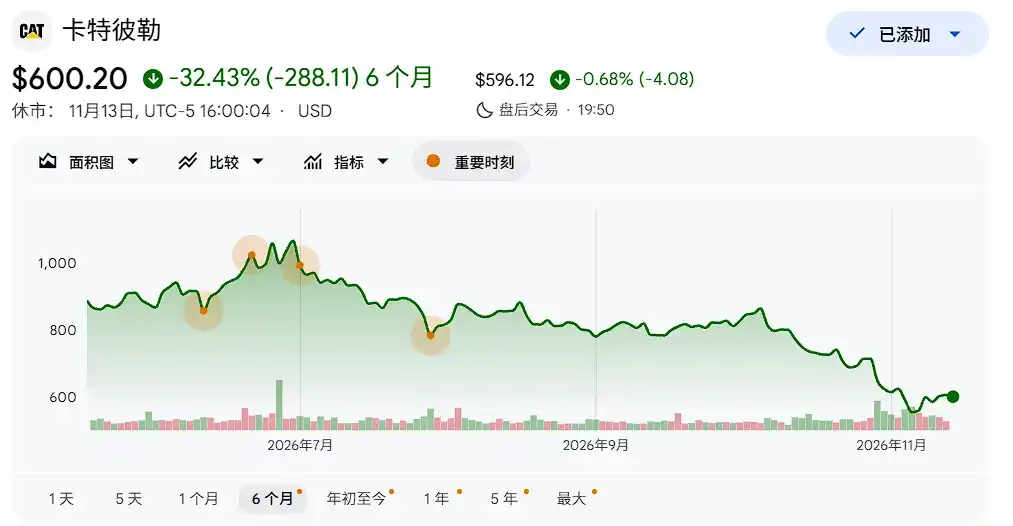
Additionally, nuclear energy firm Oklo saw its stock plunge 49%, despite signing a power supply agreement with Meta in January. HVAC systems manufacturer Comfort Systems and fiber optics producer Corning both lost approximately half their market value during the same period.
As reported by the Financial Times, Deutsche Bank’s senior U.S. economist Brett Ryan stated that substantial institutional capital had “blindly flowed” into these trades, potentially inflating overly optimistic valuations. He also noted that the stock market is now “converging with signals long sent by credit markets”—which had already warned of rising risk financing in data center construction.
Paul Kedrosky, venture capitalist and MIT researcher, bluntly stated that treating traditional industrial firms as semiconductor stocks was fundamentally flawed.
“In discussions with hedge funds and family offices, the narrative ‘everything is a growth stock’ is omnipresent—and this is plainly absurd.”
Nevertheless, despite downward pressure on share prices, the underlying fundamentals of several companies remain robust. U.S. government data shows that construction spending on data centers (excluding IT equipment and chips) reached $96 billion in the 12 months ending September this year.
Third-quarter results further confirm demand resilience. Caterpillar reported record backlog orders of $78 billion, with power generation sales up 75% year-on-year, driven primarily by data center demand. Siemens’ data center-related electrical equipment backlog grew 60% year-on-year through 2026, reaching €7 billion; Eaton’s comparable backlog doubled. Multiple gas turbine manufacturers confirmed they had secured multi-billion-dollar orders through the first nine months of 2026.
Alex Cordovil, analyst at Dell'Oro Group, said, “From a revenue and profit potential standpoint, we still see very strong expectations for these firms.” He added that broader macro trends such as electrification and supply chain reconfiguration continue to underpin core industrial operations: “Construction hasn’t slowed… backlogs are at historic highs, meaning revenue growth is largely locked in through at least 2027.”
Allient, an industrial control equipment manufacturer, CEO Richard S Warzala stated during the November 5 earnings call that demand for AI would not decline.
“Even if new data center construction is paused, projects already underway must be completed.”
Moreover, Kedrosky remains cautious about backlog data, viewing it as a lagging indicator reflecting past expectations rather than current real demand. He pointed out the phenomenon of “double or even triple ordering”—where companies over-order to secure positions amid perceived supply shortages.
Brett Ryan’s assessment is more direct: the stock market is undergoing a delayed valuation correction, aligning with risk signals already transmitted by credit markets. This months-long adjustment, resulting in over $4 trillion in market value erosion, is fundamentally a systemic repricing of the “everything is a growth stock” narrative by capital markets.
Regulatory Uncertainty Post-Midterm Elections
An additional key context behind this selloff is the uncertainty surrounding data center regulatory policy following the U.S. midterm elections. In this month’s midterms, proposals to restrict data center construction received broad voter support, though their actual impact remains unclear.
Following the election, Citigroup Research issued a report noting that while stricter regulations are expected to increase volatility in the data center industry, large-scale construction bans remain unlikely.
Joseph Dominguez, CEO of Constellation Energy, described the post-election market reaction as “overreaction,” emphasizing that Democrats “greatly value” protecting blue-collar jobs tied to data centers.
Deutsche Bank’s Ryan argued that even if certain regions impose bans, construction demand would simply shift to areas with more lenient regulations.
“Ultimately, if there’s market demand for these facilities, they will be built somewhere.”
Source: Friends of Planet Lord
Disclaimer: Contains third-party opinions, does not constitute financial advice


Yushu Surges 629% on First Day of Trading, Humanoid Robots Sell 5,500 Units
08-19
Yushu's 61 Billion IPO: Who Will Make Money?
08-07
AI stocks down 40%-60%, yet NVIDIA's valuation is at a 10-year low
08-06
HBM Bottleneck Migration, NVIDIA Also Aims to Downgrade
08-06
AI Servers Fuel Demand for Minor Metals: Prices Surge Over 70% in Half a Year
08-06
AI is not a search bar—it's a supercomputer costing just a few dozen dollars
08-05Cloud vendors first declined then surged—why the divergence in AI assets?
08-05


