Zhīhuìjūn's robot has driven a 52.9 billion yuan increase in company valuation within 14 days
Zhīhuìjūn's robot has driven a 52.9 billion yuan increase in company valuation within 14 days

2026-11-16 14:06
Lead: The real challenge for a 20,000 RMB entry into the household is sustained usage and profitability. One year after Zhiyuan Robotics took over, Shangwei New Materials announced the completion of its 10,000th robot.
One year after Zhiyuan Robotics took control, Shangwei New Materials announced the completion of its 10,000th robot. This company, once generating only a few million RMB in annual net profit from resin materials, has now seen its market cap approach nearly 100 billion RMB under the vision of becoming "the Apple of the robotics industry." But Shangwei New Materials and Zhihui Jun must now answer the next critical question: Can the Qiyuan robot—priced below 20,000 RMB—sustain such an elevated market valuation?
01
The 10,000-unit milestone marks a pivotal turning point
Recently, Shangwei New Materials’ transformation into a robotics player has truly exploded.
On November 9, Shangwei New Materials’ stock surged 20CM to a daily limit; on November 11, it soared to a historical high of 244.20 RMB per share, with a market cap reaching 98.4 billion RMB. From October 23 to November 11, within just 14 trading days, the stock price skyrocketed by 120%, adding 52.9 billion RMB in market value.
This explosive rally was triggered by a corporate announcement. On the evening of November 8, Shangwei New Materials revealed that its Qiyuan robot had successfully completed production of its 10,000th unit. Industry insiders view this “10,000-unit” milestone as a crucial watershed, signaling that consumer-grade humanoid robots have entered a phase of stable mass production. The ramp-up speed of Qiyuan robot production is remarkable—the 5,000th unit was produced on October 25, and just two weeks later, output doubled. Meanwhile, daily production capacity increased from around 10 units at the beginning of October to 240 units today.
Clearing the 10,000-unit threshold means this company, originally rooted in wind turbine blade resin materials, has finally achieved a stunning transformation toward personal robotics.
At the time of the 10,000th robot’s completion, an on-site observer noted that Liu Dongfang, co-president of Qiyuan Robotics, and Jiang Nan, president of Lens Technology China, were both present and enthusiastically clapped together. Liu Dongfang also shared several intriguing metrics: the initial seed users currently have a monthly active rate exceeding 98%, peak daily online engagement surpassing 40%, average daily online duration of 3 hours, and an average of over 100 interactions per user per day.
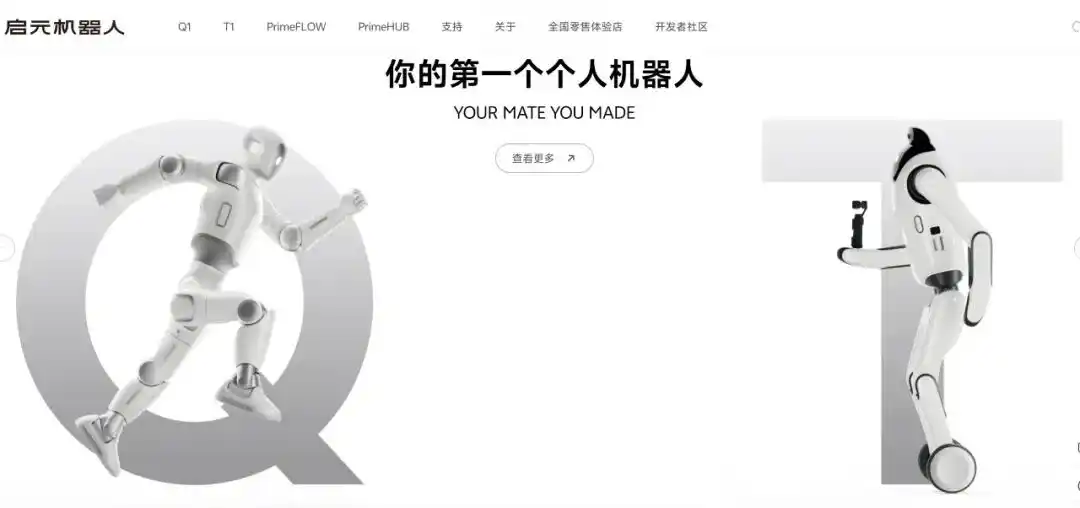
▲ Image source / Qiyuan Robotics official website
High monthly active users indicate these customers aren’t merely purchasing robots as display pieces—they are genuinely using them. When Qiyuan Robotics launched its new products in September, celebrities including Huang Xiaoming, Hu Jun, and Tian Liang couple attended the event. Both models start at just 19,999 RMB: the Qiyuan T1, capable of switching between bipedal and quadrupedal forms with a standing height of about 100 cm; and the smaller Qiyuan Q1, a compact humanoid robot measuring 88 cm tall that can be fully folded and stowed in a backpack.
The young brand’s widespread attention stems not only from celebrity endorsements but also from a strong foundational pedigree: Qiyuan Robotics is both a subsidiary of Shangwei New Materials and part of the rising star ecosystem known as the “Zhiyuan Group.” Zhihui Jun (Peng Zhihui), co-founder of Zhiyuan Robotics, concurrently serves as chairman of Shangwei New Materials.
Fast forward to 2025: Zhiyuan Robotics acquired controlling stake in Shangwei New Materials via a tender offer. This five-year-old material science firm listed on STAR Market thus gained a new identity as a leader in embodied intelligence. The Qiyuan Robotics brand was officially launched by year-end. Market sentiment responded swiftly, prompting revaluation of the company’s pricing. Starting in July 2025, Shangwei New Materials’ stock climbed from over 7 RMB per share, reaching a historic high by November 11—a 26-fold increase in less than a year.

If last year’s market interest in Shangwei New Materials stemmed from a new narrative, today that story has found a tangible anchor. “Cumulative 10,000 units delivered, doubling in 14 days”—this has shifted Shangwei New Materials from a ‘story stock’ to a ‘growth stock.’ Coupled with the scarcity of A-share integrated hardware + branding plays and the credibility of the Zhiyuan ecosystem, the company achieved a stock price doubling within 14 trading days,” said Bai Wenhui, deputy chairman of the China Enterprise Capital Alliance.
Beyond this, Qiyuan Robotics has also timed its entry into the latest wave of physical AI momentum. Bai Wenhui summarized: With Tesla’s Optimus robot achieving early-stage mass production, humanoid robot manufacturing goals becoming realistic, breakthroughs in robotic cognition, and major tech giants like Apple, OpenAI, and ByteDance intensifying investments, market expectations for this sector have rebounded. “Last cycle focused on hardware narratives; this round focuses on models, mass production, and data flywheels.”
Yet behind the milestone of mass production, what investors truly care about is the product’s future commercialization potential. On November 13, Shangwei New Materials’ stock retreated to around 213 RMB, with market cap dropping back to 85.9 billion RMB. This brings up the next urgent question for Shangwei New Materials and Zhihui Jun: Can the Qiyuan robot, priced under 20,000 RMB, sustain the company’s lofty valuation?
02
Who will buy a 20,000 RMB robot?
In Shangwei New Materials’ transformation narrative, Zhihui Jun stands out as the most prominent figure. This former Huawei “genius youth”, Bilibili hard-tech content creator with millions of followers, serves as CEO and CTO of Zhiyuan Robotics and simultaneously holds the position of chairman at Shangwei New Materials.
While Zhihui Jun oversees strategic direction for both companies, Zhiyuan Robotics and Qiyuan have already been clearly demarcated. According to sources within Zhiyuan, Qiyuan Robotics currently independently handles its own R&D, supply chain management, and sales. Their application scenarios are differentiated: Zhiyuan primarily targets B2B markets, while Qiyuan Robotics focuses on individual and family consumption. Public disclosures confirm that in R&D collaboration, Qiyuan Robotics previously received partial general-purpose software code licenses from Zhiyuan. However, core technologies tailored for consumer use are developed exclusively by independent teams.
Why target consumer robotics? And why launch through a standalone Qiyuan brand? In his personal social media post, Zhihui Jun wrote: “The ultimate goal of robotics isn’t dancing on stage—it’s truly entering every person’s life, becoming a natural intelligent terminal like smartphones.”
Shangwei New Materials’ CEO Tian Hua put it more directly: “Our positioning is to become the Apple of robotics.” Product pricing is explicitly benchmarked against consumer electronics.
For a company originally built on advanced materials, this shift comes with inherent advantages—their traditional business now finds new outlets. Tian Hua once remarked, “All technological challenges ultimately boil down to material issues.” The company has accumulated years of expertise in composite materials, which can now be directly applied in robot body manufacturing. Its partner, Lens Technology, began as a leading player in smartphone glass and structural components—proving that supply chain capabilities, unlike models or algorithms, cannot be easily shared or replicated. Whoever achieves supply chain breakthroughs can significantly reduce product costs.
For small-scale, morphable robots, Qiyuan does not aim to sell features based solely on household chores or dance routines. The 88-cm-tall Qiyuan Q1 boasts 22 degrees of freedom—capable not only of dancing but also engaging in conversation, choreographing movements, and graphical programming. The Qiyuan T1 switches between two modes, accompanying users from indoor to outdoor environments, supporting smart following and automatic photography, serving as a mobile camera assistant.
Users who’ve purchased Qiyuan robots first describe them as “great fun.” “I took my Q1 outside right away, testing all its dance moves and even holding hands for a walk,” said Li Jie, one of the early adopters. “It feels like a mother watching her child grow.” On pricing, she finds it acceptable: “It’s just slightly more than a high-end smartphone.”
Li Jie mentioned that in late October, Qiyuan Robotics released an OTA (Over-The-Air) update. Post-update, the robot’s dance repertoire expanded, walking gaits became more natural, and functionalities diversified: it now integrates with NetEase Youdao for English practice, demonstrates improved stability in complex environments, supports original video calls, and enables gesture-based remote control. In her community of over a hundred users, some shared outdoor photos taken with the robot, others reported using WorkBuddy to connect and experience developer mode. Some users also noted persistent microphone voice recognition issues and loss of character profile after updates.
From current product offerings, Qiyuan Robotics centers on companionship and interaction—children use it to learn English, young adults treat it as a playmate, and content creators use it for dynamic filming. This represents Shangwei New Materials’ experiment: consumer-grade robotics lacks a proven business model yet, but can it first establish emotional connection and encourage continuous engagement with the robot in the living room? Based on publicly available monthly active and interaction data, results so far appear promising.
03
The real test lies ahead
Although the launch has started well, for Qiyuan Robotics—only beginning deliveries in October—the real challenge isn’t surviving one month of use, but ensuring long-term retention. “For consumer-grade personal robotics, the true key lies in stable yield rates and genuine demand. Otherwise, it’s just shifting inventory risk upfront,” said Liu Zhiyong, chairman of Zhenji Intelligent.
Liu Zhiyong emphasized that home environments impose stricter safety requirements on robots, while battery life critically impacts user experience. More fundamentally, constraints include generalization ability in unstructured home environments, single-task success rate, manual takeover frequency, after-sales cost, privacy compliance, and scalable cost reduction.
After crossing the 10,000-unit milestone, Qiyuan still faces multiple unanswered questions: What will fault rates be post-production ramp-up? Can order volumes sustain the pace? Will software updates keep pace? Most importantly, can the product actually be sold? Otherwise, 10,000 units remain mere inventory—not orders or revenue.
Shangwei New Materials is already under pressure on the profitability front. For the first three quarters of this year, total revenue reached 1.209 billion RMB, down 5.51% year-on-year; consolidated net loss amounted to 422 million RMB, a staggering 796.94% increase in losses. The primary reason: heavy investment in R&D and marketing. By end of Q3, R&D spending alone on robotics reached 360 million RMB.
Despite substantial investment, as of September 30, the company had not yet recognized any revenue from robotics operations. In the first half of the year, pre-received payments for robotics totaled 210 million RMB, with contract liabilities growing from 4.32 million RMB at the end of last year to 200 million RMB by end of September. Per the equity incentive plan introduced in August, the company set a target of at least 25% new business revenue contribution by 2026—meaning the robotics segment must generate tens of millions in revenue in Q4 to meet this goal.
Robotics delivery is gradually ramping up. Even if all 10,000 units convert into confirmed orders, achieving this target remains extremely challenging. Yet Shangwei New Materials has already placed significant bets on this future.
As a young independent brand, Qiyuan Robotics is racing against time to catch up, visible across multiple platforms through active recruitment. The embodied intelligence space is fiercely competitive—according to one insider, “996 work culture is unavoidable here, and intensity spikes further during project milestones.”
Consumer-facing businesses require large capital outlays and long cycles. The business model for domestic robots remains unproven across the entire industry. At the product launch, Tian Hua stated, “Someone has to take the first step.”
With the completion of 10,000 units, Qiyuan Robotics has secured a foothold in this category and established itself as a benchmark for production scale. Shangwei New Materials, riding the narrative of “Apple in robotics,” now stands at a crossroads: its market cap surged by hundreds of billions, yet first three quarters saw a transition into loss. Shangwei New Materials has obtained a ticket to the consumer robotics arena—but only when real revenue materializes will it be clear whether this ticket truly grants access into consumers’ homes.
Source: Cai Tian COVER
Disclaimer: Contains third-party opinions, does not constitute financial advice


HuggingFace's "AI Duck" Goes Viral, Boosting Chinese Chip Supplier Rockchip
09-02
Yushu Surges 629% on First Day of Trading, Humanoid Robots Sell 5,500 Units
08-19
14 Executives Depart, Horizon Unleashes a Robot Legion
08-11
Yushu's 61 Billion IPO: Who Will Make Money?
08-07
AI stocks down 40%-60%, yet NVIDIA's valuation is at a 10-year low
08-06
HBM Bottleneck Migration, NVIDIA Also Aims to Downgrade
08-06
AI Servers Fuel Demand for Minor Metals: Prices Surge Over 70% in Half a Year
08-06


