After Reaching a $50 Billion Valuation, Why Is Kimi Dismantling Its Overseas Structure to Rush for a Hong Kong IPO?
After Reaching a $50 Billion Valuation, Why Is Kimi Dismantling Its Overseas Structure to Rush for a Hong Kong IPO?

2026-11-15 10:56
Executive Summary: ARR approaching $2B, but still must cross the thresholds of compute cost and profitability. On November 13, according to The Wall Street Journal, Kimi’s developer, Moonshot AI, is restructuring its pre-IPO corporate framework.
On November 13, according to The Wall Street Journal, Moonshot AI, the developer behind Kimi, is reorganizing its pre-IPO structure: planning to dissolve the Cayman holding company, repurchase shares held by early investors, and then redirect investor capital into the primary operating entity within China.
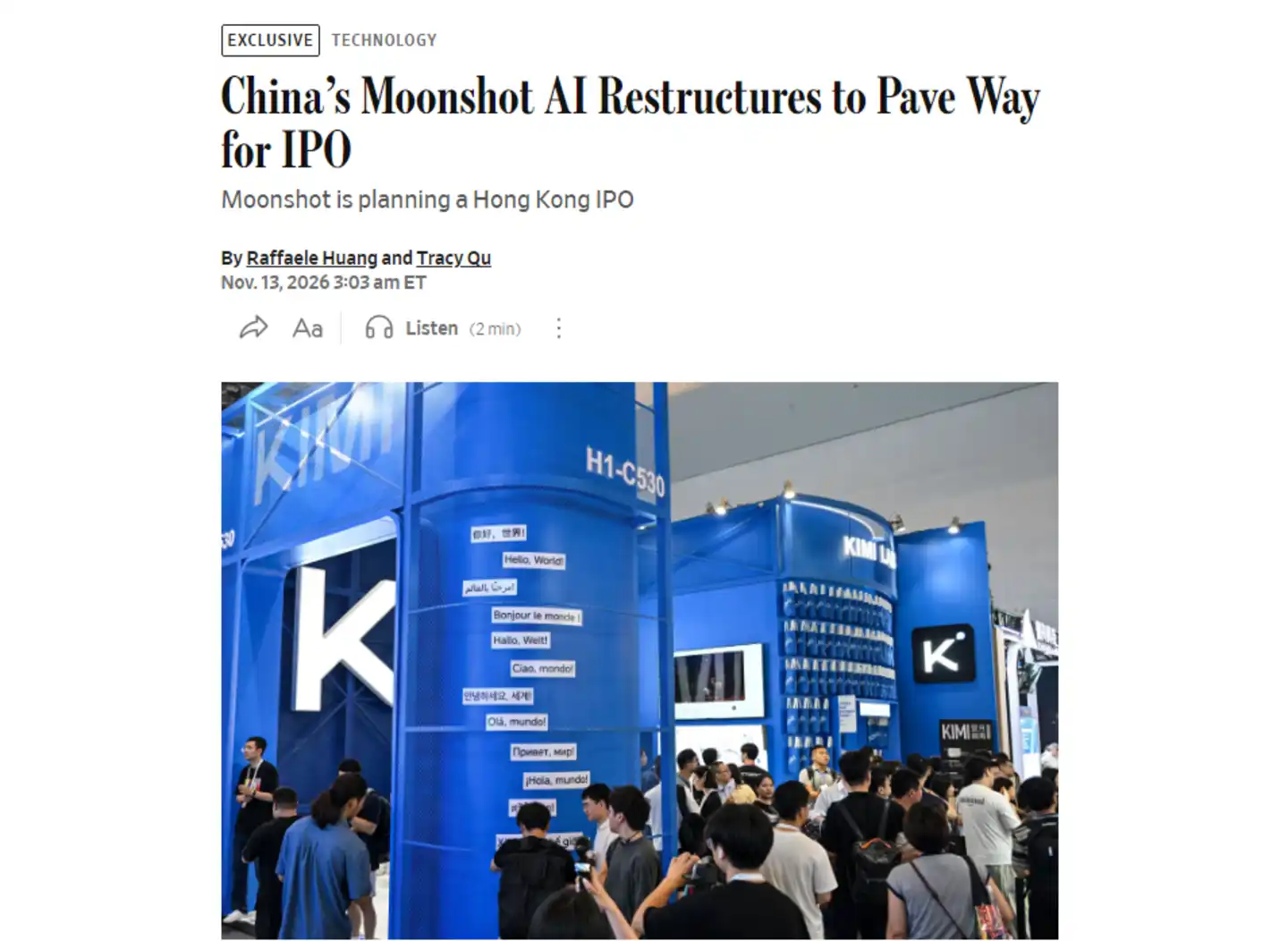
This restructuring is seen by external observers as a pivotal step in Moonshot AI’s preparation for a Hong Kong IPO.
Previously, market rumors had circulated about Moonshot AI’s intention to list in Hong Kong. Bloomberg reported that the company’s latest funding round valued it at approximately $50 billion, with plans to debut on the HKEX in Q1 2027, potentially raising up to $5 billion.
If realized, Moonshot AI would become a landmark Chinese AI startup entering public markets.
Yet more critical than the timing of the listing or fundraising size is the capital structure it is actively reshaping.
Why would an AI company initially fueled by U.S. dollar-denominated venture capital dismantle the offshore vehicle that once enabled its financing during the growth phase?
01 From USD Capital to Domestic Reintegration
In 2023, Yang Zhilin founded Moonshot AI and launched Kimi. Leveraging its long-context processing capabilities, the company rapidly attracted market attention, securing investments from Sequoia China, ZhenFund, Alibaba, Tencent, Meituan, and other prominent institutions.

For a large model startup, fundraising capability is paramount.
Model training demands massive computational power, R&D requires sustained investment, and talent costs far exceed those of typical internet startups. Before product revenue stabilizes, capital availability largely determines whether a company can remain competitive in the market.
Dollar-denominated funds and offshore holding structures have historically served as crucial gateways for Chinese tech startups to access international capital.
The classic Red Chip structure involves establishing a holding company offshore, then controlling the domestic operating entity via equity ownership or contractual arrangements. Foreign investors hold shares in the offshore entity, which in turn controls operations in China.
This structure facilitates access to U.S. dollar funds and preserves pathways for future overseas listings.
However, as companies scale, the original structure may no longer align with their operational and regulatory realities.
Moonshot AI’s core R&D, team, and primary business activities are all located within mainland China. As it prepares for an IPO, regulators and capital markets require clarity not only on shareholder lists but also on actual control rights, ownership of core assets, and how offshore shareholders’ interests map to domestic operations.
For a company possessing large language model technology, handling vast data sets and substantial compute resources, these issues are particularly salient.
Thus, this restructuring is not merely about dissolving a Cayman entity—it involves a comprehensive reorganization of relationships between onshore and offshore entities, aiming to clarify equity structure, core operations, and the future listing vehicle.
This does not imply a complete severance from international capital.
According to The Wall Street Journal, investors may still retain the option to conduct dollar-denominated transactions through offshore vehicles post-restructuring. In essence, Moonshot AI seeks to adjust the capital entry pathway—not to shut down offshore investment channels outright.
Beneath this shift lies a new challenge confronting Chinese AI startups: initial reliance on international capital for rapid scaling, followed by the imperative to align capital structure with local regulatory requirements and listing rules as they approach public markets.
02 Dismantling Offshore Structure: The Challenge of Early Investors
The true complexity of the restructuring lies not in dissolving an offshore entity, but in managing existing investors who have already entered the company.
Moonshot AI has undergone multiple rounds of financing. Investors joined at different times, used varying currencies, held stakes through different legal entities, and have distinct exit strategies.
When the company decides to restructure its holding framework, existing equity rights must be recalibrated.
As reported, Moonshot AI will repurchase shares held by early investors and then guide them to reinvest funds into the domestic operating entity. This means investors previously holding equity through offshore entities must now establish direct investment relationships with the onshore entity.
This process raises at least three key challenges.
First, valuation alignment.
Early investors joined when the company’s valuation was vastly different from today’s. With current market estimates placing the latest funding round at ~$50 billion, the revised investment may impact old shareholders’ equity stakes, acquisition costs, and future return expectations.
Second, capital and tax structuring.
Repurchasing offshore shares, moving capital across jurisdictions, and reinvesting domestically involve complex legal and tax regimes across multiple jurisdictions. How to handle U.S. dollar capital flows, confirm prior equity rights, and register new holdings post-reinvestment—all require meticulous coordination.
Third, future exit mechanisms.
For dollar-denominated funds, investing in a Chinese AI firm isn’t just about technology potential—it’s about exit viability. If the offshore structure changes, investors must reassess how their equity is protected and whether dollar-denominated exits remain feasible.
Thus, this restructuring tests not only the company’s execution capability but also the founders’ ability to coordinate with early investors.
For Moonshot AI, clarifying equity relationships before IPO can reduce future compliance and governance costs; for investors, the priority is ensuring their prior rights are properly preserved and future returns and exit paths remain transparent.
The $50 billion valuation amplifies the sensitivity of this transition.
It should be noted that $50 billion reflects media-reported funding valuation, not final IPO pricing; $5 billion is merely a speculated upper bound for fundraising, not a confirmed offering plan.
But these figures signal a fundamental shift: Moonshot AI is evolving from a private-market financing logic toward public-market governance principles.
In the past, investors were willing to pay premiums for technological potential and growth expectations. Now, in the public markets, investors demand clarity on equity structure, financial quality, corporate governance, and sustainable profitability.
Capital can fuel rapid expansion, but it cannot substitute for building a stable operational foundation.
03 Beyond $50B: Market Focuses on Profitability
If judged solely by valuation, Moonshot AI’s story is already impressive.
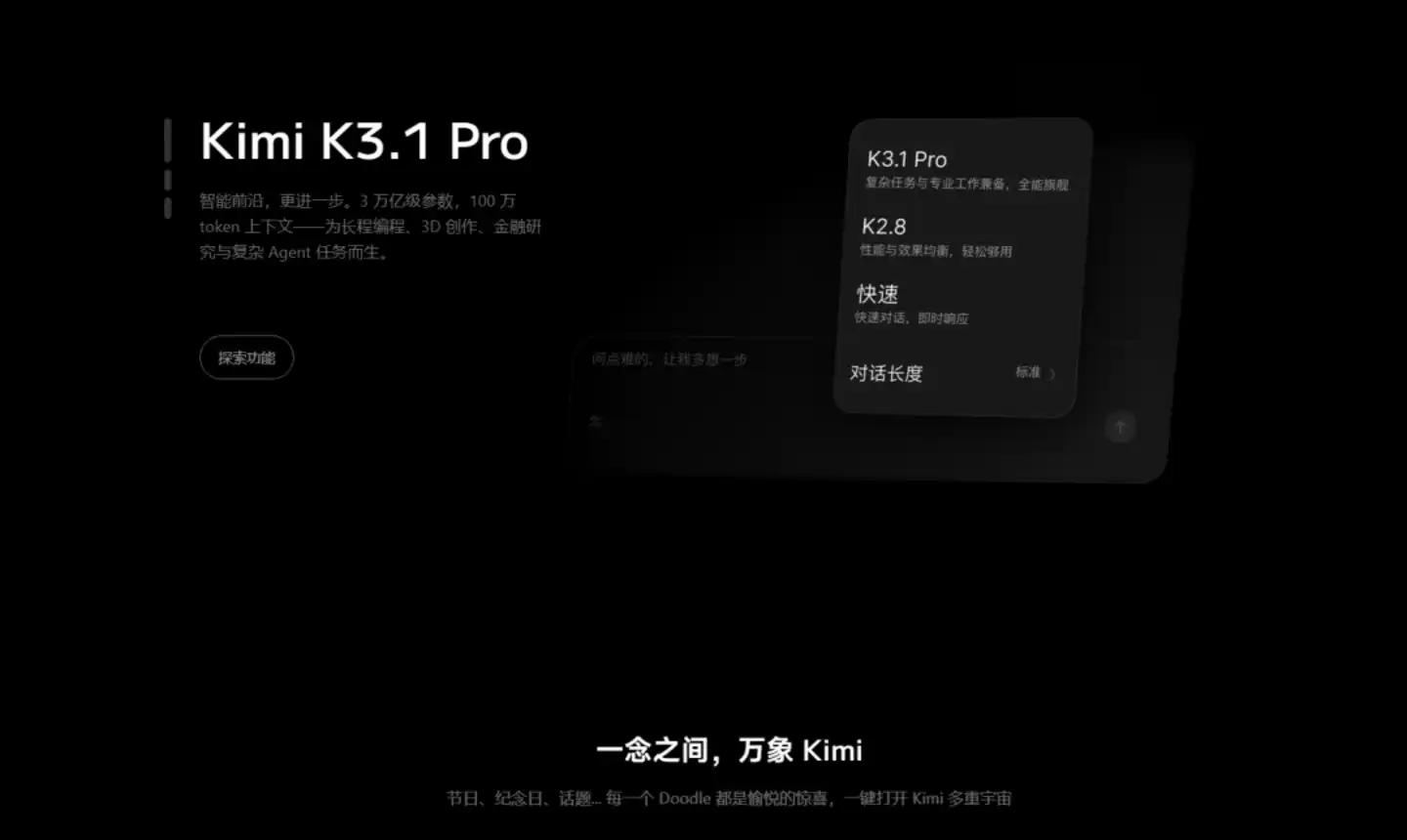
Kimi quickly captured market share thanks to its model capabilities, and the company continues to roll out new models and products. Media reports indicate Moonshot AI told investors that Annual Recurring Revenue (ARR) could reach $2 billion by end-2026—double the $1 billion reported in August.
However, ARR is an annualized projection based on current run rate—not confirmed full-year revenue, nor indicative of profitability.
This is precisely the challenge Moonshot AI must confront post-IPO: how to convert model capability into sustainable, scalable revenue.
Commercialization for LLM companies primarily follows several paths.
For individual users, subscription models generate revenue, but user volume doesn’t equate to paid conversion. Distinctions exist between free, paying, and high-frequency users. Stronger model performance may increase willingness to pay, but inference costs also rise accordingly.
For enterprises and developers, revenue can come from API calls, model-as-a-service, and enterprise solutions. These models offer more predictable income streams, but clients remain sensitive to call costs, service stability, response latency, and support reliability.
Additionally, compute cost remains a non-negotiable hurdle. Higher model usage increases revenue potential, but also inflates compute consumption. If revenue growth fails to keep pace with inference cost escalation, scaling may not improve profitability.
Therefore, what truly matters to capital markets isn’t just Kimi’s user count or model ranking—but revenue mix, customer concentration, gross margin, compute procurement costs, and cash flow dynamics.
This marks a necessary evolution for AI startups transitioning from fundraising to public markets.
Early-stage investors accept premiums for innovation and growth potential, allowing firms to trade capital for time and scale. But post-IPO, investors demand clear business models: Who are the customers? Where does revenue come from? How are costs controlled? Can sustainable profitability be achieved?
Moonshot AI is not alone in facing this challenge.
Over recent years, Chinese large model startups experienced intense fundraising and product competition. Now, the industry is shifting from race-based on model capability, talent, and fundraising speed to one focused on commercial efficiency, compute resource management, and organizational maturity.
An IPO opens new capital channels, supporting continued R&D and compute investment, but also subjects the company to stricter financial and governance scrutiny.
For Moonshot AI, adjusting its offshore structure is a prerequisite for entering capital markets. It must manage early investors’ equity rights while ensuring the future listing entity’s business and ownership structure are transparent and robust.
But this is only the first step.
The $50 billion valuation represents market pricing of Kimi’s past performance; the IPO is a market reassessment of its future operational capacity.
Dismantling the Cayman structure resolves how to go public. Post-IPO, Moonshot AI must prove it can not only build competitive large models but also transform technical advantages into revenue, profit, and long-term competitiveness.
Source: Houxue Business
Disclaimer: Contains third-party opinions, does not constitute financial advice


The AlphaGo Moment in Cybersecurity, or Starting from These 466 Agent Matchups
10 days ago
Yushu Surges 629% on First Day of Trading, Humanoid Robots Sell 5,500 Units
08-19
Yushu's 61 Billion IPO: Who Will Make Money?
08-07
AI stocks down 40%-60%, yet NVIDIA's valuation is at a 10-year low
08-06
HBM Bottleneck Migration, NVIDIA Also Aims to Downgrade
08-06
AI Servers Fuel Demand for Minor Metals: Prices Surge Over 70% in Half a Year
08-06
AI is not a search bar—it's a supercomputer costing just a few dozen dollars
08-05


