OpenAI Cancels Independent Robotics Team Despite Launching 3.3 Million CNY Annual Salary Recruitment Drive
OpenAI Cancels Independent Robotics Team Despite Launching 3.3 Million CNY Annual Salary Recruitment Drive

Abstract:
Just expanded robot roles, then canceled the independent team—what's OpenAI really planning?
November 13, at the Conference on Robot Learning (CoRL) held in Austin, USA, OpenAI’s reserved booth No. 208 remained empty.
The conference map still listed OpenAI, but no company branding or product displays were visible.
Subsequently, OpenAI confirmed to Fortune magazine that it had disbanded its independent robotics research team.
Former robotics researchers have been integrated into the core research department led by Chief Research Officer Mark Chen, while robotics applications and hardware personnel have been transferred to the Applied division under President Greg Brockman.
The company stated that robotics remains a key component of its long-term technological vision, and this restructuring aims to accelerate R&D progress.
The news came as a sudden shift.
In September this year, OpenAI was actively hiring robotics R&D personnel, with some positions offering base salaries as high as $500,000 annually. At the beginning of the year, the company’s San Francisco robotics data collection lab already employed around 100 staff members, with plans underway for a second facility.
Sam Altman previously publicly stated that he expected to demonstrate a compelling robotics showcase by 2027.
While investing heavily in labs and hiring hardware engineers, OpenAI has now dissolved its independent robotics team—how exactly is the company approaching robotics? And where will the previously invested R&D resources be redirected?

How much has OpenAI invested in embodied intelligence?
OpenAI has actually undergone such a team dissolution before.
In 2019, the company showcased Dactyl, a robotic hand capable of solving a Rubik’s cube. Researchers leveraged large-scale simulation and reinforcement learning to enable robots to master complex object manipulation.
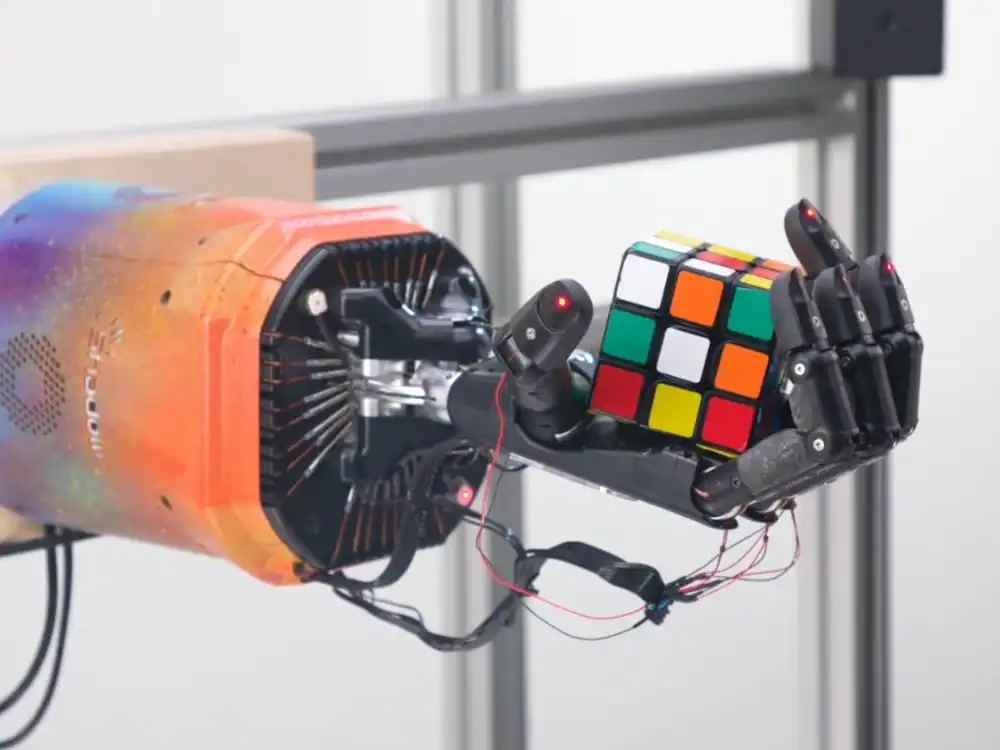
Figure | In 2019, OpenAI demonstrated results from reinforcement learning-controlled robotic hand solving a Rubik’s cube
In 2020, OpenAI concluded its first phase of independent robotics research and shifted focus toward large-scale language models—a path that later gave rise to ChatGPT.
In 2024, the company re-established its robotics team and partnered with human-like robotics firm Figure to co-develop AI models. Their collaboration ended in February 2025, after which Figure pivoted to self-developing robot models, while OpenAI continued expanding internal R&D.
In January this year, Business Insider investigated OpenAI’s robotics data collection lab in San Francisco. Construction began in February 2025, and the lab subsequently expanded over fourfold, employing approximately 100 data collectors operating in rotating shifts.
Staff used 3D-printed GELLO teleoperation controllers to manipulate Franka robotic arms, performing tasks like folding clothes and placing bread into a toaster. The system recorded scenes and operations via cameras, accumulating training data for robot models.
Early tasks were simple—such as placing a rubber duck into a cup—but gradually increased in complexity.
The report also noted a detail: although a humanoid-like device existed in the lab, most data collection relied on robotic arms rather than full humanoid systems.
OpenAI also planned to build a second lab in Richmond, California.
For embodied intelligence companies, data collection represents a significant cost. While language models can leverage vast amounts of existing text and images from the internet, robots require learning physical interactions such as grasping, contact, and movement. Acquiring such data demands equipment, personnel, maintenance, and on-site management.
At the time, OpenAI was establishing its own data production pipeline, with hiring scaling up accordingly.
As of September, Business Insider reported that OpenAI’s robotics-related job postings rose from 11 in May to 27, covering areas including machine learning, robot control, electronics engineering, actuators, firmware, and data collection. Some roles offered base salaries as high as $500,000 annually.
As of November 14, Techin.com found that OpenAI’s official website still listed multiple robotics engineering positions.
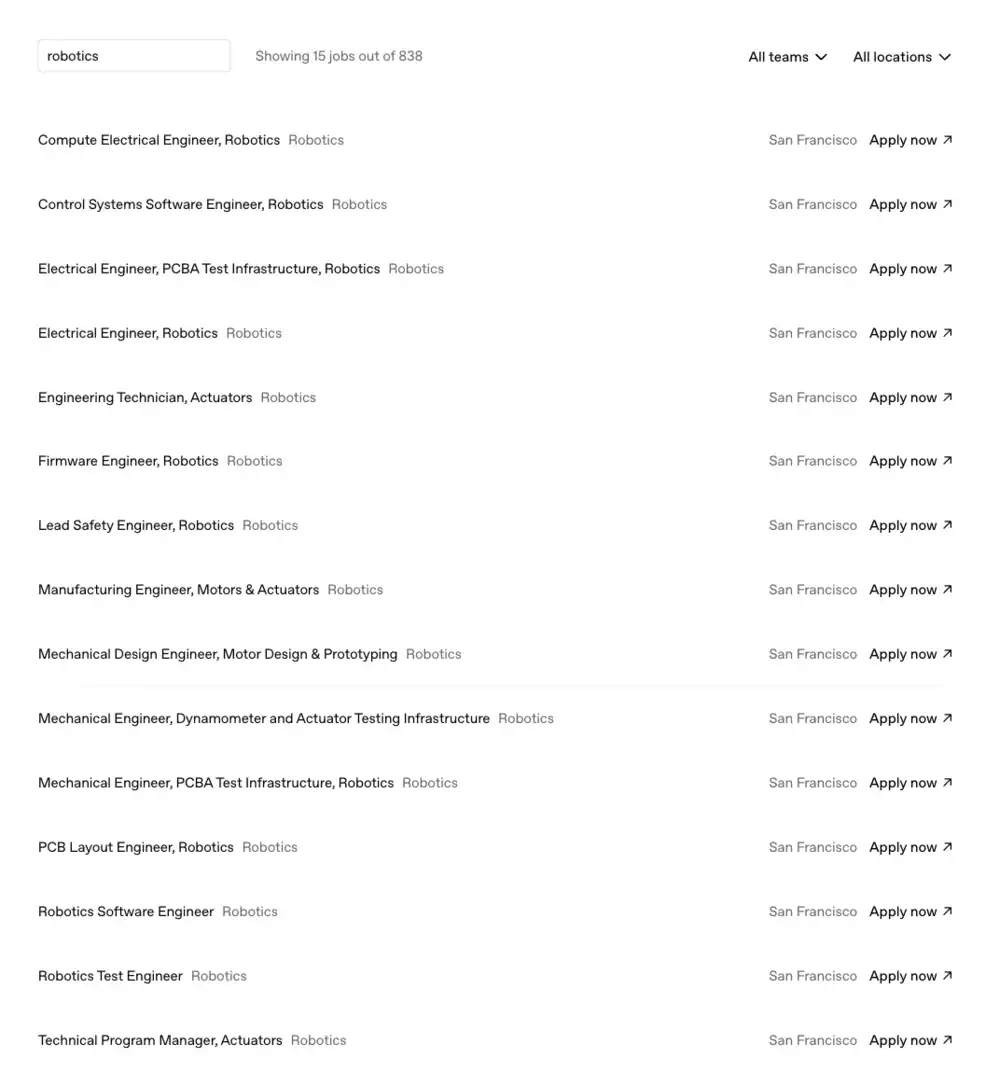
Figure | As of November 14, OpenAI’s official site continues to advertise positions in robot onboard computing, control software, motors, and actuators—embodied intelligence-related roles
Previously, the company was also advancing supply chain preparations. In January, OpenAI launched a U.S. manufacturing supplier solicitation initiative, placing robotics alongside data centers and consumer electronics within its hardware supply chain strategy.
The scope included critical components such as motors, gearboxes, reducers, and power electronics. According to the original document, OpenAI aimed to select suppliers by 2027, though no procurement contract values have been disclosed.
Beyond engineering R&D, funding arrangements for the robotics business had also entered executive discussions.
In May, The Wall Street Journal revealed that Sam Altman had considered spinning off robotics and consumer hardware into standalone entities, allowing them to raise external capital independently.
The plan ultimately did not materialize. One reason was that even if split, related assets and financial performance would still need to be consolidated into OpenAI Group’s overall financial statements.
These records indicate that OpenAI’s investments in robotics over the past year spanned data collection, model research, hardware engineering, and supply chain preparation.
After confirming the restructuring on November 13, OpenAI has yet to disclose specific allocations of budget, personnel, or compute resources, nor has it clarified whether data collection labs or prototype projects will undergo adjustments.

Wang Xingxing said: “The biggest mistake I made over the past decade was not believing enough in AI.”
OpenAI explained the technical rationale behind this adjustment to Fortune. Early this year, researchers believed that leveraging video generation models like Sora to learn physical world dynamics represented a promising path toward enhancing robot intelligence.
However, general-purpose models such as GPT-6 Astra later demonstrated direct robot control capabilities. OpenAI decided to integrate relevant researchers into the general foundation model team, enabling robotics research to leverage the latest advances in existing models.
Wang Xingxing, founder of Unitree Robotics, recently echoed this trend in two speeches within the past month.
On October 12, during a roundtable discussion at the Shanghai Industrial Expo, Wang mentioned that after the release of GPT-6, Unitree had successfully integrated it into various robots to perform tasks—actual outcomes exceeded prior expectations.
He admitted: “Over the past decade, my biggest mistake was not trusting AI enough.”
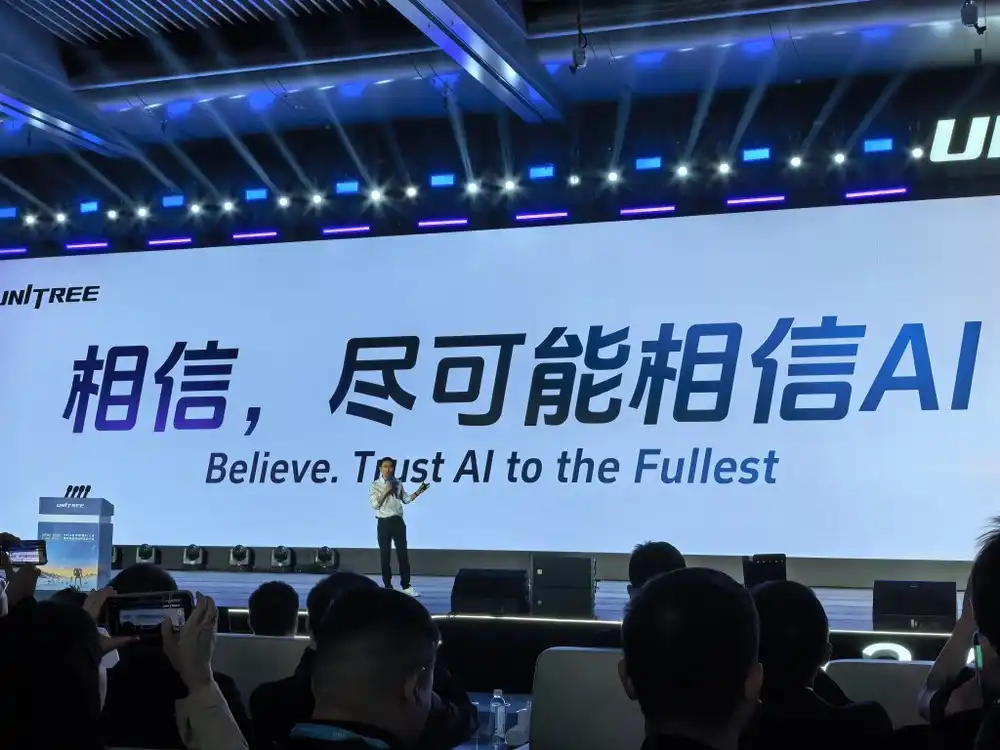
Figure | On October 22, 2026, Wang Xingxing shared advancements in using general large models to control robots at the World Physics & AI Summit. Source: The Paper
Wang believes that AI models improve noticeably every one or two months. If GPT-7 continues to break through, the technological tipping point for embodied intelligence could arrive within the next one or two years.
On October 22, at the World Physics & AI Summit, he also demonstrated Unitree robots using GPT-6 to paint. A reference artwork, blank paper, paint, and water were placed before the robot. It picked up a brush, changed colors mid-process, and even cleaned the brush itself. Unitree also showcased other tasks like playing chess.
Wang repeatedly emphasized that the team did not conduct specialized training for these tasks, nor did they write complex motion programs.
Robots still require motion control and hardware systems, but general-purpose models can now organize partial operational steps based on visual input and task requirements.
Previously, many robot tasks required developers to collect expert demonstration actions and train corresponding action policies. Now, general-purpose models can handle parts of visual understanding, spatial reasoning, and task planning.
Anthropic’s recent release of Claude Fable 5.2 also provides experimental evidence.
On November 9, Anthropic demonstrated Claude controlling a robotic arm to solve a Rubik’s cube, unscrew a bottle cap, and paint.
In the RoboDojo Sim simulation benchmark, internal tests showed that Fable 5.2 achieved an average success rate of 64.9%, compared to 27.6% for the previous version Fable 5.1. Under the same test framework, GPT-6 Astra scored 29.8%.
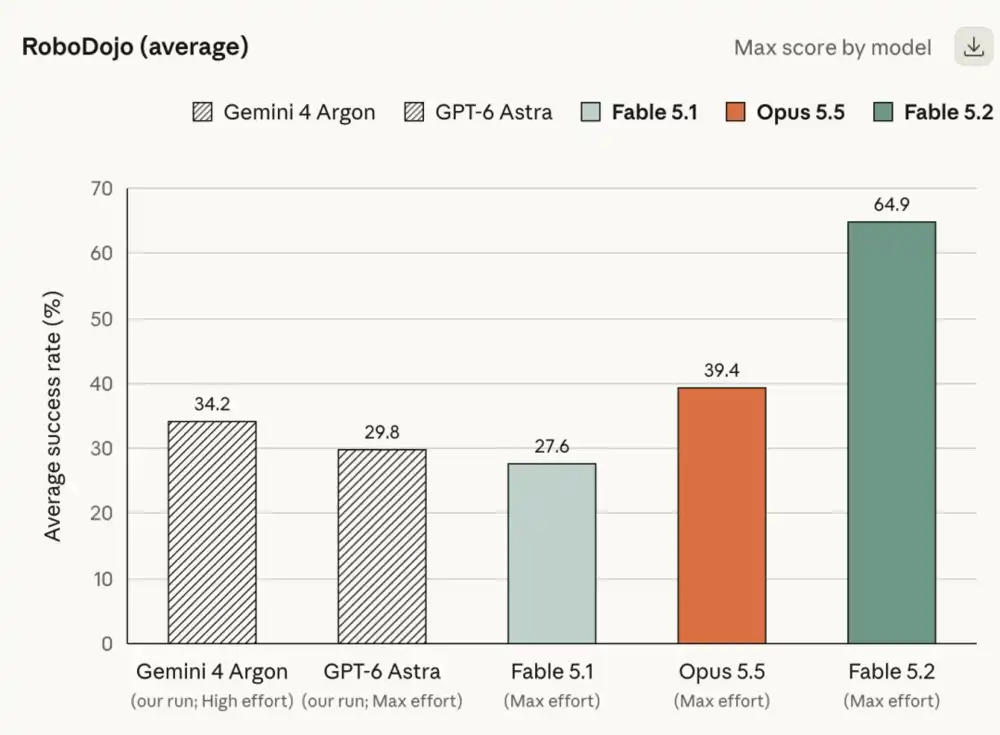
Figure | Anthropic’s published RoboDojo Sim simulation evaluation: Claude Fable 5.2 achieved 64.9%. Source: Anthropic
NVIDIA’s October release of Astranomy research directly used GPT-6 Astra to control simulated robots.
In the RoboLab-120 test, the direct control approach achieved a 66.3% task success rate. After researchers added mechanisms for continuously recording operation history and checking execution results, the agent-based control approach reached 74.8%, surpassing the previous best dedicated robot model at 51.0% on this benchmark.
Although these experiments used different testing environments, they all demonstrate the progress of general-purpose models in physical manipulation.
Guanya Shi, a robotics researcher at Carnegie Mellon University, told Fortune that OpenAI may now be viewing robotics as a downstream application of general intelligence.
For OpenAI, directly leveraging general-purpose models means that certain robotics intelligence research can share training outcomes from core models. The return on investment for independently developing a dedicated robotics foundation model thus needs reevaluation.
However, NVIDIA’s experiment also exposed another issue: the computational overhead of general-purpose models is substantial.
In the Astranomy study, the GPT-6 Astra direct control approach averaged 18.56 seconds per inference.
Although the agent-based approach improved success rates, each successful task episode consumed approximately 30.9 million tokens on average—equivalent to an estimated API cost of $36.40.
These costs stem from simulation testing and cannot be directly translated into real-world robot operational expenses. But in actual factories, longer task execution times could increase unit output costs.
Even more problematic is latency. Simulation environments can pause during model inference, but conveyor belts, machinery, and workpieces in real factories do not stop waiting for ten or more seconds.
Robots still require faster-response systems capable of directly controlling their physical bodies. This is one reason why other tech companies continue training specialized robot models.

Google, NVIDIA, Unitree still training specialized models
On November 10, Google DeepMind unveiled experiments with Apollo 2 humanoid robots working in Mercedes-Benz factories.
The robot retrieved metal brackets from bins and placed them into designated containers according to production sequences. Testing locations included Mercedes-Benz plants in Sindelfingen, Germany, and Kecskemét, Hungary. Google reported a 96% success rate on this parts sorting task.
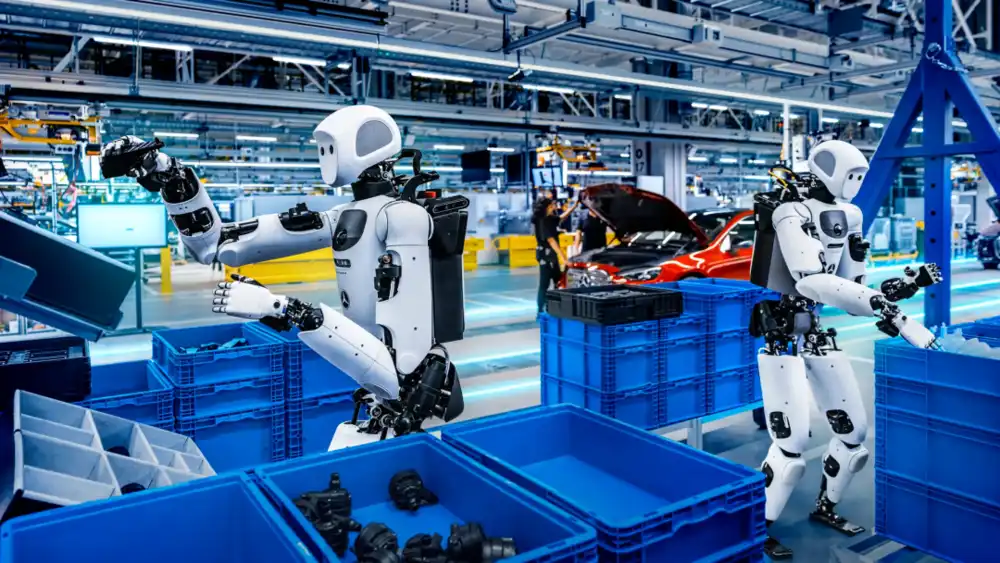
Figure | Apollo 2 humanoid robot conducting parts sorting tests at a Mercedes-Benz auto factory. Source: Google DeepMind
During operations, two models performed distinct roles.
Gemini Robotics ER handled production flow comprehension and task progress assessment; Gemini Robotics 2.5, trained specifically on robotic motions, managed actual arm and dexterous hand operations. Google also used Gemini 4 Argon to build simulation environments and analyze failure cases.
Jeff Cardenas, CEO of Apptronik, stated that Apollo 2 showed noticeable improvement after several weeks of training and maintained minimal performance degradation when migrated to the Mercedes production line.
This was a scenario-limited proof-of-concept, with no disclosure on long-term failure rates or production costs. Nevertheless, Google demonstrated how general reasoning models and specialized motion models can collaborate to complete factory tasks.
NVIDIA’s November release of GR00T 2 focused instead on training costs when robots enter new environments.
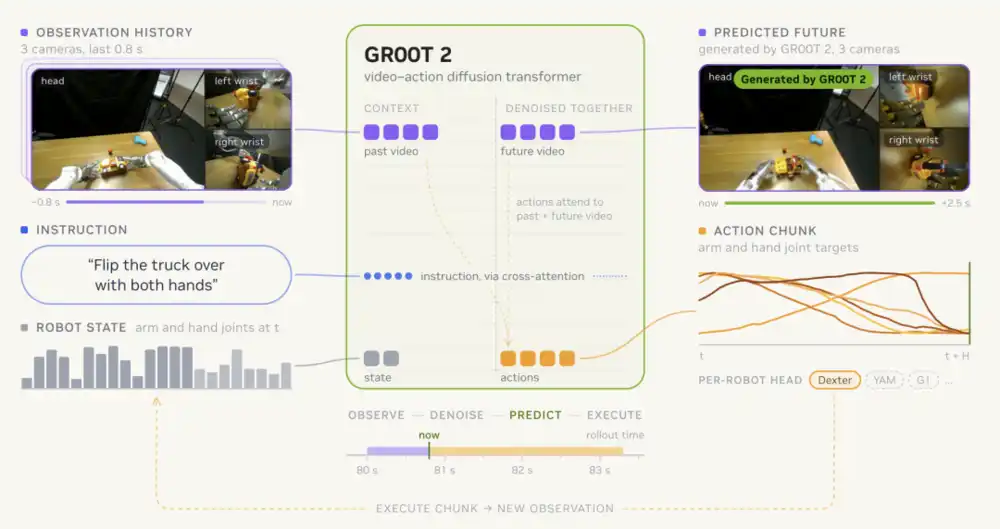
Figure | GR00T 2 reads recent video, instructions, and robot state, performs denoising on future video and action segments, executes the action segment, and repeats the process
In 50 tasks not previously trained on the target robot, GR00T 2 achieved a zero-shot average success rate of 40%. After adding just five demonstrations and less than three minutes of robot data per task, followed by approximately 30 minutes of fine-tuning on a single RTX 5090, success rates increased to 95%.
When robots move to new factories, they often need to re-adapt to item placement, grasp order, and specific equipment. Being able to adapt with only a few demonstrations could significantly reduce investment in data collection, on-site debugging, and engineer on-site presence.
Yet robots must still address physical errors in precise operations.
On November 5, Wang Xingxing mentioned at the CIIE Hongqiao Forum that current top-tier multimodal models possess strong understanding and planning capabilities, but tasks like part insertion often fail in the final few millimeters.
Grasping a box allows for some positional tolerance, but inserting a connector requires precise handling of angles, friction, and contact forces. Even minor deviations can damage components.
NVIDIA conducted real-robot reinforcement learning for such tasks. In their published experiments, trained robots achieved a 94% success rate on cable insertion and 96% on charger insertion.
Unitree and Zhiyuan are also continuing to train their own robot models. Unitree’s publicly released UnifoLM-WLA-1.0 used about 2,500 hours of real-robot data, while Zhiyuan continues investing in robot operation data and post-training via GO-3 Preview and Genie Evolver.
In a typical precision assembly task, general-purpose models can understand operational requirements and sequence execution, while specialized motion models must learn how different robotic arms approach parts, adjust positions, and handle contact feedback. For sustained operation, underlying control systems must also promptly respond to anomalies.
This division of labor does not require every company to train a foundational model from scratch for understanding and planning. Robotics firms can leverage external models and then train motion capabilities tailored to their own hardware, customer tasks, and field data.
For OpenAI, integrating robotics research into the GPT team reflects a strategic choice to resolve more robotics intelligence challenges within the general model ecosystem. The previously established data collection and hardware R&D capabilities can now be repurposed to validate how well these models perform on real robots.
(This article’s featured image was AI-generated)
Source: Phoenix Tech
Disclaimer: Contains third-party opinions, does not constitute financial advice


The AlphaGo Moment in Cybersecurity, or Starting from These 466 Agent Matchups
9 days ago
HuggingFace's "AI Duck" Goes Viral, Boosting Chinese Chip Supplier Rockchip
09-02
Yushu Surges 629% on First Day of Trading, Humanoid Robots Sell 5,500 Units
08-19
14 Executives Depart, Horizon Unleashes a Robot Legion
08-11
Yushu's 61 Billion IPO: Who Will Make Money?
08-07
AI is not a search bar—it's a supercomputer costing just a few dozen dollars
08-05
Former Huawei Genius Youth: Building 5,000 Reliable Robots This Year Won't Exceed 3 Companies
08-05


