Claude Code Lead: Setting a 0.2-Second Target for AI
Claude Code Lead: Setting a 0.2-Second Target for AI

2026-11-14 16:06
Introduction: Four-Dimensional Ambition — Elevate, Deepen, and Introduce Cross-Domain Methods. Set Unrealistic Goals, Then Tell the Model: This Is Fully Achievable!
Set Unrealistic Goals, then tell the model: This is entirely reasonable!
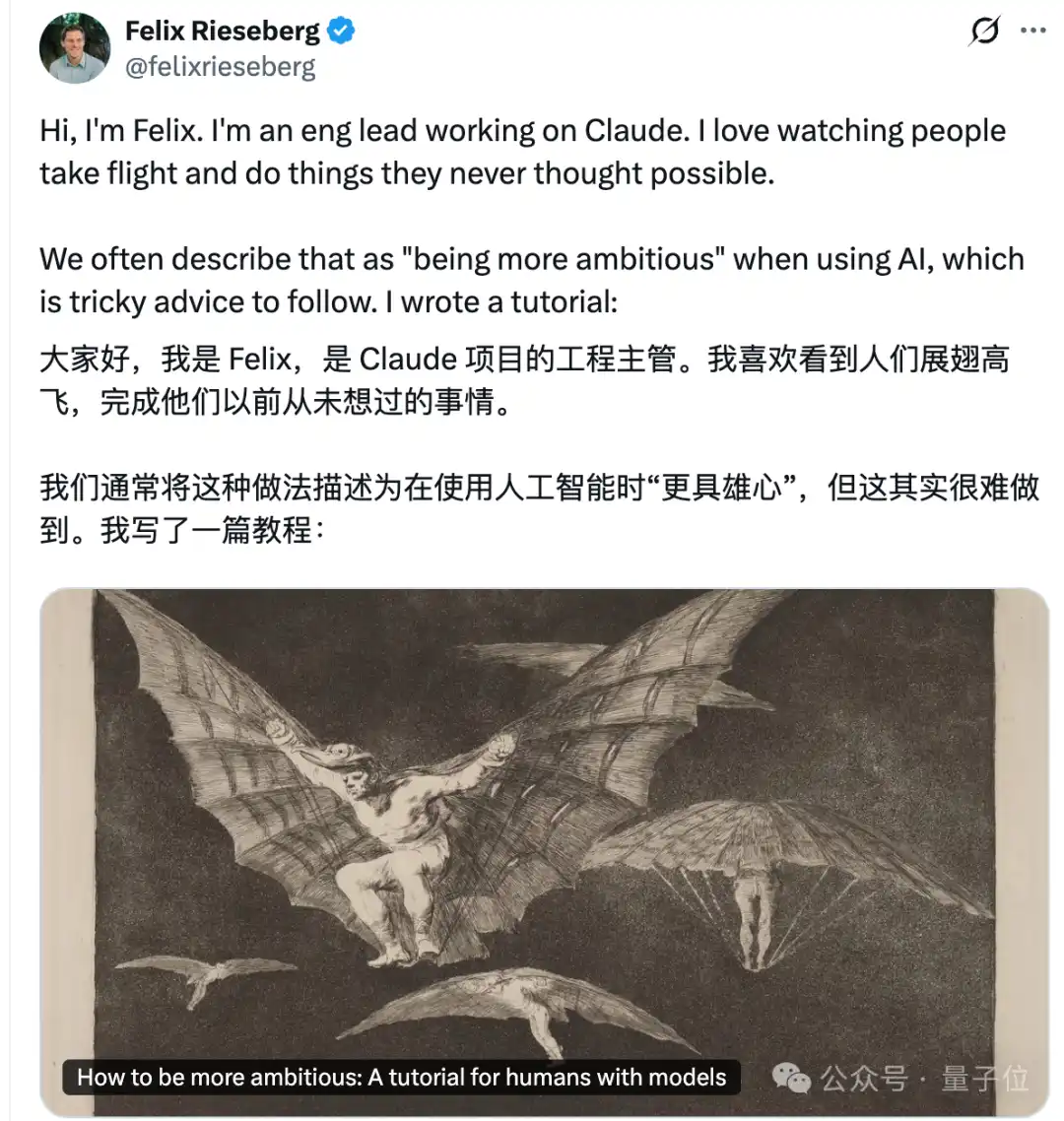
This is a subtle AI usage tip shared by Felix Rieseberg, lead developer of Claude Code Desktop.
How to do it specifically?
Suppose you want to reduce your website’s loading time from 10 seconds to 5 seconds. His advice: set the target directly to 0.2 seconds.
If the model says it's impossible? Keep insisting: this problem can absolutely be solved—try again, keep trying.
In Felix’s view, we can dare to assign tasks to AI with even greater boldness.
He also shares a trick: turn nouns in your task into verbs.
For example, instead of “create a presentation PPT,” rephrase it as:
Within 30 minutes, convince a group of busy people of your interpretation of the root causes and consequences of an issue, enabling them to make decisions even when the situation remains unclear.
Besides deliberately setting aggressive goals, he offers several specific practices:
Don’t just ask the AI to “think like an expert.” Follow up with: What raw materials would real experts consult? What tools would they use? What methodologies would they apply? Then incorporate these requirements directly into your prompt.
Don’t treat your own judgment as the final answer. Submit it to the AI for validation—have the AI return to the original data sources to find evidence supporting your claim, as well as potential counterexamples that could refute it.
Don’t let the AI self-assess. Run the code. Test predictions using new data. Let actual results speak for themselves.

Below is the detailed tutorial on how Felix (re)trains (teaches) Claude, polished for clarity.
Enjoy~
We Can Be More Ambitious With AI
I work at the Claude team.
The most fascinating aspect of this job is that almost every day I learn of another task completed—or even independently executed—by Claude.
Some things I never imagined possible. Others I originally thought were beyond reach. And still others simply didn’t spark enough curiosity or free time for me to explore myself.
This month alone, Claude may have assisted in discovering a new exoplanet; I witnessed the first AI-generated music video I truly loved; we’ve even begun discussing whether a new era of mathematics might be emerging.
Model capabilities don’t advance uniformly. As Terence Tao noted, they’re “astonishing in some directions, yet still lacking in others.”
Some have already mastered leveraging these remarkable abilities, as if they’d truly taken flight. Watching them soar to such heights using a product I helped build is genuinely captivating.
Others are still learning how to use these newly grown wings. They’re still wondering: beyond answering “What is the capital of France?” or “Can you soften the tone of this email?”, what else can AI do?
My colleagues and I often repeat one phrase: We should aim higher with AI.
This has become our mantra. Whenever we see an astonishing result, we share it with the caption: “We’re not ambitious enough.”
I know this sounds easy to say, but hard to practice. So here’s a guide on how to be more ambitious.
I categorize ambition into four dimensions: speed, height, depth, and breadth.
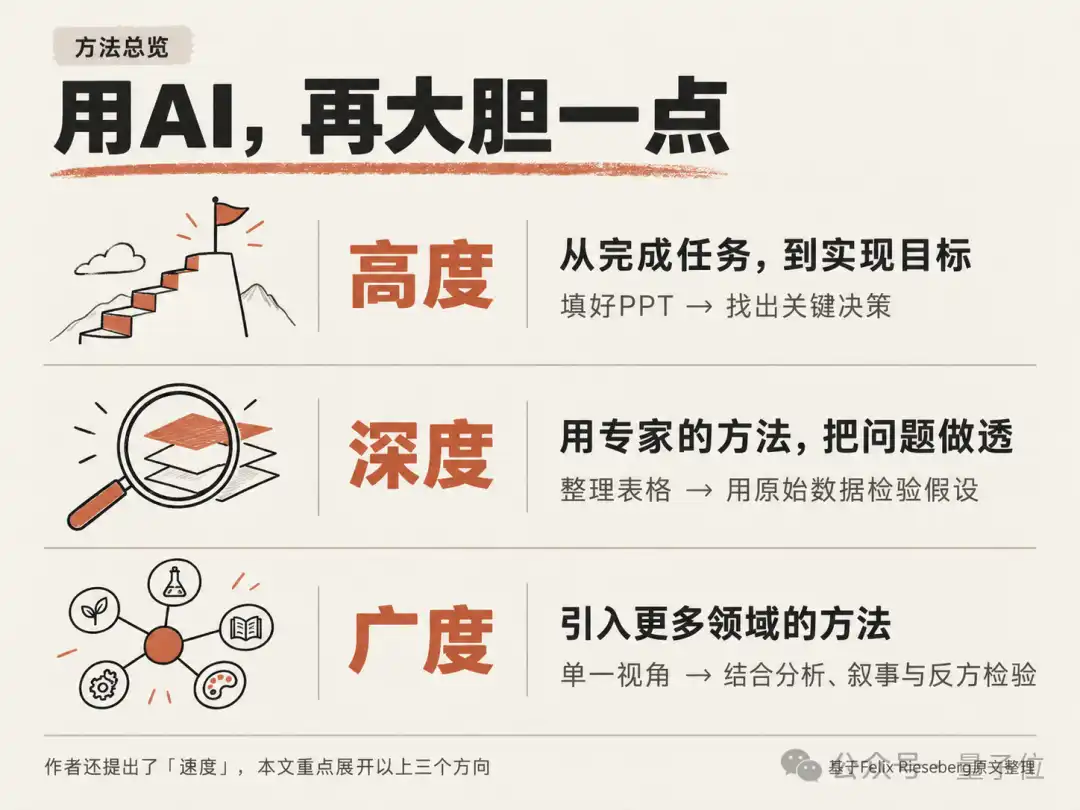
Speed: Complete the same work in less time. This is the most fundamental way AI generates economic value.
For instance, writing code with Claude’s help lets me finish faster. This application is already mature and doesn’t require complex techniques—so we’ll skip it here.
Height: Raise the abstraction level of the task, focusing on the ultimate outcome rather than individual steps.
Depth: Think like top-tier experts—dig deeper into underlying data, tools, and problems.
Breadth: Draw insights from multiple domains, incorporating knowledge, tools, and methods you wouldn’t normally consider.
Though I primarily use Claude, these suggestions aren’t model-specific.
Height: Make the Model Work at a Higher Abstraction Level
We casually refer to this approach as “making the model work at a higher abstraction level”. When you assign a task, the model executes your optimal vision for achieving the desired outcome.
To think at a higher level, ask yourself: What do you actually hope will happen next? What lies behind your goal?
Early last year, I asked Claude to fix a single program crash. Later, I directly requested it ensure our app remained crash-free at all times.
Consider a routine office task (to be honest, even a bit dull).
Suppose you're at Acme Corp., preparing a QBR (Quarterly Business Review) presentation. You feed Claude raw data—it happily creates a slide deck. Perhaps you already have a template; it just fills in content.
This pales in comparison to discovering a new planet. But even for a standard quarterly report, what else can we push AI to do? Let’s start simple and progressively raise the bar:

Step 1: Have it understand what happened in the business.
Most retrospectives revolve around three questions: What changed this quarter? Why? What should we do next?
If you only want to update numbers in a template, resist that urge—feed the model as much available data as possible so it truly understands your business, then ask:
Tell me what changed this quarter, why it happened, and what actions we should take.
Step 2: Have it identify the necessary decisions.
An ideal meeting—especially a good one—should conclude with actionable decisions. Ask Claude:
Based on everything you’ve learned, what are the three most urgent decisions right now? Analyze each potential course of action, listing pros and cons for each.
Step 3: Have it redesign the entire process.
Previously, conducting a QBR required humans to carefully filter data, interpret meaning, then decide whether adjustments were needed.
Now, try asking Claude:
The purpose of a retrospective is to detect issues early and redirect resources—people and funding—to where they belong.
Design a method superior to a quarterly PPT. Use our historical data to prove it could have detected key issues earlier. Then run it alongside the current system for one quarter.
Raising the abstraction level works best when pursuing a clear end result. Its applicability is more limited for creative tasks.
A good signal: If your task requires a follow-up meeting, elevate your goal one level higher.
Of course, limitations remain—until at least 2026, saying “Claude, go make money” still won’t auto-run the business.
But my overall observation is that as models grow stronger, they increasingly operate at higher levels of abstraction.
Raising the goal level also helps establish sustainable workflows that run without constant human intervention, freeing you from issuing new tasks one after another.
To achieve this, you often need to overhaul existing workflows.
For example, to let Claude ensure our app never crashes, I first had to give it easy access to crash reports, link each app version to its corresponding Git commit, and grant it permissions to access Windows, macOS, and Linux machines. Only then could it reproduce bugs independently and verify fixes effectively.
Depth: Go All the Way with Expert-Level Methods
Sometimes, you just want a task done exceptionally well.
Being more ambitious in depth means pushing the model to use the tools, techniques, media, and knowledge employed by the best professionals in the field—and keep ratcheting up the expectations until even those experts might learn something new from your output.
Let’s continue with Acme’s QBR. Suppose the company faces customer attrition—users gradually leaving over time.
I’ve found combining the following approaches particularly effective:

Stick to Tools Used by Industry Experts
When you ask the model to “work like a professional,” it often just swaps jargon—without changing actual methods.
To deeply analyze a problem, use the tools of top data scientists and statisticians. When Claude reaches for a Markdown table, insist it switch to databases and statistical models.
You don’t need to know in advance which tools experts use—Claude usually does.
Set “Unrealistic” Goals, Then Tell the Model They Are Fully Reasonable
Want to cut website load time from 10 seconds to 5? Demand 0.2 seconds.
If the model claims something is impossible? Reiterate: This problem is solvable—keep trying.

Challenge Your Assumed Conclusions
In business, many things we believe are facts are merely rough approximations of reality.
Have the model engage with raw data and information, scrutinizing assumptions with skepticism.
For example:
We assume user churn stems from the onboarding process. Try to reproduce this conclusion from raw data.
Discover New Knowledge
This step naturally follows “challenging established beliefs”—since Claude is already deep in the data, push further to uncover blind spots:
Build a customer simulation model from our logs to replicate the past year. Then identify signals that foreshadowed churn—signals we didn’t know about—and validate predictive power using unseen data.
Introduce External Evaluation
Don’t let the model judge itself.
As models grow smarter, this issue may resolve eventually. But as of October 2026, I strongly recommend external validation.
Ideal validation tools should be executable by the model, providing immediate feedback.
Here’s a simple prompt that frequently helps me:
I want to go deeper, not broader. Before rewriting the task, complete these four steps:
Explain what top professionals in this field do that I haven’t explicitly requested.
List the most original materials they’d start with—not pre-processed summaries.
List the specific methods and tools they’d use.
Identify other independent sources that could confirm the correctness of the result.
Then, rewrite my prompt to include these requirements precisely.
Breadth: Apply Methods from Other Domains
Being more ambitious in breadth means examining your work through the lens of different fields.
Today, exploring more domains is feasible because previously, the cost made it impractical.
This idea isn’t new. Almost every movie about elite teams spends the first 30 minutes assembling a diverse group of specialists with varied backgrounds.
As AI tools make multi-agent systems easier to run—whether via multiple threads, coordinators, or direct sub-agents—I’ve found that having Claude draw from other domains often yields surprising results.
It’s not easy to implement—it requires creativity.
Before seeing colleague Alex Albert render interior designs in Blender, I never imagined using Claude to create a 3D environment for my personal homepage.
After all, I used to develop video games!
Yet, this is exactly where I most often encounter delightful surprises.
Here’s how I approach it:
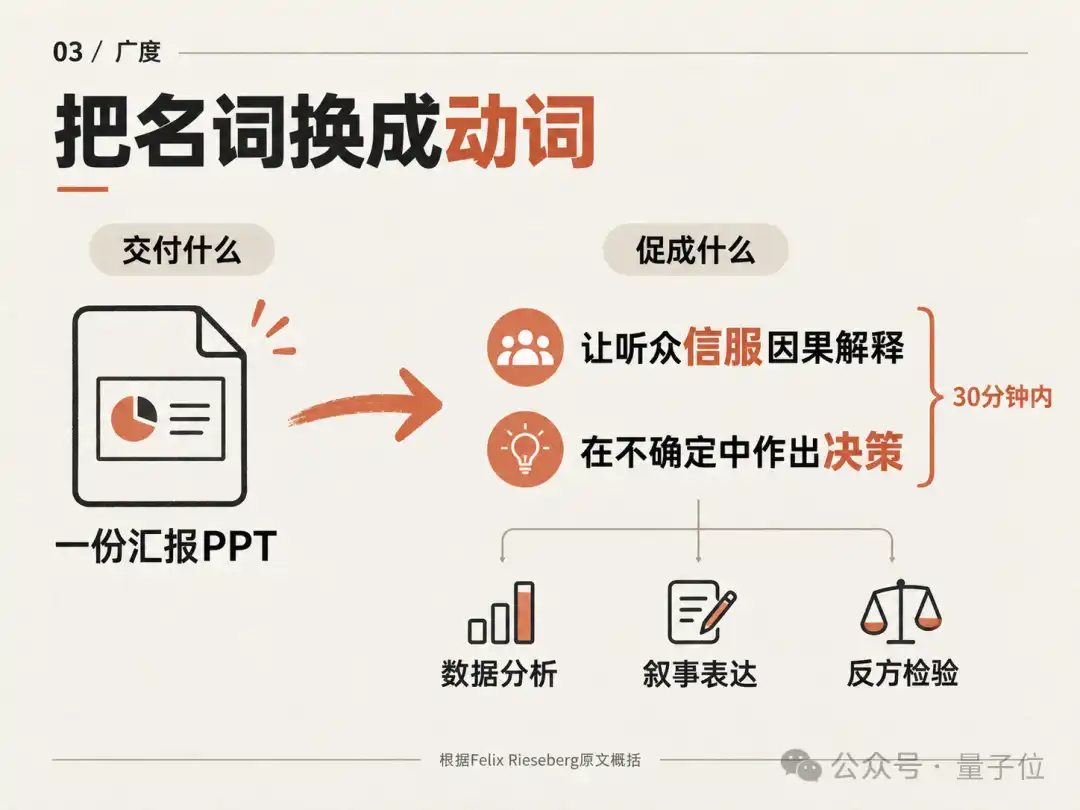
Try Turning Nouns into Verbs
This is an old technique from Tom Kelley and Jonathan Littman’s *The Art of Innovation*.
The goal of a QBR isn’t just to produce “a PPT.” You’re doing:
Convince a group of busy people of a coherent narrative explaining cause and effect within 30 minutes, enabling them to make decisions under uncertainty.
Describing tasks with verbs helps me and Claude better identify which domains offer unique, valuable perspectives.
Assemble a Cross-Disciplinary Team
Suppose this PPT must be spectacular—or else aliens will destroy Earth. What team would humans assemble?
To guarantee quality, I’d bring in an analyst, a journalist, and an editor.
If live demonstration is needed, perhaps also a motion designer and an audio designer.
Adding a dedicated “red team” to challenge flaws might help—bring in a skeptic and a forensic accountant.
But beware: this risks turning into role-playing, making conversations stranger without improving outcomes.
Use this method to identify useful domains and technologies. Direct the model to investigate using a skeptic’s approach to investment analysis—far more meaningful than scripting a “skeptic” character.
All the methods I’ve described require the model to have access to a machine capable of running software and accessing relevant data—via MCP connectors or other means.
Several tools now provide these conditions. I recommend choosing one and using it.
Self-Efficacy: Update Your Self-Assessment of Capability
That’s my practical advice on how to be more ambitious.
If you’re willing to stay a little longer, I’d like to discuss why we need to have this conversation.
Humans are limited by their own judgments: what we believe is possible or impossible. Worse, we typically assume we can only excel in very narrow domains.
Michelangelo initially refused to paint the Sistine Chapel—a famous example. He saw himself as a sculptor, not a painter.

[Francisco Goya was one of Spain’s greatest painters, regarded as a pioneer of Romanticism and a bridge between classical masters and modern art.]
While researching “ambition,” I encountered a psychological concept: self-efficacy.
Simply put, people with higher self-efficacy believe more in their abilities—and thus accomplish more.
Evidence shows self-efficacy can be strengthened through deliberate methods.
Locke and Latham reviewed 35 years of goal-setting research, concluding clearly: individuals given clear, challenging goals outperform those told only to “do their best.”
Stripe co-founder Patrick Collison maintains a list called “Fast,” documenting what humanity has achieved under bold goals and tight deadlines.
Here are several well-documented approaches:
Believe Difficult Things Are Possible
In 1939, George Dantzig arrived late to a statistics class at Berkeley.
He copied two problems from the blackboard, assuming they were homework, and submitted his solutions.
They were, in fact, two unsolved problems in statistics.
See Others Do It, Then Attempt the Hard Task
For decades, humans tried to break the four-minute mile.
In May 1954, Roger Bannister broke the barrier. But that “only he could do it” state lasted just 46 days.
If you follow running, you’ll notice a similar shift happening at the two-hour marathon mark.
This April, Sabastian Sawe became the first official marathoner to break two hours in a race. The runner-up also crossed the line under two hours.
[Two-Hour Marathon Barrier: A marathon is 42.195 km. Breaking two hours is considered a landmark endurance milestone, comparable to the four-minute mile.]

Allow Yourself to Fail, Then Attempt the Hard Thing
The Inner Game of Tennis seems to be everyone’s favorite business book—but I discovered it only last week.
Its core idea: when you strain too hard, you perform worse.
Engineers might recall how Linus Torvalds described Linux when first released:
I built this just for fun—not as grand or professional as GNU.
(Who could have predicted Linux would dominate, while the GNU kernel remains unrealized…)
Self-efficacy isn’t a new problem—but it’s now more critical than ever.
In an era where capabilities leap every few weeks, we urgently need methods to accomplish things we’ve never seriously considered—and never believed possible.
Source: Recommended Reading
Disclaimer: Contains third-party opinions, does not constitute financial advice


The AlphaGo Moment in Cybersecurity, or Starting from These 466 Agent Matchups
9 days ago
AI is not a search bar—it's a supercomputer costing just a few dozen dollars
08-05
Anthropic Locks in 6 Years of Compute with $10 Billion Commitment
08-05Not building robots—why is it worth $14 billion?
07-31AI is no longer competing on benchmark scores, but on profitability
07-25
ByteDance's Douyin Beans priced at 68 RMB—worth it for 382 million monthly active users?
07-25
Fields Medalist Concerned About AI Extinction Heads to OpenAI
07-25


