Alibaba Spins Off Pingtouge Aims for Hong Kong Listing: $10 Billion Revenue, Why Is Valuation Off by $66 Billion?
Alibaba Spins Off Pingtouge Aims for Hong Kong Listing: $10 Billion Revenue, Why Is Valuation Off by $66 Billion?

2026-11-14 15:06
Introduction: Alibaba plans to spin off its subsidiary T-head for independent listing on the Hong Kong Stock Exchange, a company that has achieved annualized revenue exceeding RMB 10 billion, with cumulative shipments of 560,000 units of the Zhenwu series AI chips, and external clients accounting for
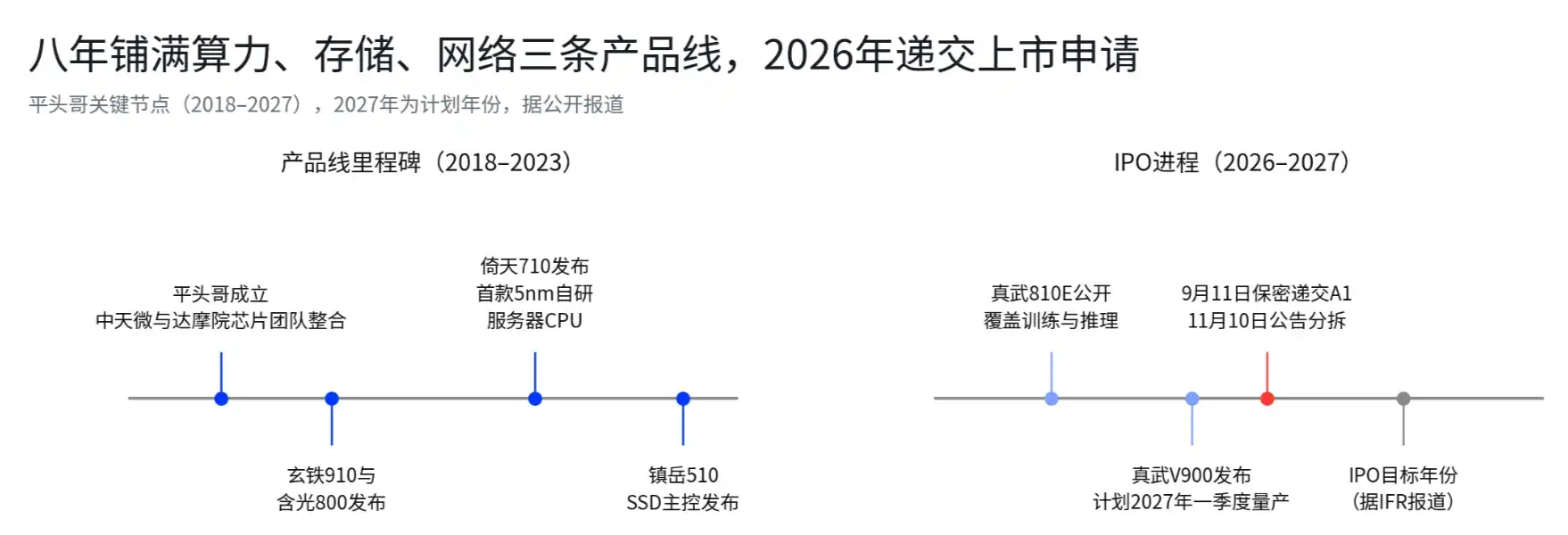
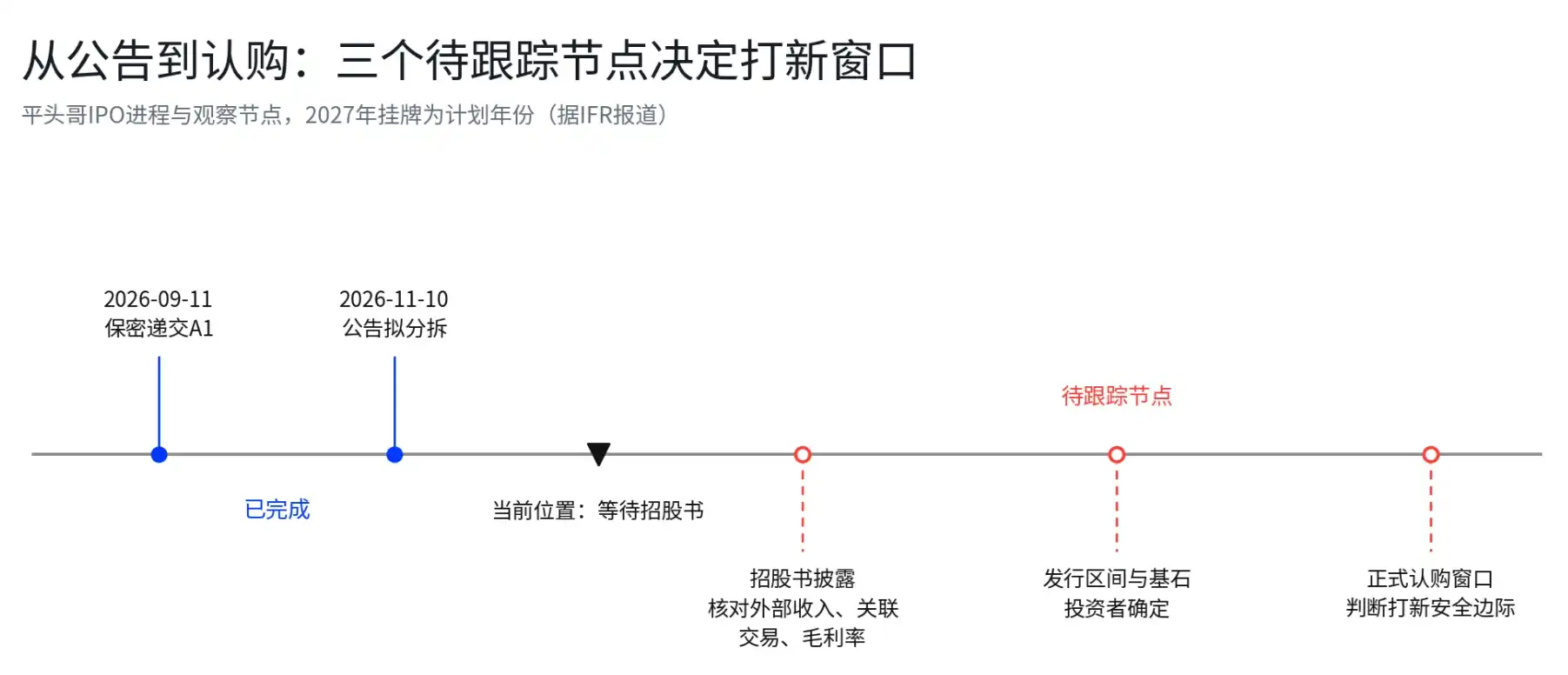
Late on November 10, Alibaba-W (09988.HK) announced its intention to spin off its wholly-owned subsidiary, T-head (Shanghai) Technology Co., Ltd., for an independent listing on the Main Board of the Hong Kong Stock Exchange, with the HKEX confirming approval for the spin-off; T-head had previously submitted its confidential A1 listing application form on September 11, 2026. From establishment to IPO preparation, T-head has taken approximately 8 years.
This company, named after the honey badger, was initially positioned as a chip design firm. Today, its product portfolio spans AI computing, server CPUs, SSD controllers, intelligent network adapters, interconnect chips, and RISC-V processor IP. The company now generates annualized revenue exceeding RMB 10 billion, and the Zhenwu series AI chips have transitioned from product validation to large-scale commercialization. The key focus of T-head’s IPO now lies in “how much product can be sold, how independent the customer base is, how much profit can be retained, and what valuation the capital markets are willing to assign.”
For the Hong Kong market, this is an event worth adding to early watchlists: if the listing proceeds, the domestic compute power sector in Hong Kong will gain a new player covering compute, storage, and networking—providing investors with a more direct benchmark for pricing of domestically developed AI chips.
I. HKEX Confirms Spin-Off – T-head IPO Enters Substantive Phase
The current information is clear and confirmed. Alibaba has submitted the spin-off proposal under Chapter 15 of the HKEX Listing Rules, and the exchange has confirmed approval for the spin-off. T-head filed its confidential A1 application form on September 11, 2026, aiming for H-shares listing and trading on the HKEX Main Board, with plans for a global offering including public offering in Hong Kong and allocation to institutional and professional investors.
This spin-off does not constitute selling off T-head. After independent listing, Alibaba will retain control, and T-head will remain a subsidiary within the Alibaba Group. This has two immediate implications for the company: first, post-IPO, the chip business’s revenue, customer base, R&D investment, and profitability will receive clearer capital market pricing; second, Alibaba Cloud, Qwen, and other internal ecosystems will continue to provide application scenarios and compute demand, meaning T-head is not entirely detached from its original ecosystem but still embedded within it.
Regarding fundraising scale and listing timeline, market information remains in the expectation phase. According to IFR, the planned fundraising ranges from USD 2–3 billion, targeting a 2027 listing. What is already confirmed is the “initiation of IPO process”—the final issuance size, issue price, and valuation remain undetermined. The next critical document determining new issue value is the prospectus.
II. Over RMB 10 Billion in Revenue Is Not Just a Story – Zhenwu Chips Have Entered Large-Scale Commercialization
The most valuable shift at T-head today is the transition from “chip R&D” to “chip sales.” According to disclosures in the company’s earnings call, T-head’s annualized revenue exceeds RMB 10 billion, with cumulative shipments of the Zhenwu series AI chips surpassing 470,000 units; media reports estimate that by April 2026, cumulative shipments reached about 560,000 units, serving over 650 enterprise clients by June 2026, with external commercial customers accounting for over 60%.
If this commercialization trend is further validated in the prospectus, T-head will clearly differ from early-stage semiconductor firms relying solely on technology narratives for valuation: it already has revenue, shipment volume, customer base, and real procurement cycles.
Product iteration continues. Public data shows the Zhenwu 810E features 96GB HBM2e memory and 700GB/s inter-chip bandwidth, already deployed in selected Alibaba Cloud multi-card clusters for training and inference of the Qwen large model. The next-generation Zhenwu V900, launched in September 2026, increases memory to 216GB and inter-chip bandwidth to 1200GB/s, with official claims of threefold performance improvement over the previous generation, scheduled for mass production in Q1 2027.
For IPO valuation, the significance of V900 lies in growth logic: if V900 achieves planned mass production and generates revenue, T-head can demonstrate growth isn’t dependent solely on existing products but driven by continuous innovation—directly impacting the market’s valuation midpoint.
III. From AI Chips to RISC-V – T-head Sells a Complete Product Ecosystem
T-head’s other advantage lies in its diversified business beyond AI acceleration chips. Currently, its data center offerings include the Zhenwu series AI chips, Yitian 710 server CPUs, Zhenyue 510 enterprise SSD controllers, Panmai intelligent NICs, and ICN interconnect chips; on the terminal side, it also offers Xuantie series RISC-V processor IPs, with cumulative shipments exceeding 6 billion units and over 400 ecosystem partners.
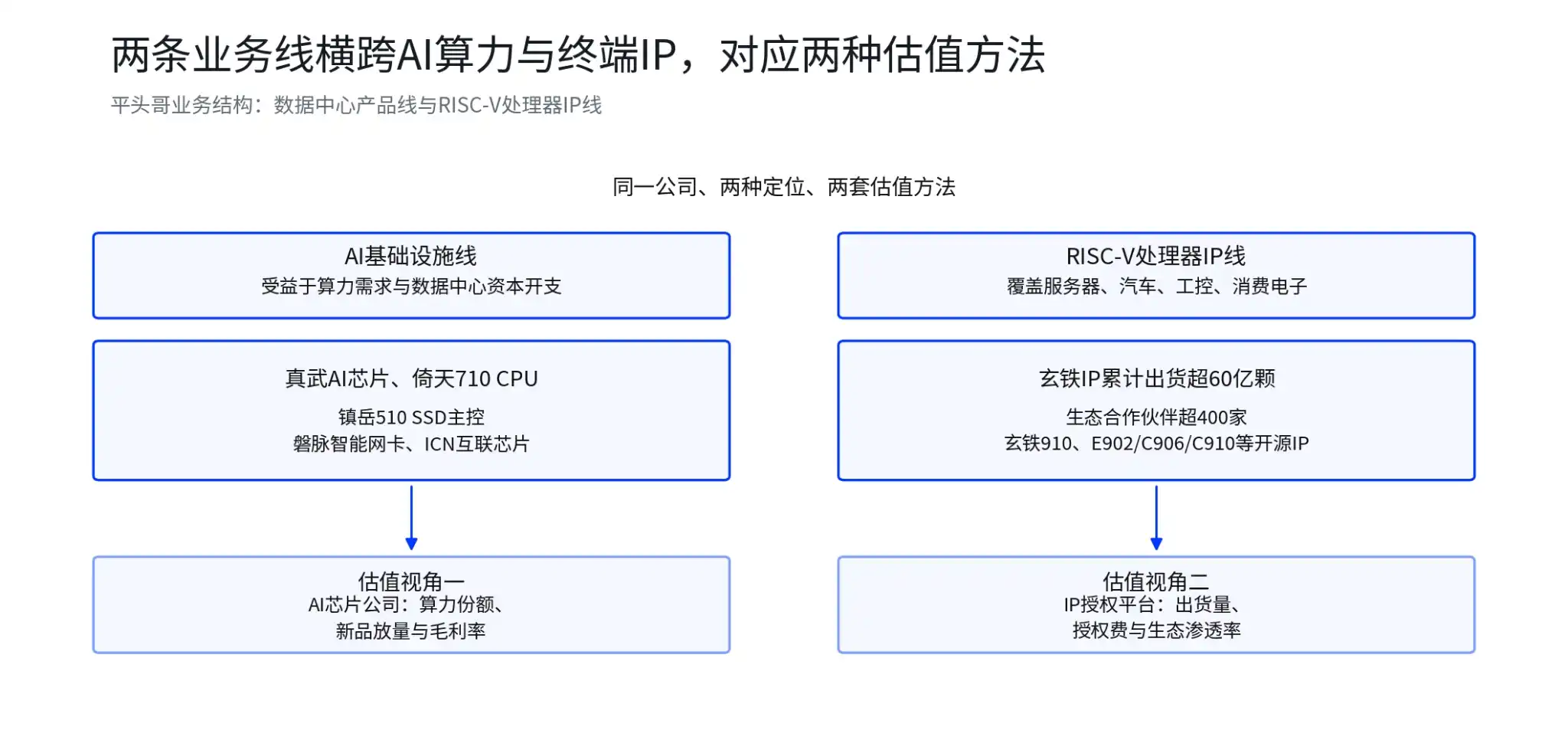
This means T-head’s business model spans two distinct lines: one centered on AI infrastructure, directly benefiting from rising compute demand and data center CAPEX; the other focused on RISC-V processor IP, covering broader end-market segments such as servers, automotive electronics, industrial control, and consumer electronics.
For Hong Kong investors, this structure is noteworthy because it determines how T-head will ultimately be positioned in the market—whether as an AI chip company, a comprehensive chip platform, or an infrastructure asset within the Alibaba ecosystem. Different positioning leads to different valuation methodologies.
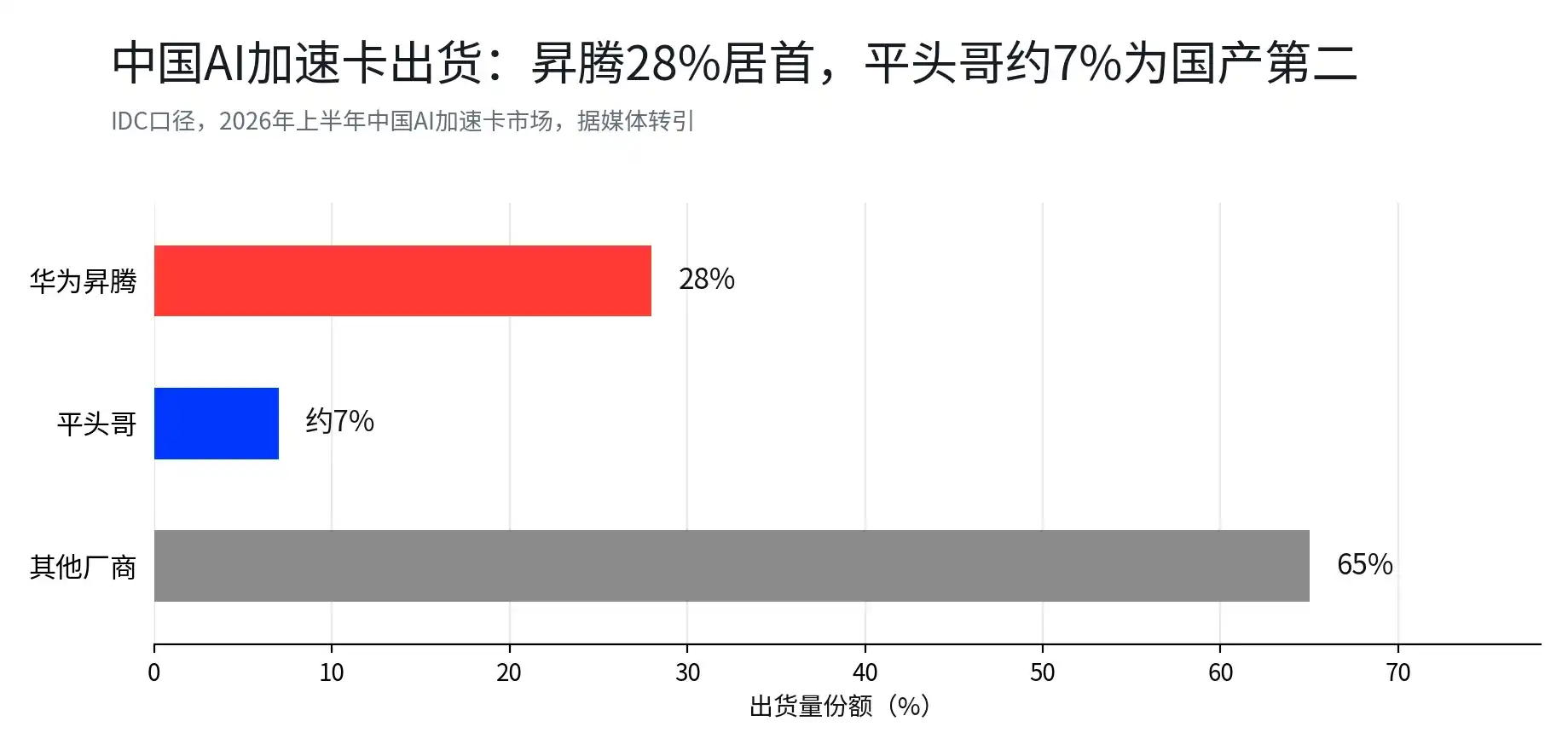
In the AI infrastructure segment, third-party data already provides benchmarks. According to IDC data (cited by media), in the first half of 2026, T-head captured approximately 7% of China’s AI accelerator card market share, ranking second among domestic players behind Huawei Ascend’s 28%.
IV. The Real Valuation Puzzle: Why Can It Range from $20B to $86B? A $66B Difference
Market expectations for T-head’s valuation vary significantly. According to 21st Century Economic Report, professional institutions estimate a valuation range of approximately $20B to $30B; JPMorgan’s January 2026 analysis ranged from $25B to $62B; another report cited Morgan Stanley’s range at $28B to $86B. The gap between high and low estimates spans $66B.
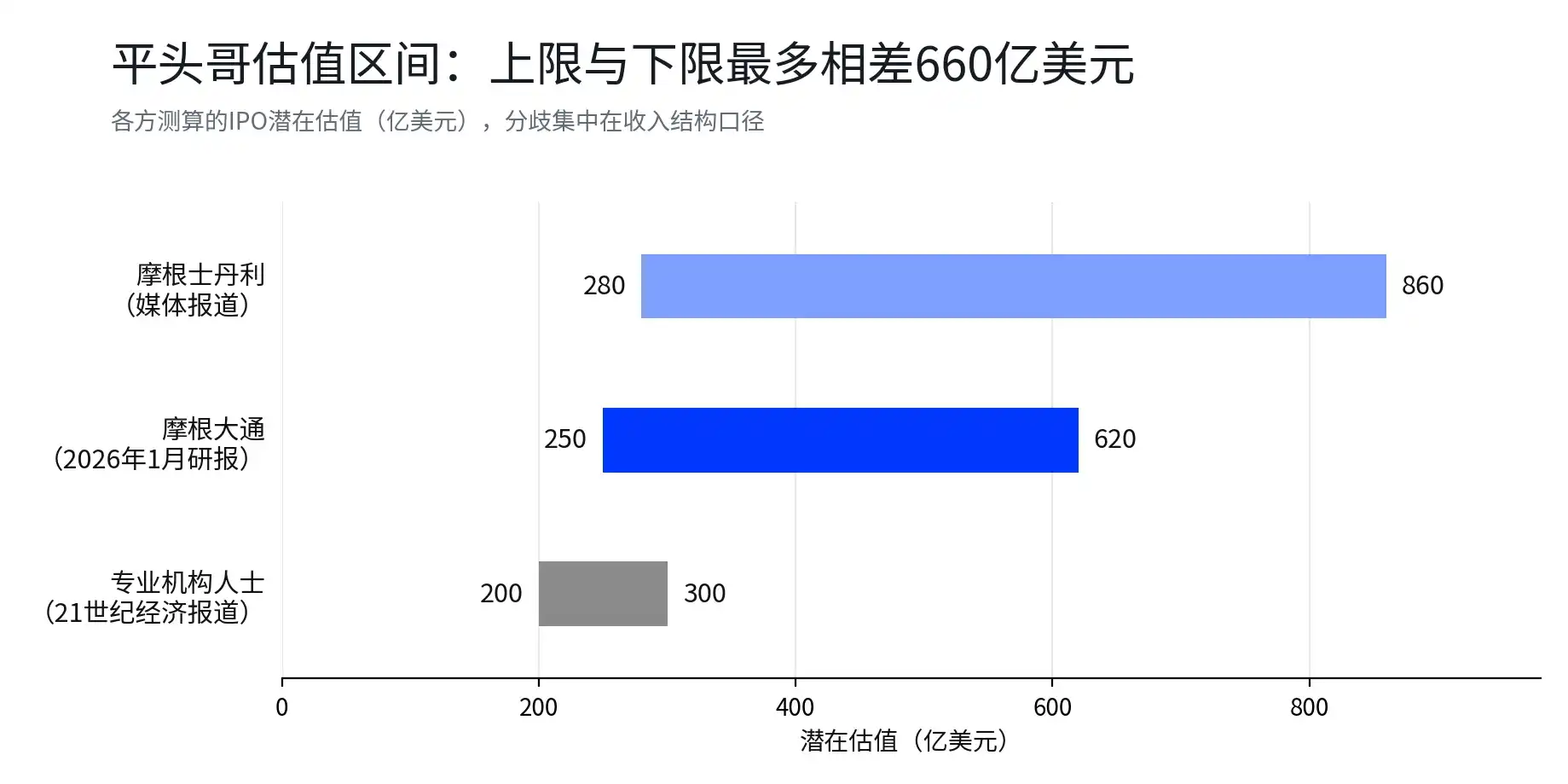
For a company, this divergence exceeds normal estimation error margins of a few hundred million dollars—it reflects a fundamental disagreement in capital market understanding of the business model. This doesn’t mean the market lacks clarity on T-head’s intrinsic value; rather, the missing pieces are several key financial metrics.
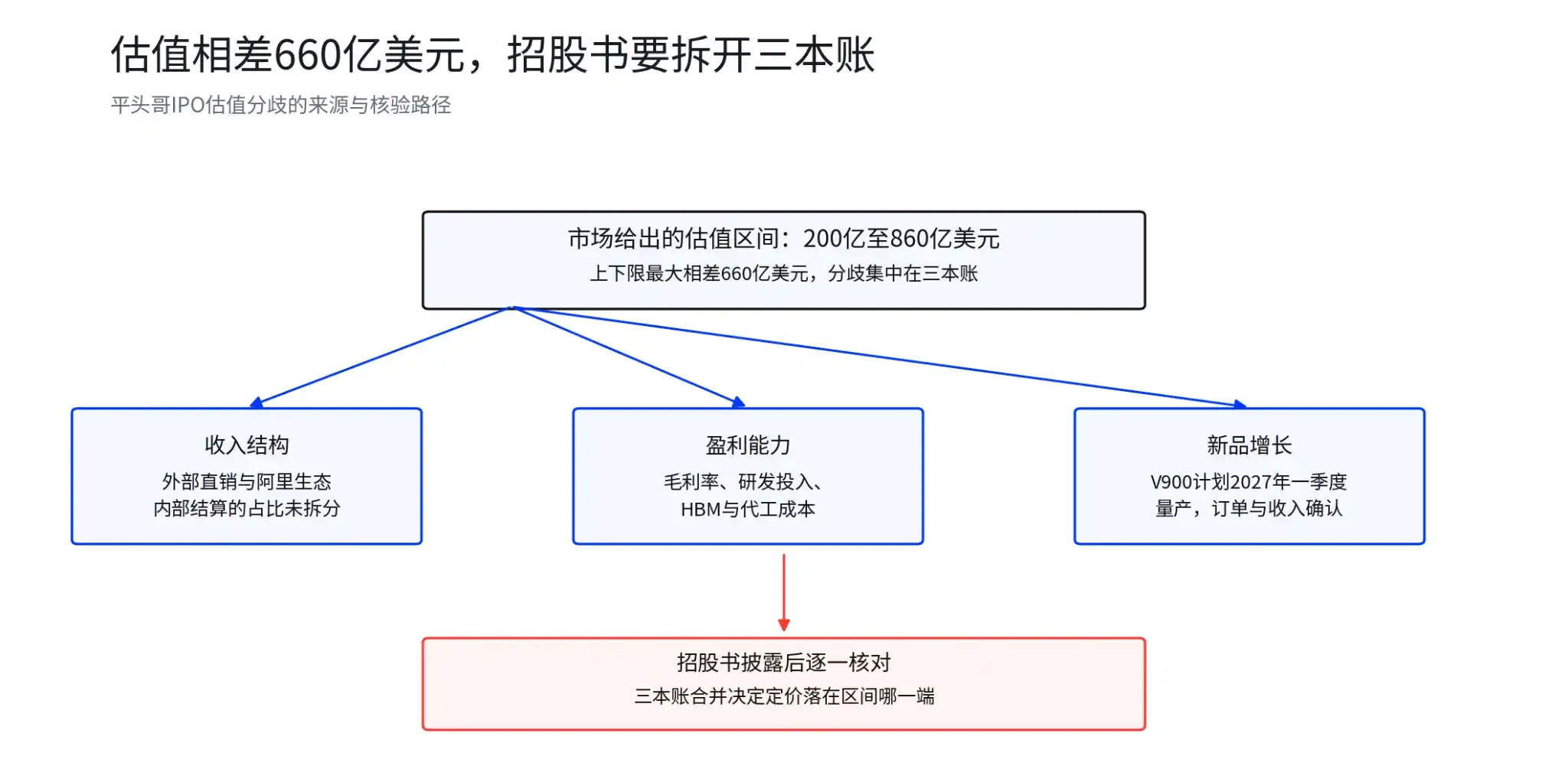
First, revenue composition: while T-head’s annualized revenue exceeds RMB 10 billion, the proportion derived from genuine external customers versus internal Alibaba ecosystem transactions remains opaque due to lack of complete public disclosure.
Second, profitability: revenue growth in chip companies doesn’t automatically translate into high margins. R&D, wafer fabrication, advanced packaging, HBM, and supply chain costs all impact gross margin and net profit. Markets will assign high valuations only if high revenue can gradually convert into sustainable profits.
Third, new product growth: if the V900 achieves successful mass production in Q1 2027 and rapidly secures orders and revenue, the market will see an upward-trending product curve, potentially pushing total revenue well beyond the current RMB 10 billion level.
Thus, the truly pivotal documents in the prospectus are those that could elevate T-head’s valuation from $20B to $86B—the underlying financial and customer structure cards.
V. Five Numbers to Watch Before the Prospectus: They Might Determine T-head’s True Value
After the formal prospectus release, investors should focus on verifying the following five metrics.
1. External customer revenue share. Current public data indicates external commercial clients account for over 60%. If this figure continues to rise, it signals reduced dependency on Alibaba’s internal orders and stronger independent commercial capability; if it remains low, greater scrutiny is warranted on related-party transactions and revenue quality.
2. Growth rate of external revenue. Total revenue growth matters, but external revenue growth matters more. If external client revenue grows faster than overall business, it indicates T-head is evolving from an internal chip unit into a market-facing semiconductor supplier.
3. Zhenwu V900 mass production timeline. Official plan is Q1 2027. For new issue valuation, V900 is not just a product launch—it’s a critical validation point for whether the next round of revenue growth can materialize. Mass production, shipment, customer onboarding, and revenue recognition are the full chain to track thereafter.
4. Gross margin and R&D expenditure ratio. The semiconductor industry cannot be judged solely on revenue. If revenue grows fast while gross margin improves and R&D spending ratio declines, profit elasticity becomes evident. Conversely, if revenue growth relies heavily on high R&D and supply chain costs, securing a high valuation becomes harder.
5. Issue valuation and price. This is the most direct question for Hong Kong IPO new issue investors. Even the best company may face compressed upside if the issue price is too high; strong fundamentals paired with moderate valuation can create positive investor sentiment.
Therefore, once entering the subscription phase, investors must consider the issued market cap, fundraising scale, issue ratio, peer valuations, and company earnings forecasts together—not merely rely on speculative valuation numbers circulating in the market.
VI. IPO Still Not in Subscription Window – What Should Hong Kong Investors Watch Now?
T-head remains in the IPO progression phase. Formal prospectus and final listing terms await future filings. Thus, the most appropriate action now is to add T-head to an early watchlist; with no fixed issue price, pre-listing trading is premature.
The most direct observation path is the Hong Kong domestic compute power sector. If the market begins pricing in T-head’s IPO expectations, related areas—including domestic AI chips, server CPUs, semiconductor manufacturing, packaging and testing, storage, and data center infrastructure—may experience emotional spillover effects.
However, such spillover requires distinguishing two types of signals: if increased trading volume, leading stocks strengthening in tandem, and supporting fundamentals like order flow or pricing changes appear, it typically signals higher-quality sector momentum; if it’s merely a single-day spike triggered by IPO news, it’s better suited for observation rather than chasing.
For Hong Kong IPO investors, the three key milestones to wait for are: prospectus disclosure, issuance range and valuation confirmation, and formal subscription. Only then, combined with issuance valuation, cornerstone investors, public offering ratio, company profitability, and peer valuations, can one make informed decisions—far more meaningful than speculating on issue prices now.
VII. Why This IPO Deserves Continuous Tracking?
T-head’s significance goes beyond being another Alibaba subsidiary going public. If successfully listed on Hong Kong, the market will gain a domestic chip platform covering AI compute, server CPUs, storage control, network interconnect, and RISC-V IP.
Even more importantly, as revenue, customer base, shipments, and R&D investments become increasingly transparent, the market can begin comparing domestic compute companies using a unified capital market language. For investors, this comparability itself is value.
Previously, the market mainly traded on narrative trends and thematic expectations around domestic compute. Post-listing, investors can further compare who grows revenue faster, who has more external customers, who enjoys higher gross margins, and who efficiently converts R&D into sustained orders. This is precisely why T-head’s IPO is most significant—it may drive domestic compute from thematic trading toward fundamental pricing.
Final Thoughts: Focus on Company Quality First, Then Issue Price
From its founding in 2018 to achieving annualized revenue exceeding RMB 10 billion and shipping hundreds of thousands of AI chips, reaching the doorstep of a Hong Kong IPO, T-head has completed a crucial step from technology development to commercial validation. However, the real justification for a new issue investment shouldn’t be mere labels like “Alibaba-affiliated,” “domestic compute,” or “AI chip.”
What matters most moving forward is whether the prospectus reveals external revenue, customer structure, gross margin, R&D efficiency, and V900 scalability can jointly support a higher valuation. The current market valuation range of $20B to $86B serves as a powerful reminder: broad market acceptance doesn’t imply every price is worth buying.
For Hong Kong investors, the current stage involves adding T-head to the IPO watchlist, closely tracking the prospectus, issuance valuation, and cornerstone investor status. Only when the price is finalized should one assess whether a “good company” and a “good price” coexist.
Under applicable eligibility requirements and jurisdictional restrictions, BIT provides eligible users with Hong Kong and U.S. stock trading services (Hong Kong trading services are not available to Hong Kong residents or users in restricted jurisdictions). Guaranteed financing for IPO subscriptions may increase subscription capacity but does not guarantee additional allocations; leverage amplifies both cost and risk and should be carefully considered based on individual risk tolerance. This article does not constitute investment advice; participation decisions rest solely with investors.
This content is for general informational and market commentary purposes only, compiled from publicly available data up to the time stated. Related market data, expectations, and probabilities may change with market conditions. Third-party views, analyst opinions, or investment strategies cited in this article represent the perspectives of those parties at specific points in time and do not reflect BIT’s views or recommendations. This article does not constitute investment advice, research, solicitation, invitation, or recommendation of any security, investment product, or trading strategy, nor should it serve as the basis for any investment decision. Financial markets carry risks—security prices and market performance may fluctuate. Past performance does not guarantee or imply future results. Investors should independently assess relevant risks based on their personal circumstances and seek professional advice when necessary.
Source: BIT
Disclaimer: Contains third-party opinions, does not constitute financial advice


The AlphaGo Moment in Cybersecurity, or Starting from These 466 Agent Matchups
9 days ago
The Trump administration plans to offer Constellation Nuclear a $5 billion loan for capacity expansion, with the additional power mostly pre-allocated to AI giants such as Google
16 days ago
Silicon Valley Executives Spark Controversy Over Using AI for Household Tasks; Survey Reveals Half of American Adults Worry About Impact on Relationships
16 days agoTensorlake npm package suffers supply chain attack, malicious version 0.5.144 injected with Shai-Hulud data-exfiltration worm
10-08Tesla and Musk Have Yet to Define "Amazing Abundance" — Visionary Slogan Sparks Skepticism
10-01Instinct Launches Curated Recommendation Feature, Sparking Frustration Among Some Users Receiving Passive Product Suggestions
09-30Security Weekly Report: Placeholder Domain Takeover Impacts Approximately 1,700 Repositories, with Major Cyberattacks Worth $387M and AI Agent Escalation Risks Highlighted
09-28
