$10 per hour, workers wear cameras to work for robots
$10 per hour, workers wear cameras to work for robots

2026-11-14 08:06
Lead: NVIDIA’s GR00T 2 Validates Data Value, Tactile Transfer Remains a Bottleneck. Produced | Huxiu Tech Team Featured Image | AI-Generated
Produced | Huxiu Tech Team
Featured Image | AI-Generated
10 RMB per hour, Zhang Li (pseudonym) has had her labor "distilled."
She is a sewing worker at a garment factory. Several months ago, the factory distributed a new device to its workers—resembling a headlamp, secured with straps around the head, and equipped with a small camera at the front.
The factory claimed that wearing it during regular shifts would yield an additional 10 RMB per hour in subsidy.
Zhang Li didn’t question it. Her work remained unchanged, just with an extra device on her head. It was slightly uncomfortable after prolonged use, but she welcomed the extra income.
Soon, nearly all workers at the factory were wearing the device. Sewing machines continued operating normally; workers repeated actions like laying out fabric, folding, and stitching—but now, all these movements were being recorded by the camera mounted above their heads.
They only knew they earned more money. As for where these videos ended up or how they were used, most didn’t care.
In reality, they were working for robots.
The devices worn by workers are Egocentric (Ego) data collection units. These capture human operational sequences in real-world environments. After cleaning, annotation, and processing, such video data becomes raw material for training embodied AI systems.
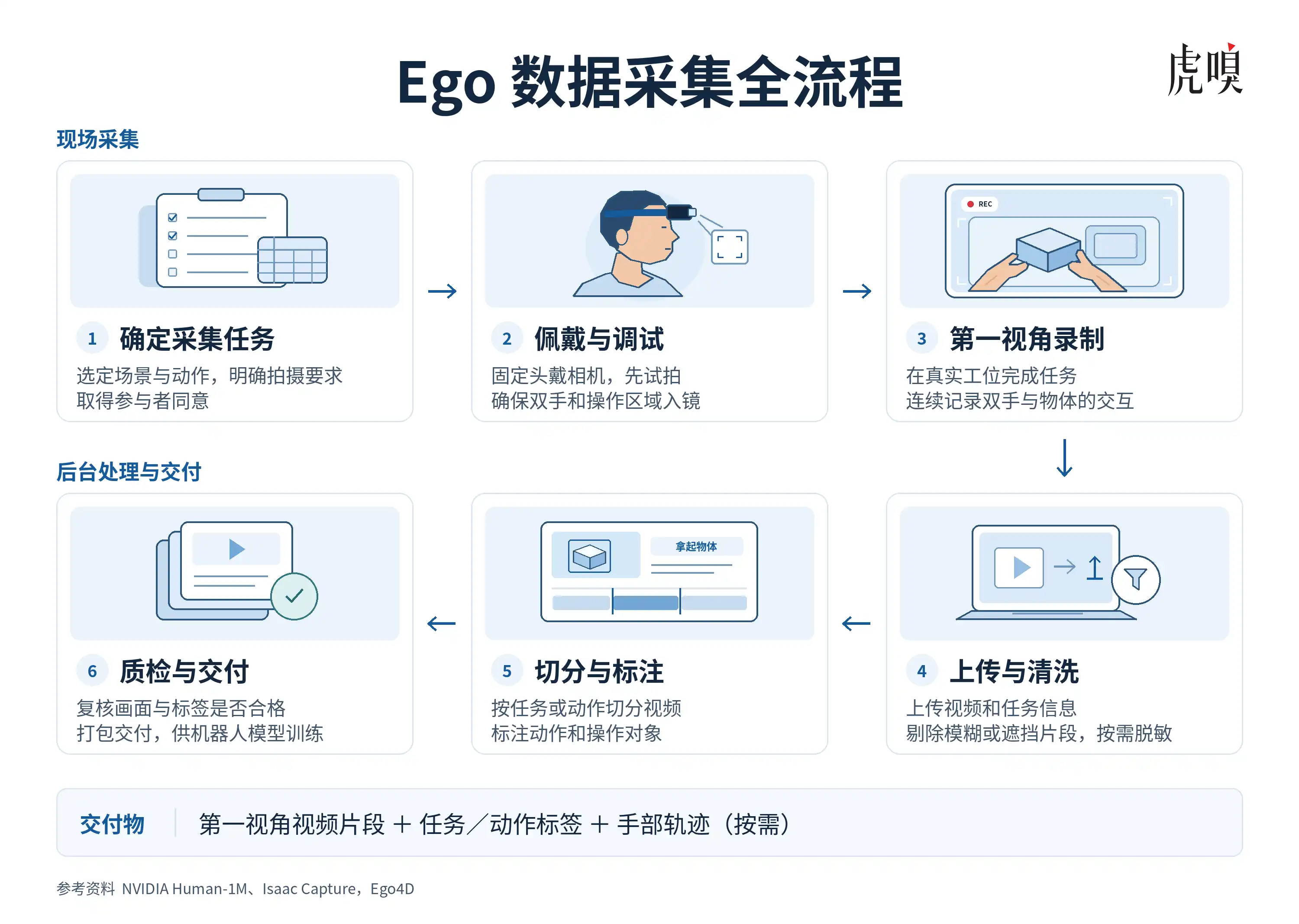
Currently, almost every company in the embodied intelligence industry is crying out about “data scarcity.”
To train robots for real-world tasks, the industry has explored multiple data acquisition pathways, including real-robot teleoperation, simulation generation, and body-free collection. Among them, Ego data—captured via head-mounted cameras recording human operations—is gaining momentum.
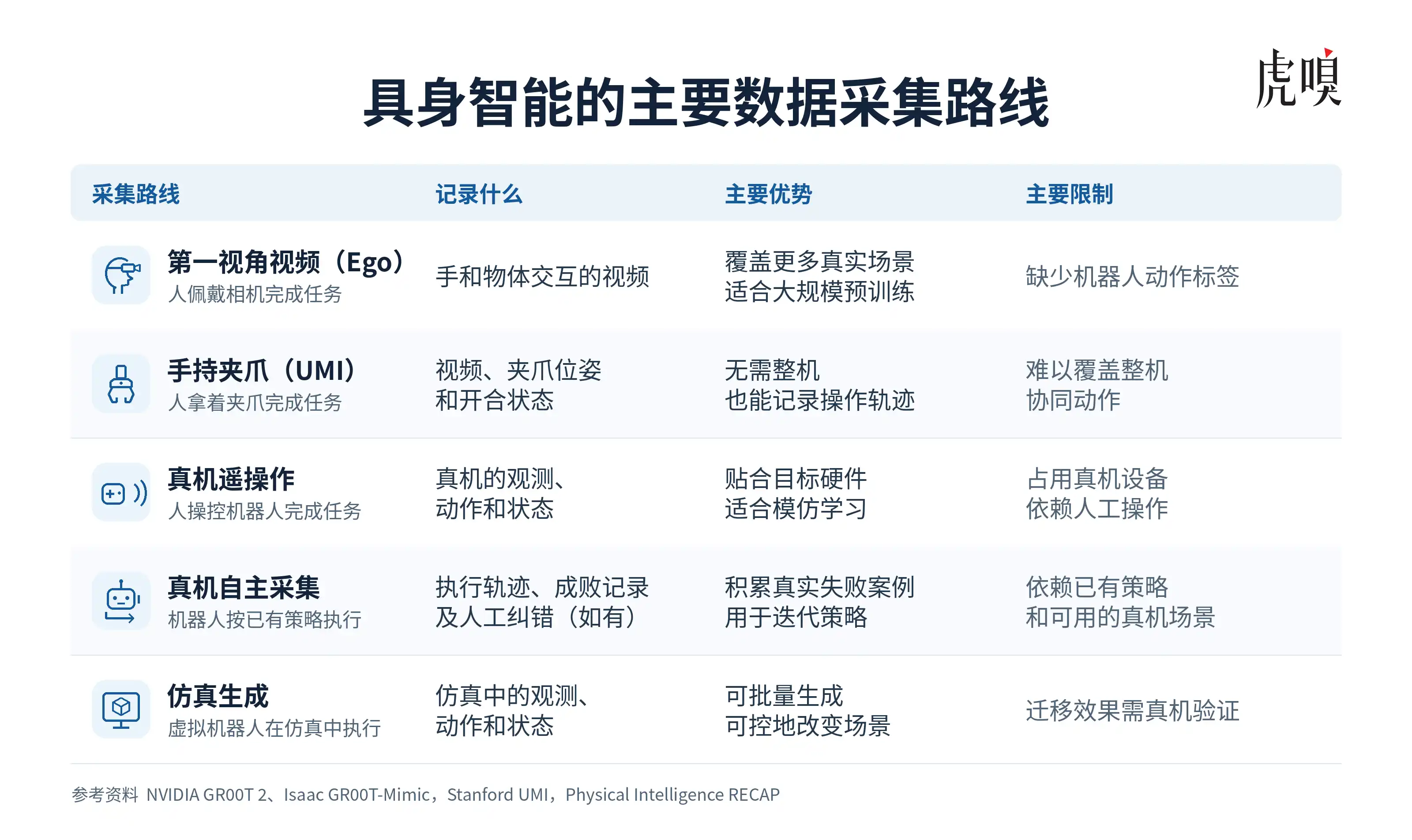
Compared to methods requiring robot bodies and dedicated facilities, Ego data collection has lower entry barriers. Workers in factories, warehouse sorters, restaurant chefs, even ordinary household users can participate in data collection during daily routines.
Low cost, high reproducibility, and scalability have made Ego one of the fastest-growing data acquisition channels in embodied intelligence today.
Within just a year or so, a new business model centered on human labor behaviors is rapidly taking shape.
Everyone Can Be a Data Collector
Zhang Li’s garment factory is merely a microcosm of this data collection wave.
Over the past year, as demand for Ego data has surged, more and more companies have entered this space.
From a supply chain perspective, participants fall into three categories:
Upstream: Equipment manufacturers producing head-mounted cameras, smart glasses, and other motion-capture hardware;
Midstream: Data service providers responsible for identifying use cases, recruiting personnel, organizing data collection, and cleaning, annotating, and processing raw video;
Downstream: Robot and embodied model developers who utilize the data for model training.
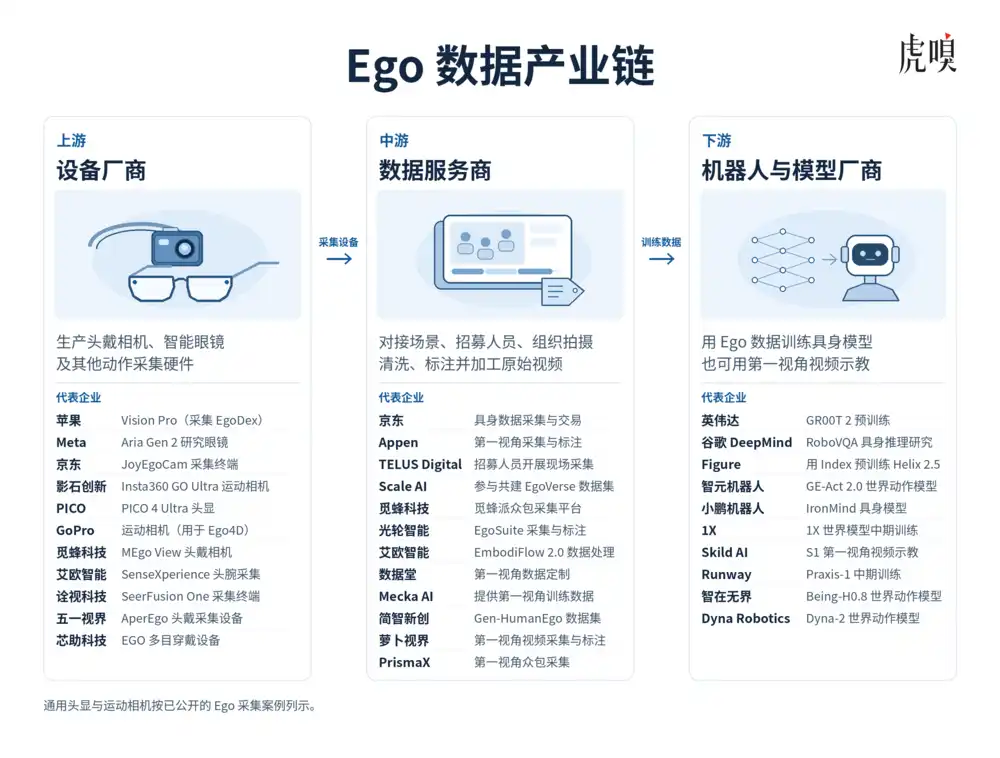
However, today’s players are no longer satisfied with focusing on just one segment. Increasingly, downstream enterprises are expanding upstream, aiming to control the entire pipeline from data collection to model training.
Among them, global tech giants such as Meta, JD.com, Ant Group, and Tencent have all entered the arena.
JD.com has taken the most aggressive action. In April 2026, JD announced the launch of its Embodied Intelligence Data Infrastructure, planning to accumulate 10 million hours of real-world human scenario videos within two years, mobilizing up to 600,000 people. JD also developed its own JoyEgoCam data collection device, extending data acquisition into logistics, retail, community, and home environments.
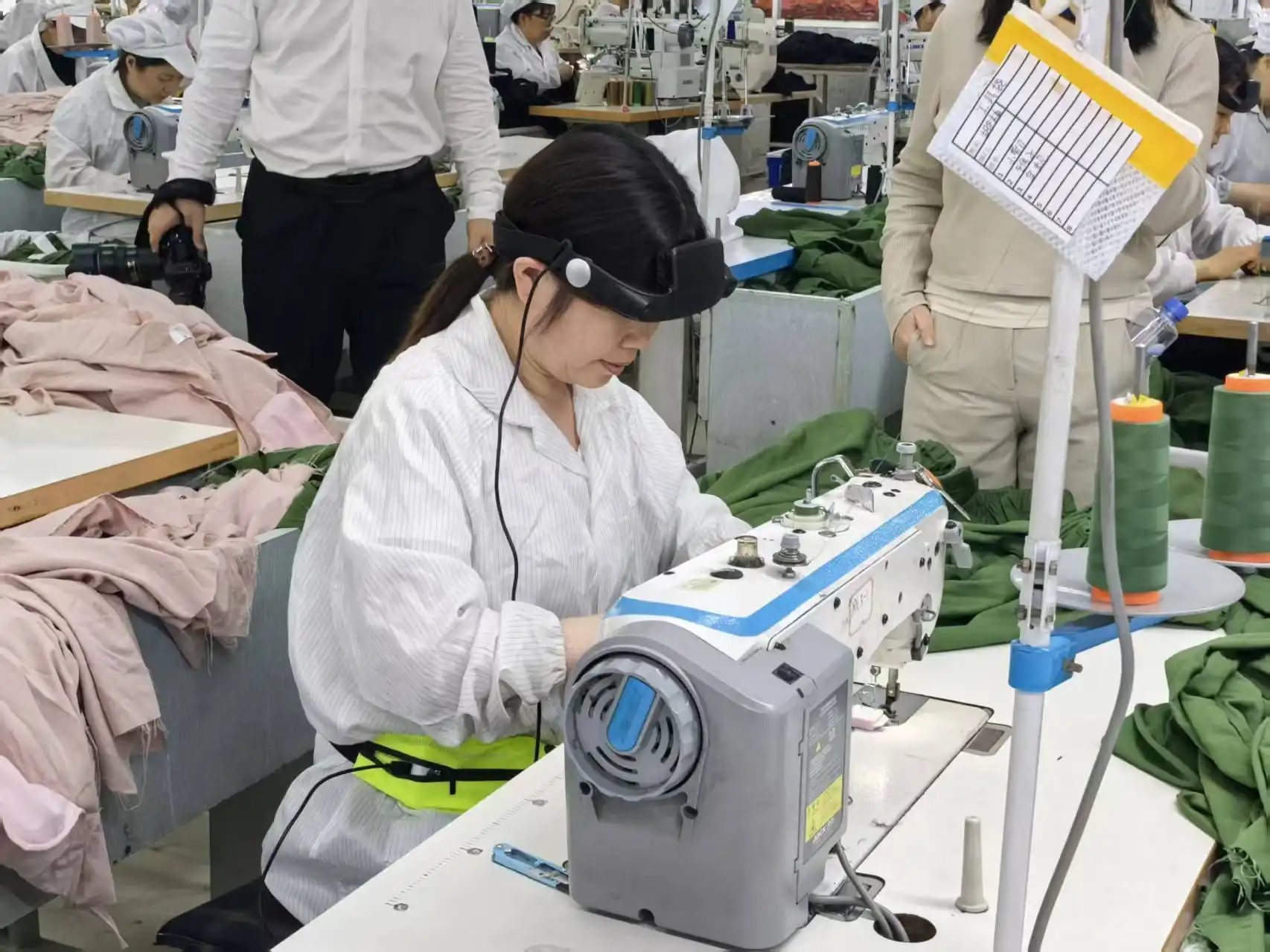
JD.com Robot Data Collection Center Source: CaiLian News
Ant Group is exploring low-cost data acquisition. In February this year, its research team proposed the AoE framework—using smartphones and neck-mounted brackets to record first-person videos, then applying software tools for filtering and annotation, reducing reliance on specialized equipment.
Meanwhile, robotics firms are directly recruiting “data workers” themselves.
In August, U.S.-based humanoid robotics company Figure launched a crowdsourced platform called Index, paying individuals to film daily activities like cooking and household organization.
According to Brett Adcock, Founder of Figure, during a public company meeting in October, Index had accumulated over 37.5 million video uploads, with app downloads exceeding 1.26 million and coverage across 112 countries.

In China, Mifeng Technology—a spin-off of Zhiyuan Robotics—has integrated equipment, collection, and data services under one roof.
By late August 2026, Mifeng announced the completion of its 20,000th MEgo body-free data collection unit, with over 1 million hours of accumulated data covering more than 500 niche tasks.
To scale production, Mifeng launched a crowdsourcing platform called “Mifeng Pai,” allowing ordinary users to rent devices, receive tasks, and earn compensation based on verified effective hours.
This model resembles food delivery platforms: the platform handles task dispatching, rule-setting, and payment settlement, while collectors contribute their time, labor, and real-world context.
An increasingly widespread, socially distributed network for data production—from factories and warehouses to supermarkets and homes—is rapidly taking shape.
Yet to expand this network into more scenarios, countless mid-tier service providers and intermediaries remain essential.
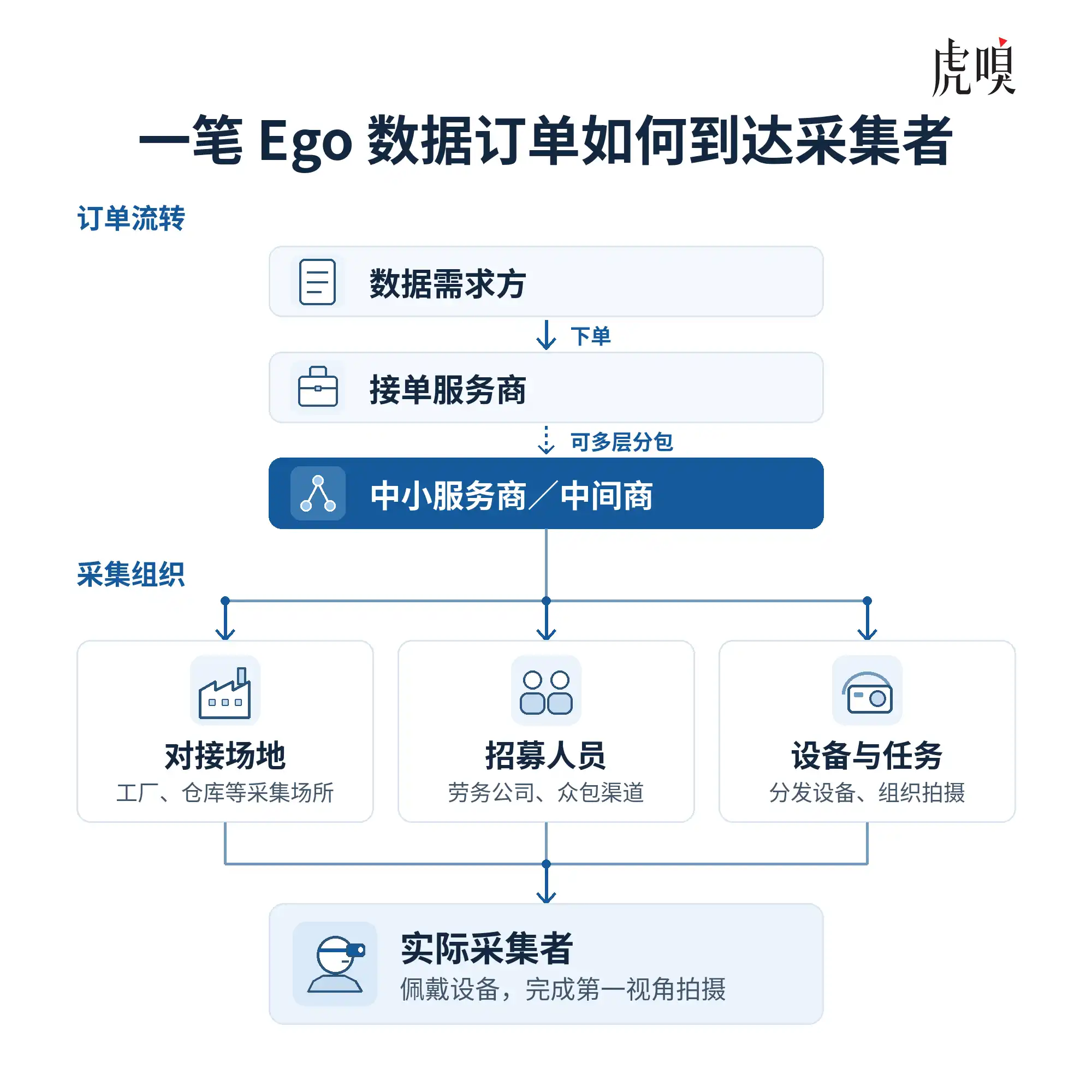
These entities take on data orders, identify factory or warehouse collection sites, then recruit personnel through labor agencies and crowdsourcing channels, distribute devices, and organize collection. A single order may pass through multiple layers of subcontracting before reaching the actual collector.
To secure more stable and lower-cost labor, some practitioners have even turned their attention to special venues.
Earlier, Huxiu spoke with several related labor dispatch agencies, who mentioned potential collaborations with certain confidential institutions, hoping to have staff wear devices during work hours to simultaneously collect data.
This claim remains unverified, and whether such partnerships have been realized is unclear. But the mere emergence of such ideas reflects the urgent need in today’s data collection industry to expand labor sources and reduce costs.
A data collection manager told Huxiu outright that current Ego data collection remains a typical labor-intensive business. Simply organizing people to collect data involves low entry barriers and shallow moats.
In his view, whoever can organize more people at lower cost and access more scenarios will gain greater data capacity.
But once data capacity expands rapidly, who will actually profit?
One Hour of Labor, Multiplied by Price Layers
How much can Ego data collection actually earn?
The answer varies from collectors to data companies.
At the end of August 2026, when Mifeng Technology unveiled its 20,000th device, on-site staff told media that the upcoming crowdsourcing platform would offer 45 RMB per hour for data collection.
But actual earnings are not so straightforward.
In October, Huxiu experienced Mifeng Pai as a regular user and found the platform uses a “base rate + daily incentive” pricing model. The base rate is 20 RMB per valid hour, with additional rewards calculated based on cumulative valid hours per day, divided into four tiers: 0, 20, 23, and 25 RMB per hour.
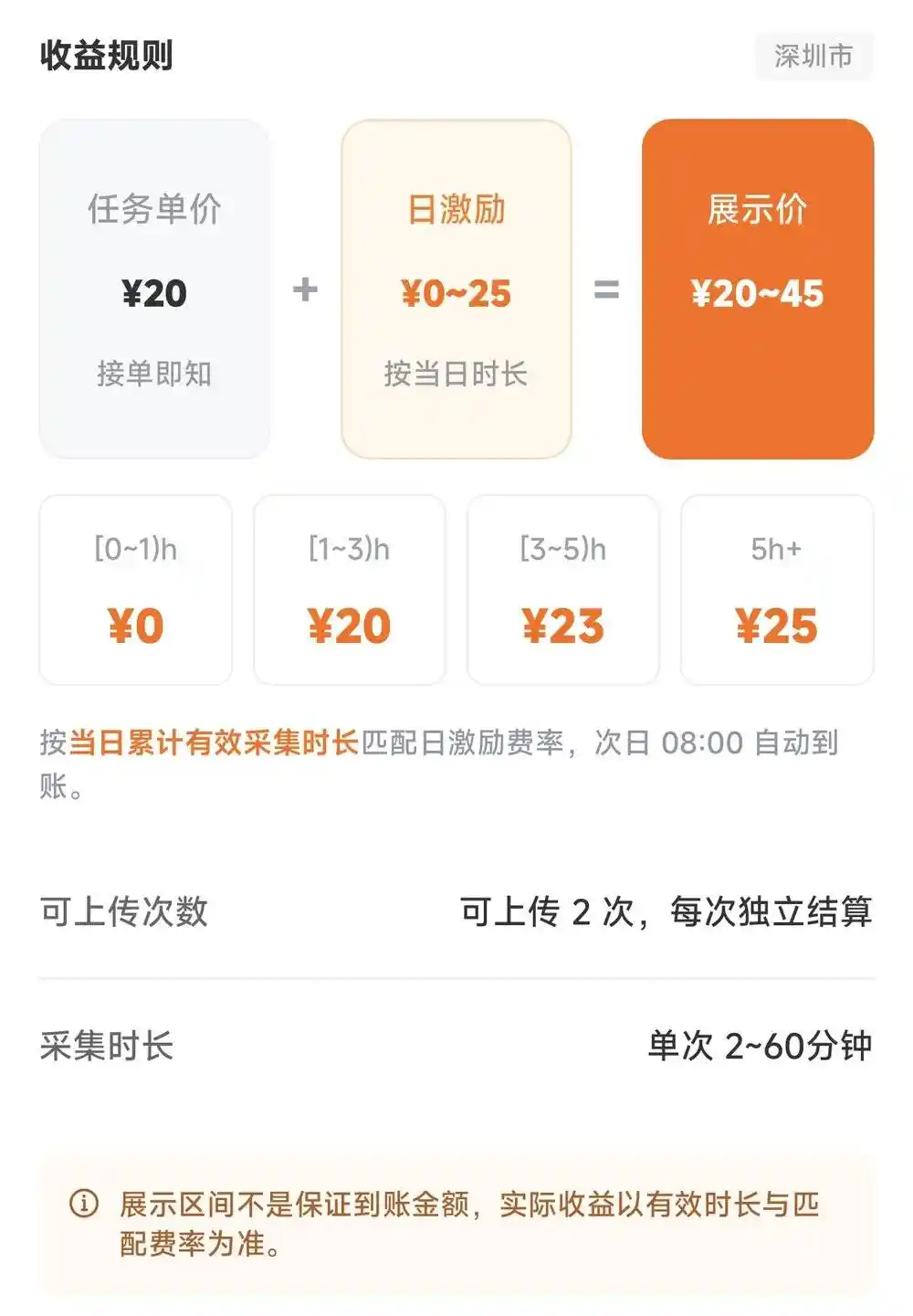
Thus, 45 RMB per hour is only achieved when hitting the highest reward tier.
The more critical variable is the valid data rate.
The platform only pays for hours that pass review. If the camera is obstructed, actions are non-compliant, or tasks are incomplete, the video may be partially or fully rejected.
I personally tested half an hour of tasks, primarily wiping tables. Although I recorded around 30 minutes of video, after platform review, only about 20 minutes were deemed valid, earning me less than 10 RMB.
Additionally, collectors must cover equipment rental fees. For example, the MEgo View device had a promotional rental price of 19 RMB/day, with a minimum one-week rental period; non-promotional rates were approximately 39 RMB/day.
After accounting for invalid hours and equipment rental, actual take-home pay shrinks further.
For data service companies, collector payments are only part of the cost.
From acquisition to delivery, each video incurs expenses related to equipment procurement and depreciation, scene development, personnel management, data transmission, cleaning, annotation, quality inspection, and potentially advanced processing like 3D hand pose reconstruction and motion trajectory recovery if clients require higher precision.
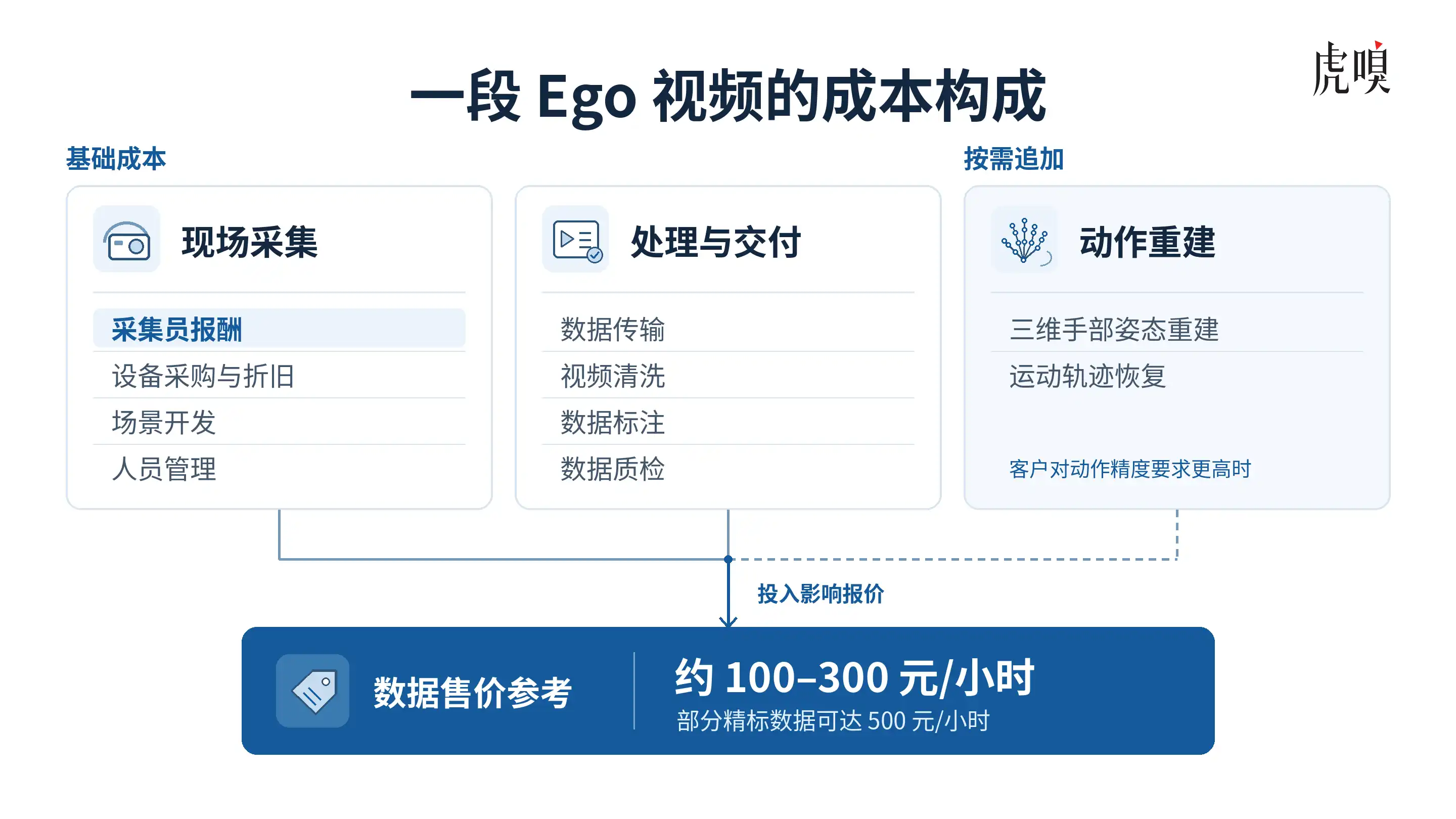
All these investments ultimately reflect in the final data pricing.
According to Huxiu’s investigation, current market prices for body-free/portable data range from 100–300 RMB/hour, while real-robot teleoperation data ranges from 500–1,000 RMB/hour.
But this does not mean that workers earn 10–20 RMB/hour while companies resell data for hundreds, achieving tens of times profit.
Acquisition hours, platform-verified valid hours, and client-accepted delivery hours often represent three different books.
Even if videos pass initial quality checks, they may still be rejected by clients due to incomplete action information or non-compliance with task requirements—yet labor, equipment, and processing costs have already been incurred.
This divergence has led to varied commercial models among embodied data firms.
Some sell or lease collection devices; others organize data collection and charge per valid hour; others provide data processing, management platforms, and customized delivery services.
During a visit, one embodied intelligence data company explained its business spans equipment, data collection services, and data management platforms, with most workers hired via outsourcing. The company revealed it achieved break-even in 2025, though it declined to disclose financial details.
This multi-stage integration allows firms to reuse customers, equipment, and delivery infrastructure, reducing redundant investment. However, actual profitability still hinges on order volume, data acceptance rate, and processing cost efficiency.
So, what is the true market size of this business?
On October 28, Zheshang Securities released a research report forecasting that under neutral assumptions, the embodied data collection market will grow from 2.1 billion RMB in 2026 to 19.3 billion RMB in 2027, reaching 174.1 billion RMB by 2030. Of this, the Ego data market alone is projected to reach 102.8 billion RMB.
However, these projections are based on assumptions of substantial data demand growth and sustained price declines. The actual transaction volume of Ego data remains unverified by authoritative statistics.
Currently, embodied model companies, robotics firms, and large-scale AI model developers are the primary buyers, while research institutions also exhibit procurement needs.
For example, Mifeng Technology has established data collaboration agreements with Tencent Robotics X Lab and Ant Lingbo. Noiteng revealed that single customer data orders in the industry are evolving from tens of thousands of hours to millions.
Yet demands vary significantly. Some purchase raw operation videos for large-scale pre-training; others require precise motion trajectories and structured data to adapt to specific robots.
For data companies, the ultimate determinant of business scale is how much downstream clients are willing to pay for which type of data.
And this comes down to one fundamental question: How much can robots truly learn from these human videos?
More Data Doesn’t Mean More Value
From a technical standpoint, the value of Ego data is beginning to be validated.
On November 9, NVIDIA released its next-generation robotic foundation model, GR00T 2, trained on over 400,000 hours of human egocentric video, along with handheld gripper demonstrations and robot teleoperation data.
In a test involving 72 tasks, as Ego training data increased from zero to full scale, the robot’s average task completion rate rose from 50% to 70%.
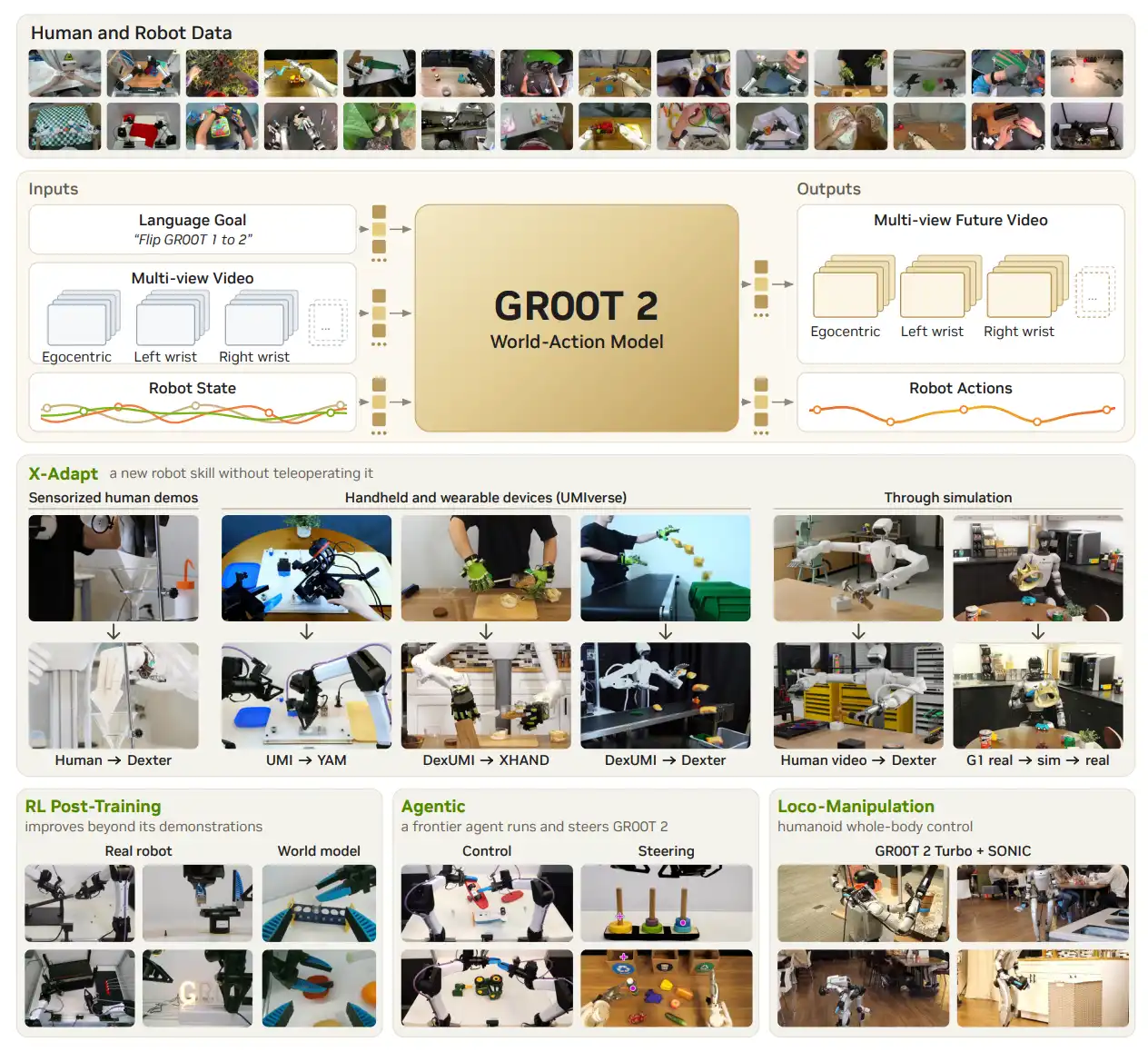
This proves that large-scale human egocentric data can help robots learn operational skills.
Yet the improvement in experiments still depends on techniques like action information extraction and human-machine alignment. Raw footage from ordinary cameras is far from direct executable commands for robots.
Take Zhang Li’s daily sewing routine: she relies on tactile feedback and years of experience to quickly judge whether fabric is aligned or stitches are skewed, adjusting pressure instantly.
The camera can record how she performs the task but struggles to fully reconstruct the force applied by her fingers, the contact state of the fabric, or the precise control signals behind the movement.
Therefore, even after watching tens of thousands of hours of sewing videos, a robot may still fail to sew a single garment independently.
Another challenge lies in the disparity between human and robotic anatomy—different robots also have varying configurations—and learned actions may not transfer directly.
Previously, Dr. Zhongyu Li, Assistant Professor at the Chinese University of Hong Kong and co-director of the Hong Kong Embodied Intelligence Lab, expressed clear optimism about Ego data in conversations with Huxiu.
In his view, human egocentric data provides massive pre-training material, enabling robots of diverse configurations to learn generalized operational experience.
Yet regarding data scale, he cautioned: “Repeating the same video ten thousand times—even if it adds up to ten thousand hours—does not increase useful information significantly.”
What truly impacts model capability is the diversity of tasks, scenarios, and interaction modes.
Li believes that human data should first be used for pre-training, then deployed onto various robot configurations, allowing them to generate new data through real-world tasks, which can then feed back into future training cycles.
This aligns with the practical direction of several robotics firms.
Currently, multimodal data fusion training has become a key strategy among embodied intelligence companies.
Startups like Xingdong Jiayuan, Wujie Dynamics, Xiaomi Robotics, and overseas players such as 1X and Skild AI are all exploring hybrid training pipelines combining real-robot, Ego, teleoperation, and simulation data—leveraging real-robot data for physical execution while using human videos to scale training breadth.
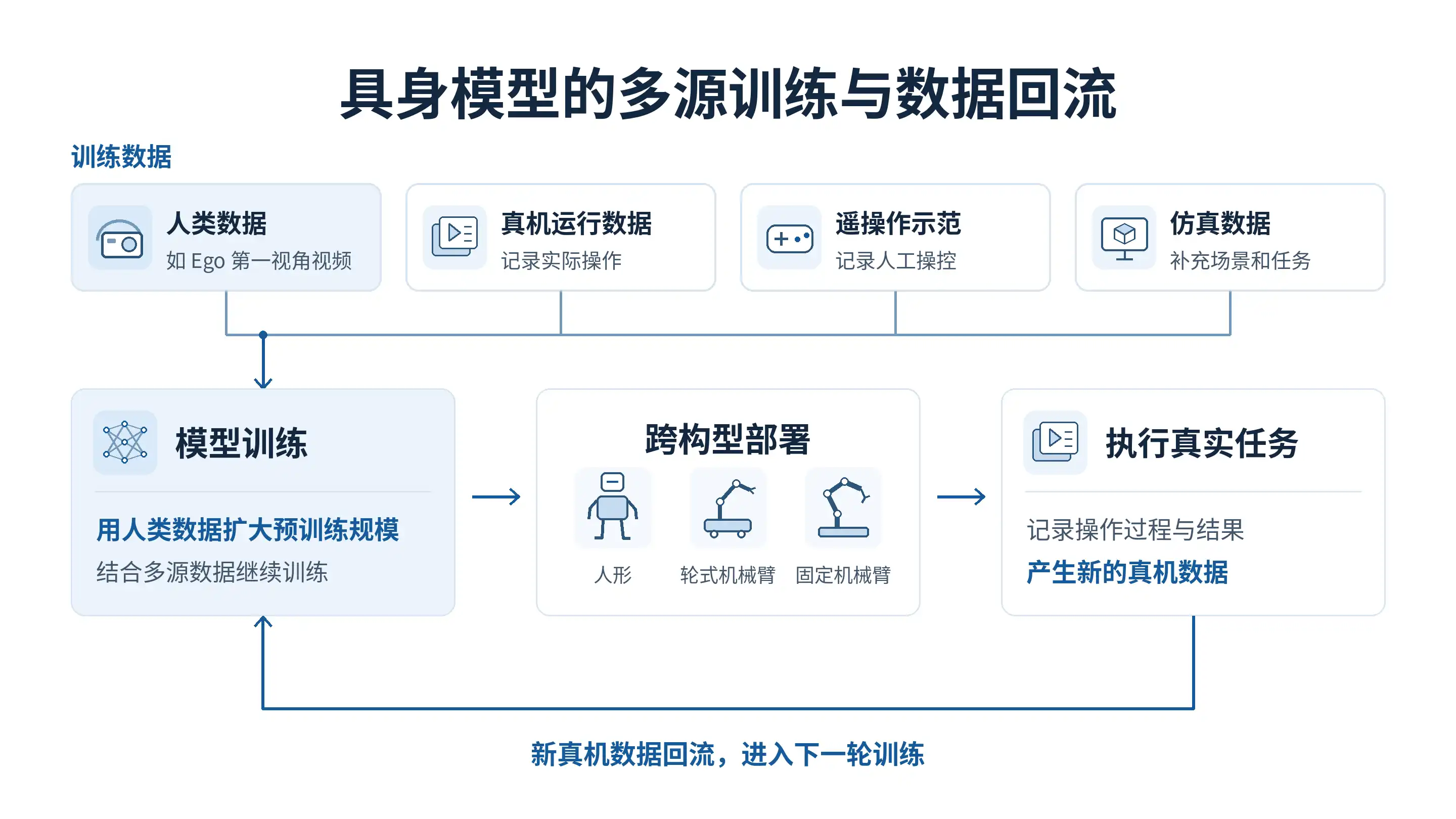
Human data offers broad operational experience, while real-robot data records the robot’s own motions, states, and interaction feedback—helping models adapt to specific hardware.
For downstream buyers, data value must ultimately translate into tangible performance: How many additional hours of Ego data improve task success rate by how much? And how much do they save in real-robot data acquisition costs?
This will shape the future of the Ego data supply chain.
As general household and simple grasping videos become abundant, homogenized data may face fiercer price competition. Conversely, complex operations, rare scenarios, and data containing precise motion and haptic information may command premium pricing.
Back at Zhang Li’s sewing machine.
The head-mounted camera continues recording her adjustments to fabric and needle control.
At the bottom of this data chain, she won’t know which company’s training set eventually absorbed these videos—or how many percentage points the robot’s success rate improved.
To her, it’s just another day’s repetitive work and an extra 10 RMB per hour.
But for the robotics industry, these mundane labors are becoming the learning material for the next generation of robots.
In a sense, humans are teaching robots how to become future workers—through their own labor experience.
Source: Yi Yuqin
Disclaimer: Contains third-party opinions, does not constitute financial advice


HuggingFace's "AI Duck" Goes Viral, Boosting Chinese Chip Supplier Rockchip
09-02
Yushu Surges 629% on First Day of Trading, Humanoid Robots Sell 5,500 Units
08-19
14 Executives Depart, Horizon Unleashes a Robot Legion
08-11
Yushu's 61 Billion IPO: Who Will Make Money?
08-07
Former Huawei Genius Youth: Building 5,000 Reliable Robots This Year Won't Exceed 3 Companies
08-05
China's climbing robotic vacuum cleaner captures 70% of the global market
08-05Musk spent nearly half of the Tesla earnings call discussing AI and robotics, with automotive business accounting for less than one-third of total revenue
08-05


