500,000 RMB/year becomes "a bargain," with average annual salary at Unitree employees at only 126,000 RMB
500,000 RMB/year becomes "a bargain," with average annual salary at Unitree employees at only 126,000 RMB

2026-11-13 08:00
Introduction: The Capital Cooling Period Arrives—The Era of Hyper-Priced Talent Acquisition Cannot Last Forever. The Ultimate Frontier of AI Is Still Human Talent.
AI’s ultimate frontier, is still returning to talent itself.
Recently, Blue Whale Technology reported that this year’s autumn recruitment season saw an incoming master’s graduate specializing in embodied intelligence receive a 500,000 CNY annual offer—yet even this compensation is being jokingly referred to within the industry as “vegetable prices.”
This statement carries three parts jest and seven parts truth.
MaiMai’s 2026 Spring Recruitment Report reveals that from January to April 2026, the number of embodied intelligence positions surged 15-fold year-on-year, with average monthly salaries rising from 59,000 CNY to 62,000 CNY. According to the Coolidge International Compensation Guide, the annual salary cap for embodied intelligence algorithm engineers has reached up to 2 million CNY.
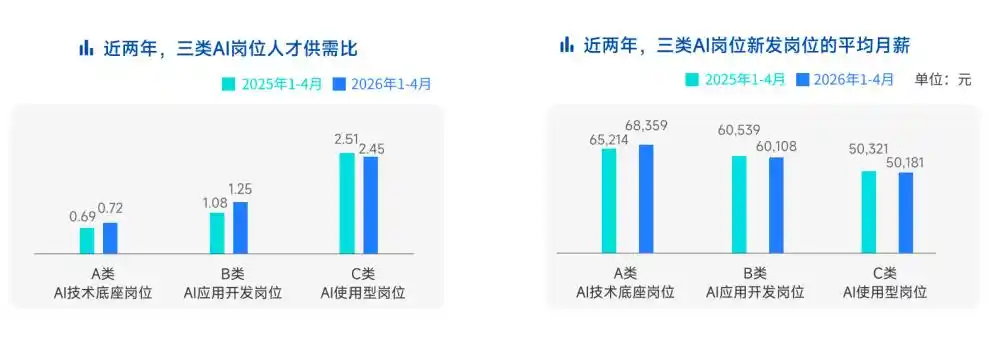
Source: MaiMai
How fierce is the competition in this sector? Some startups have even offered near-million CNY salaries to recruit interns, securing potential talent before they’ve even graduated.
While industry compensation continues to soar, these attractive pay packages are not conjured out of thin air.
01. Investors Have Been Pouring In Too Much Capital
Regarding the claim that a 500,000 CNY annual offer is considered “vegetable prices”, an industry insider told us: “This isn’t actually high.” However, they added, an incoming graduate’s salary still largely depends on their academic publications and research achievements.
Still, some product managers argue this is an outlier—algorithm roles may reach such levels, but other positions likely won’t.
When viewed against historical data of Chinese university graduates, this compensation level is already exceptional.
Wind data shows that between 2024 and 2026, graduating cohorts exhibited a pattern of “sluggish real wage growth, stabilized campus hiring starting salaries, and increasingly pronounced internal disparities.”
Using the MyCounsel measurement standard, the actual monthly income of bachelor’s degree holders six months after graduation rose from 6,199 CNY in 2024 to 6,435 CNY in 2025—a nominal increase of 3.8%.
Even at top-tier universities, a 500,000 CNY annual salary far exceeds the average. According to China Salary Network data, the average monthly salaries for 2025 graduates from Tsinghua University, Shanghai Jiao Tong University, and Peking University were 13,245 CNY, 13,200 CNY, and 12,947 CNY respectively—equivalent to a total annual income of approximately 155,000 to 160,000 CNY.
Wage gaps between education level, major, and industry continue to widen; top-tier roles in AI algorithms and integrated circuits can command several times more than ordinary positions. This indicates that such high salaries are concentrated primarily among specific roles and elite individuals.
Given such extreme valuations, why are market players still willing to pay?
The answer lies first in the primary market—investors expect companies to attract talent quickly, accelerating business execution and value realization.
Data shows that total fundraising in China’s embodied intelligence and robotics sectors reached approximately 73.5 billion CNY in 2025, surging to nearly 109.2 billion CNY by mid-2026, with over 35 billion CNY disclosed in the first four months alone—meaning capital flowed into this sector almost daily.
Moreover, large-scale funding rounds exceeding 1 billion CNY have become increasingly common: about six in 2025, and already over 20 within just half a year of 2026.
For instance, Yushu Intelligent Navigation secured a Pre-A round of 455 million USD, setting a new record for single fundraising in China’s embodied intelligence space; Lingchu Intelligence raised 2 billion CNY in its Pre-A round. Upon suddenly receiving hundreds of millions in capital, company founders didn’t rush to buy equipment or expand capacity—they immediately prioritized talent acquisition.
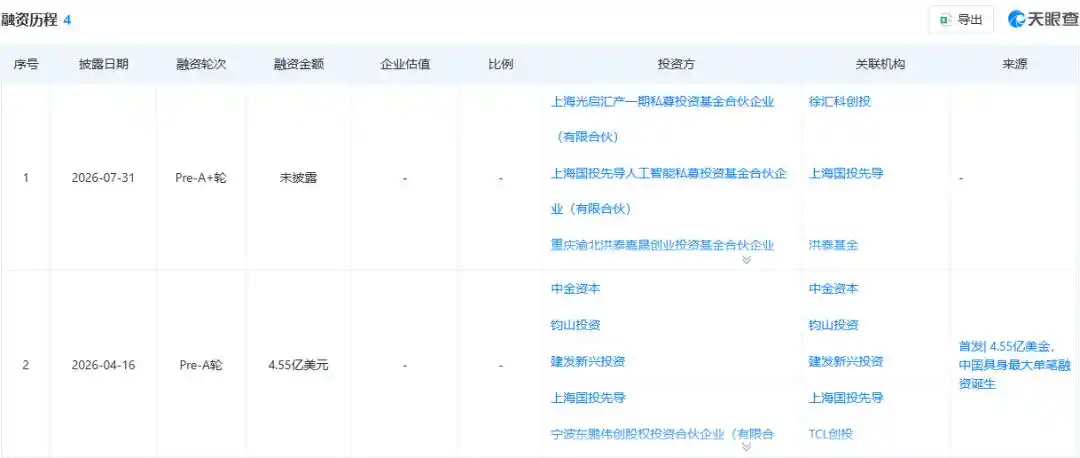
Source: Tianyancha
This sense of urgency is not new.
02. Talent Shortage Cannot Be Bridged by Money Alone
“Talent Scarcity Whistleblower” Wang Xingxing, founder of Yushu Tech, repeatedly voiced concerns before going public: nearly every role in the company suffers from staffing shortages—from R&D and algorithms to marketing and operations. He openly admitted that long-term understaffing is a key reason behind the team’s sustained high-intensity work cycle.
The center of gravity in industry competition is shifting.
Over the past few years, the core challenge in embodied intelligence lay in physical hardware and motor control (“the small brain”): could robots stand steadily, walk reliably, and execute complex motions? With industrial chain maturity, this capability is no longer an absolute barrier.
The true determinant of the next phase’s success lies in the robot’s “brain”—its ability to understand environments, make autonomous decisions, and dynamically plan actions based on tasks.
Once again, it was Wang Xingxing who sounded the alarm. He frequently expressed his own “anxiety,” admitting that he and his team had deeply invested in robot hardware and motion control early on, yet missed the initial wave of general AI momentum.
This reflects a shared anxiety across the entire embodied intelligence industry: hardware can be iterated, models can be retrained, data can be accumulated gradually—but truly exceptional talent capable of effectively embedding AI capabilities into robotic applications remains exceedingly scarce.
The reality is harsh: the race for the “brain” will likely result in only two outcomes—either leading the pack or getting left behind.
Meanwhile, increasing entrants and shorter technology iteration cycles are accelerating the pace. Previously, the development cycle for an embodied intelligence robot product was measured in years; now it’s measured in months, even weeks.
As the “brain” becomes the core battlefield, VLA models, real-world data, and intelligent decision-making directly shape a company’s next technological narrative. Falling behind even briefly makes catching up exponentially harder.
Thus, the competition for key talent gradually transcends conventional salary logic.
In early April this year, Ubtech led the charge with the announcement: “124 million CNY for a Chief Scientist”—a global search for a Chief Scientist in embodied intelligence, offering a total annual package starting at 1.5 million CNY, with a maximum of 124 million CNY, benchmarking Silicon Valley’s top tech firms.
A week later, Magic Atom, a subsidiary of Travor, revealed its founder Yu Hao plans to offer a 200 million CNY annual salary for a Chief Scientist. Earlier, rumors circulated about a top-tier embodied intelligence firm aiming to hire academics from universities with multi-million CNY offers.
On the surface, many companies appear generous with spending, but most remain unprofitable. Even while operating at a loss, they prioritize high salaries for talent—because the underlying calculation is simple: bringing in key talent doesn’t just enhance technical capability—it also influences market perception of the company.
Within the industry, there’s even speculation that hiring one top-tier scholar from a prestigious university or a seasoned executive with industry experience could boost a company’s valuation by hundreds of millions or even billions of CNY.
03. After the Sky-High Talent Bidding War
But this applies only to elite talent—ordinary employees face a completely different reality.
Financial reports and Tianyancha data show that in 2025, Ubtech employed around 2,550 full-time staff, with payroll costs totaling approximately 915 million CNY—averaging about 358,700 CNY per employee annually. Meanwhile, Yushu Tech’s prospectus reveals that in 2025, the company had 516 employees, with total employee compensation amounting to 65.2244 million CNY—averaging roughly 126,000 CNY per employee annually.
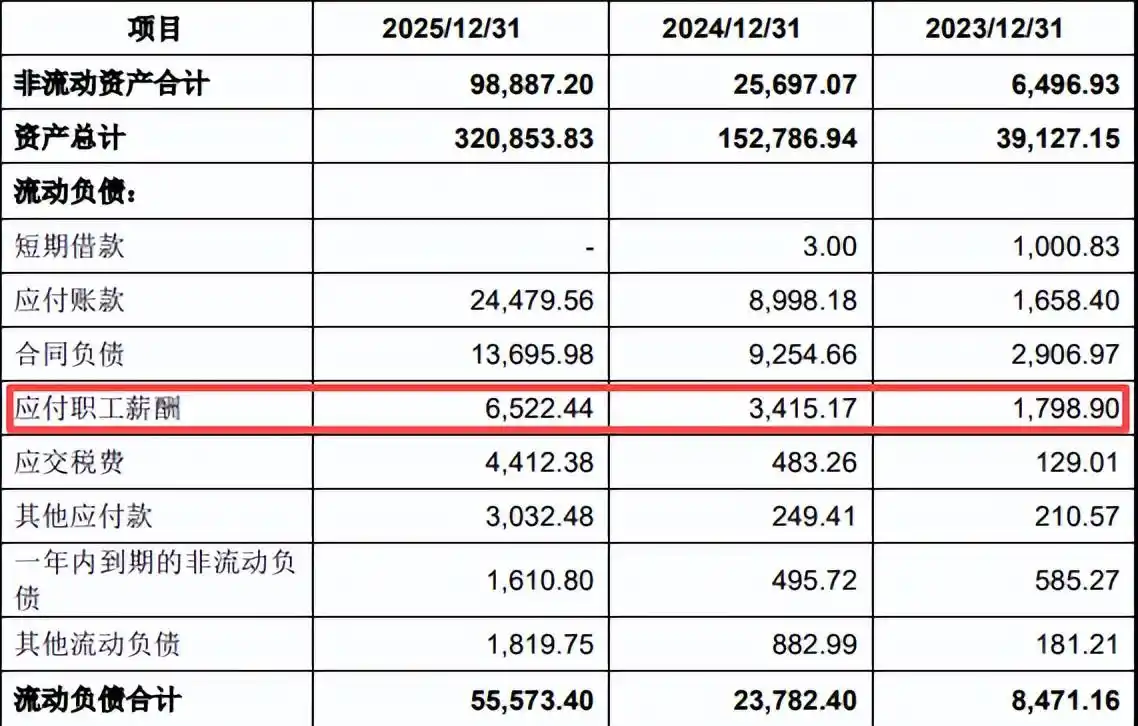
Source: Yushu Tech Prospectus
Comparing these figures, even top-tier companies don’t deliver the sky-high average salaries often imagined. According to Dahan Daily, some former Yushu employees noted that regular staff salary increases lag behind industry averages, and work intensity remains high.
This is not an isolated case. Many startups, after securing funding, first raise salaries for core teams and critical roles—while ordinary R&D staff salaries rise too, the increase is often far less dramatic than perceived externally.
The reason the 500,000 CNY offer is called “vegetable prices” isn’t the number itself—it’s that the industry’s perception of “normal pricing” has been distorted by capital rhythms and technological anxiety.
On one hand, elite incoming graduates and pivotal talent commands rapidly inflating salaries; on the other, the majority of R&D staff remain within more realistic compensation brackets. The chasm between them is often not driven by product revenue, but by fundraising pace, technological positioning, and valuation expectations.
Yet the capital environment underpinning this high-salary narrative is not static.
Starting this second half of the year, the first batch of struggling embodied intelligence firms began exiting the market, and IPO conditions tightened—marking the market’s gradual transition into a capital cooling period. Data indicates that industry fundraising in September 2026 declined by about 40% compared to August. As fundraising slows, the high-salary space built on valuation expectations and financing leverage will inevitably contract.
Therefore, what matters most is this: when the industry treats high salaries as a source of security, that security itself may prove unstable.
Source: Yuanmeihui
Disclaimer: Contains third-party opinions, does not constitute financial advice


HuggingFace's "AI Duck" Goes Viral, Boosting Chinese Chip Supplier Rockchip
09-02
Yushu Surges 629% on First Day of Trading, Humanoid Robots Sell 5,500 Units
08-19
14 Executives Depart, Horizon Unleashes a Robot Legion
08-11
Yushu's 61 Billion IPO: Who Will Make Money?
08-07
AI stocks down 40%-60%, yet NVIDIA's valuation is at a 10-year low
08-06
HBM Bottleneck Migration, NVIDIA Also Aims to Downgrade
08-06
AI Servers Fuel Demand for Minor Metals: Prices Surge Over 70% in Half a Year
08-06


