Four AI Video Models Tested: Who Can Deliver Reliable, Usable Videos?
Four AI Video Models Tested: Who Can Deliver Reliable, Usable Videos?

2026-11-12 20:01
Introduction: Seedance is the strongest but most expensive, while Wan excels in material consistency. In recent weeks, the AI video industry has been saturated with a palpable sense of "intense competition" that feels like it's burning up.
In recent weeks, the air in the AI video industry has been thick with a suffocating sense of "burning out from over-competition".
The shift began with capital flows. Early November, Kuaishou announced the completion of a 19.802 billion RMB external funding round for its subsidiary Ke Ling AI, post-money valuation reaching approximately $18 billion—what does this mean?
It exceeds the parent company Kuaishou’s own HK-listed market cap, making the son worth more than the father.
This transaction set a new record for the largest single funding round ever for a global video foundation model company. Even more notably, Tencent, Alibaba Cloud, and Baidu—longtime rivals—appeared on the same shareholder list. On November 5, Sand AI, founded by 90s-born Tsinghua PhD Cao Yue, successfully closed a $200 million Series A+ round, marking its third financing this year. Earlier, Shengshu Tech raised $500 million, and Aishi Tech secured another 100 million RMB in a B+ round in mid-October.
AI video has officially replaced large-scale models themselves as the hottest, most capital-intensive super sinkhole in today’s market. Yet, the hotter the field becomes, the more obvious the inflated claims appear to be sizzling under pressure.
Meanwhile, new models continue to battle head-on: On October 8, Shengshu’s Vidu Q4 Preview launched at a minimum rate of 0.09 RMB per second; on October 15, Kling 4.0 was fully opened; on November 5, Google’s Gemini Omni 1.2 Flash topped both Arena leaderboards and simultaneously slashed prices by 30%.
Just looking at launch events, today’s video models all seem to be “Hollywood-level” productions: a cyberpunk car chase, a solo dance sequence—the texture is so sharp you can see individual pores.
Yet frontline creators are silently fuming with thousands of complaints: the same protagonist shifts from a youthful first love face to a random stranger’s visage in the next shot; given a product reference image, one expects faithful replication, but the output ends up worse than the original; asking someone to pick up a noodle with chopsticks results in obviously fake spinning noodles; the characters’ signage always renders as a jumbled mess of familiar-looking gibberish.
The most painful truth? Users can’t afford to keep pulling random cards daily—just testing a few videos burns through 100 RMB. High costs force users to meticulously ration every generation.
Today, we’ll take the perspective of an everyday user plagued by prompt engineering and conduct a cross-comparison of four models: Seedance 2.5, Kling 4.0, Vidu Q4 Preview, and Wan 3.0.
This evaluation focuses on just one question: when accounting for instruction following, material fidelity, generation speed, and failure retry rates, which model can most consistently deliver a usable video? For creators, this determines the real cost of a single clip; for Ke Ling AI, recently independent from fundraising, it also answers whether its $18 billion valuation holds water.
Action Sequence: When Ling Ling and Xue Zhenzhu Fight in the Office
Compared to real filming, AI-generated video is most easily exposed as "obviously fake" during action sequences—when the model fails to understand physical laws, fights inevitably feel weak, lacking impact and proper force.
To test how well these models handle action scenes, we simulated a modern office showdown inspired by Ip Man: let “Xue Zhenzhu” and “Ling Ling” fight it out with real weapons in a corporate environment.
Test Prompt:
A hardcore, master-level martial arts duel in a modern office setting:
【0–5 seconds】: The woman on the right, wearing a beige trench coat and glasses (Ling Ling), furious, suddenly grabs a stack of files from the desk and hurls them toward the left; the elderly woman on the left, clad in a leopard-print coat with red lipstick and curly hair (Xue Zhenzhu), narrows her eyes, her orange handbag hanging on her left arm remains perfectly still, while her right hand swiftly executes a Wing Chun 'Palm Block', precisely deflecting the flying files—A4 paper explodes into a shower. Immediately after, she lunges forward, fists striking like a Gatling gun against the beige trench coat, each punch causing visible fabric dents and wind waves, forcing the opponent to retreat helplessly.
【5–10 seconds】: She smoothly drops her shoulder, twists her waist, transforms her right palm into a flat strike, delivering a powerful slap squarely across the opponent’s left cheek! The camera instantly cuts to 240fps slow motion—upon contact, the cheek’s soft tissue undergoes violent wave-like deformation, the thin-rimmed glasses fly askew and shatter upon impact, spinning mid-air before smashing onto the ground, hair completely disheveled.
【10–15 seconds (Close-Range Punch & Environmental Destruction)】: Return to normal speed. She lands one final close-range punch to the opponent’s abdomen, sending them airborne backward, crashing into a wooden desk behind them. The monitor, keyboard, and thermos fall chaotically to the floor. She elegantly retracts her fist, casually adjusts the collar of her leopard-print coat, and sneers coldly with her red lips.
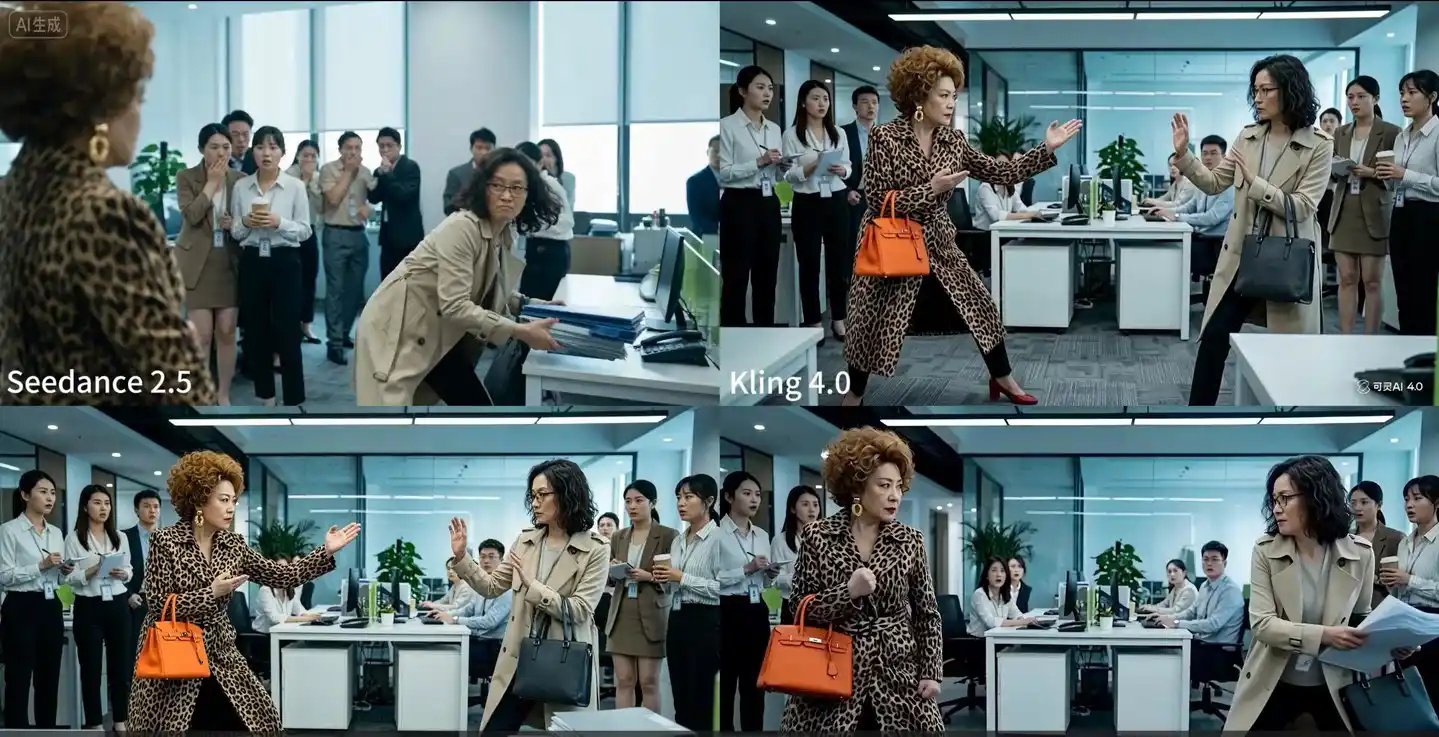
Seedance 2.5 performs impressively here, rendering the facial soft-tissue compression during the slap with remarkable realism—borderline cinematic quality. (Though it pays little attention to bystander safety during the assault.)
Vidu Q4 Preview largely fulfills most prompt requirements—such as deflecting the file stack and the final sneer. Its slap effect is reasonably realistic, though the rapid-fire punches lack sufficient force. Additionally, the floating glasses have an extra leg.
Kling 4.0 delivers decent punch effects, but when the opponent’s glasses “fly off,” the physics is inconsistent, and the shattered lens fragments look artificial—white lenses breaking into black shards.
Wan 3.0 struggles significantly: the recoil after consecutive punches appears jerky, the slap turns into a fist, and the glasses’ flight path is absurdly unrealistic. Overall, performance in action scenes is poor.
Emotional Performance: Seamless Emotional Shifts from Sorrow to Joy and Back
AI is now competing directly with short-form and long-form drama actors for livelihoods. But can their performances match those of real actors? If not, what’s the gap—eye-catching fake or merely subpar?
Recreating a scene from Wong Kar-wai’s “The King of Comedy,” where the male director asks Wong Kar-wai to demonstrate emotions sequentially: “wife giving birth,” “son born,” “wife dead.”
We pay homage: assign the AI protagonist a storyline involving winning the lottery only to find it expired, testing a seamless four-stage emotional arc: extreme sorrow → shock-induced joy → frozen smile → collapse into despairing laughter.
Test Prompt:
【0–4 seconds (Grief & Tears)】: In a dimly lit rental apartment, a scruffy young man stares blankly at a instant noodle table, his eyes hollow and desperate. Tears finally overflow from his bloodshot eyes, a single droplet sliding down his rough cheek. His mouth twitches painfully downward.
【4–8 seconds (Pupil Dilatation & Tearful Joy)】: His gaze locks onto a crumpled blue lottery ticket in his hand—his pupils dilate violently, breath stops. Then, with tears still wet on his cheeks, his eyebrows and mouth uncontrollably surge upward in ecstatic delight (must retain visible moisture and full-toothed grin simultaneously). His hands tremble violently with excitement.
【8–12 seconds (Smile Instantly Fades)】: Mid-ecstasy, his eyes suddenly drop to the bottom of the ticket—“Expired.” Within one second, the lifted facial muscles and mouth collapse like a power cut, expression turning instantly rigid and lifeless, eyes shifting from wild joy to utter blankness.
【12–15 seconds (Desperate Smile)】: He releases the ticket, letting it float out of frame. Slowly closes his eyes, takes a deep breath, then opens them again—giving rise to a grotesque, tear-streaked smile far worse than crying. He shakes his head weakly.
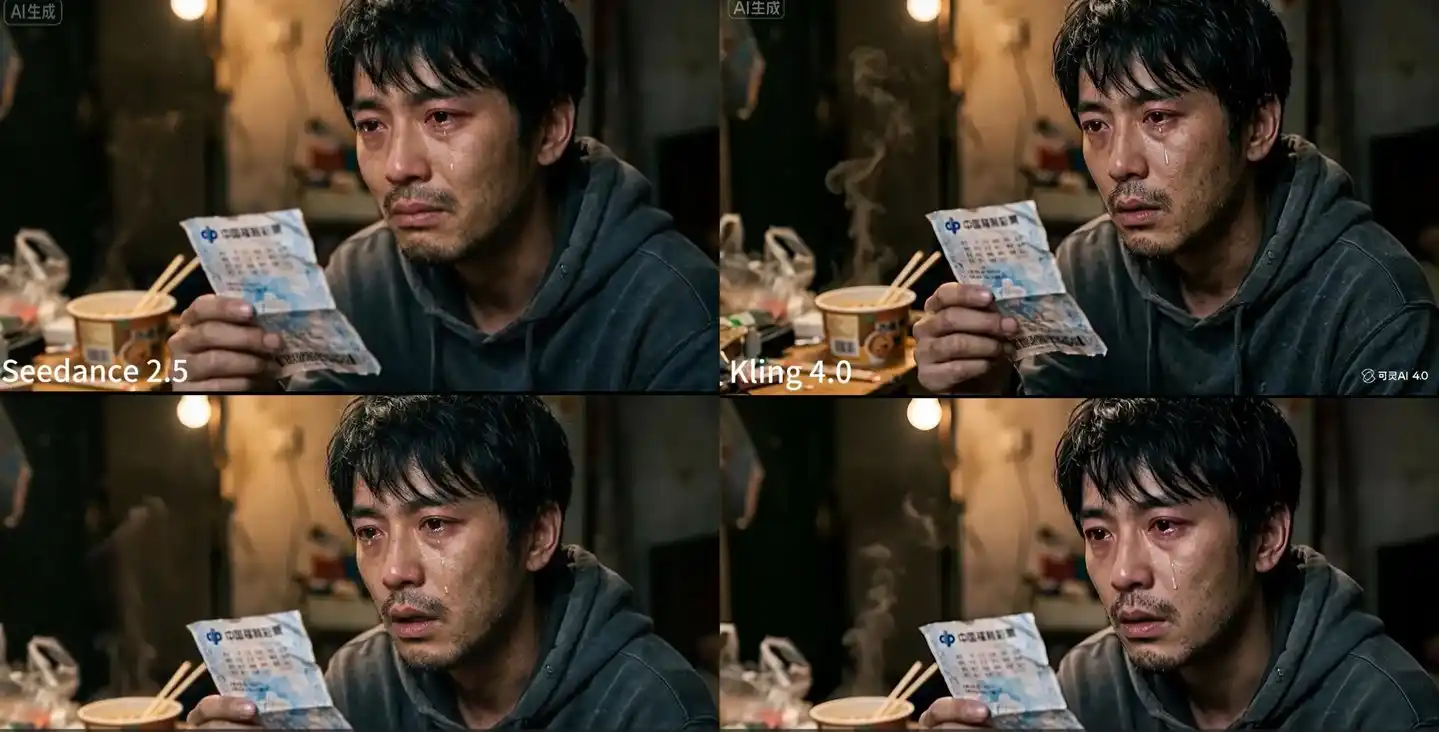
Overall, Seedance 2.5 excels in facial muscle control: early trembling mouth is clearly visible, and the final grimace feels authentic—outperforming the other three models.
Kling 4.0 performs well overall, though the ecstatic facial distortion is overly exaggerated. Vidu Q4 Preview starts shaking prematurely in the early stage, but the final breakdown glance is excellent, capturing sudden confusion convincingly.
Wan 3.0 performs decently initially, but the final grimace falls short—it looks more like resignation than genuine despair.
Multi-Reference Material Consistency: Can AI Truly Utilize Every Reference?
Previously, video creation was most frustrating when characters turned into different faces mid-shot, or objects transformed into something else between camera angles. To maintain consistency, platforms now offer reference video features, allowing users to upload pre-made assets for use in videos. Current benchmarks generally require support for up to 15 image references.
We jump straight into testing: first generate character and prop images via AI, then task the video models with recreating a low-budget version of “Huaqiang Buigua” (Huaqiang Buys Watermelon).
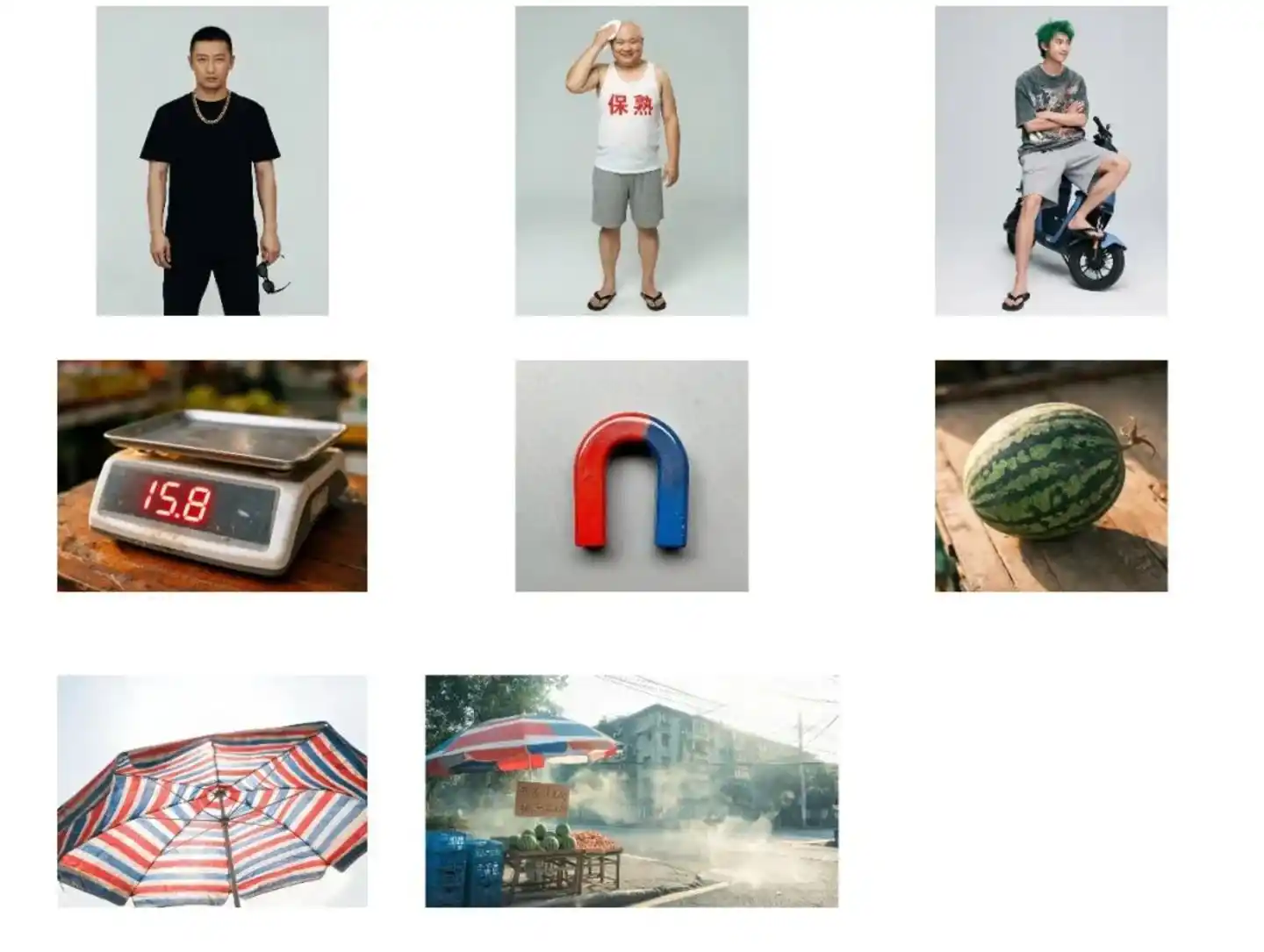
Test Prompt: On a summer street fruit stall, under a red-blue-white striped sunshade. Foreground left: Huaqiang (Image 1), wearing a gold chain, staring coldly at the counter; foreground right: bald boss in a white “Guaranteed Fresh” vest (Image 2), drenched in sweat; background left: green-haired youth (Image 3) straddling an electric scooter.
0–5 seconds: Huaqiang removes his sunglasses, voiceover 1 speaks in a low tone; the bald boss forces a nervous smile, the word “Guaranteed Fresh” on his vest clearly visible.
5–10 seconds: Close-up on the electronic scale (Image 4), red digits flashing “15.8,” holding a striped watermelon (Image 6). Huaqiang flips the tray open, pulls out a red-blue U-shaped magnet hidden beneath the scale (Image 5), slaps it beside the melon.
10–15 seconds: Full-face close-up of both men, Huaqiang smears the raw melon flesh onto the boss’s head.
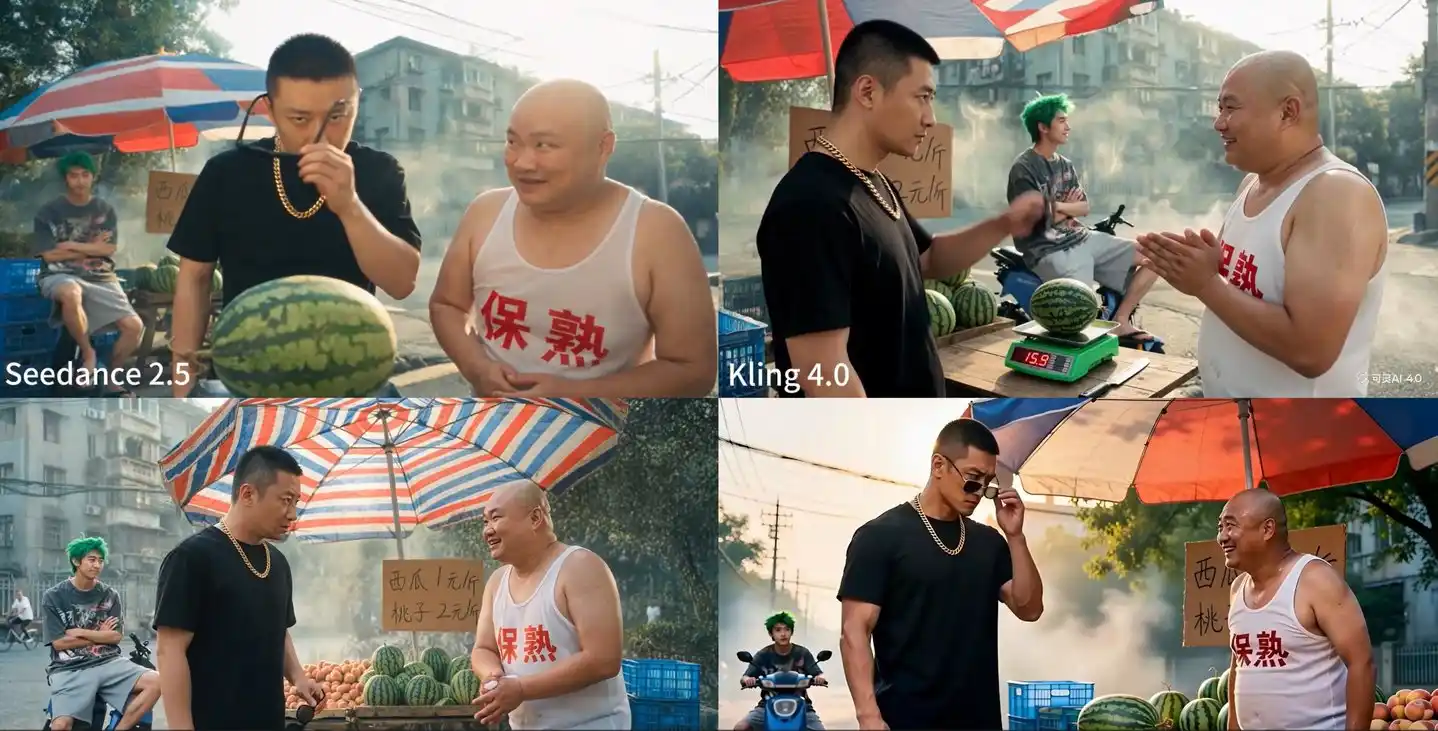
This round, Wan 3.0 stands out best: it preserves the scene while accurately reproducing the uploaded sunshade at 1:1 scale. It also correctly renders the magnet and electronic scale—two items where other models failed. However, it still has noticeable flaws: the melon pulp starts white but turns red only when slapped onto the head.
Among the others, Kling 4.0 changed the scale base to green and altered the number display; Vidu Q4 Preview made only the umbrella wrong, kept the melon pulp red throughout—all else correct; Seedance 2.5 lost the spirit youth’s electric scooter entirely and turned the magnet into a circle.
Interaction-wise, Kling 4.0 and Vidu Q4 Preview perform better—they remember the “spectator” role of the spirit youth, reacting with surprise even though it wasn’t explicitly stated in the prompt.
Long Narrative Capability: Nine-Step Dance Battle — Who Lasts?
Generating a few seconds of video is meaningless. To truly integrate into production workflows, users need coherent long-form storytelling. We tasked each model with executing a nine-step continuous dance routine featuring Huang Renxun and Su Ma performing “Updown Funk”—writing nine sequential actions to see who can execute them flawlessly from start to finish.
Consecutive 9-step Long Prompt Excerpt: ① Silver-haired, black leather-clad figure taunts with a hand wave; ② Suit-clad female CEO points at him; ③ Black leather-clad figure performs a crab walk; ④ Draws out a money-shooting gun and fires into the sky… (subsequent steps include high-five without clipping, cross-step kick, knee-slide, shoulder-pat, and final pose—totaling 9 actions).
From performance, Seedance 2.5 and Wan 3.0 both closely follow all required actions. Overall, Seedance performs best—dance flow is smooth and natural, and the toy money-shooting gun effect is more realistic.
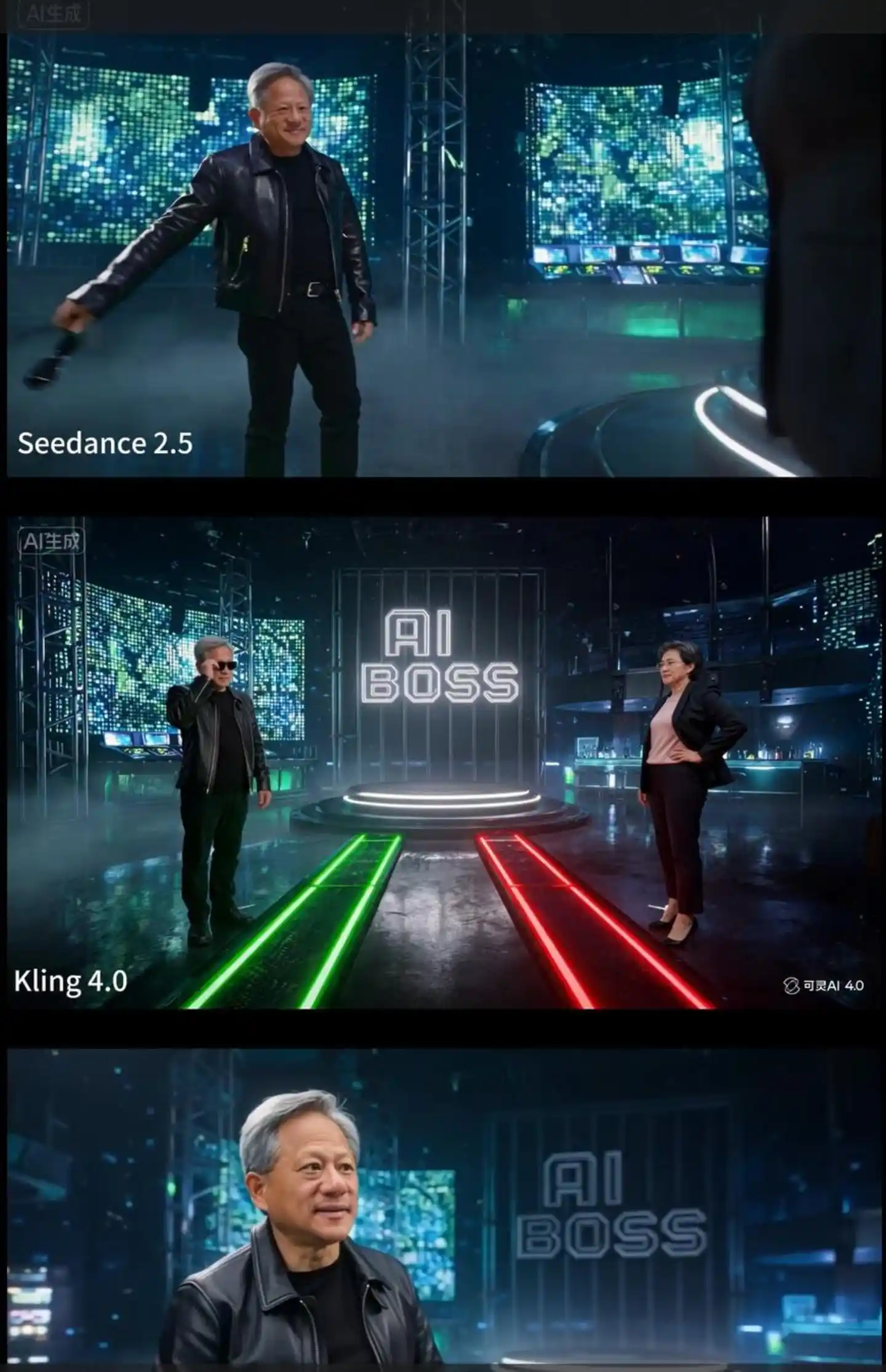
Vidu Q4 Preview, limited to maximum 16-second generation, still managed to pack in all nine steps—but the final “AI Boss” signboard turned into garbled text, and the human realism slightly lags behind other models.
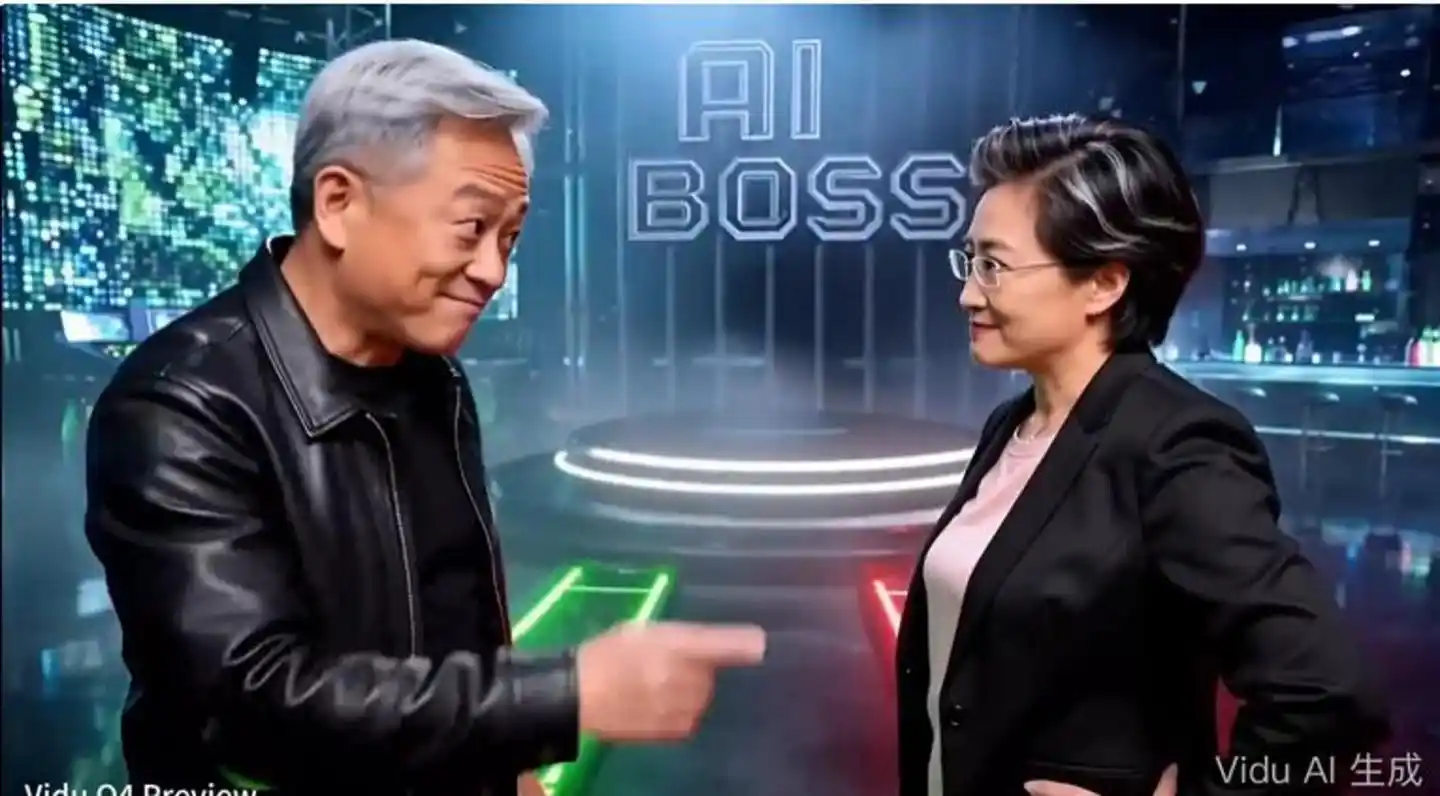
Ke Ling 4.0 missed a step: it omitted the “cross-arm shoulder pat” move in the penultimate action. Additionally, the toy money gun appeared to float when pulled from the chest, and several camera rotations felt abrupt.
Eating Spaghetti: The Everlasting “Spaghetti Barrier” for AI
In the AI video industry, “eating spaghetti” is a legendary challenge. Years ago, the “Will Smith Eating Spaghetti” test emerged, revealing distorted expressions, stiff hand movements, awkward swallowing, and unnatural noodle twisting—making the difficulty of AI eating spaghetti instantly clear.

The challenge lies in teaching AI how to hold the fork, how to wrap noodles properly, and how they bend realistically when inserted into the mouth. Noodles must remain continuous—soft, slender, bending, wrapping, stretching.
Test Prompt:
【0–5 seconds】: A girl with a bun grips a metal fork in her right hand, rotating her wrist twice, tightly wrapping several strands of red tomato-meat-sauce-laden spaghetti around the tip of the fork in tight coils (must show the physical process of rotation and coiling—no flat fork placement allowed). She lifts the fork upward; the spaghetti naturally hangs down due to gravity, forming long threads.
【5–10 seconds】: The girl opens her mouth, precisely guiding the spaghetti bundle into her oral cavity. Her lips close, biting firmly. With her right hand, she cleanly withdraws the fork—its tip must be empty (spaghetti must be genuinely inside the mouth; no piercing cheek or disappearing noodles allowed). Her cheeks puff up as she chews vigorously, throat visibly contracting during swallowing, a smear of red sauce left at the corner of her mouth.
【10–15 seconds】: Using her left hand, she picks up a transparent orange juice glass, three-quarters full, brings it to her lips, tilts it back, and drinks deeply. As she swallows, the liquid inside the glass follows fluid dynamics, tilting naturally. When she places the glass back on the table, the liquid level must visibly drop below half—irreversible volume reduction.
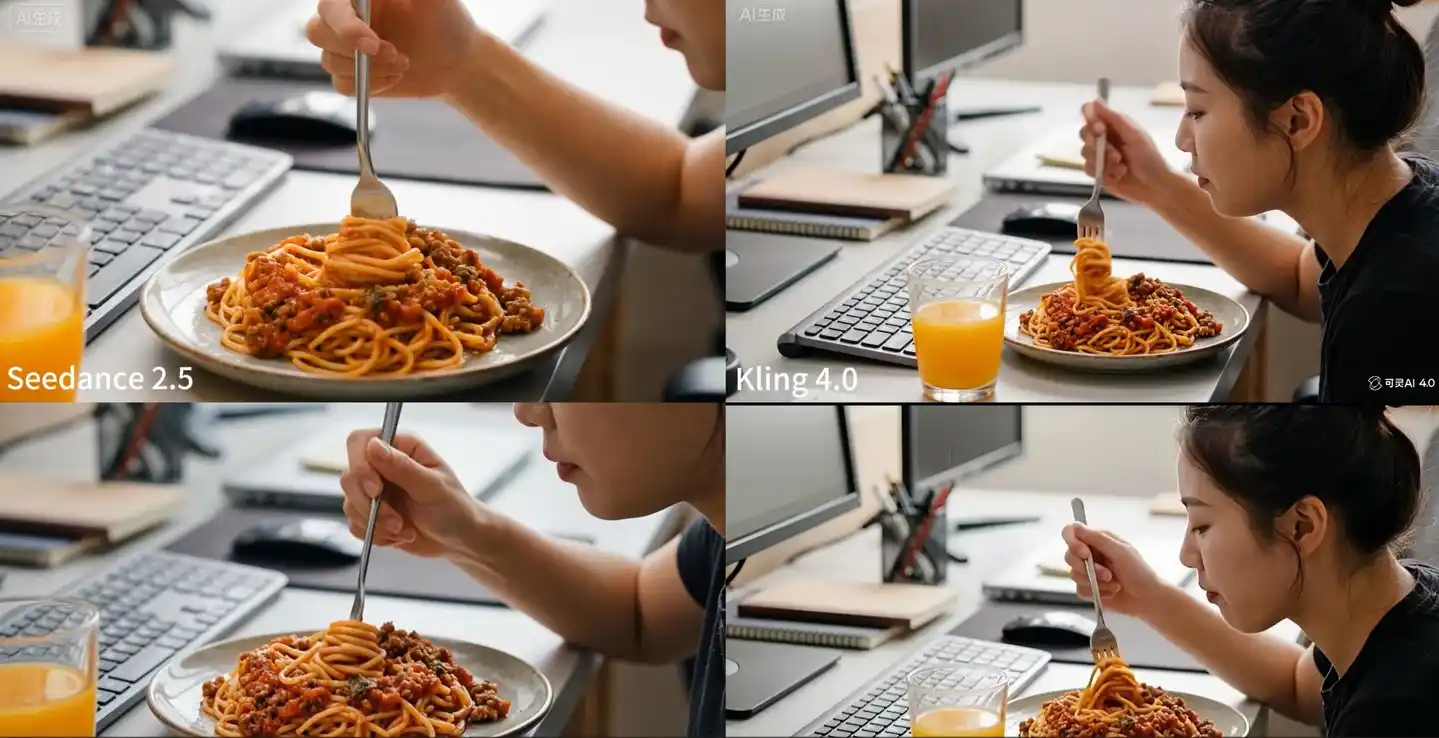
Most models fail spectacularly here—AI simply doesn’t know how to “wrap” noodles. At best, it symbolically picks up already-formed spaghetti from the plate. This is clearly evident in Seedance 2.5 and Wan 3.0.
Kling 4.0 didn’t show the proper coiled spiral shape, but the character’s movements were natural, and the spaghetti on the fork remained in a normal state.
However, Vidu Q4 Preview showed glaring issues: it failed to coil the spaghetti in the plate, yet in the next frame, the spaghetti magically becomes coiled when lifted—clearly a continuity error.
Physical Law Adherence: Conservation of Momentum in Newton’s Cradle
This is a classic benchmark in our test suite. Testing Newton’s Cradle primarily assesses whether the model handles collisions, momentum transfer, and temporal evolution correctly. In an ideal Newton’s Cradle, lifting one ball and releasing it causes a chain reaction—only the opposite ball swings outward, while the middle balls remain stationary.
Video models often render scenes realistically but miscalculate movement—such as balls passing through each other, stopping mid-air, or sudden velocity changes.
Test Prompt:
Five identical steel balls suspended by thin strings form a Newton’s Cradle. The leftmost ball is pulled back and released, triggering elastic collisions. The rightmost ball swings outward immediately, while the middle three remain relatively still. Energy and momentum propagate sequentially, with oscillations gradually damping. Fixed front-facing camera, stable framing. Natural lighting, metallic spheres exhibit realistic reflections and subtle shadows.
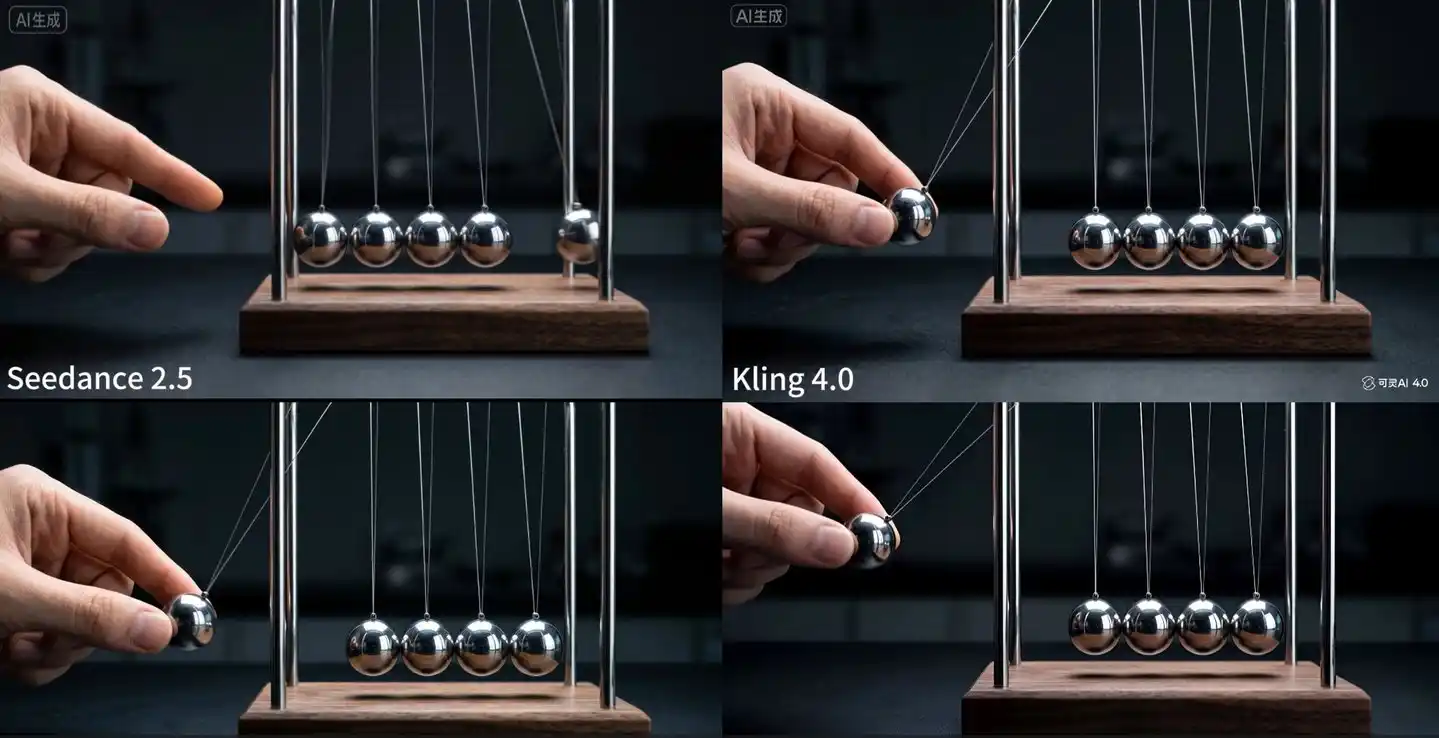
In this test, Kling 4.0 performed best—ball movement speed closely matched reality, and no errors occurred in subsequent motion changes. Seedance 2.5 moved too slowly, but overall adherence to physical laws was acceptable.
However, Vidu Q4 Preview and Wan 3.0 performed poorly: the former showed overlapping balls—initially normal, but starting at 5 seconds, they flew wildly; Wan 3.0 got it wrong from the beginning—balls moved slowly and flew erratically.
Light Source Tracking: Flame Sweep Across Face and Underlighting Effect
Differences in texture between real and AI-generated videos still lie in shadow and subtle local lighting tracking. This test evaluates how models handle light trajectory tracking in a dark room.
Test Prompt:
【0–8 seconds (Hand-held Light Sweeping Face 180° Horizontally)】: He slowly moves his right hand, bringing the flame of a single glowing lighter from beside his right cheek, across the nose center, to beside his left cheek. As the light source moves from right to left, the illuminated areas, eyeglass frames, and high nasal bridge casting shadows on his face must smoothly transition from the right half to the left half in real time. The reflection point of the flame on the lenses must also slide synchronously from right to left.
【8–12 seconds (Move Below Chin — Test Horror-style Underlighting)】: Head stays fixed, right hand moves the flame vertically downward to hover directly below the chin. The light becomes extreme downward-facing ‘horror movie underlighting’—the chin, nostrils, upper lip, and lower eyelid glow intensely, while the upper eye sockets and forehead plunge into deep shadow.
【12–15 seconds (Extinguish to Total Darkness)】: He lowers his head and blows gently—the flame extinguishes instantly, plunging the scene into 100% total darkness. Only a wisp of smoke and the last glimmer of light on the glasses fade away.
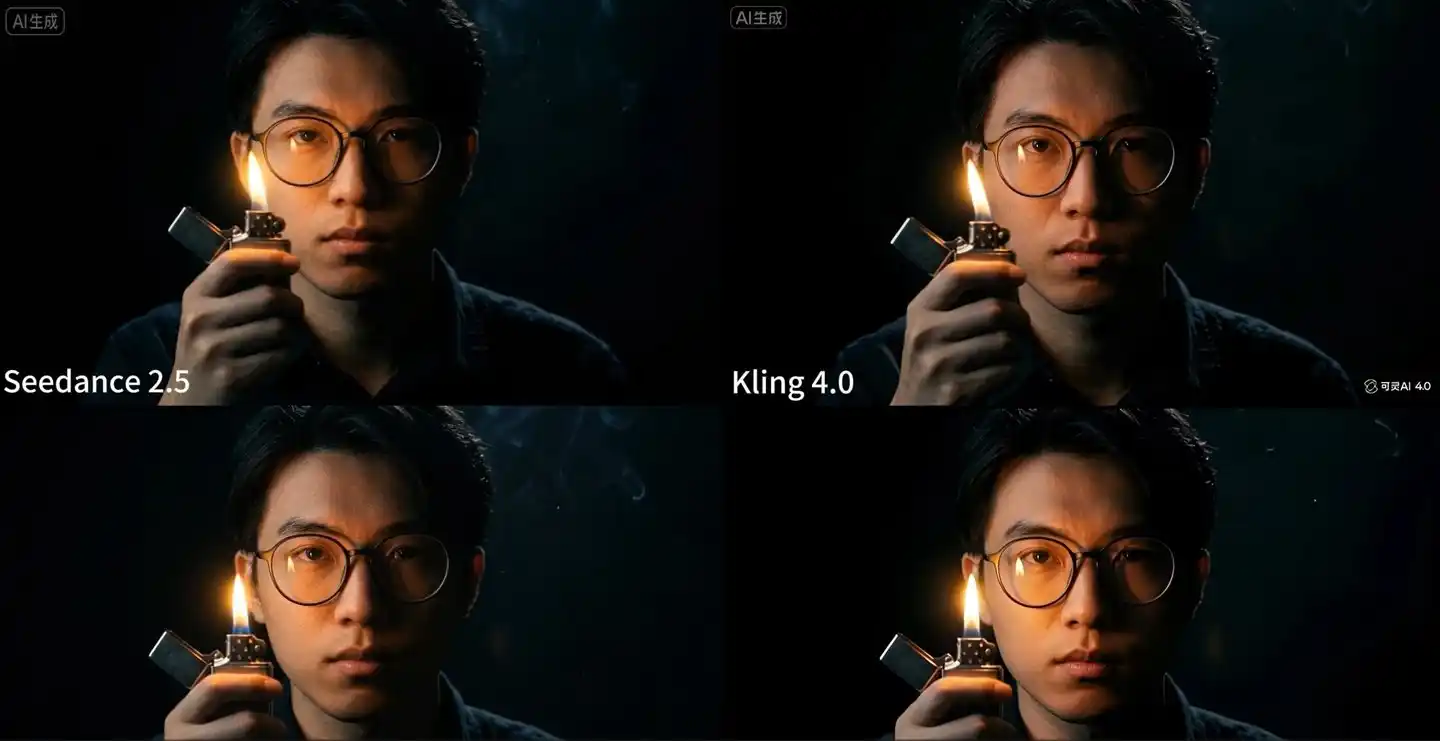
When handling horizontal flame sweeps, Seedance 2.5 delivered the best result—overall shadow rendering is highly realistic, and the transition to underlighting at the chin is natural.
Kling 4.0 performed well for the first ten seconds, but during the underlighting phase, the head’s shadow lagged noticeably—one second after the lighter moved, the lighting change followed. The final extinction effect was also chaotic.
Wan 3.0 lacked strong contrast and did not follow the prompt’s requirement for horror-style underlighting. Vidu Q4 Preview’s lighter movement was inadequate—not completing the full left-to-right sweep—but in terms of lighting rendering, it was actually quite ideal.
Audio-Visual Synchronization: Tongue Twister and Crunchy Cucumber
Final simple test—also a key assessment of AI video application in film production: sound and lip sync must align perfectly to avoid breaking immersion.
Test Prompt:
【0–7 seconds】: Male host in yellow hoodie leans close to a condenser microphone, speaking rapidly and clearly in Mandarin: “Eight hundred soldiers race northward, artillerymen running side by side!”
【7–10 seconds】: After finishing the tongue twister, he immediately stuffs a fresh, crisp cucumber into his mouth with his left hand, crunching loudly (accompanied by extremely crisp stereo sound effect). While chewing with puffed cheeks, he mutters indistinctly but with perfectly synchronized lip movements: “Oh my god, this cucumber is really crunchy!”

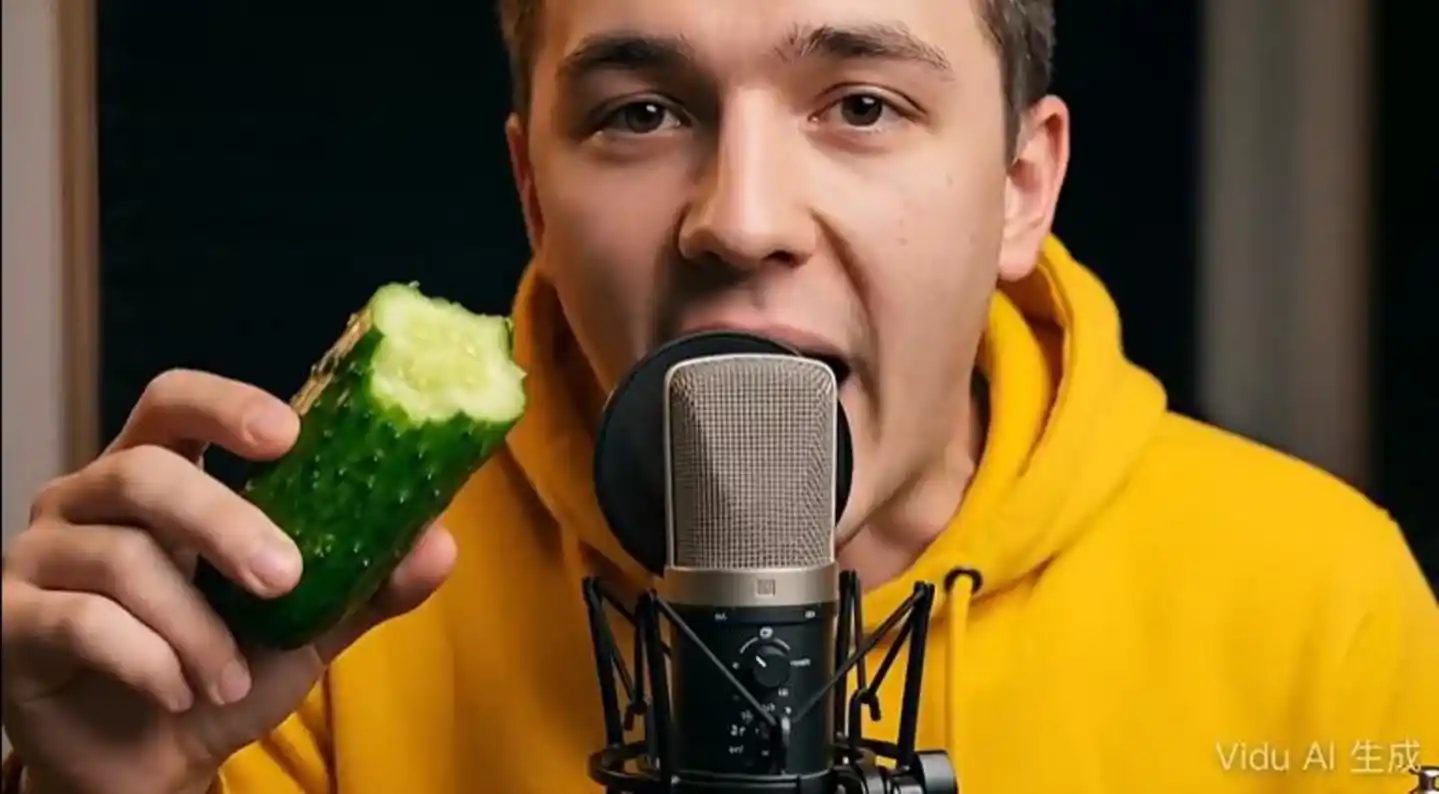
In actual testing, Seedance 2.5 and Kling 4.0 performed normally—no need to display here.
Vidu Q4 Preview repeatedly misread words or added extra syllables in multiple trials. Wan 3.0 used breathy vocalization for dubbing, which felt jarring.
Which Model Is Best? (The Most Direct, Objective Conclusion)
After eight rigorous tests, we summarize the strengths and weaknesses of the four models and recommend choosing based on your specific needs, considering time and cost.
Seedance 2.5: Unmatched capability, but slow and expensive.
While not optimal in multi-item reference scenarios, Seedance 2.5 clearly outperforms others in complex instruction-following, character realism, and emotional expression.
Its major drawbacks: excessive slowness and high cost. Assuming a 15-second 720p video consumes 12 credits for 1 RMB, it uses 300 credits—equivalent to 25 RMB per video.
Additionally, timing measurements show that generating a ~10-second video, excluding queue time, took 10 minutes—waiting time is significantly longer.
Kling 4.0: Inconsistent performance, but top-tier overall quality.
Its physics handling shows contradictions: strong in spaghetti-eating and Newton’s Cradle, yet weak in destructive scene physics.
Nevertheless, in the above series of tests, Kling 4.0 consistently ranks in the Top 2.
Compared to Seedance 2.5, Kling 4.0’s standout advantage lies in cost-effectiveness. At 100 credits for 5 RMB, generating the same 720p 15-second video requires only 150 credits—costing about 7.5 RMB per video, roughly one-third of Seedance 2.5’s price.
Moreover, in generation speed, Kling 4.0 is sometimes significantly faster than Seedance 2.5 and Wan 3.0—some 10-second videos complete in under 2 minutes.
Wan 3.0: Master of material consistency, weak in action scenes.
In consistency testing, Wan 3.0 is the sole winner: the sunshade rendered at 1:1 scale, the magnet under the scale and the blinking electronic scale—two items where others failed—are preserved. This strength is particularly valuable for e-commerce live-streaming and product advertising.
However, its performance in physics and action scenes is poor—Newton’s Cradle flies apart immediately, slap turns into a punch, rapid-fire punches stutter.
From a cost-efficiency standpoint, at 100 credits for 10 RMB, requiring 67.5 credits per 15-second video, the 720p 15-second video costs 6.75 RMB—slightly below Kling 4.0.
But its generation speed is very slow—comparable to Seedance 2.5—around 6–8 minutes per 10-second video. This explains why Alibaba launched Wan 3.0 Prime, the accelerated version.
Vidu Q4 Preview: Cost-effective choice, but specialized.
Overall, Vidu Q4 Preview excels in acting and cinematic tasks—its action scenes faithfully follow prompts, emotional expressions are rich, and even eating a cucumber shows more nuanced emotional fluctuations than other models.
Yet it relies heavily on trial-and-error generation. In realism evaluations, its performance falls short—floating glasses with an extra leg, spaghetti not wrapped in the plate but magically coiled in the next frame.
Among the four models, Vidu Q4 Preview is among the cheapest—69 RMB for 800 credits, 90 credits per 15-second video—costing 7.76 RMB for a 720p 15-second video, slightly higher than Wan 3.0 but significantly faster—around 2–3 minutes for a 10-second video.
Source: Light Cone Intelligence
Disclaimer: Contains third-party opinions, does not constitute financial advice


The AlphaGo Moment in Cybersecurity, or Starting from These 466 Agent Matchups
7 days ago
AI is not a search bar—it's a supercomputer costing just a few dozen dollars
08-05
Anthropic Locks in 6 Years of Compute with $10 Billion Commitment
08-05Not building robots—why is it worth $14 billion?
07-31Douyin Releases 220,000 AI Animated Series in Half a Year, Most Creators Earn Less Than $10 Monthly
07-29AI is no longer competing on benchmark scores, but on profitability
07-25
ByteDance's Douyin Beans priced at 68 RMB—worth it for 382 million monthly active users?
07-25


