Google's first decision-making model, capable of assessing 1,000 questions in a single run
Google's first decision-making model, capable of assessing 1,000 questions in a single run

2026-11-12 16:39
Introduction: A single forward pass enables thousands of judgments to share context. What is Gemini Decision 1? Gemini Decision 1 is Google's first decision model—no chat, only judgment. One API call can answer up to 1,000 yes/no, multiple-choice, or scoring questions based on a single multimodal input (text, image, audio, video, PDF, up to 256K tokens), outputting answers, option probabilities, and confidence scores from 0 to 1 in one response with latency of 150–250ms. Gemini Decision 1 is ideal for batch judgment scenarios such as tool selection, content moderation, and model routing.
What is Gemini Decision 1?
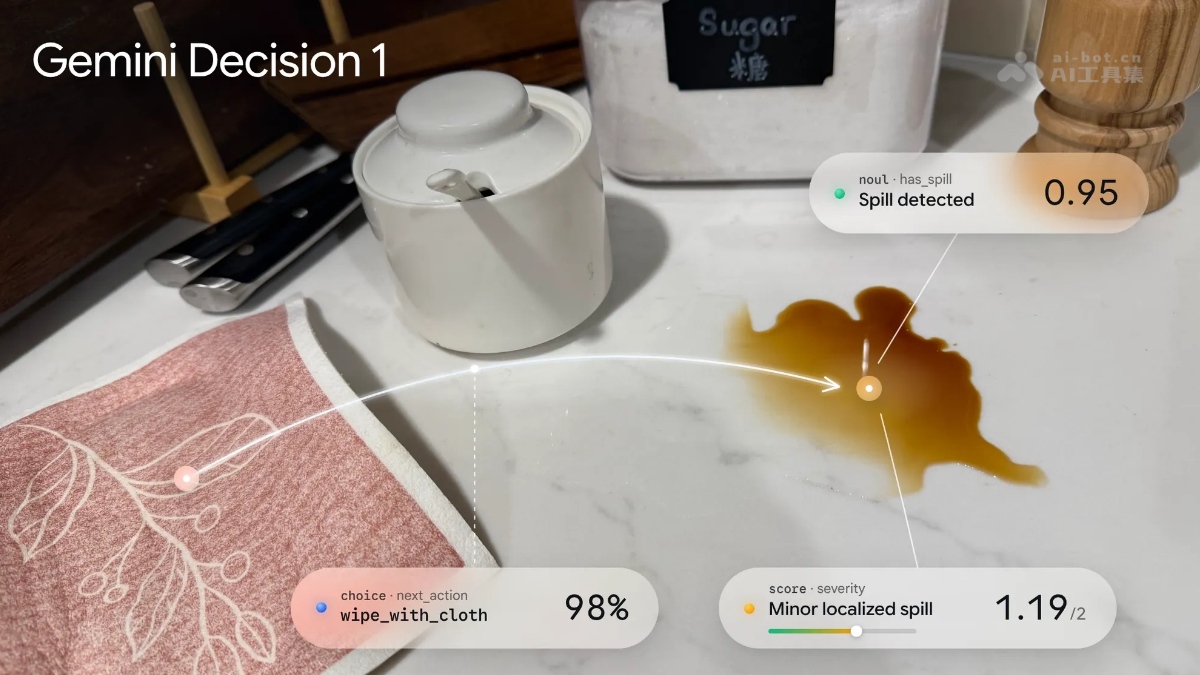
Gemini Decision 1 is Google’s first decision model, designed for judgment tasks rather than conversation. It can process up to 1,000 yes/no, multiple-choice, or scoring questions in a single API call using the same multimodal input (text, images, audio, video, PDFs, max 256K tokens). The model returns answers, normalized probabilities for each option, and a confidence score between 0 and 1—all within 150–250ms end-to-end latency. This makes it highly suitable for high-throughput, low-latency applications like tool selection, content moderation, and model routing.
Key Features of Gemini Decision 1
- Batch Judgment: One API call evaluates up to 1,000 questions based on a shared input, eliminating the need for sequential queries.
- Three Question Types: Supports yes/no (noul), multiple-choice (choice, 2–255 options), and ordered scoring (score) questions.
- Probabilistic Output: Returns answer, normalized option probabilities, and a 0–1 confidence score per question, enabling automated decision routing via code.
- Native Multimodal Input: Text, images, audio, video, and PDFs can be mixed in a single input and evaluated in one pass—no preprocessing or splitting required.
- Confidence-Based Routing: Low-confidence outputs can be automatically routed to fallback models or human review.
- Ultra-Low Latency: End-to-end latency of 150–250ms; model computation alone takes only 50–100ms, with nearly flat scaling across 1 to 100 questions.
Technical Principles Behind Gemini Decision 1
- Single Forward Pass Scoring: Unlike traditional generative models that decode token-by-token, Gemini Decision 1 skips decoding entirely. Instead, it assigns a probability score directly to each candidate option in a single forward pass. This eliminates output token costs and serial decoding latency, enabling zero-cost output billing.
- Native Multimodal Architecture: Built on a unified representation space, the model processes text, images, audio, video, and PDFs natively. Mixed inputs (e.g., call recordings + account data, scanned documents + damaged photos) are evaluated without splitting or preprocessing. Image and video inputs also support resolution tuning for trade-offs between visual fidelity and token cost.
- Calibrated Confidence Estimation: All output probabilities are trained through calibration to reflect real-world accuracy rates, ensuring reliable automation policies—such as triggering human review when confidence falls below a threshold.
- Shared Context Reuse: The multimodal input is encoded only once and reused across all questions. Each question adds only its own prompt and option tokens, so increasing the number of questions incurs negligible additional latency or cost—this is the technical foundation of its “pay once per input” pricing model.
How to Use Gemini Decision 1
- Request API Key: Log in to Google AI Studio to create or copy your API key.
- Install SDK: Ensure you have
google-genaiPython SDK version ≥ 3.2 (pip install -U google-genai). - Initialize Client: Create a client using
genai.Client()and specifyapi_version="v1beta"(Decisions API is currently available only in v1beta). - Prepare Shared Input: Place your judgment content into the
inputfield—supports text, images, audio, video, and PDFs, allowing mixed modalities in one input (charged once regardless of mix). - Define Questions: Specify each question in the
questionsdictionary—usenoulfor yes/no,choicefor multiple-choice (2–255 options), andscorefor scoring questions. Up to 1,000 questions per request, with mixed types supported. - Send Request: Call
client.decisions.create(model="gemini-decision-1", ...)and wait 150–250ms for results. - Parse Results & Route: Extract answers, option probabilities, and confidence scores. Route low-confidence responses to fallback models or human review.
Core Advantages of Gemini Decision 1
- Extremely Low Latency: End-to-end latency of 150–250ms, with near-identical performance for 1 vs. 100 questions—ideal for real-time routing, moderation, and online inference.
- Native Multimodal Support: Text, images, audio, video, and PDFs can be combined in a single input and evaluated in one pass—no preprocessing or splitting needed.
- Unified Coverage of Three Question Types: Yes/no, multiple-choice, and scoring questions can be mixed in a single request, all sharing one input—up to 1,000 questions per batch.
- Calibrated Confidence Scores: Each answer includes a 0–1 confidence score with industry-leading calibration accuracy—low-confidence results can be auto-routed to fallback systems or human reviewers.
- One Forward Pass, Full Output: Bypasses stepwise decoding and directly scores candidate options—resulting in faster, cheaper, and structurally consistent outputs.
Project Repository
- Official Website: https://blog.google/innovation-and-ai/technology/developers-tools/gemini-decisions-api/
Competitive Comparison with Gemini Decision 1
| Comparison Dimension | Gemini Decision 1 | Jev |
|---|---|---|
| Third-party Decision Score | 66 points | 66 points |
| Google Internal Benchmark (9 metrics) | 7 outperforming | 2 outperforming |
| JevBench (Google standard) | +2.2 points lead | Baseline |
| Knowledge & Reasoning Tasks | Highest across all categories | Second best |
| Classification & Information Extraction | Average performance | Good performance |
| Benchmark Cost | $345 / million tasks | Lower |
| Input Pricing | $0.10 / 1M tokens | Lower than Gemini |
| Output Pricing | Free | — |
| Maximum Questions per Call | 1,000 questions | Fewer |
| Latency | 150–250ms | — |
| Multimodal Support | Text/Image/Audio/Video/PDF | Text-focused |
| Audio/Video Evaluation Performance | Supported: Unique feature | Not Supported: Missing |
| Confidence Calibration | Lowest calibration error | Second best |
| Free Tier | AI Studio Free Tier | Available free tier |
| Access Channels | AI Studio, OpenRouter (launch day), Google Cloud (coming soon) | OpenRouter, etc. |
Use Cases for Gemini Decision 1
- Model Routing: Acts as an intelligent entry router, judging query complexity in milliseconds—simple queries use lightweight models, complex ones trigger deep reasoning, reducing latency by up to 40%.
- Content Safety Moderation: Enables bulk policy checks on text, images, and audio/video content, with low-confidence outputs automatically routed to human review.
- Tool Selection (Tool Selection): In agent-based workflows, selects the optimal tool from 2–255 candidates in a single call—significantly faster than having an LLM generate each invocation sequentially.
- Customer Service Ticket Prioritization: Combines call recordings and ticket text to use scoring questions (score) for automatic severity-based ticket routing.
- Interactive App Instant Feedback: Enables sub-second responses in apps like Stitch (rapid clickable wireframe generation) or CC (instant emoji selection from 200+ options)—low latency makes real-time interaction feasible.
Source: AI Tools Hub
Disclaimer: Contains third-party opinions, does not constitute financial advice


Step Code – The Open-Source Terminal Programming Agent by Jieyue Star
09-24
Hy4 Preview Lightweight Version – Tencent Hunyuan's Open-Source Hy4 Quantized Compression Model
09-02
Claude Fable 5.1 – Anthropic's Latest Flagship Large Model
09-02
Open-source Retool is here, drag-and-drop backend with 60+ components
08-19
Claude Opus 5 is Here: Half the Price Approaching Fable 5
07-25
Tencent Open-Sources 260 Real-World Tasks to Test AI Workforce Capabilities
07-25
Meituan Open-Sources AI Exam Platform: 813 Minecraft Tasks
07-25


