$1,000 Embodied Data Collection Orders: How Do They Become $8/Hour?
$1,000 Embodied Data Collection Orders: How Do They Become $8/Hour?

2026-11-12 10:00
Lead-in: Huang Renxun’s compute accounting is pushing data away from hourly pricing. Xiao Yun repeatedly layers and unfurls her jacket at home—this is a physical data collection task she received from a part-time group. When she gets paid, it's at a rate of
Xiao Yun repeatedly layers and unfurls her jacket at home. This is a physical data collection task she received from a part-time group, earning 15 RMB per hour.
The first-person action data she records, after being packaged by intermediaries, can be sold to robotics companies at up to 300–500 RMB per hour. The gap between 15 RMB and 300 RMB isn't just about data quality—it also spans a multi-tier subcontracting chain.
The Star Tech Daily reporter spent several days investigating frontline data collectors, data suppliers, procurement parties, and county-level data collection service providers. The findings reveal significant price disparities in embodied data transactions. While high-quality real-machine data can be priced at over 1,000 RMB per hour, raw monocular data at the downstream end sells for as low as 5 RMB per hour. These price differences stem not only from variations in data quality and processing depth but also from layered subcontracting and repeated resales. In some projects, frontline collectors are paid as little as 8 RMB per hour.
On one hand, capital is heavily investing in embodied intelligence data collection services, with multiple firms joining the billion-dollar valuation club, while the industry loudly claims scarcity of high-quality data. On the other hand, low-quality replicas flood the market, orders are sub-subcontracted across multiple levels, data provenance fails, and authenticity of orders is increasingly questioned. How does a 1,000 RMB per hour order for embodied data collection gradually collapse into an 8 RMB hourly wage? Where do 5 RMB per hour data sources come from?
Recently, The Star Tech Daily reporter traced the flow of orders and data origins through investigation.

Data Collection Worker on Site (Photography by Tianye)
Where Did the Price Gap Go: Layered Subcontracting and Replica Reselling
Xiao Yun’s experience is far from isolated. Multiple data collection practitioners confirmed to The Star Tech Daily reporter that multi-tier subcontracting exists widely in the industry. An order initially valued at over 100 RMB per hour from a client may pass through five or six intermediaries before reaching grassroots collectors, leaving them with only around 15 RMB—sometimes as low as 8 RMB.
A data collection service provider operating in a county-level region told The Star Tech Daily reporter that his minimum payment to collectors is 30 RMB per hour. “Below this threshold, either the project cannot be profitable, or the data’s compliance and origin are questionable.”
Through interviews, The Star Tech Daily learned that the low barrier to entry for non-physical device data collection has rapidly led to labor subcontracting. Model developers or large suppliers issue orders, intermediaries break down tasks, and regional collection points organize personnel to record actions.
“This is essentially a ‘labor contractor’ model—management capability directly determines output capacity,” said the county-level data collection service provider. “Collectors need only basic literacy and can be trained in three days. As a result, the core profit driver of some projects has shifted from technology development to human organization capabilities.”
In projects the provider has engaged with, after upstream clients secure orders worth hundreds of RMB per hour, they subcontract to service companies at 70–90 RMB per hour, then further divide the work, reducing the final settlement to frontline collectors at only 40–15 RMB per hour. These figures vary across different projects and should not be viewed as fixed splits for a single order, but the phenomenon of successive price suppression was repeatedly mentioned by multiple interviewees.
Senior industry expert Wang Jian likened certain intermediaries to “data grain merchants.” Terminal buyers require tens or even hundreds of thousands of hours of data, so suppliers collect from dispersed collection points, remove duplicates, process the data, and deliver unified packages. Due to the limited number of buyers capable of absorbing massive datasets, whoever controls the order largely holds the power over subcontracting and pricing.
The county-level data collection service provider revealed that domestic data producers average gross margins of 20%–30%, while overseas markets achieve 30%–50%.
Besides subcontracting, another way to depress data prices is selling the same dataset multiple times.
Co-founder and CEO of Lingyu Intelligence Jin Ge estimates that collecting non-physical data in China, even with low-cost approaches, still incurs total costs—labor, equipment, storage, and transmission—of 20–40 RMB per hour. For datasets sold for just a few RMB per hour, buyers must verify whether they are being resold repeatedly, privately retained, or sourced from elsewhere.
“Reselling the same non-physical data three to five times is common in the industry,” Jin Ge said. Because such data is hard to trace, some teams secretly back up data during order completion and resell it; worse, others set up additional recording devices beside customers’ equipment to monetize the same footage across multiple channels.
One practitioner described a more covert operation to The Star Tech Daily reporter: a team ties several phones together with rubber bands and synchronously records the same action. One copy serves the original order, while the rest are kept privately and later enter black markets.
Jin Ge admitted that his team has added traceable “data fingerprints” to real-machine data, but there is currently no effective solution for non-physical data. When data origin, authorization, and resale counts cannot be verified, comparing prices per hour loses its fundamental meaning.
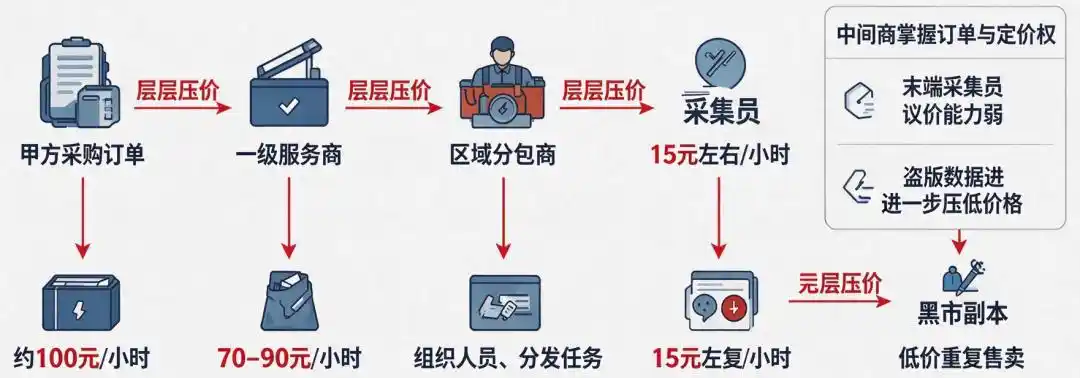
Illustration by Tianye
A Single "Hour" – Price Disparity by a Factor of a Hundred
According to information gathered, currently circulating embodied intelligence data primarily falls into two categories. One is real-machine data generated by robot bodies in operation. The other consists of first-person human perspective recordings captured using cameras, glasses, and similar wearable devices—commonly referred to in the industry as non-physical data or Ego data.
Compiled by Li Mingming
Co-founder and CEO of Lingyu Intelligence Jin Ge provided industry benchmarks to The Star Tech Daily reporter: non-physical data ranges from approximately 100–300 RMB per hour, while real-machine data ranges from 300–1,000 RMB per hour, or even higher.
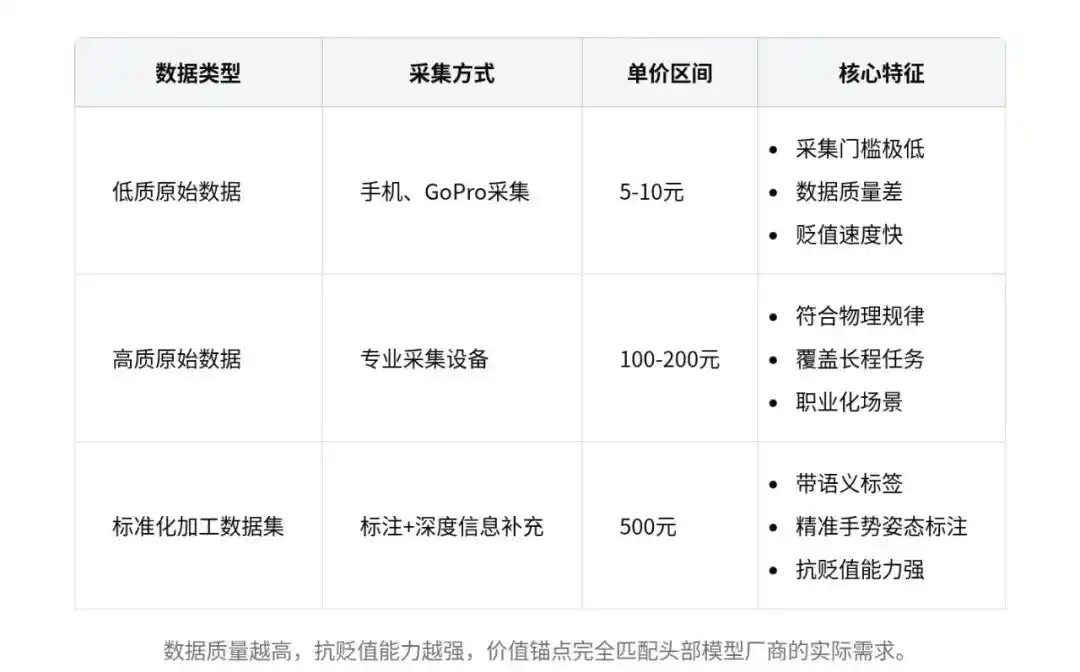
Senior industry expert Wang Jian offered another stark contrast: raw monocular data collected using simple devices like smartphones or GoPros is available from some sources at just 5–10 RMB per hour. After semantic annotation and addition of gesture, posture, depth, and other information, standardized non-physical datasets can reach 500 RMB per hour.
Wang Jian told The Star Tech Daily reporter that many non-top-tier robot body products currently have obvious design flaws, performing significantly worse than humans in routine tasks. He estimates that less than 1% of current real-machine data meets training standards. Only a small number of top-tier manufacturers’ robots meet requirements; most other real-machine data has limited reference value.
A relevant executive from embodied intelligence company Yuanli Lingji also told The Star Tech Daily reporter: “For embodied intelligence, more data isn’t necessarily better. The key is whether the data is authentic, effective, and capable of enabling models to learn correct action strategies.”
If low-quality data is used directly for post-training, inherent issues in the data will be carried into the training process, ultimately manifesting in poor deployment performance. “Using 5 RMB per hour substandard data to train models not only wastes compute resources but also pollutes the model,” said the executive.

Photography by Li Mingming on-site
The Decline of Data Collection Hubs: Orders Must Pass the Test of Real Demand
Beyond pricing confusion, the authenticity of orders is now under scrutiny.
According to The Star Tech Daily, as of June 2026, over 70 embodied intelligence training facilities have been built and activated nationwide, with over 40 more under construction or in planning stages. In September, Shao Tianlan, founder of Mecademic, publicly questioned that some embodied intelligence companies rely on data collection centers and related-party transactions to generate “fake and unsustainable revenue.”
Co-founder and CEO of Lingyu Intelligence Jin Ge believes the data collection center model is not inherently synonymous with fake orders. Local platforms bear heavy asset investments in equipment and venues, while enterprises supply equipment and repurchase data—similar to an order-based agricultural model. As long as the data is genuinely collected and used for internal model training or sold to clients with real demand, the business chain remains viable.
Yet he acknowledges that data collection centers were transitional structures in the early stage. Currently, most orders remain at the demonstration or prototype phase, failing to create tangible industrial value. However, capital markets may assign valuations based on mature-stage expectations. Once terminal demand fails to materialize or local fiscal support contracts, companies reliant on such orders face revenue decline risks.
Senior industry expert Wang Jian told The Star Tech Daily reporter that, based on his observations, the practice of robot companies reciprocally purchasing hardware and data—creating artificial transactions—is decreasing this year. Some vendors relying solely on real-machine data collection have already exited the market.
“Local governments are no longer building traditional centralized real-machine data collection hubs as before. Future data collection centers will shift toward real-world scenarios, using human-collected non-physical data,” Wang Jian said.
An observable example is the Shijingshan Shougang Park Ruierman data collection site, which once claimed to be Beijing’s first humanoid robot data training center using remote-operated real machines—now defunct.
This shift reflects a change in data demand. During the pre-training phase, models require vast, diverse scenario data. But real-machine data collection is slow, limited in scenario variety, and costly—no longer fully aligned with current needs. Whether data comes from real machines is no longer the primary concern. Instead, the new benchmark is whether the data enters real-world environments and can be effectively utilized by models.
How Can Data Value Shift from Scale to Quality?
Previously, embodied data was priced and purchased based on “how many hours were collected.” That logic is now breaking down.
A relevant executive from Yuanli Lingji told The Star Tech Daily reporter that data itself cannot be directly priced per hour. In their data collection practices, post-training is billed based on actual GPU training duration, while cloud inference after deployment is charged per Token consumption.
He also noted that 1 RMB per million Tokens is the standard invocation price for general models, with no direct correlation to data value. “It’s incorrect to derive data value from Token pricing or assume that the 5 RMB to 1,000 RMB price gap will compress proportionally during post-training. Ultimately, whether data is valuable depends on whether it helps models solve more complex real-world tasks.”
“Authentic data does not equal real-machine data,” the executive argued. At this stage, where robot deployment scale remains limited, human first-person recordings can serve as crucial supplements to real-machine data. But long-term, embodied data must transition from manual collection to large-scale robot operations in real-world environments, continuously feeding back data. Only by letting robots operate in real scenarios and accumulate failure cases and feedback can a truly effective data flywheel emerge—more data leads to better model training.
It’s important to note that data suppliers and capital markets face the same core questions: Is data legally and clearly authorized? Are customers actually using it? Can it sustain repeat purchases and payments? When evaluation criteria shift from “how many hours delivered” to “how much has the robot learned,” business models based solely on data replication, labor cost suppression, and inflated order volumes will have shrinking room.
The Star Tech Daily reporter notes that current pain points in the embodied data industry have entered policy focus. Recently, the National Data Bureau, in a forum on building high-quality data sets in the chain of custody, proposed “demand-driven supply, use-driven construction, evaluation-driven quality improvement”—clearly guiding the industry toward a shift from scale to quality.
(Names Xiao Yun and Wang Jian are pseudonyms, as requested by interviewees.)
Source: AI Observer
Disclaimer: Contains third-party opinions, does not constitute financial advice


HuggingFace's "AI Duck" Goes Viral, Boosting Chinese Chip Supplier Rockchip
09-02
Yushu Surges 629% on First Day of Trading, Humanoid Robots Sell 5,500 Units
08-19
14 Executives Depart, Horizon Unleashes a Robot Legion
08-11
Yushu's 61 Billion IPO: Who Will Make Money?
08-07
Former Huawei Genius Youth: Building 5,000 Reliable Robots This Year Won't Exceed 3 Companies
08-05
China's climbing robotic vacuum cleaner captures 70% of the global market
08-05Musk spent nearly half of the Tesla earnings call discussing AI and robotics, with automotive business accounting for less than one-third of total revenue
08-05


