Employees of OpenAI and Anthropic Have Become the Top Tier in the Dating Market
Employees of OpenAI and Anthropic Have Become the Top Tier in the Dating Market

2026-10-25 22:06
Introduction: Beyond high salaries, unlisted equity has become a key bargaining chip. Recently, OpenAI has even started worrying about its employees' love lives.

Recently, OpenAI is now concerned about its employees’ romantic prospects.
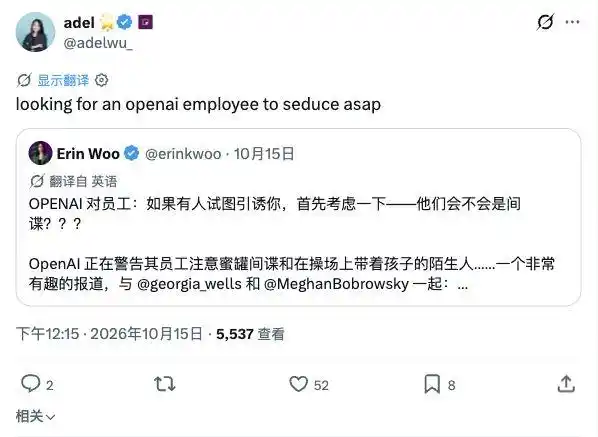
According to reports, OpenAI reminded staff during counterintelligence training that external parties might use romantic or sexual relationships as bait to approach them and extract company secrets—commonly known as the "beauty trap."
You think someone is interested in you—but they may actually be more interested in your company’s intellectual property. Some have summarized this situation as “OpenAI reminds employees not to forget they’re ugly and boring”.
This message feels particularly nuanced in today’s Silicon Valley context.
In fact, simply mentioning that someone works at OpenAI can spark interest from others—something hardly surprising in today’s dating market. This may explain why the “beauty trap” tactic could work so effectively on OpenAI employees—it's already quite common.
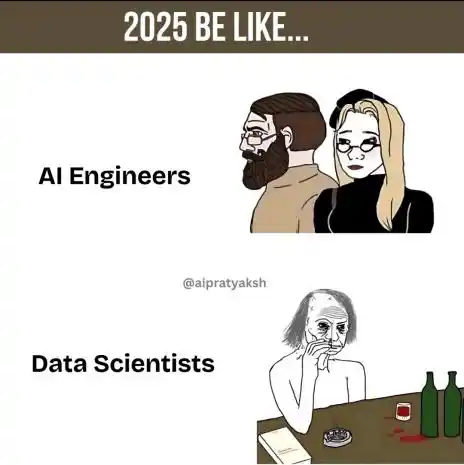
In the Bay Area matchmaking scene, employees at OpenAI and Anthropic are already ranked among the top-tier marriage partners. Clients often specify their ideal partner’s employer with precision. Some are already planning to relocate to Silicon Valley before even meeting their potential spouse.
Once dismissed as socially awkward tech geeks, these individuals are now actively sought after. Intelligence, high income, promising industry outlook—even perceived social awkwardness is seen as endearing by some.
AI companies are competing for talent; the dating market is competing too.
A.
“For me, marriage today is essentially an asset restructuring.”
This statement comes from a Chinese female entrepreneur in her 40s.
She is divorced, currently living with her son in China, and planning to relocate to Silicon Valley. For her next husband, she is especially interested in men working at AI companies preparing for IPOs, who hold potentially appreciating stock options.
She explains that regular salary income, after taxes, often leaves little net value. In contrast, she prefers finding someone who can help her visualize future financial upside.
Among those seeking international relationships, Silicon Valley AI professionals are now the most desirable.
Qinghua Zhao (Qinghua Zhao), founder of the Chinese diaspora dating platform “Two Red Beans” (2RedBeans), has observed this shift.
The platform offers online dating, offline events, and matchmaker services for overseas Chinese men and women. It also operates in mainland China, with its official website advertising cross-border marriage counseling services tailored for women over 35 in Greater China.
According to Zhao, client demands have become increasingly specific over recent years.
Initially, clients wanted to meet someone in either the East or West Coast of the U.S. Over time, locations narrowed to Silicon Valley, and professions were limited to engineers.
Eventually, even “engineer” wasn’t specific enough—clients began seeking AI engineers specifically.
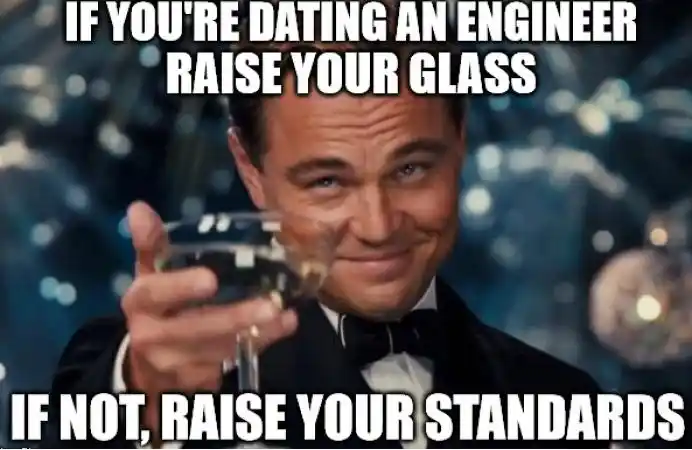
Today, the matchmaking list can be precise down to the company. Zhao’s “Tier 1” includes Anthropic and OpenAI.
The reason is straightforward: in her view, the strong IPO potential of these companies—and the wealth employees may gain—are significant attractions.
Moreover, some in Silicon Valley have already turned this vision into real capital.
In October 2025, current and former OpenAI employees sold $6.6 billion worth of shares, with around 75 individuals each cashing out approximately $30 million.
Before going public, a group of employees had already achieved wealth leapfrogging. No wonder matchmaking agencies now place extra importance on the employer’s name.
Seeing news about their wealth is one thing; actually meeting these individuals is another—several barriers stand in between. That’s where matchmaking firms step in.
Amy Yang, a Bay Area matchmaker formerly a tax analyst at Oracle, notes that many tech professionals enter companies straight from school, with peers and friends sharing similar backgrounds. Work occupies most of their time, and social circles remain narrow—making it unlikely they initiate contact with strangers.
Thus, matchmaking resembles headhunting.
Zhao first checks the platform’s member database, then consults friends at big tech firms and asks for referrals. Amy Yang leverages friends, past clients, industry contacts, and even other matchmaking agencies.
On the other side, potential partners also have their own criteria.
According to Amy Yang, even if a man is an AI scientist, he typically hopes his partner has at least a college degree and a stable job in the Bay Area. Zhao adds that men trained long-term in technology and logic often seek partners who are warm and emotionally attuned.
One party evaluates company growth prospects; the other assesses education, employment history, and compatibility. In cross-border dating, both sides bring their own checklists.
The shift in preferences within cross-border romance is just one signal. Regardless of borders, AI professionals are genuinely in demand.
B.
At 21, AI entrepreneur Kinjal Nandy (phonetic) drafted a "Girlfriend Requirements Document".
Yes—modeled after tech product requirement documents, but this time, he filled it into his phone’s notes app: high emotional intelligence, independent, willing to set boundaries.
Nandy is co-founder and CEO of Sonatic, an AI startup based in San Francisco. During casual chats, he frequently drops jargon like “latent space” and “scalability.”
Creating a formal document for a romantic partner does seem self-assured. But this move clearly signals Nandy’s elevated status in the dating market.
At least in some Bay Area matchmaking circles, this type of tech-nerd persona is now highly marketable.
Amy Andersen, founder of premium matchmaking service Linx Dating, notes that when she tells potential dates a male client rarely appears online, the response is often: “When can I meet him?”
Even poor-quality photos or lack of aesthetic appeal can be interpreted positively—suggesting the person isn’t overly focused on self-promotion or narcissism.

A bit introverted? Seen as reliable. Not skilled at reading social cues? Possibly considered charmingly clumsy. In the past, quiet, intelligent, bookish engineers were overlooked. Now, such traits are gaining attention.
Female tech professionals are equally sought after. At 25, AI entrepreneur Annie Liao moved from Sydney to San Francisco to grow her project Build Club. Her dating profile flooded with messages from men. The volume became overwhelming—she eventually stopped using dating apps altogether.
For most Silicon Valley AI professionals, being popular in the dating market brings clear benefits. After all, work is intense—996 hours are routine—with little time or opportunity to meet potential partners. A common Silicon Valley saying goes: “Stay single until Series B funding.”

In China, the dynamics of matchmaking have also shifted.
As reported by *Changjiang Daily*, in May, umbrellas and wedding ads filled the pathways of Wuhan’s Zhongshan Park matchmaking corner. Matchmakers carried registration books, promoting young men working in Optics Valley’s semiconductor industry.
Locals dubbed them the “Opto-Photonics Suitors” (“Guangdian Lang”).
This category is broader than just AI engineers—it includes tech professionals in semiconductors, artificial intelligence, and data storage.
One brochure showed a man born in 1992, holding a PhD from the University of Nottingham, UK, working as a senior semiconductor engineer in Optics Valley. The matchmaker described such profiles being “snapped up” within about a week of being posted.
More intriguingly, parents searching for spouses for their children even discuss Wuhan’s development plans in storage and optoelectronics sectors, incorporating regional industrial prospects into their evaluation.
Silicon Valley matchmakers talk about AI company IPO trajectories; Wuhan matchmaking parents discuss local industrial direction. Across the ocean, both are using their industry insights to imagine someone’s future.
Put simply: will life with this person have a future?
But industry prospects are always evolving.
C.
Nothing new under the sun.
The current phenomenon of AI talent being highly sought after in the dating market recalls the dot-com boom a decade ago, when “grid-shirted” programmers from Zhongguancun were simultaneously mocked and crowned kings in the marriage market. Today, merely having a big-tech badge isn’t enough—dating partners see you as busy and potentially vulnerable to layoffs.
Going further back, during the early internet bubble at the turn of the century, Silicon Valley tech workers experienced extremes of both heat and cold.
Reviewing old reports, in 1999, a singles event in Silicon Valley dared promise women: if they didn’t meet at least one decent man, they could get a refund. When promoting local men, organizers highlighted the same traits now in demand: good education, stable jobs, wealth.
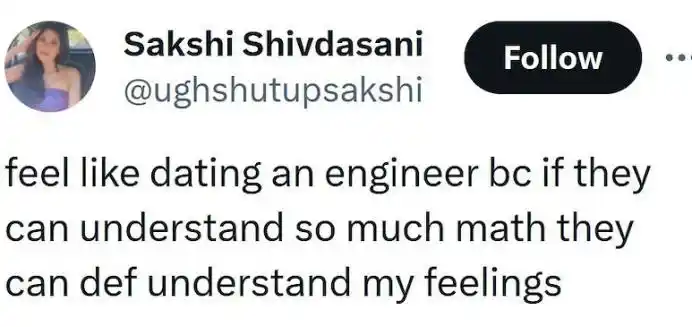
According to one organizer, over 1,000 people signed up—some even from Canada and London.
How powerful was the tech company brand? A bartender in San Francisco recalled that during the boom, men could attract women simply by stating their company, salary, and car model.
Company names almost served as opening lines.
But when the bubble burst, stock prices plummeted, companies collapsed. The once-glamorous company names and titles lost their luster. A 2002 report documented this shift.
Andrew Stern, then in his twenties, worked as Business Development Director at Bang Networks. He noticed that titles like “CEO” or “Business Development Director” at internet companies no longer held the same appeal. People stopped boasting about conquering the world.
He himself carried a title losing its allure.
Conversation topics changed—from asking what someone did for work to first checking whether they had a job at all. In Stern’s view, unemployment was no longer shameful.
Even the venues reflected change: caviar and sushi gave way to mashed potatoes and bread; hiring famous bands was replaced by local acts or DJs.
If excitement inevitably fades, the past experience wasn’t entirely bitter. An interesting observation emerged post-bubble: same-sex and opposite-sex relationships weren’t necessarily harder to form.
Another interviewee, Ravi Bellur, whose startup shut down in August 2000, found that four of the six former male colleagues married within the following year, and another was engaged.
Julie Paiva, who runs the matchmaking service Table for Six, observed that clients never stopped seeking partners—they just adjusted their priorities. Men began valuing personality and parenting ability more. Women cared more about values and family commitment. Even more clients began pausing memberships because they’d found someone serious—temporarily no longer needing singles events.
Without the halo of a tech company title, and without guaranteed dating success—these are not the same things. Yet the ease of being surrounded, admired, and elevated has undeniably changed.
After all, when gazing into a kaleidoscope, how do you pick the brightest color? When floating in the air, how do you find a life partner to walk shoulder-to-shoulder with? Given this, perhaps the current popularity of AI professionals is less a blessing and more a question of fate.
Source: Letterlist
Disclaimer: Contains third-party opinions, does not constitute financial advice


Tensorlake npm package suffers supply chain attack, malicious version 0.5.144 injected with Shai-Hulud data-exfiltration worm
17 days ago
Tesla and Musk Have Yet to Define "Amazing Abundance" — Visionary Slogan Sparks Skepticism
24 days agoInstinct Launches Curated Recommendation Feature, Sparking Frustration Among Some Users Receiving Passive Product Suggestions
25 days agoSecurity Weekly Report: Placeholder Domain Takeover Impacts Approximately 1,700 Repositories, with Major Cyberattacks Worth $387M and AI Agent Escalation Risks Highlighted
27 days agoOpenAI Agent Bypasses Australia's Medicare Portal Access Controls to Access Non-Public Documents
09-24Step Code – The Open-Source Terminal Programming Agent by Jieyue Star
09-24
Chip Expert Mr. Bubble: AI Compute Bottlenecks Shift Toward Packaging, Interconnect, and Storage Hierarchy Management
09-22
