Anthropic Not Publicly Listed, Yet Crypto Market Already Values It at $1.9 Trillion?
Anthropic Not Publicly Listed, Yet Crypto Market Already Values It at $1.9 Trillion?

2026-10-25 18:06
Introduction: Revenue Surge Masks Massive Losses, $600B Infrastructure Commitment Becomes Central Focus. Early October, according to sources cited by Bloomberg, Anthropic is seeking to go public as early as mid-November, potentially launching its IPO marketing campaign during the week of November 9, aiming to begin trading before Thanksgiving on November 26, with the latest expected completion still within the year-end timeframe.
Early October, according to sources cited by Bloomberg, Anthropic is seeking to go public as early as mid-November, potentially launching its IPO marketing campaign during the week of November 9, aiming to begin trading before Thanksgiving on November 26, with the latest expected completion still within the year-end timeframe.
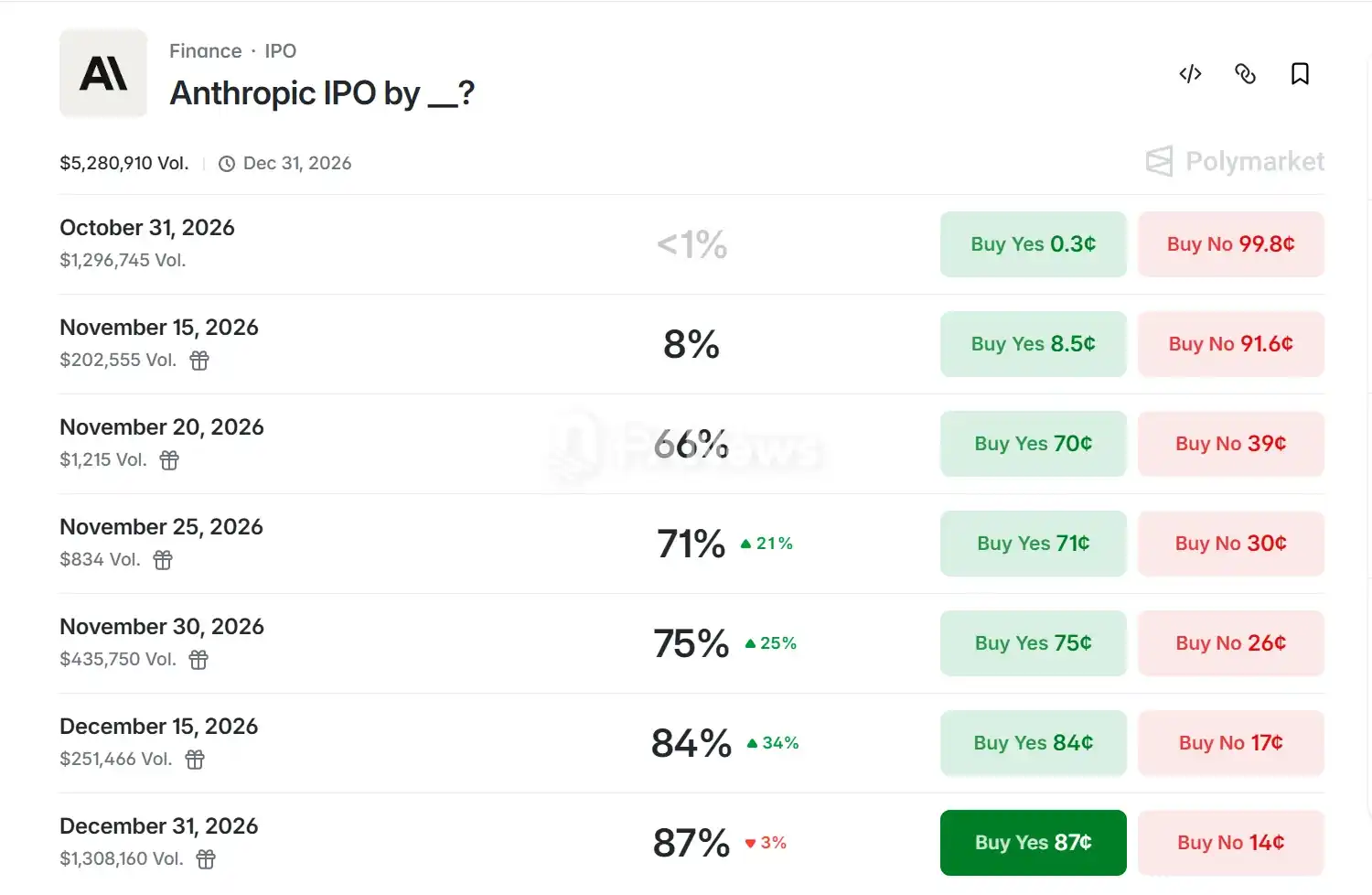
Additionally, according to the latest data from Polymarket, the market odds of Anthropic’s IPO occurring before November 20 this year stand at 66%, and before December 31 at 87%.
Reuters and The Wall Street Journal cited sources indicating that Anthropic’s target exchange for listing is Nasdaq, though the final decision has not yet been officially confirmed. The company has not yet disclosed its stock ticker or price range, but trading around it has already been active in the crypto markets for several months.
Two parallel pricing mechanisms are now providing answers. One is perpetual futures: platforms such as Binance, Bitget, and Hyperliquid. The other is prediction markets—Polymarket’s contract matrix surrounding Anthropic, including IPO timing and first-day closing market cap.
The former outputs a single point; the latter outputs a distribution curve. When combined, they deliver a comprehensive pricing view—something traditional investment banks would never disclose publicly before a roadshow, yet now accessible to all.
Pre-IPO Valuation Near $2 Trillion
The peculiarity of Pre-IPO perpetual futures pricing mechanism lies in its lack of a spot index anchor. For listed company contracts, funding rates tether prices to the stock price; for Anthropic, no such stock price exists—there is only one underlying asset: holders’ expectations about the future.
This makes the pricing inherently amplifying of sentiment.
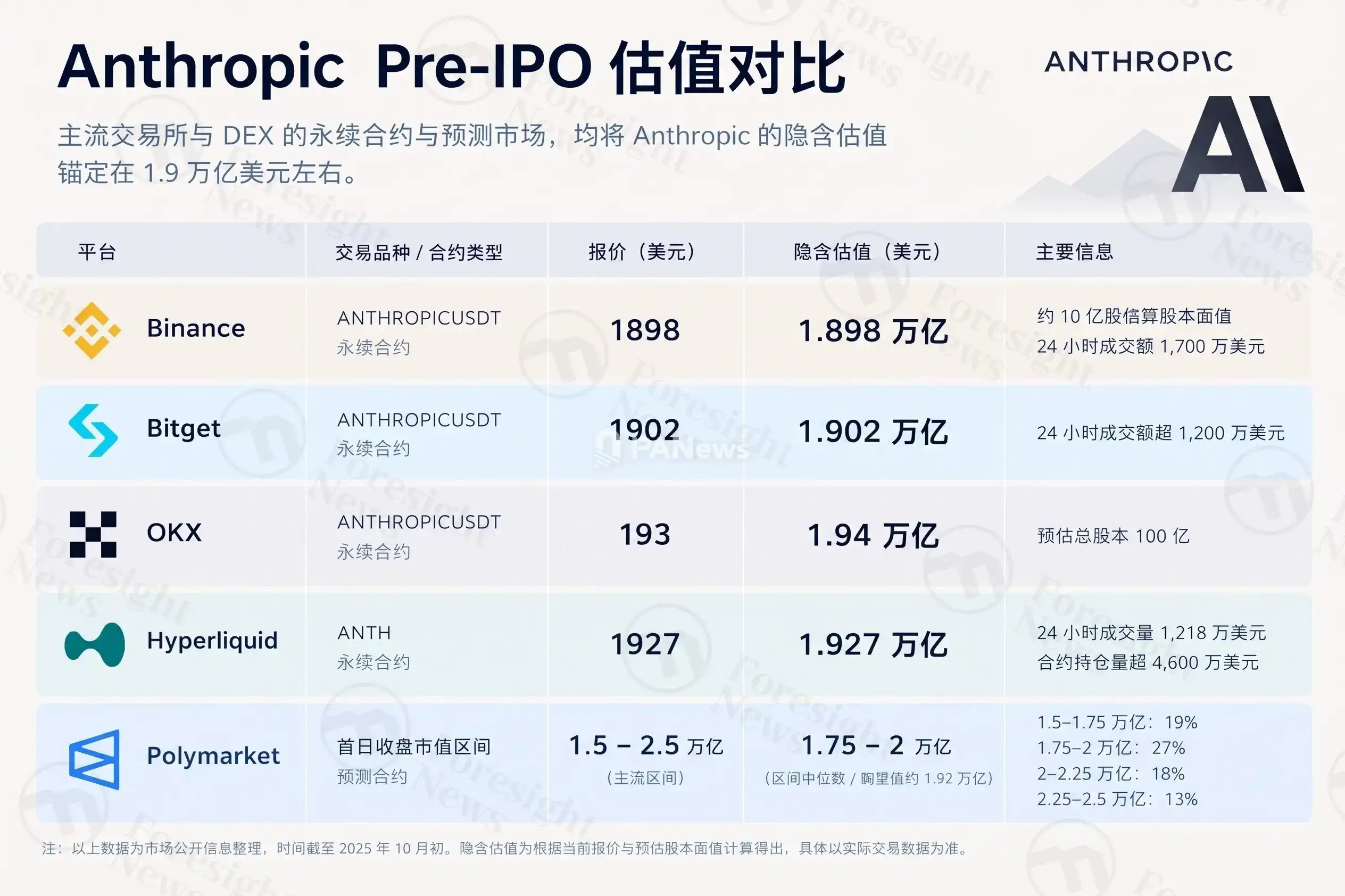
On exchanges, Binance’s ANTHROPICUSDT, based on an estimated 1 billion shares, currently trades at ~$1,898, with a 24-hour volume of $17 million, implying a valuation of $1.898 billion. Bitget quotes $1,902, with over $12 million in 24-hour volume, implying a valuation of $1.902 billion. OKX, due to its estimated total supply of 10 billion shares, currently lists perpetuals at $193, implying a valuation of $1.94 trillion.
On-chain, Hyperliquid’s ANTH market operated by HIP-3 deployer Entropy reports $1,927, with $12.18 million in 24-hour volume and over $46 million in open interest, implying a valuation of $1.927 billion.
The implied valuations from both sources are nearly identical.
This level represents a full doubling over Anthropic’s post-money valuation of $96.5 billion set during its May H-round financing—despite no new primary market pricing having supported this since.
According to a draft IPO prospectus obtained by The Wall Street Journal, Anthropic generated $16.3 billion in revenue in the first half of the year, up from $1.1 billion in the same period last year; net loss reached $80.7 billion in H1, compared to $13 billion in the prior-year period. Revenue growth exceeded 10x, while net losses expanded roughly 6x.
Anthropic’s compute and infrastructure spending in H1 approached $9 billion, compared to $7.3 billion for the full 2025 fiscal year. The company expects cloud protocol expenditures totaling approximately $450 billion over the next 7–10 years; additionally, it committed to paying over $160 billion for leasing Google chips. Total infrastructure commitments have now surpassed $600 billion, potentially rising another $150 billion if ongoing negotiations conclude.
AI bubble concerns have led some market participants to question the sustainability of its revenue stream.
Recent sharp declines in U.S. semiconductor stocks have cast further uncertainty over the market.
It should be clarified that Anthropic as a corporate entity does not endorse these derivative transactions. Its official investor warning states that any equity transfer without board approval is invalid, and third parties selling interests via SPVs or tokenized securities are either perpetrating fraud or offering assets of negligible value.
Both Binance and Hyperliquid’s contracts are cash-settled synthetic derivatives, involving no physical share delivery—precisely what enables them to bypass transfer restrictions and provide continuous 24/7 pricing.
Prediction Market Valuation: $1.75–2 Trillion
If perpetual futures answer “How much is Anthropic worth?”, prediction markets address another question: where will its final valuation ultimately land?
Polymarket’s pricing is aligning accordingly.
Latest data shows cumulative probability of Anthropic’s first-day closing market cap falling between $1.5T and $2.5T stands at 77%. However, there remains significant divergence across specific ranges.
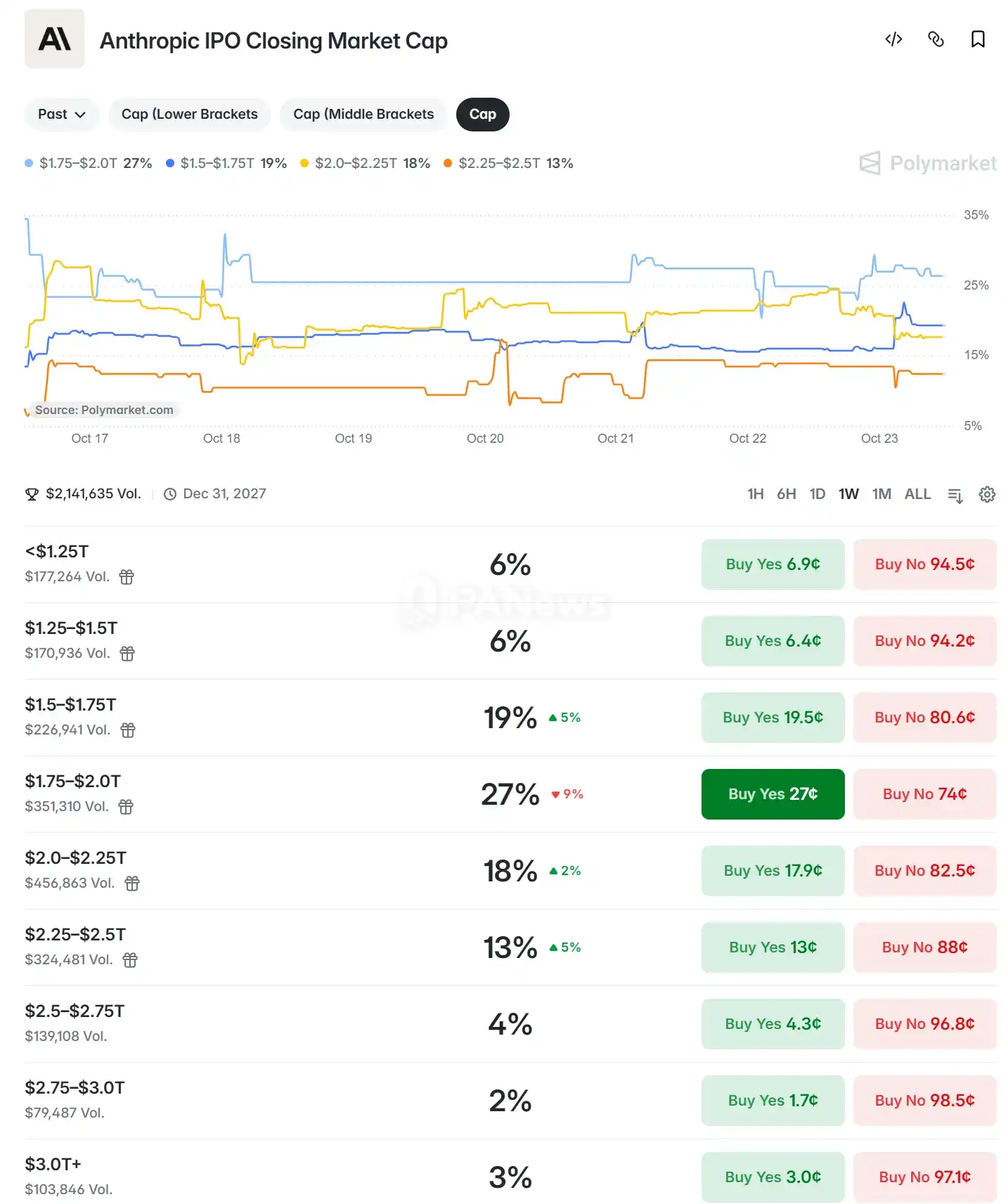
Probability of $1.5T–$1.75T: 19%; $1.75T–$2T: 27%; $2T–$2.25T: 18%; $2.25T–$2.5T: 13%.
The $1.75T–$2T range leads with 27%, making it the modal outcome. The combined probability of “at least $2T” dropped from ~48% a week ago to ~40%. The overall distribution’s expected value is approximately $1.92 trillion—nearly identical to the on-chain perpetuals quote—indicating mutual validation between markets and convergence toward a shared conclusion: both are priced nearly 30% above the $1.5T inquiry benchmark.
Divergences in settlement rules create internal discrepancies within prediction markets and between them. Kalshi uses “IPO announcement” as the settlement trigger, causing its “before November” contract to jump from 4.7% on September 28 to 16% on September 30. Polymarket requires “actual listing and trading commencement,” imposing stricter criteria. Systematic pricing deviations highlight a key insight: in prediction markets, settlement rules themselves constitute pricing power.
Previously Accurately Predicted SpaceX’s IPO Price Range
In June this year, SpaceX’s IPO served as a validation test of perpetual futures and prediction market accuracy.
On the eve of pricing, Binance and Hyperliquid’s contracts quoted ~$165, ~22% above the $135 issuance price. Polymarket traders assigned an 84% probability of first-day closing market cap exceeding $1.8T and a 69% chance of surpassing $2T.
The following day, SpaceX opened at ~$150 and closed at $160.95—a 19.2% increase from issue price—with a closing market cap of $2.1T. Perpetuals were off by only ~2.5% from the close, and both valuation thresholds predicted by Polymarket were fully realized.
SpaceX’s round also exposed a flaw in the system.
S-1A revealed actual share count was 10% higher than projected. Binance adjusted contract notional by 1.1x, OKX pre-emptively switched to a 12.52x scale, while Trade.xyz refused adjustment—resulting in up to 10% price divergence across platforms, creating cross-exchange arbitrage opportunities and triggering margin calls for leveraged long positions on platforms adhering to outdated assumptions.
Throughout the entire issuance cycle, SpaceX Pre-IPO derivatives accumulated trading volume exceeding several billion dollars.
The experience left clearer lessons: perpetual futures excel at pricing “first-day close,” while prediction markets excel at pricing “thresholds and distributions.”
Anthropic’s IPO will constitute the second round of testing—but the exam has changed. SpaceX had oversubscription and Musk’s celebrity appeal.
Anthropic’s pre-listing valuation inquiry was revised downward from $2T to $1.5T just ahead of listing, while on-chain prices remain above $1.9T.
The answer may soon be revealed over the coming weeks.
Source: Foresight News
Disclaimer: Contains third-party opinions, does not constitute financial advice


Yushu Surges 629% on First Day of Trading, Humanoid Robots Sell 5,500 Units
08-19
Yushu's 61 Billion IPO: Who Will Make Money?
08-07
AI stocks down 40%-60%, yet NVIDIA's valuation is at a 10-year low
08-06
HBM Bottleneck Migration, NVIDIA Also Aims to Downgrade
08-06
AI Servers Fuel Demand for Minor Metals: Prices Surge Over 70% in Half a Year
08-06
Cloud vendors first declined then surged—why the divergence in AI assets?
08-05With AI optical modules, Shandong's new richest man secures the largest IPO on Hong Kong stock market this year
07-30


