Why Aren’t Robotics Companies Rushing to IPO After Yujie’s Listing?
Why Aren’t Robotics Companies Rushing to IPO After Yujie’s Listing?

2026-10-25 14:06
Lead: Regulatory scrutiny intensifies on order authenticity, prompting capital to reassess commercialization metrics. "I'm still counting on going public to cash out—I'm worried the longer we delay, the lower the valuation of our embodied AI company will become."
"I'm still counting on going public to cash out—I'm worried the longer we delay, the lower the valuation of our embodied AI company will become."
This sentiment comes from an employee at a robotics firm rumored to be secretly filing under Hong Kong's 18C Specialized Technology Channel.
Holding substantial stock options, they anticipate a swift IPO, but now, even six-figure engineers are juggling R&D and testing while monitoring capital markets—afraid that prolonged delays could devalue their equity holdings.
This anxiety is spreading rapidly across the embodied intelligence sector.
Almost everyone shares an unspoken perception: the IPO window for robotics firms has already closed.
After YuShu’s listing on August 19, previously aggressive robotics startups began altering their capital market strategies.
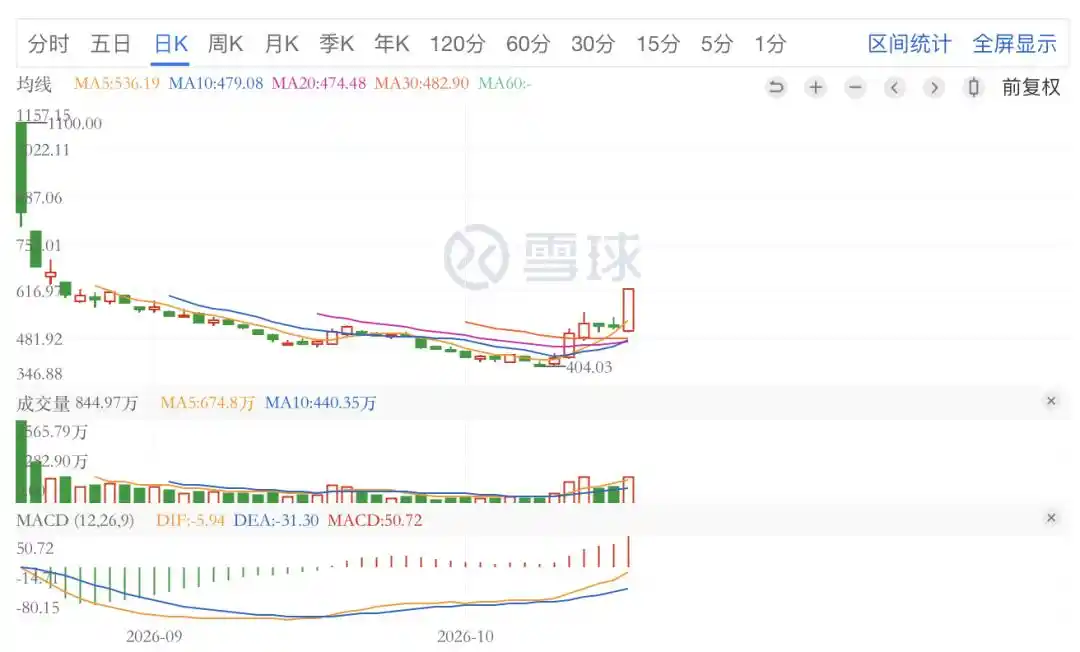
△ Daily K-line chart of YuShu Technology since listing as of October 23, 2026
Industry insiders told QbitAI that AgiRobot has abandoned its original plan to go public within this year.
Recent media reports indicate AgiRobot is advancing a new round of financing worth approximately 1 to 1.5 billion RMB, with an estimated valuation of around 50 billion RMB.
The company has not yet officially confirmed this. If true, and assuming no special exemption from HKEX, AgiRobot must wait at least 120 days after closing this round before listing.
Counting the days, the 2026 Hong Kong IPO window is effectively shut. (doge)

On July 24, AgiRobot publicly confirmed it had initiated preparations for a Hong Kong listing. At the time, investors expected a debut in August, targeting a valuation range of 40–50 billion HKD.
At that time, several other embodied AI companies—including Zhiji Dynamics, Zhongqing Robotics, Ziyuan Robotics, Xinghai Map, and Galaxy General—were reported to have quietly filed their IPO applications.
Yet, over two months later, Zhang Tao, a partner at a top-tier law firm, told QbitAI that the IPO timeline for embodied AI firms may be slower than initially anticipated, with valuations likely to decline compared to earlier expectations.
Especially for companies whose commercial viability remains unproven, future operational capabilities—such as R&D and sales performance—and corresponding financial data will become critical evaluation criteria during both the IPO process and post-listing stock pricing.
“Regulators will likely focus closely on enterprise quality. Beyond standard IPO issues, they’ll scrutinize whether embodied AI firms possess verifiable technological leadership and whether products demonstrate real-world commercial potential. If these can’t be objectively substantiated, the IPO process may slow significantly.”
Huang Lichong, President of Huisheng International Capital, served as lead sponsor for both the Main Board and Growth Enterprise Market listings at HKEX.
He also emphasized that the hardest aspect for embodied AI firms to justify to capital markets is how much value their technology creates—and how much of it actually stays within the company’s own books.
Improved model performance and higher customer efficiency don’t automatically translate into higher profits.
“Will customers pay more? Does the company have pricing power? After deducting compute costs, data processing, implementation, and manual review expenses—how much remains? All of this needs to be calculated.”

IPO is a matter of perfect timing—requiring “timing, terrain, and human alignment.”
When the window opens isn’t always within a company’s control. But if you miss the moment when IPO momentum revives, only to find yourself blocked by old issues like equity structure, financials, or compliance, it would be a great pity.
What exactly must a robotics firm prepare in advance to seize an IPO opportunity?
Recently, QbitAI spoke with multiple securities lawyers and capital market experts to unpack the hidden mechanics behind a robotics startup’s journey from inception to public listing.
IPO Cooling Down: Who’s Most Urgent?
Once the IPO rhythm slows for robotics firms, the first to feel restless are often the investors behind them.
Funds represent LPs (Limited Partners), who eventually need exit strategies.
Over the past two years, funding enthusiasm for embodied intelligence has remained high. Many robotics firms secured multiple rounds of financing before establishing stable use cases.
Valuations rose steadily, shareholder lists expanded, and expectations for an IPO accumulated accordingly.
But each robotics company has its own R&D and commercialization timeline.
From model training and scenario validation to bulk customer procurement, it doesn’t always align with fund exit cycles.
Li Ming, a securities lawyer with over seven years of experience, frequently advises founders to be cautious about investor onboarding—not to accept every dollar available.
Money comes in, everyone’s happy.
Problems often emerge only years later.
△ AI-generated
Zhang Tao once worked with a tech firm.
The company was performing well, completed fundraising at a high valuation, and began preparing for an IPO.
Unexpectedly, external industry conditions shifted, company performance fell short of expectations, and the IPO plan had to be shelved.
To add insult to injury, because the investment agreement included the IPO date as a condition in a contractual bet, some investors immediately demanded buybacks.
But the raised funds had already been invested in R&D and business expansion—leaving the company unable to raise large cash reserves quickly.
Per the agreement, founders might face buyback obligations.
A round of financing obtained years ago became a heavy burden due to delayed IPO progress and unmet contractual terms.
Higher valuations bring more complications.
One tech firm used a high valuation to grant stock incentives to employees. When employees left, they requested equity exits—under the agreement, founders had to take them back.
The result? Higher valuations meant higher buyback costs.
Stock incentives meant to attract talent turned into a financial burden for founders.
Moreover, fair value assessment and tax treatment related to equity incentives represent significant workloads for IPO legal teams.

Though similar cases originated from other tech firms, they’re far from irrelevant to currently high-valuation embodied robotics companies.
Worse still, private market valuations must withstand renewed scrutiny in the public market.
Huang Lichong is skeptical about setting issue prices based solely on maintaining prior-round valuation levels without solid operational backing.
A 50-billion RMB post-money valuation for a robotics firm doesn’t mean secondary market investors will automatically accept the same market cap upon listing.
Especially for robotics firms still in early-stage commercialization, clear explanations are essential:
Is today’s valuation paying for proven, scalable operations—or are future sales, capacity, and service revenues being front-loaded into current pricing?
If revenue forecasts rely on unconverted pilots, investors will naturally discount the likelihood and timing of future income realization and capital needs.

△ AI-generated
Thus, embodied AI firms must prepare contingency plans for below-expectation valuations, reduced issuance size, or delayed listings.
Investors want exits; founders fear buybacks; option-holders hope to cash in via IPO.
Everyone is waiting for the IPO.
But urgency won’t speed up the process.
To Ring the Bell, First Settle Old Accounts
Beijing’s Yonghe Temple, Zhoushan’s Putuo Island, South Yue Temple frequented by industrial tycoons in Central China—entrances are nearly overwhelmed.
Some bosses visit these sites just before key review stages, seeking good omens.
Others even calculate the exact date for submitting their prospectus.
Even more extreme: some consult the birth dates and astrological charts of their sponsors to check compatibility.
Discussing these industry secrets, Li Ming sighed: “Belief in fate truly knows no age.”

But choosing an auspicious date doesn’t guarantee success.
Some firms discover unclear historical equity or fund flows just before filing; others submit applications but stall indefinitely.
Some even pass review but fail to issue shares as planned.
Where’s the problem?
Based on years of IPO project experience, senior securities lawyers have identified several areas commonly overlooked by embodied AI firms. Companies preparing for listing should conduct self-audits in advance.
Problems can start as early as the first round of financing.
Zhang Tao worked with a tech firm originally aiming for A-share listing, later shifting to Hong Kong.
The issue lay in the shareholders.
Early investors involved offshore trust arrangements triggered intense regulatory scrutiny during the listing phase—especially regarding the legitimacy and rationale of trust holding. The firm had to conduct complex follow-up investigations based on feedback.
While trust holding itself isn’t an insurmountable barrier to listing, under special regulatory contexts, firms must clearly explain and meet all required audit standards.
Founders focus on funding amount and valuation during fundraising. But during IPO, lawyers ask: Who actually invested? Could the nature of these shareholders create unnecessary review obstacles?

△ AI-generated
Beyond this, Li Ming finds three issues most troublesome: shareholding proxies, capital contribution flaws, and shareholder traceability.
For example, in early-stage development, one shareholder held shares on behalf of a friend. Back then, relationships were strong—everyone thought it was trivial.
Years later, when the company prepared for IPO, lawyers had to re-verify actual ownership—checking if agreements existed, and where the capital came from.
Some shareholders contributed capital irregularly or couldn’t clarify sources.
Lawyers had to dig through bank statements from years ago, line by line.
Li Ming encountered several projects where companies operated well—but ultimately failed to file or withdrew mid-process due to unresolved historical equity and capital origin issues.
“Once bank records exist, they can’t be erased.”

Now consider shareholder traceability.
Even if the nominal investor is a single institution, lawyers may need to drill down into the ultimate beneficial owners.
For instance: does the firm have former personnel from securities regulatory systems as shareholders? Are their employment history, entry timing, and method of investment compliant?
It’s not that any such stake automatically causes problems—but every necessary check must be thorough.
Sometimes, the biggest pitfalls lie buried in the company’s founding stage.
For example, early investment agreements often contain clauses like buyback rights, anti-dilution protections, and other special arrangements—terms founders may overlook during fundraising.
When money arrives, IPO seems distant, and both parties rarely dwell on how these clauses will play out later.
But as IPO nears, problems surface.
Some special rights must be cleared before filing; others, even if terminated, carry reinstatement triggers. If the IPO fails, those rights may reactivate.
Earlier investors demanding buybacks due to IPO delays exemplify how financing terms can generate long-term consequences.
YuShu Technology’s prospectus disclosed that in its June 2025 funding round, investors held special rights including buyback, preemptive subscription, and anti-dilution clauses.
In September 2025, the company signed termination agreements with relevant shareholders.
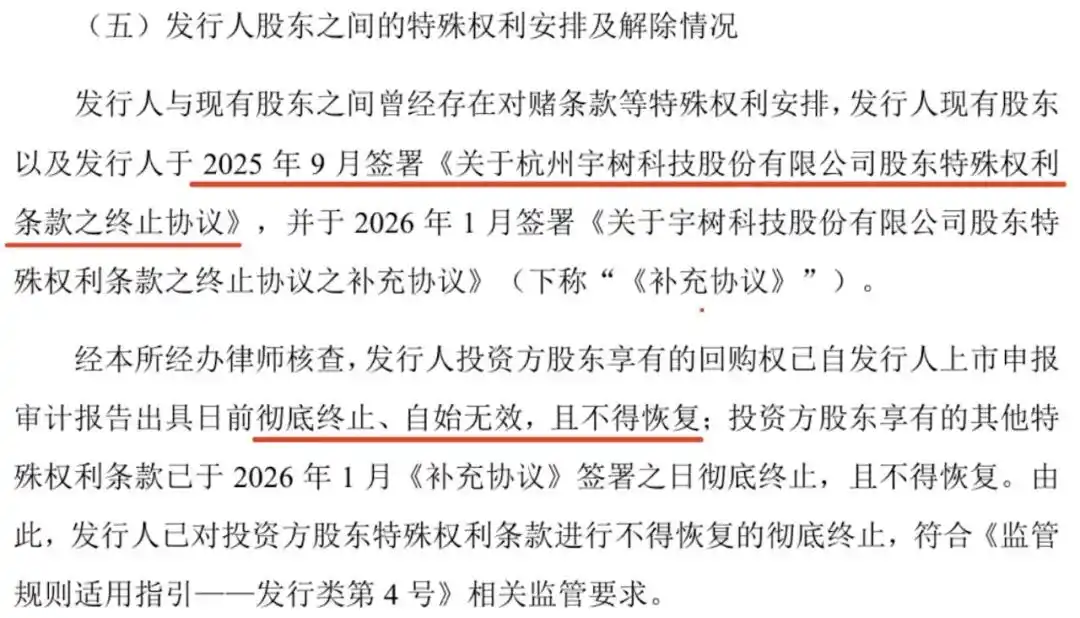
△ Screenshot from YuShu Technology’s IPO legal opinion, public data
This agreement stated that the company’s buyback obligation was “completely terminated, retroactively invalid, and non-revivable.”
In essence, even if the IPO fails, the company won’t be required to repurchase shares.
Ultimately, this prevents public funds from being used to fulfill early investors’ contractual bets—protecting retail investors in the secondary market.
Another category of trouble requires resolving with employees’ former employers.
Li Ming once dealt with a company applying for a patent where the inventor was an engineer recently hired from another firm.
So the question arose: Was this technology developed during their prior employment, or independently after joining the new company?
If it qualifies as a work-made-for-hire, who owns the rights?
To clarify ownership, Li Ming had to contact the engineer’s previous employer.
“You have to track down each former employer individually. Imagine the workload—isn’t that painful?”
Embodied AI firms should be especially vigilant about such situations.
Today’s robotics talent moves fast—many core R&D staff come from universities, research institutions, or other tech firms.
Algorithms, motion control, training data, models—all stem from long-term technical accumulation and collaborations with academic or research entities.
An engineer changes jobs—their expertise doesn’t vanish.
But specific technical outcomes must be clearly attributable during the IPO stage.
You can pick your bell-ringing day—but you can’t avoid settling old accounts.
Huang Lichong also warns that robotics firms preparing for Hong Kong listing must strengthen their commercial validation and operational management.
Orders, shipments, acceptance, revenue, after-sales obligations, and collections must align. R&D personnel, project expenditures, IP rights, and data usage rights must be documented.
Meanwhile, financing plans must evolve with business progress.
How much capital is needed next? How long can cash reserves last if IPO is delayed? Can founders and shareholders accept a lower-than-expected valuation?
All these questions must be answered in advance.
“Especially for firms targeting HKEX’s 18C route, R&D requirements span multiple fiscal years—historical records must accumulate continuously. You can’t just fill gaps at the last minute,” Huang Lichong told QbitAI.

△ AI-generated
Even the best-laid plans can go awry.
Common risks include last-minute whistleblower complaints or sudden regulatory oversight and on-site inspections.
Zhang Tao even described whistleblowers and on-site checks as “a sword hanging over every IPO applicant.”
“This is a necessary measure to ensure application quality—no one can claim immunity.”
QbitAI learned that YuShu and Yuejiang both faced complaints during their IPO processes involving patents and share ownership disputes.
Li Ming served a tech firm that endured over ten rounds of complaints pre-IPO, requiring multiple responses.
“A complaint doesn’t imply wrongdoing, nor does it necessarily derail the IPO,” Li Ming said. “The key is whether the allegations are factual and involve major issues like equity or core IP.”
For founders, the best strategy is to avoid complacency, proactively eliminate risks, and diligently prepare filings.
As for what else might arise during the IPO journey—no one can predict.
Given all this, perhaps visiting Yonghe Temple for incense burns makes a strange kind of sense.
Robot Orders: The Hardest Scorecard to Build
Even after resolving equity, financial, and compliance issues, a robotics firm hasn’t necessarily built sufficient IPO credibility.
Having observed the secondary market for years, Huang Lichong knows precisely what investors care about most:
Customers have already paid; products are in use—and after using them, they’re willing to purchase again.
Because old debts can be sorted slowly, orders can’t be fabricated overnight.
Some robotics firm leaders, during IPO prep, constantly emphasize “telling a story.”
“Honestly, I’m not fond of that term,” Zhang Tao admitted. “But I understand—it’s a crowded field. Besides competing startups, giants like Xiaomi, XPeng, and Tesla are entering too.”
Competitors are stronger than ever—everyone wants to prove they’re different.
Of course, pressure on embodied AI firms extends beyond competition.
According to algorithm engineer Wang Peng at an embodied robotics firm, the challenge stems partly from generative AI model companies.
“Last year, Gemini Robotics demonstrated robotic manipulation and placement abilities—this was a standout demo in the embodied AI space. Now, simply integrating GPT-6 Astra achieves the same.”
Wang Xingxing, CEO of YuShu Technology, feels this impact firsthand. Post-IPO, he openly discussed GPT-6 Astra’s implications for embodied intelligence.
“The world hasn’t fully grasped AI’s importance or believed in it—myself included.” On October 22, at the 2026 World Physics AI Conference, he intensified his remarks.
Wang believes physical AI is showing signs of being disrupted. That tipping point could arrive in 1–2 years, or at most 2–3 years.
On one hand, general-purpose large models are gaining stronger generalization capabilities, encroaching into embodied AI domains.
On the other, traditional robotics firms with existing customers and scenarios are leveraging large models to enhance intelligence, expanding into the territory of embodied AI companies.
“During this period, developers working on embodied pre-training are increasingly experiencing existential crises,” Wang Peng lamented. “China’s embodied AI has entered a technical plateau—no paradigm-shifting breakthroughs visible in the short term.”
Nevertheless, before the latest wave of disruption from general models, some robotics firms have already delivered commercial results.
YuShu generated RMB 1.699 billion in revenue in 2025, with non-GAAP net profit attributable to parent company of ~RMB 590 million (non-GAAP before adjustment: RMB 278 million). It sold 5,215 humanoid robots annually.
Cloud Deep’s scale is smaller, but revenue grew from RMB 50.11 million in 2023 to RMB 337 million in 2025, achieving profitability that year.
Earlier entrants into warehouse logistics, like Gees, had cumulatively delivered around 56,000 AMRs (autonomous mobile robots) by end-2024, generating over RMB 2.4 billion in 2024 revenue.
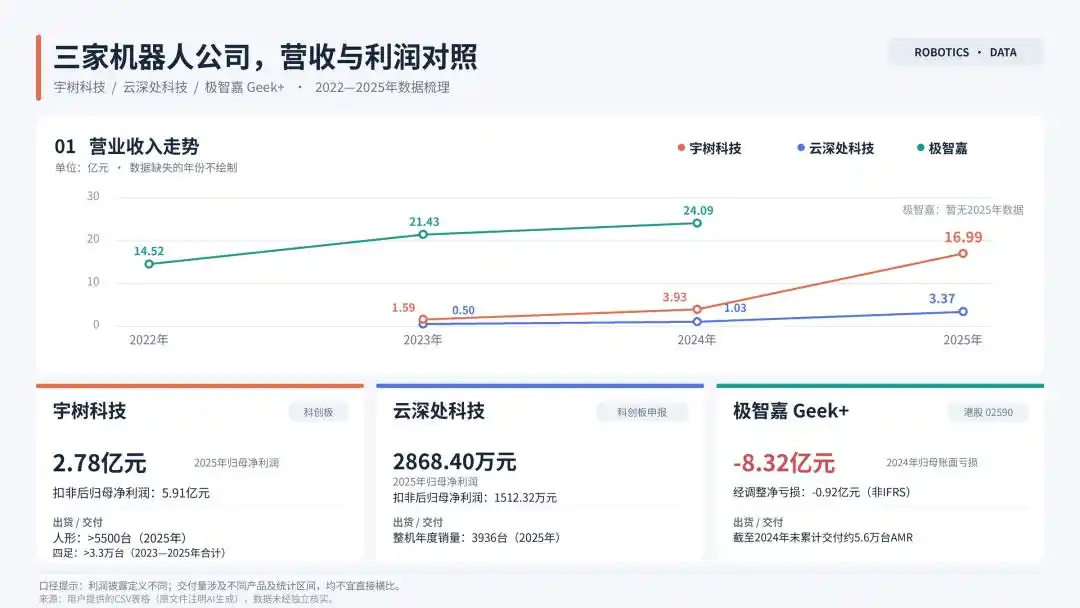
But for capital markets, unit volume sold is merely the first step in assessing commercialization capability.
Embodied robotics face an additional hurdle beyond pure software AI: they must operate reliably in real physical environments over extended periods.
“Customers buy production capacity—not a demonstration of a single action,” Huang Lichong says.
Same robot sold—buyer is a university lab versus a factory line needing automation? Their purchase intent, usage frequency, and sustained demand differ vastly.
Whether PoC (Proof of Concept), small-batch purchases, or mass replication—Huang Lichong focuses on follow-on orders after real-world use.
When customers buy a second, third, or even expand robots across multiple factories, that proves demand can be sustained.
But mere repeat purchases aren’t enough. Scaling from one pilot to other sites must maintain cost-efficiency, reliability, and collection performance.
Otherwise, more orders may make the business harder to manage.
Current industry debates center exactly on these points.
A finance insider familiar with embodied AI suggests orders must be analyzed carefully: framework agreements, cancellable orders, purchase contracts with acceptance clauses, and fulfilled sales carry different weights.
Accounting recognition depends on contract fulfillment and transfer of control—not just signing contracts, receiving deposits, or shipping equipment.
Recent media reports reveal some robotics firms’ orders involve investor-driven procurement or local industrial fund-led partnerships.
Some companies form joint ventures with local capital to generate robot equipment and data service orders.
Others attempt to inflate order volumes through mutual hardware and data purchases with data aggregators.
According to Caijing, some data aggregators participated in such transactions—contracts were signed, but physical delivery never occurred.
Thus, while balance sheets show activity, actual delivery remains questionable.
Have robots reached client sites? Were data truly delivered? What will clients do with them afterward?
All relate to transaction authenticity.
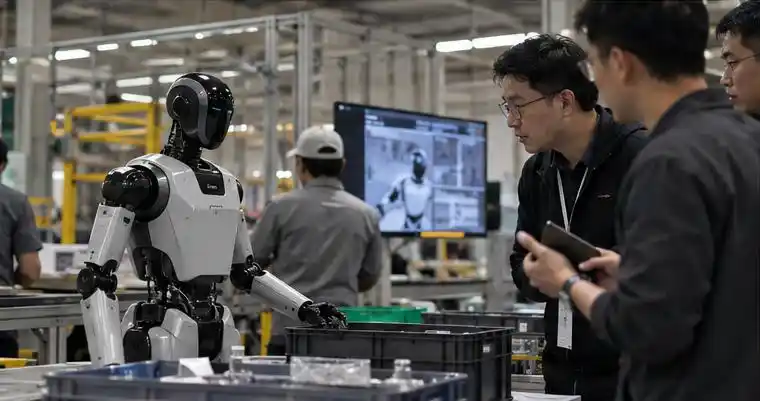
△ AI-generated
Let’s be honest: industrial capital orders in robotics aren’t universally problematic.
Some local industrial investors back robotics firms specifically to attract projects, nurture industrial ecosystems, and promote local application scenarios.
Helping portfolio companies secure clients is common in industrial synergy.
Investor-driven procurement doesn’t automatically constitute related-party transactions. Even if such relationships exist, it doesn’t mean the firm cannot list.
What matters is clarifying whether the transaction reflects genuine commercial demand, pricing fairness, delivery completion, and proper disclosure of related interests.
For embodied robotics firms, the crucial question is: Can orders sustain after losing investor ties and local support?
Huang Lichong particularly values revenue quality in technology-driven firms.
He observes many technical teams clearly know what robots can do—but easily conflate signing contracts, shipping equipment, project acceptance, and customer payment as equivalent events.
In reality, progress tracking, control transfer, payment terms, returns, or price concessions can alter revenue and cash flow assessments.
For example, a project with high gross margins might require long-term free maintenance, extensive on-site staffing, or depend on subsequent conditions for payment—so growth shouldn’t be judged solely by contract value.
Conversely, received cash must be assessed by nature—prepayments cannot be treated as earned revenue.
Investors accept transparency about challenges—but they won’t tolerate the same business appearing in three different forms across fundraising materials, financial statements, and bank records.

Naturally, for firms not yet achieving scale revenue but meeting qualifying criteria, revenue alone isn’t decisive.
In 2023, HKEX introduced the 18C Specialized Technology Listing Regime, offering a path to public markets for qualified non-commercialized tech firms.
The STAR Market on the A-share market also offers flexible listing standards for qualifying hard-tech enterprises.
These frameworks provide strategic flexibility—but regardless of the route, customers must still be found one by one.
Regarding future commercialization, Wang Peng isn’t overly pessimistic.
“While there’s no major paradigm shift yet, let domestic partners focus on real-world deployment—accumulate more scene data. That way, we can hold our ground against the onslaught of large models a little longer.”
His words are laced with irony—but not baseless.
Wang Peng bluntly states: “China’s market is huge. As long as robotics firms are willing to ‘do dirty work’—meaning relentlessly collecting data and deploying odd tricks until success rate hits 99.9999%—they can sustain seven or eight embodied AI firms.”
Zhang Tao works with a quadruped robot company whose founder is actively pursuing product deployment.
The firm invites investors to connect with tech firms and research institutes while directly engaging property management and hotel clients—trying to sell robot dogs into security and patrol roles.
The sales team attends exhibitions everywhere and visits potential clients. “Wherever clients exhibit, they follow.”
One more thing
Regarding shifts in the embodied AI IPO landscape, some speculate the trigger may involve one person:
Shao Tianlan, Founder of Mech-Mind Robotics.
This September, he publicly questioned certain embodied AI firms’ related-party transactions and commercial models, bringing previously taboo topics into the open.
Industry observers believe this controversy may have prompted regulators to pay closer attention to the order structures and commercial quality of embodied AI firms.
But this remains speculation. While much can be planned ahead, many uncertainties remain.
Buddha doesn’t save people—each has their own karma.
(Zhang Tao, Li Ming, Wang Peng are pseudonyms)
Click “Like,” “Share,” and “Heart” to support
Leave your thoughts in the comments!
Source: QbitAI
Disclaimer: Contains third-party opinions, does not constitute financial advice


HuggingFace's "AI Duck" Goes Viral, Boosting Chinese Chip Supplier Rockchip
09-02
Yushu Surges 629% on First Day of Trading, Humanoid Robots Sell 5,500 Units
08-19
14 Executives Depart, Horizon Unleashes a Robot Legion
08-11
Yushu's 61 Billion IPO: Who Will Make Money?
08-07
AI stocks down 40%-60%, yet NVIDIA's valuation is at a 10-year low
08-06
HBM Bottleneck Migration, NVIDIA Also Aims to Downgrade
08-06
AI Servers Fuel Demand for Minor Metals: Prices Surge Over 70% in Half a Year
08-06


