Tencent Hunyuan Opens Interactive World Model, Capable of Running on a Single 4090
Tencent Hunyuan Opens Interactive World Model, Capable of Running on a Single 4090

2026-10-25 12:02
Introduction: Single RTX 4090 enables local inference, supporting dual control via text and camera. What is Hy-Nomas? Hy-Nomas is an open-source interactive video world generation model from Tencent Hunyuan.
What is Hy-Nomas?
Hy-Nomas is an open-source interactive video world generation model developed by Tencent Hunyuan, leveraging a segmented autoregressive architecture to generate videos. It supports seamless switching between text prompts and camera trajectory controls across segments, while maintaining long-term consistency through a lifelong KV cache. The code and model weights are fully open-sourced, offering distilled and INT8 quantized variants optimized for local inference on a single RTX 4090.
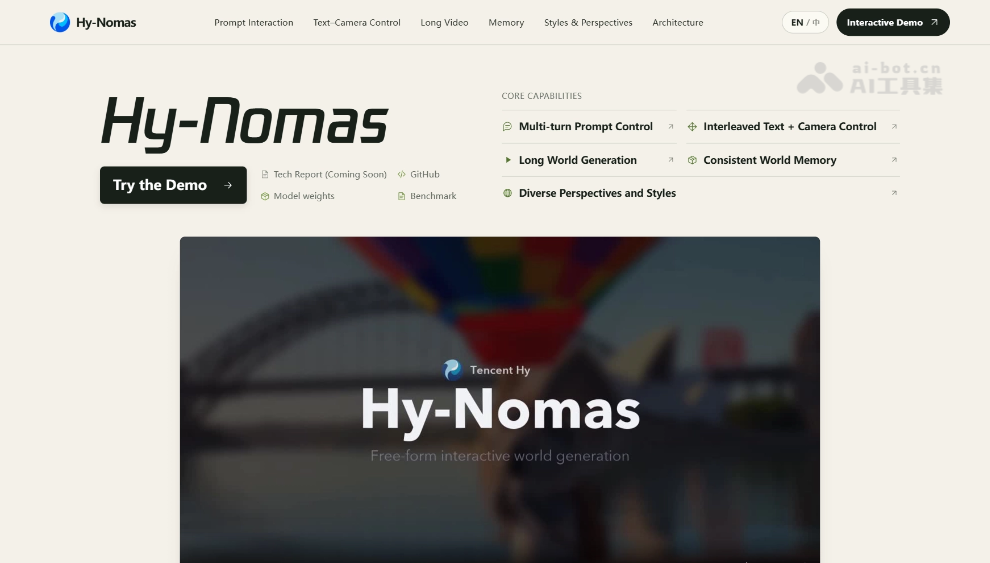
Key Features of Hy-Nomas
- Free-form Text Control: Supports arbitrary text prompts to govern objects, styles, scenes, and actions within the generated world.
- Camera Trajectory Control: Enables conditional generation based on camera motion paths, freely combinable with text prompts.
- Multi-turn Interactive Generation: The web-based interface allows injection of new instructions at segment boundaries for continuous, iterative generation.
- Prompt Enhancement (Nomas-PE): An integrated online model automatically converts informal user commands into structured generation prompts.
- Consumer-grade Local Deployment: Optimized with INT8 quantization and CPU offload, enabling inference on a single RTX 4090.
- LoRA Fine-tuning: Supports fine-tuning with custom video data, with resulting LoRA weights mergeable into the distilled model for inference.
Technical Principles of Hy-Nomas
- Segmented Autoregressive Architecture: Long videos are generated in segments, each conditioned on current prompts or camera signals, with a lifelong KV cache maintained across all segments to ensure temporal consistency in scenes, objects, and styles—enabling long-range world generation.
- Distillation for Accelerated Inference: Through distillation training, denoising steps are reduced to 4/6/8, paired with a specially fine-tuned PixelUMM decoder handling 32-channel DCAE-V latent variables, significantly reducing inference latency without compromising quality.
- Low VRAM Inference Mechanism: DiT weights and KV cache use INT8 storage with BF16 computation; historical context is truncated via sliding window to prevent unbounded growth; text encoder, DiT, and VAE are dynamically offloaded between CPU and GPU to keep peak VRAM usage within consumer-grade GPU limits.
- LoRA Segment-forcing Training: Fine-tuning starts from a non-distilled checkpoint using a segment-forcing training pipeline, training only LoRA parameters (rank/alpha = 256). After training, LoRA weights are merged back into the distilled checkpoint, yielding a model that combines distillation speed with customization capability.

Follow WeChat and reply “open-source” to join the AI Open-Source Project Discussion Group
Core Advantages of Hy-Nomas
- Dual-Modal Free Switching: Each segment can seamlessly switch between text prompt and camera trajectory control, enabling flexible interaction.
- Long-Term Consistency: Lifelong KV cache ensures object, scene, and style continuity across segments, preventing drift in long videos.
- Consumer-Grade Feasibility: INT8 quantization + sliding window + CPU offload enables local inference on a single RTX 4090.
- Ultra-Fast Inference: Post-distillation denoising requires only 4–8 steps, drastically reducing generation latency.
- Fully Open-Source: Code, weights, training, and data annotation pipelines are fully public under Apache 2.0 license for commercial use.
Project Links for Hy-Nomas
- Official Website: https://hy-nomas.hy.tencent.com/
- GitHub Repository: https://github.com/Tencent-Hunyuan/Hy-Nomas
- HuggingFace Model Hub: https://huggingface.co/tencent/Hy-Nomas
Competitive Comparison with Similar Models
| Comparison Dimension | Hy-Nomas (Tencent Hunyuan) | Genie 3 (Google DeepMind) |
|---|---|---|
| Open-Source Status | Fully open-source: code, weights, and training workflows publicly available (Apache 2.0, commercial use permitted) | Closed-source, limited access via Project Genie web prototype (restricted to US AI Ultra subscribers) |
| Hardware Requirements | Consumer-friendly: single RTX 4090 with INT8 quantization enables local inference | Cloud-only inference; official experience capped at 60 seconds due to compute cost |
| Control Modalities | Dual-modal: text prompts and camera trajectories, freely switchable across segments | Navigation actions (WASD, etc.) + promptable world events |
| Interaction Mode | Multi-turn segmented generation: new instructions injected at segment boundaries, not frame-by-frame real-time | Real-time interaction: 24fps frame-by-frame generation, generating as exploration proceeds |
| Consistency Mechanism | Lifelong KV cache maintains cross-segment long-term consistency | Approximately 1-minute visual memory; scene re-entry remains consistent |
| Resolution / Visual Quality | 1280×704, enhanced with cinematic LoRA for richer texture | 720p photorealistic quality |
| Customization Capability | Supports LoRA fine-tuning + data annotation pipeline for training personalized worlds | No fine-tuning interface; limited to official product UI only |
| Target Audience | Researchers, developers, creators (seeking local deployment and secondary development) | General users (seeking quick access to interactive worlds) |
Application Scenarios of Hy-Nomas
- AI Game Prototyping: Rapidly generate interactive game worlds via text and camera commands, enabling low-cost validation of gameplay concepts.
- Robotics Simulation Training: Leverage official Robotics LoRA to generate realistic robotic arm operation environments, providing synthetic training data for embodied intelligence.
- Film Previsualization & Storyboarding: Generate coherent long takes with cinematic LoRA to assist directors in shot composition and visual pre-review.
- Virtual Tourism & Spatial Exhibitions: Use camera trajectory control to generate navigable scenic spots, exhibition halls, and real estate environments, replacing traditional 3D modeling.
- AI Research & Education: Fully open-sourced training, fine-tuning, and data annotation code serves as a foundational platform for teaching and research in world modeling.
Source: AI Tools Kit
Disclaimer: Contains third-party opinions, does not constitute financial advice


Step Code – The Open-Source Terminal Programming Agent by Jieyue Star
09-24
Hy4 Preview Lightweight Version – Tencent Hunyuan's Open-Source Hy4 Quantized Compression Model
09-02
Claude Fable 5.1 – Anthropic's Latest Flagship Large Model
09-02
Open-source Retool is here, drag-and-drop backend with 60+ components
08-19
Claude Opus 5 is Here: Half the Price Approaching Fable 5
07-25
Tencent Open-Sources 260 Real-World Tasks to Test AI Workforce Capabilities
07-25
Meituan Open-Sources AI Exam Platform: 813 Minecraft Tasks
07-25


