Prompt Engineering "Is Dead"? Riley Goodside: Just Ask Directly
Prompt Engineering "Is Dead"? Riley Goodside: Just Ask Directly

2026-10-25 10:26
Lead: Vulnerability discovery relies on sandboxing and execution engines, not complex incantations. The man who pronounced its death sentence is none other than Riley Goodside—the very individual who first formalized the role of "prompt engineer."

The one who declared its demise is none other than Riley Goodside—the man who originally turned the role of "prompt engineer" into a formal job title.
The grandmaster himself wrote an obituary for his own livelihood.
Here’s how it unfolded.
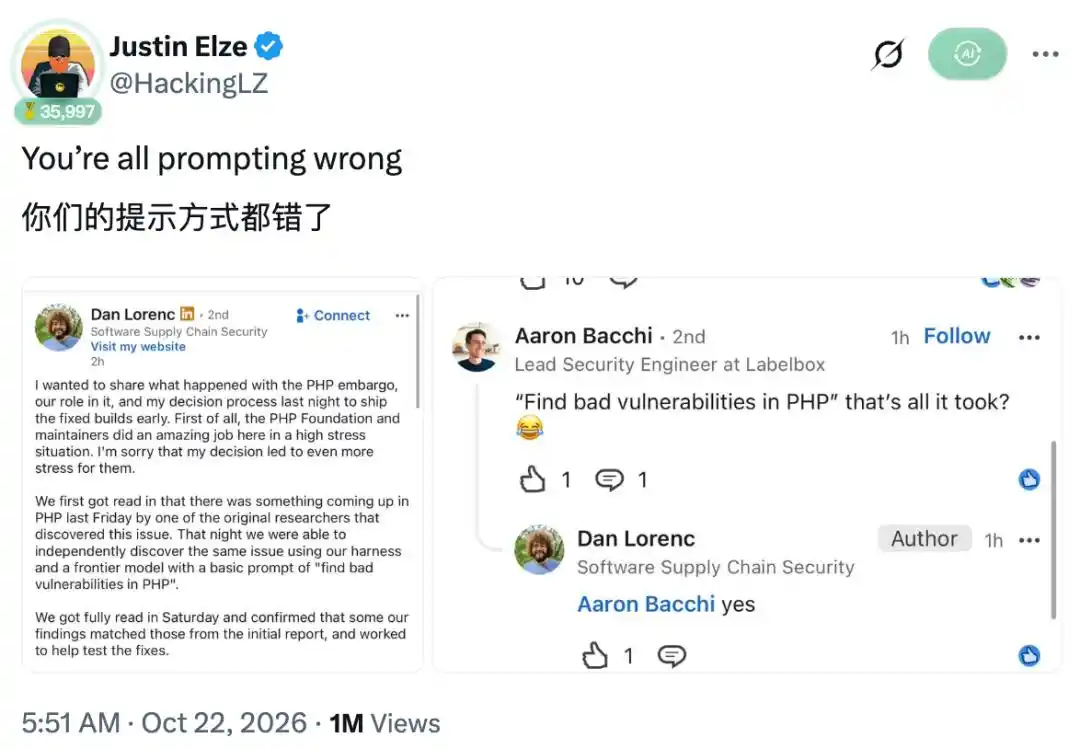
On October 22, security researcher Justin Elze posted on X with a single line: You're all prompting wrong—you’re doing it wrong.
The post was accompanied by two LinkedIn screenshots.
The following day, Riley Goodside shared it, dropping three lines with casual nonchalance:
Prompt engineering is dead. Prompt however you want. Have fun. — Prompt engineering is dead. Ask however you like. Have fun.
Three sentences. Ten English words total. Yet those ten words triggered a seismic wave across the AI community.
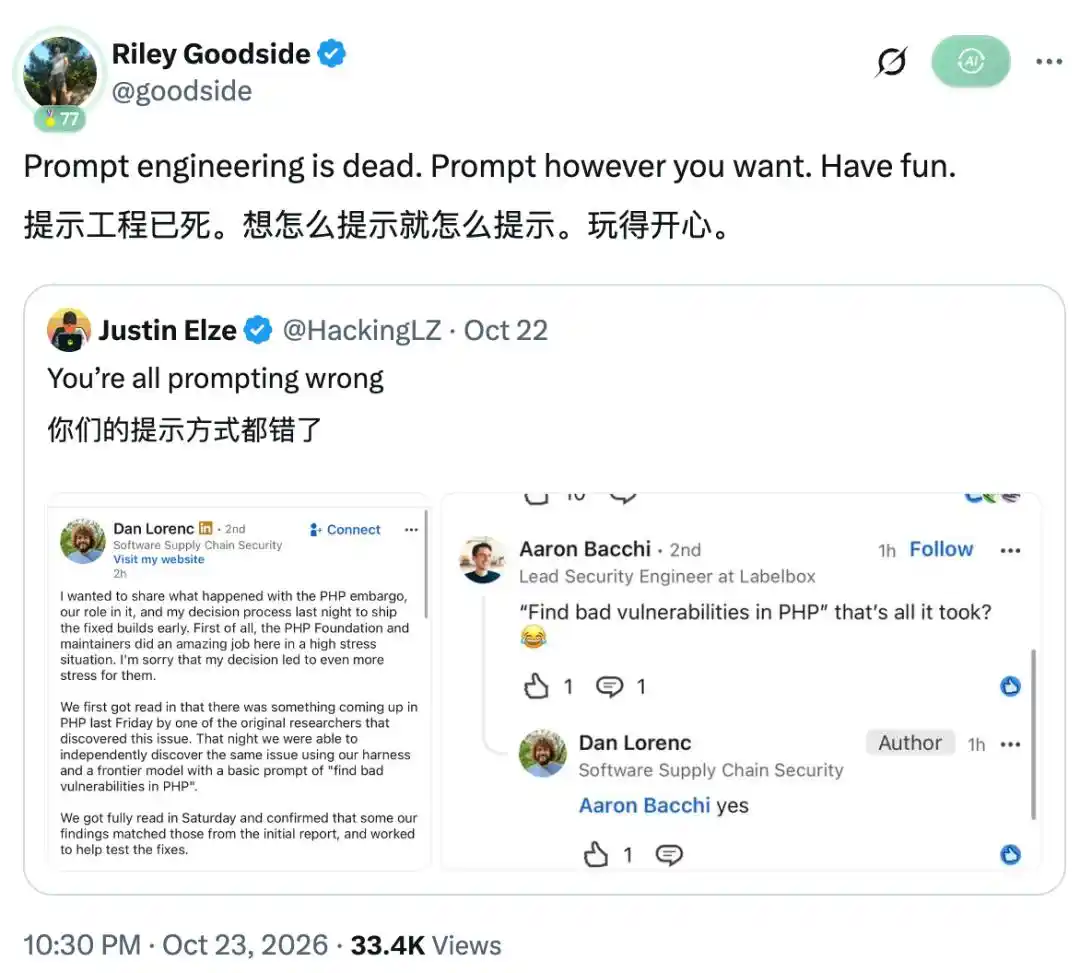
Not just anyone could utter such words with this weight.
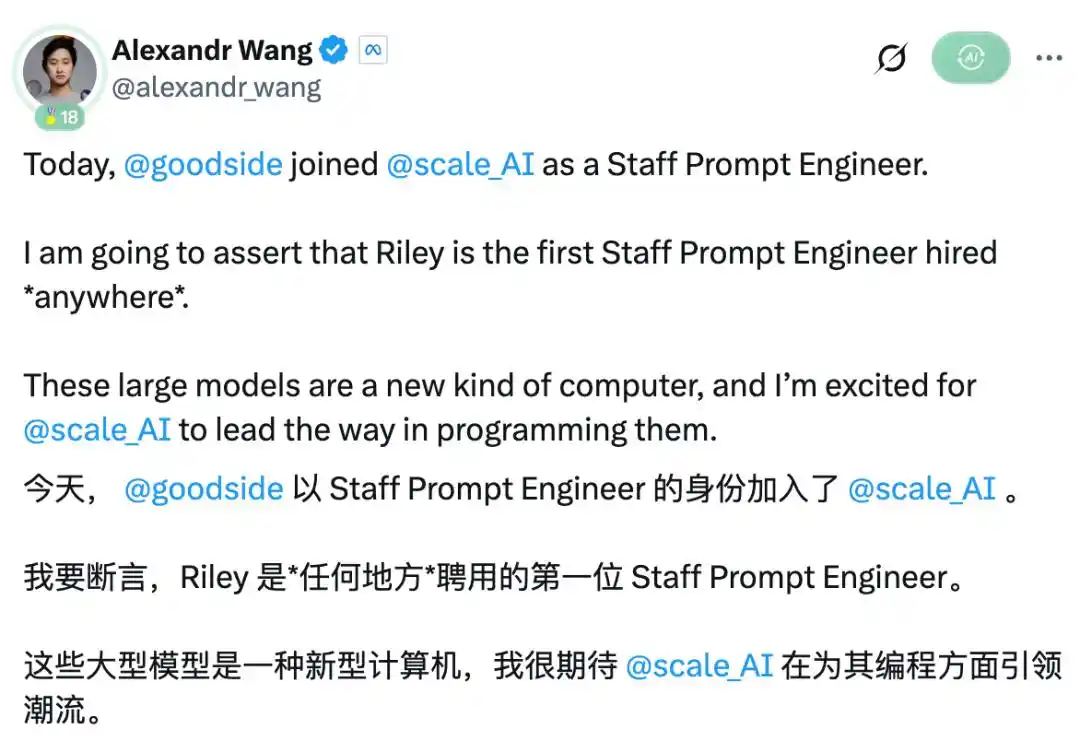
Goodside served as Chief Prompt Engineer at Scale AI before joining Google DeepMind to continue in the same domain. Scale AI’s CEO Alexandr Wang once personally endorsed him, betting that Goodside was the world’s first formally hired prompt engineer.
In his early career, he gained fame through public experiments exploring interactions with large models—among which was pioneering research into "prompt injection attacks," a foundational concept in AI security.
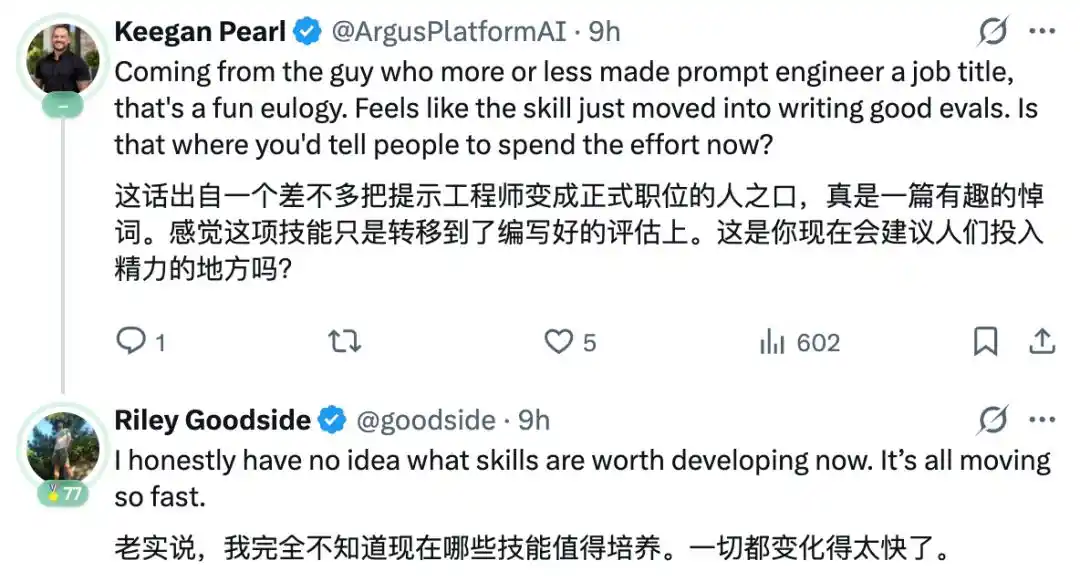
A comment cut straight to the core: It’s ironic that a statement like this comes from someone who essentially founded the role—it’s a fitting eulogy.
You’ve lived through the era of “casting spells,” haven’t you?
Let’s rewind the clock.
When ChatGPT first went viral, didn’t everyone have a few “universal prompt templates” saved in their bookmarks?
First assign the AI a role—“You are a senior XX expert”—then define output format, add a reminder to “think step by step,” and finish with a polite phrase or two.
Write it all out, and it felt like chanting incantations—afraid even one missing word would break the spell.
Back then, people truly believed in it.
Writing effective prompts became a resume-worthy skill. For a time, “prompt engineer” was the most coveted new profession online.
Reports claimed salaries reached six figures without writing a single line of code—just chatting with AI.
Three years later, the very inventor of these “spells” stands up and says: Stop chanting. It’s obsolete.
A plain statement, doing the work of experts.
Justin’s two screenshots serve as living proof.
The images are from Dan Lorenc, CEO of Chainguard.
The company is renowned in software supply chain security.
Just mid-October, Chainguard officially launched their AI-powered vulnerability detection system—a custom-built execution framework paired with cutting-edge large models for security research.
The prompt given to the model? So simple it’s almost laughable: Find high-risk vulnerabilities in PHP that can be remotely exploited without authentication.
No role-playing. No step-by-step templates. No “You are a senior security expert—please follow these steps…”
Just plain human language.
Yet the system successfully reproduced known critical vulnerabilities and helped validate official patch solutions.
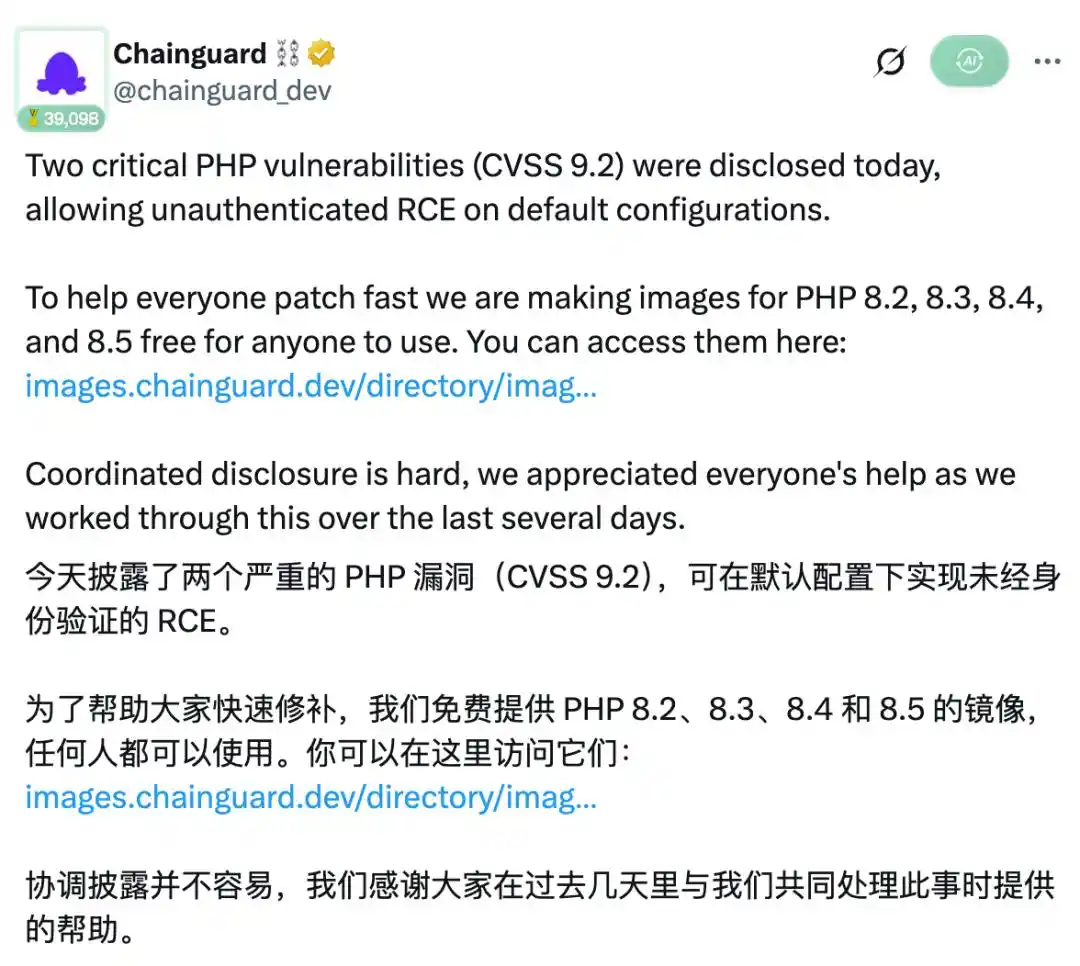
The incident caused significant ripple effects. The FBI issued warnings. The PHP Foundation urgently released patches. Multiple government websites were temporarily affected.
Years ago, this would have required seasoned security experts to meticulously craft prompts over multiple rounds of dialogue.
Now, one clear sentence suffices.
What died was the phrase. What lives is the system.
Before long, Goodside added a follow-up in the comments.
He clarified he was only joking earlier.
Those building low-level prompts for systems, fine-tuning smaller models, embedding prompts into applications—they still have plenty of work. But for the average user staring at the screen, the ceiling on what “asking directly” can achieve has effectively vanished.
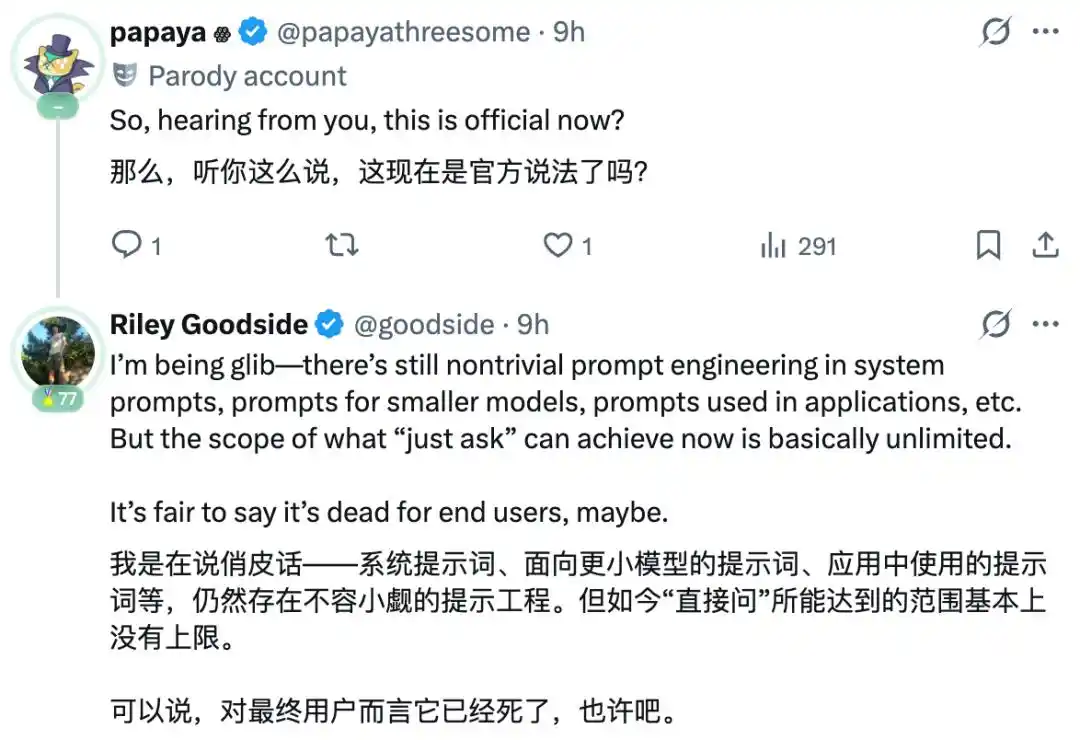
Someone asked: Which new model prompted your change of mind?
He replied there was no sudden shift—since the emergence of ChatGPT, prompt engineering as a core skill for general users has been gradually fading away, a slow but continuous process.
A comment hit the nail on the head: “It feels like the work has just shifted from prompts to harnesses.” Goodside responded with two words: Yes.
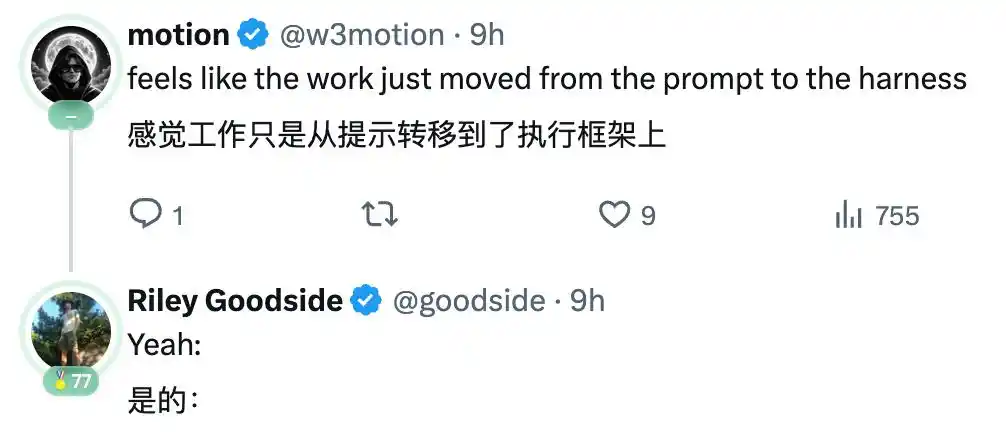
Exactly right.
Dan Lorenc’s “find vulnerabilities” prompt succeeded not because of its linguistic brilliance, but because of the complete system behind it: sandbox environment, target source code, and execution engine.
The model’s strength lies in capability. The system’s power lies in design.
Spells expire. Judgment does not.
Looking back over recent evolution, the trajectory is crystal clear:
Initially, it was Prompt Engineering—crafting elegant phrasing. Then came Context Engineering, pushed by Karpathy and others, focused on feeding models the right information. Then Harness Engineering—building robust runtime environments, setting rules and constraints. Now, the field is embracing Loop Engineering—enabling entire systems to run autonomously, self-iterate.
Layer upon layer, the focus drifts further from prompts.
Ordinary users no longer need to memorize spells or save templates—the models now understand natural language.
Most ironically, Goodside himself was asked where to focus effort now. The grandmaster answered honestly: To be frank, I have no idea what skills are worth cultivating today—everything is changing too fast.
Techniques are being matched by models every few months.
Now, three things matter more than ever: Can you clearly frame the problem? Can you articulate exactly what you need? Can you assess whether the AI’s output is actually correct?
Source: New Wisdom Yuan
Disclaimer: Contains third-party opinions, does not constitute financial advice


AI is not a search bar—it's a supercomputer costing just a few dozen dollars
08-05
Anthropic Locks in 6 Years of Compute with $10 Billion Commitment
08-05Not building robots—why is it worth $14 billion?
07-31AI is no longer competing on benchmark scores, but on profitability
07-25
ByteDance's Douyin Beans priced at 68 RMB—worth it for 382 million monthly active users?
07-25
Fields Medalist Concerned About AI Extinction Heads to OpenAI
07-25
Meta gives away models for free—who dares to price AI now?
07-24


