Secures $200M Funding, Today AI Aims to Become "Your Understanding" Personal Assistant
Secures $200M Funding, Today AI Aims to Become "Your Understanding" Personal Assistant

2026-10-24 22:06
Introduction: Memory and connectors form barriers, with application companies evolving upstream toward models. In the past month, Personal AI products such as Muse and Instinct have caused a global sensation, becoming the most prominent AI startup track.
In the past month, Personal AI products including Muse and Instinct have triggered a worldwide frenzy, emerging as the most closely watched frontier in AI entrepreneurship. Among them, Muse surpassed 5 million downloads within just 22 days—far outpacing ChatGPT’s 56-day journey to reach that milestone—offering rare validation for the AI application sector.
Today AI might be exploring this space even earlier than Muse. Founded by Qi Junyuan, who previously founded Teambition and held product leadership roles at major tech giants like Alibaba and ByteDance, Today AI assembled its team early this year and officially launched its international and domestic versions starting September 9.
To summarize in one sentence, Today aims to become your personal assistant. By gaining user authorization to access their information and app data, Today accumulates memory through continuous conversations, striving to evolve into a general-purpose assistant organized around "the person" rather than individual tasks.
Compared to other Personal AI products, Today places special emphasis on making the AI assistant feel human. This principle permeates every aspect of the product: users must assign a name to their AI assistant during registration; during conversations, Today consistently avoids task-based window segmentation, completing all interactions within a single unified interface.
Interestingly, years ago when Qi Junyuan was still an entrepreneur, Teambition once launched a product named “Today.” He wrote upon launch: “We hope it can understand everything you need to do in a day better than you—ranging from trivial to-dos to critical work assignments, from casual personal appointments to serious corporate meetings, even every article you need to read—and gently remind you what you should handle right now… Our expectation is simple: it should be easy enough to use.”
Before Muse’s breakout success, many investors still viewed this vision as merely aspirational. But the Today AI team disagrees—by 2026, Claude Code and Cursor have already demonstrated that Agents can autonomously complete complex professional tasks; numerous teams are advancing breakthroughs in model memory and context engineering. “An Agent managing all your affairs” is no longer mere technical speculation.
Today AI represents the team’s first tangible response to this long-held vision.
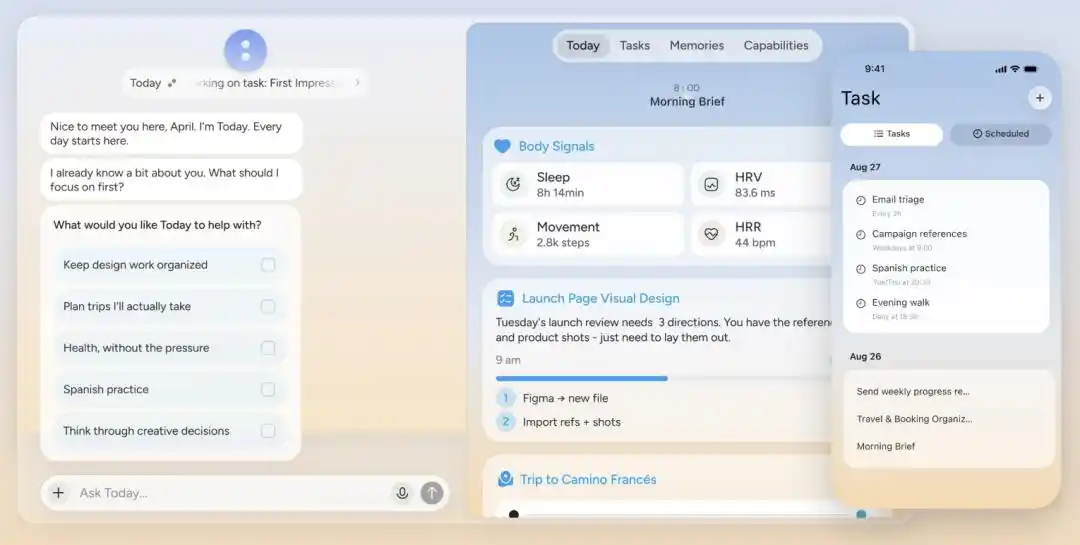
△ Today AI Product Interface
On October 21, Today AI officially announced a seed round exceeding $200 million, led by investors including IDG Capital, Tencent, Sequoia China, Five Sources Capital, Ant Group, Transsion Holdings, Tongge Venture Capital, and Shanghai Jiao Tong University Hanyuan Asset Management.
In the AI application ecosystem, this is a substantial investment. However, the Today AI team emphasizes that from day one, their ambition extends beyond building AI applications—they also aim to train their own models, enabling the company to be truly built for personalization: by training proprietary interaction models, they reduce per-unit intelligence costs while aligning the product’s tone, comprehension, and execution capabilities closer to those of someone who genuinely knows you.
This trend reflects a broader movement among recent star AI application companies. On September 28, Manus launched its Personal Agent product “Cue,” followed shortly by an announcement of over $500 million in new funding. We’ve learned that Manus is also training its own models.
Essentially, AI application companies and model companies are converging from opposite ends—the former moving upstream to train models to lower per-unit intelligence cost, enhance performance, and increase margins, while the latter move downstream to build applications as revenue outlets. As the required capabilities increasingly overlap, the boundary between AI applications and models naturally blurs.
An additional consideration for startups seeking large capital is that building a Personal Agent requires not only model training but also seamless integration across services and ecosystems—a path far from straightforward for anyone.
Within China, there are already instances where AI-powered smartphone assistants have been blocked by joint efforts from ride-hailing, shopping, and food delivery platforms. Abroad, despite more fragmented platform ecosystems, Personal AI still faces significant entry barriers—on September 20, Amazon restricted Muse’s access and shopping functionality on its platform, citing violations of terms due to unapproved AI Agents.
For many AI application companies, both in terms of new ventures and fundraising, 2026 has been particularly challenging. This has further strengthened the resolve of many China-origin AI teams to focus early on overseas markets before considering a return to domestic ones.
In contrast, Today AI’s strategy is bolder: launching first in the U.S. market in September, then swiftly following up with the Chinese version two weeks later, rapidly supporting platforms such as Feishu, DingTalk, Enterprise WeChat, and TickTick.
The Today AI team explains this pace stems from their own assessment: early release itself is part of the competitive battle—visibility, growth, and customer acquisition cannot wait for the product to reach “perfect” maturity.
“There’s always room for startups in the Personal AI space,” they say. Despite big tech giants entering the arena, startups hold advantages in concentrated talent density, faster decision-making, and greater willingness to make early, aggressive bets on memory and proactive behavior.
Recently, Intelligence Emergence had an in-depth conversation with the Today AI founding team, seeking to understand the product while addressing current industry questions about Personal AI.
Below are statements directly from the Today AI team:
Is Personal AI a False Demand?
Since Today's launch, we've heard repeatedly that Personal AI is a false demand. Yet historically, every technological wave begins with widespread skepticism before gradually gaining acceptance—this cycle was no different during the last Agent boom.
From our perspective, there is genuine incremental demand emerging this time. Previously, all Agents focused on office-related tasks, but personal life needs will inevitably be covered too—everyone may need an assistant.
Naturally, whether we’ve reached a mature PMF stage or users are ready to pay remains uncertain—we’re still validating this. But we have no doubt about the existence of the demand itself.
The surge in Personal AI is deeply tied to Claude Code. Before Claude Code, models lacked sufficient function call and instruction-following capabilities, resulting in assistants with no generalization power—pre-programmed for fixed scenarios and incapable of true personalization.
After Claude Code, Agents proved viable as a technology capable of helping in many areas, and model capabilities began to generalize.
Muse’s explosive success proves one thing: Personal AI can rapidly scale to massive user bases. Reaching 5 million downloads in just 22 days far exceeded ChatGPT’s pace—this is a powerful signal of confidence for the entire ecosystem.
Muse also helped the market understand what a Personal Agent actually is. Before Muse, describing our goal as building an OS Agent was difficult to convey clearly. After Muse launched, people instantly grasped what a Personal Agent looks like and what it can do.
We believe the demand is real: Personal Agents should handle the vast array of repetitive, high-frequency tasks everyone encounters daily—tasks scattered across various apps and chat windows, without any single assistant able to fully manage them.
Beyond visibility, we believe the most important metric is not download volume but long-term value—whether the product is useful depends on whether users keep using it, retain engagement, and sustain context accumulation. Whether users are still active the next day, week, or month—that’s the true measure of usefulness.
Long-term retention, balancing proactivity and intrusion, privacy authorization boundaries, and platform ecosystem access remain shared challenges across the industry.
Without a Standalone App, Users Can’t Perceive an Agent’s Value
In one sentence: Today is your personal assistant.
Unlike office-focused Agents that create a new session for each task—archiving it upon completion—Today aims to behave like a human: you maintain a continuous conversation in a single chat window, without needing a new interface for every action.
A human life is continuous; you have long-term goals requiring sustained companionship—learning, career growth, professional planning. These are hard to achieve in task-centric products.
Early in March, we explored a direction similar to Instinct—embedding within IM without a standalone app. But we identified two major issues: first, lacking GUI (graphical user interface) severely limits user guidance in exploring Agent capabilities.
If you're an early adopter familiar with what these products can offer, you might self-explore. But our core mission has always been to serve the mass market.
For ordinary users, GUI currently acts like a map, guiding them through the labyrinthine treasure trove of Agent potential. Without a standalone app, confined to IM and chat boxes, users struggle to perceive how it differs from a regular chatbot.
The second issue: without a native client, agents can’t obtain certain device-level permissions, limiting their inherent capabilities.
After confirming the standalone app format, we needed to clarify what Agents should connect to. We quickly realized that if aiming to be an OS Agent, we shouldn’t limit ourselves to one operating system—we should integrate with all existing systems.
More fundamentally, we must first understand what problems users want solved, then choose the appropriate technical path. For example, “help me operate mobile software” isn’t my real need; solving travel logistics is. Booking a flight and helping me operate the Ctrip app are two distinct needs—there are multiple ways to book a ticket, not necessarily requiring direct manipulation of the Ctrip app.
We should first clarify what users truly want, then select the right technical approach—not redefine user needs to fit a particular technology path.
Thus, Today is technically and conceptually an OS Agent, but for users, the delivered value is Personal AI. From day one, our device gateway was designed for scalability across diverse devices, not limited to PCs, phones, or specific operating systems.
Build Products for the Masses, Deliver Personalized Service
When ordinary users encounter an Agent, they face a black box—they don’t know what problems the Agent can solve, nor can they imagine which issues they could delegate to AI.
Intent should emerge from software and the Agent, not from the user. Thus, proactivity is critical. The ideal state is for the Agent to be highly proactive, precisely understanding your needs based on deep user insight, accurately informing you of what it can help with—and actually delivering.
Building products for the masses and personalized services has been our foundational alignment since Today’s inception, and we’ve never wavered from this vision.
Therefore, in product design, we strive to make the Agent feel more human. For instance, we’ve consistently maintained a single-session architecture—one unified chat window.
Many past Agent products segmented conversations by task—this was a technical compromise born of limited context capacity. With too much context, immature engineering leads to chaos, and model attention becomes scattered.
But with breakthroughs in long-term and cross-session memory, we believe future Agents should adopt a single-session model. We’ve invested heavily in engineering optimizations: using minimal models, maximizing context information density, minimizing latency, designing natural authorization flows and profile visualizations, and employing bubble-style responses to reduce mechanical feel and enhance humanness.
In many personal scenarios, users must recall “which chat window contained that previous task”—an extra cognitive burden. The most natural approach is to interact within a single, persistent chat window, eliminating the need to manage multiple sessions.
Testing shows that for identical tasks, the Agent Team’s token consumption is significantly higher under multi-session setups, and efficiency gains in handling routine matters aren’t guaranteed—instead, latency increases.
Agent Teams offer clear value in professional collaborative settings requiring discussion or review, such as code reviews—but not for Personal AI.
What Truly Makes a Useful Personal AI?
Historically, users hesitated to let AI handle everyday small tasks because the cost of re-establishing context exceeded doing it themselves. Scheduling, appointments, recording baby vaccinations, tracking pet medication—these minutiae were never considered suitable for AI, as each required repeating background details.
Today’s key design innovation lies in reducing delegation costs.
To achieve this, we identify two core pillars for building Personal AI: memory mechanisms and proactivity.
We accumulate memory through two paths: first, via user-authorized Connectors allowing Today to enter your digital world—Feishu, health apps, Calendar—it autonomously learns about you; second, through daily conversations, accumulating memories of your preferences and interests.
For example, during a period when I frequently discussed memory-related research papers, it noticed my interest and proactively searched for and pushed relevant papers to me.
Beyond daily chores, there are long-term goals—learning, career planning, fitness—difficult for task-centric office agents to handle. Today helps you establish long-term plans in memory, proactively reminding you of progress. When I delegated language learning to Today, it sends a daily lesson at noon, refining content through our ongoing interaction.
The core challenge of proactivity is “too proactive = harassment.” We adjust push frequency based on user feedback: first, checking if users actually respond to proactive messages; second, verifying if they at least read them. If no positive signals are detected, we recognize it as harassment and automatically reduce frequency.
Ultimately, Personal AI should liberate more of our time—this is its true value. It should reduce interruptions, cognitive load, and context overhead. If it fails to deliver, the product is flawed.
However, the operational cost of Personal AI is indeed much higher than previous-generation AI products. Cost is currently a real challenge. Market research suggests Instinct’s daily running cost is around $1–3, driven by sandbox calls, search, proactive mechanisms, and long-term task execution—all significant expenses.
Does Personal AI Have Barriers?
Honestly, today’s Personal AI market is experiencing intense homogenization—everyone sees the value of memory and proactivity. It’s hard to identify extreme differentiation; even if present, minor feature differences are quickly eroded by competition.
We care less about isolated features and more about the overall product philosophy: human-like interaction, single-session design, usability for mainstream users, progression on long-term goals, and proactive identification of potential user needs. These together define Today’s product ethos—not a single exclusive feature.
Especially for experienced internet users, their digital assets in the cyber world are already vast. Can an Agent leverage this context efficiently? This is genuinely hard to differentiate at scale.
Take email: everyone integrates it. Simply accessing and processing emails is easy—but fine-grained classification is hard, requiring multi-layer Sub-Agent architecture to distill specific scenario expertise and insights.
Barriers may not stem from a single technology but from context accumulation formed through prolonged usage. The longer users engage, the deeper the Agent understands them. While technically possible to export memories and switch products, friction costs are high. This context lock-in isn’t absolute, but it creates switching costs.
Should Personal AI Focus on General or Vertical Applications First?
Before launching Today, some team members had experience building vertical Agents. Afterward, we found that 80%-90% of effort went into foundational engineering—ensuring Agent stability, building memory systems, preserving user progress. Only 10% was dedicated to scenario-specific tuning.
If only 10% of our product effort is specific to a scenario, wouldn’t the same core capabilities apply broadly? Health, learning, finance—core functions revolve around the same foundation: Context input → Memory retention → Output results. Nearly all scenarios follow this loop, with upper layers being thin wrappers.
By this logic, vertical market barriers are shallow—users don’t need a separate Agent for every need.
Future users may only need one universal personal assistant serving as a unified entry point. Only extremely specialized cases beyond general solutions would justify vertical Agents—yet even these can be connected via the universal assistant.
Overseas Personal AI has already seen several divergent product paths. For example, Town entered via email, deeply mastering a single domain with a ~15% paid conversion rate. This tool-oriented approach is valid, but different from Today.
Muse targets broader audiences via free access, achieving ~400k active users. However, Muse’s competitive pressure means similar products in the U.S. struggle to rely solely on subscriptions as a business model.
Some subscription-focused products exist—like Grok Bot, with ~400k weekly active users. Instinct explores trusted networks: users first communicate with their Agent, which then negotiates with counterpart Agents, returning results—creating a longer chain.
Yet the line between general and vertical Agents isn’t rigid. Currently, Today plays a collaborative role in work contexts: scheduling, recording key items, conducting research, reminding forgotten tasks. Work and life will inevitably overlap in Personal AI—people rarely cleanly separate professional from personal domains.
How to Balance Privacy and Task Delivery?
This is a very practical challenge—without context, the Agent’s utility is limited. Given this premise, our goal is to ensure privacy is controllable and transparent.
First, full transparency: all memories recorded by the Agent are fully visible to users, including basic info, preferences, and interests—accessible anytime.
Second, full control: users can delete any memory at any time, and the underlying database permanently erases it.
We also implement progressive authorization: Today requests permission only when genuinely needed, not upfront for full access.
Accessing information doesn’t mean authorizing Today to make all decisions. Calendar adjustments require user confirmation; payment and critical decisions remain under user control. Proactivity means anticipation and preparation—not bypassing user judgment.
Initially, we were concerned about cold-start issues: Would users really authorize? Internal testing revealed surprisingly high authorization rates. That said, these users are still early adopters—our findings don’t yet represent all mainstream users.
Our current user base is quite diverse. Early adopters enjoy exploring Agent capabilities; another group uses the product consistently in daily life—recording, content understanding, personal management—leading to vastly different usage patterns.
User Aha moments typically occur at two points: some experience it immediately during onboarding, feeling “This Agent really knows me,” evoking the sense of meeting an old friend.
Others discover it the next day, receiving a proactive push—“It knew exactly what I’m interested in and brought it straight to me.”
Commercialization Difficulty Is Similar in China and Overseas
We reject the notion that Personal AI can only succeed overseas. Different markets have different scenarios—not that one market is inherently devoid of opportunity.
Common overseas scenarios include email, calendar, price comparison shopping—mature Connector ecosystems exist. In China, email isn’t dominant, but vast contextual data resides in Feishu, health apps, calendars, etc.
Many question whether Personal AI can succeed without WeChat data—but we’re optimistic.
Users typically want Agents to handle non-familiar network tasks. WeChat primarily hosts intimate social networks—exactly the part users least want Agents to mediate. As long as we integrate Feishu, DingTalk, Enterprise WeChat, and similar Connectors, we can gather sufficient context.
China does face data silos, but so far, integrating other Connectors hasn’t encountered major obstacles—Connector markets are gradually opening.
Regarding PMF, we’re still validating. Commercialization isn’t our top priority now—delivering real value to users is.
Currently, Chinese users’ data quality isn’t poor, but the Connector ecosystem lags behind U.S. maturity, requiring additional attention to privacy compliance.
Two weeks after launching in the U.S., we launched in China. China is a relatively homogeneous, unified large market—this market must eventually be addressed. Why wait? We might as well start now.
Commercialization difficulty in the U.S. and China is, in a way, similar. Muse is currently free—so other companies launching in the U.S. also find it hard to charge. Under such free-market competition, monetization of Personal AI—even abroad—is challenging.
We’ll explore subscriptions in the future, but it may not be the optimal model. E-commerce and ads risk harming user experience. Right now, it feels like Google before inventing ad-based monetization—Personal AI’s successful business model may differ radically from current expectations.
AI Application Companies Should Be Model Companies
If you still describe your startup as an “AI application company” today, that’s concerning.
AI is inherently driven by both engineering and models. Your goal may be solving user problems at the application layer—but to do so effectively, you must possess your own model capabilities, robust engineering, and infrastructure.
At the application level, you need clear user problem definitions and solutions, along with deep understanding and commitment to building your own Harness and infrastructure—ready to adjust and modify models at any time.
Why did Anthropic succeed against OpenAI’s formidable competition? Because it pioneered Claude Code, collected excellent trajectory data, used its own Harness for post-training, spinning the model-application flywheel.
Cursor’s model training follows the same logic: reduce per-unit intelligence cost, increase margins, improve intelligence levels.
But Today’s model needs differ from mainstream directions. We require a “dialogue model”—better interaction, more human-like, natural tone, while still capable of actual task execution.
Model companies moving downstream into applications, and application companies moving upstream into models—both sides’ capabilities converge. In the future, pure application companies or pure model companies may no longer exist.
“Startups Always Have a Fight to Win”
We’re familiar with nearly every major tech giant having entered the space. Now, product development and consensus-building happen fast—competition is fierce.
Honestly, startups won’t have an absolute advantage. But there’s always a fight to be had.
Startups’ strengths lie in centralized decision-making and boldness. For example, we may be among the earliest teams experimenting with memory in Agents.
Startups gain a brief window of product leadership—though not necessarily creating insurmountable barriers, this window remains crucial.
Our view: high-delegation-cost tasks aren’t confined to close-knit social networks. Work and life contexts are scattered across Feishu, DingTalk, Enterprise WeChat, etc. As long as Connectors exist, access to this information is possible.
We’ve observed that Connector ecosystems are maturing and opening up. Future MCP standards, Agent-friendly service providers, and technologies like Phone Use could further unlock ecosystem integration.
Still, whether each domestic company’s Personal AI can independently build its own ecosystem remains an open question.
Image Source | "Interior in Strandgade, Sunlight on the Floor", Vilhelm Hammershøi

Join the Conversation
Source: Yongyi
Disclaimer: Contains third-party opinions, does not constitute financial advice


Yushu Surges 629% on First Day of Trading, Humanoid Robots Sell 5,500 Units
08-19
Yushu's 61 Billion IPO: Who Will Make Money?
08-07
AI stocks down 40%-60%, yet NVIDIA's valuation is at a 10-year low
08-06
HBM Bottleneck Migration, NVIDIA Also Aims to Downgrade
08-06
AI Servers Fuel Demand for Minor Metals: Prices Surge Over 70% in Half a Year
08-06
AI is not a search bar—it's a supercomputer costing just a few dozen dollars
08-05Cloud vendors first declined then surged—why the divergence in AI assets?
08-05


