ScholarMuse – Integrating Paper Retrieval and Research Data into Existing AI Assistants
ScholarMuse – Integrating Paper Retrieval and Research Data into Existing AI Assistants

2026-10-19 09:59
Introduction: What is ScholarMuse? ScholarMuse is an MCP-powered tool platform designed for researchers, integrating over 50 research data sources into existing AI assistants such as Claude, ChatGPT, Codex, and Cursor.
What is ScholarMuse?
ScholarMuse is an MCP-powered tool platform tailored for researchers, seamlessly integrating over 50 research data sources into established AI assistants including Claude, ChatGPT, Codex, and Cursor. It enables paper retrieval and citation verification, retraction checks, and access to funding projects (NIH, NSF, UKRI) and research datasets. Additionally, it retrieves economic statistics and domain-specific data in life sciences, materials, environment, and astronomy, while offering automated generation of research illustrations and figure abstracts.

Core Features of ScholarMuse
- Search Papers & Verify Citations: Retrieve paper records by available identifiers; perform field-level comparison on title, author, year, and DOI of references. Retraction checks provide access to relevant notifications when available.
- Find Research Projects & Datasets: Search NIH, NSF, UKRI grants and multiple research data repositories, providing entry points for identifying research directions, preparing materials, and locating reusable datasets.
- Retrieve Scientific & Statistical Data: Query economic time series based on user questions or invoke specialized capabilities in life sciences, materials science, environmental science, and astronomy.
- Generate Research Diagrams: Create mechanistic diagrams, research workflows, pathway maps, or figure abstracts from textual descriptions, with optional text-based revision requests. Image generation requires paid credits and must be verified by the user.
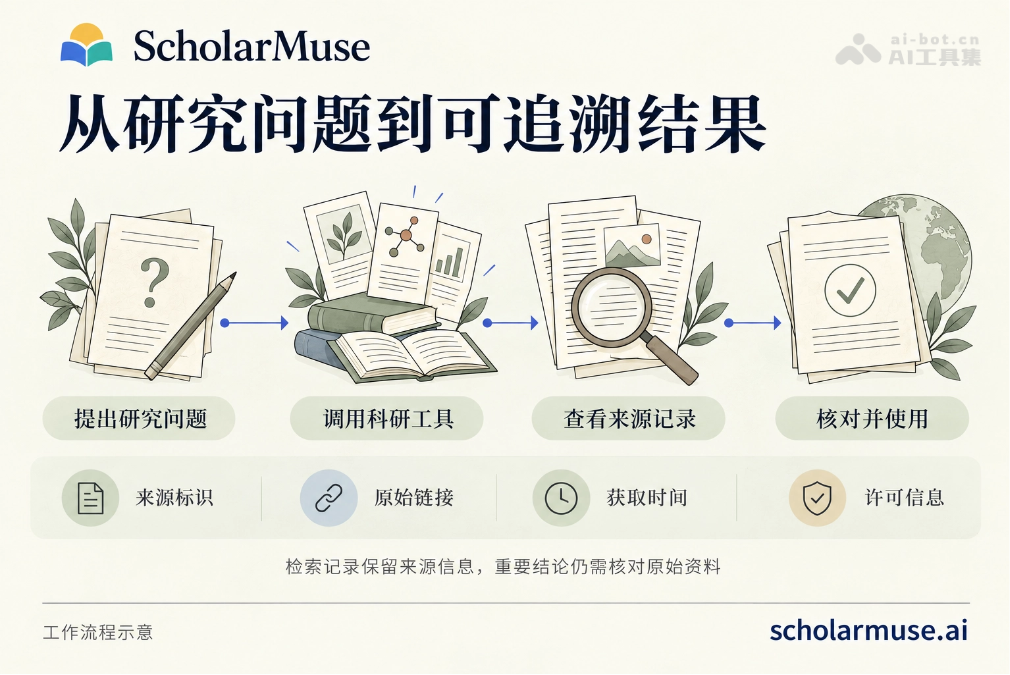
- Preserve Source Attribution: Each record includes source metadata, timestamp, and licensing information where applicable, including original links and attribution details. Researchers can return to the original source for further validation.
How to Use ScholarMuse
- Integration Setup: Visit the ScholarMuse official website at https://scholarmuse.ai/zh, follow client-specific instructions to add the MCP tool, and complete login and authorization in your browser.
- Try Small Tasks First: After connection, start with a well-defined small task—such as retrieving papers on a specific topic from the past three years with publication years and source links, or checking retraction status of entries in your reading list via DOI.
- Review Returned Results: After agent invocation, researchers should verify summary content, source origin, identifiers, and timestamps; pay attention to any warnings indicating failed source queries.
- Deepen Your Research: Once records are confirmed accurate, request the agent to organize your reading list, prepare further analysis, or generate a research workflow diagram.

Core Advantages of ScholarMuse
- Seamless Integration into Existing Workflows: ScholarMuse operates as an MCP tool integrated with widely used AI assistants like Claude, ChatGPT, Codex, and Cursor—researchers can access advanced tools without switching platforms or initiating new conversations.
- Developer-Friendly Access: ScholarMuse exposes full functionality via REST API, enabling developers to integrate its capabilities into custom research applications or scripts.
- One-Stop Cross-Disciplinary Coverage: Combines general literature tools with specialized domain capabilities in genomics, compounds, Earth systems, and astronomy under a unified interface, facilitating cross-disciplinary research on demand.
- Fully Traceable Sources: Each record includes source identification, retrieval timestamp, and licensing/copyright details, allowing researchers to revisit original sources at any time for verification.
ScholarMuse Pricing Model
- Free Trial: Unconnected users may use reference verification, retraction checks, journal lookup, NIH project search, and dataset retrieval directly on the web. Free access to web tools allows up to 5 daily non-registered calls—subject to change per page.
- New User Bonus: New accounts receive 300 data query credits valid for 30 days.
- Credit Consumption: Tools are billed per credit unit; pricing details are visible before usage. Free query quotas do not imply free generation features—scientific illustration generation requires paid plans or credit packs.
- Paid Plans: Generation features such as scientific illustrations require payment. Current public plans start at $30/month or $120/year.
Competitive Comparison with Similar Platforms
| Comparison Dimension | ScholarMuse | VIP Innovation Assistant |
|---|---|---|
| Product Form | MCP Tool Platform + REST API, integrated with Claude/ChatGPT/Codex/Cursor | Standalone Web Platform with Mini Program Interface, plus API and Agent configuration options |
| Resource Foundation | Over 50 international research data sources: scholarly papers, grants (NIH/NSF/UKRI), datasets, economic statistics | VIP’s proprietary database: 15,000+ Chinese journals, 76 million+ Chinese documents, 100 million+ international bibliographic records |
| Unique Features | Citation field verification, retraction check, grant/dataset search, scientific illustration generation | AI-assisted topic selection, intelligent search across 100 databases, AI reading, one-click synthesis reports, one-click manuscript generation, VIP proofreading, journal recommendation, research star map |
| Language Focus | Primarily English-language international data sources | Deeply optimized for Chinese research context (e.g., core journal recognition, GB/T 7714 citation format) |
| AI Hallucination Mitigation | Records include source identifiers and retrieval timestamps—users must manually verify against original literature | Emphasizes "answers grounded in real literature + one-click reference tracing," prioritizing elimination of fabricated references |
Use Cases of ScholarMuse
- Topic Selection & Literature Review: Researchers instruct AI to retrieve recent papers in a given field and cross-reference with grant databases to assess funding trends and quickly evaluate research viability.
- Citation Verification: Students or researchers batch-verify titles, authors, years, and DOIs in their reference lists prior to submission, checking for retraction notices.
- Grant Project Discovery: Research teams search NIH, NSF, UKRI project records before applying, using previously funded topics to refine their own proposals.
- Cross-Disciplinary Data Access: Interdisciplinary researchers dynamically invoke statistical, life sciences, environmental, or astronomical tools to gather data for analysis.
- Reusable Data Discovery: Through dataset searches across multiple research repositories, researchers identify publicly available, reusable data to support secondary studies.
Frequently Asked Questions
Q1: How does ScholarMuse differ from standard online search?
A1: Standard online search is suitable for finding web pages and news. ScholarMuse provides structured database records and domain-specific querying capabilities defined by tools. The two can be used complementarily, depending on which tools the client can invoke.
Q2: Can retrieved records be used directly as research conclusions?
A2: No. Retrieved records assist in material discovery and verification; original study conditions and conclusions must still be confirmed before formal citation. Generated diagrams are not considered database evidence.
Q3: Can I try ScholarMuse without using MCP?
A3: Yes—begin with the web-based tools. Developers may also integrate via REST API. Usage limits for connected tools differ from those of the free web access portal.
Source: AI Tools Hub
Disclaimer: Contains third-party opinions, does not constitute financial advice


Step Code – The Open-Source Terminal Programming Agent by Jieyue Star
25 days ago
Hy4 Preview Lightweight Version – Tencent Hunyuan's Open-Source Hy4 Quantized Compression Model
09-02
Claude Fable 5.1 – Anthropic's Latest Flagship Large Model
09-02
Open-source Retool is here, drag-and-drop backend with 60+ components
08-19
Claude Opus 5 is Here: Half the Price Approaching Fable 5
07-25
Tencent Open-Sources 260 Real-World Tasks to Test AI Workforce Capabilities
07-25
Meituan Open-Sources AI Exam Platform: 813 Minecraft Tasks
07-25


