Can AI-generated webcomics with thousands of episodes be more profitable? Top-performing series can earn up to 2 million yuan per season.
Can AI-generated webcomics with thousands of episodes be more profitable? Top-performing series can earn up to 2 million yuan per season.

2026-10-18 22:02
Introduction: AI-driven production cost reduction, long-form web novels fueling IP sequel revenue streams. AI enhances production efficiency, while long-form web novels provide abundant narrative material for sustained development.

AI boosts production efficiency, and long-form web novels supply ample story content for continuous development. Industry insiders estimate that a single successful season can generate revenue between 1 million and 2 million CNY, with ten seasons potentially exceeding tens of millions.
Supervising Producer | Zhang Yitong (Shanghai)
From multi-season serialization to one-time release of thousands of episodes, ultra-long-form has become the dominant format among top-tier anime series.
DataEye’s September Red Fruit AI Drama/Anime Top 100 list shows series IPs increasing from 23 in August to 41 in September, with 61 out of 100 works being sequels. According to Red Fruit’s official report, Season 13 of “The Chronicles of Ten Thousand Demons” launched on October 1st and surpassed 1 billion views by October 3rd; “The Treasure Pot of Immortals: Heterogeneous Roots Are the True Boss” Season 12 also hit over 1 billion views by October 6th. “Three Thousand Safeguards” has already reached its 35th season since its launch in February, with ongoing serialization.

Not only are seasons increasing, but individual seasons are also growing longer. “The Chronicles of Ten Thousand Demons” Season 12 exceeds 200 episodes; “Our Sword Sect’s Beloved Little Sister” expanded from 300 episodes in Season 1 to 666 in Season 2. Some series have even reached thousand-episode lengths—“I Have Space in 1960, No Need to Worry About Food and Drink” Season 1 launched directly with 1,000 episodes.
AI improves production efficiency, while long-form web novels offer rich content foundations for continuous development. Industry professionals confirm that a single blockbuster season typically generates revenue between 1 million and 2 million CNY.

However, profitability for blockbusters doesn’t guarantee financial success for all production studios. Premium production workshops focused on high-quality, iterative content creation are emerging, while content factories relying on volume-based experimentation still bear losses from underperforming projects. Some companies have begun scaling back operations and shifting production models.
Why Are Anime Series Getting Longer?
AI-driven capacity expansion is the fundamental enabler behind the rise of ultra-long-form anime series.
Series development has precedent in live-action short dramas—works like “My 18-Year-Old Great-Grandmother Arrives, Rebuilding Family Glory” extended narratives through sequels. However, filming sequels in live-action requires re-coordinating actors, locations, and crews. In contrast, AI-generated anime can reuse established characters, environments, voice assets, and workflows, minimizing redundant investment and enabling faster delivery of subsequent seasons.
Long-form web novels provide a robust foundation for sustained content development.
Genres such as cultivation, post-apocalyptic survival, and rural life storytelling unfold continuously through character growth, environmental shifts, and evolving relationships. Tools like Xiao Yunque’s Agent now support script generation and multi-episode production for novel adaptations and serialized content, significantly accelerating the conversion of long-form stories into video format.
Season-by-season production allows complex narratives to be delivered incrementally. Red Fruit’s high-quality AI drama production initiative requires new or completed series with minimum episode durations of 60 minutes per installment. Each season completes a narrative arc, released as a finished product, yet production can continue on the next season without interruption.
The popularity of ultra-long-form content also reflects audience desire for sustained emotional engagement. Once invested in a story and familiar with its characters, viewers wish to follow their cultivation journeys, adventures, or daily lives. The end of one season does not necessarily terminate this viewing motivation.
Red Fruit reported that Season 12 of “Treasure Pot” achieved initial heat exceeding 94.77 million; DataEye recorded that Season 12 of “The Chronicles of Ten Thousand Demons” peaked at 137 million heat, surpassing Season 11’s 125 million. At least for these top-tier titles, serialization across more than ten seasons remains viable for sustaining audience interest and driving heat metrics.
A viewer shared their experience watching “Treasure Pot,” stating they binge-watched 111 episodes and still felt unsatisfied, prompting a rewatch of Season 1. Similarly, beloved character and "group favorite" tropes foster a sense of daily companionship. Comments sections of works like “Nuonuo Comes Down the Mountain” and “Our Sword Sect’s Beloved Little Sister” feature expressions like “Auntie’s here” and “Cloud-fostering Nuonuo,” reflecting user preferences for low-conflict, everyday life narratives.

When characters and stories are compelling enough, some audiences tolerate visual imperfections. One viewer noted that despite noticing inconsistencies in visuals, they still found the content “so interesting, so cute, so beautiful.”
For these viewers, production polish isn’t the sole determinant of whether they continue following a series. AI-enhanced efficiency enables producers to respond to such demand through consistent updates.
How Much Can Ultra-Long Anime Series Earn?
Industry estimates suggest that a single blockbuster season on Red Fruit generates revenue between 1 million and 2 million CNY. With long-form web novels spanning several million characters, producing over twenty seasons could yield at least 20 million CNY in cumulative revenue.
“The Chronicles of Ten Thousand Demons” has advanced to Season 13, covering roughly three-quarters of the original novel’s current progress. The source novel has surpassed 1,070 chapters and continues serialization. “Three Thousand Safeguards” on Huo Long Anime has reached 35 seasons, with adaptation progress nearing completion of the original work “I Build a Sanctuary in Eternal Night.” Future novel updates may continue to serve as story sources for the anime adaptation.

As market supply surges, the revenue ceiling per season is declining.
Industry insiders report that after April–May, revenue from split payments for similarly popular projects dropped by over 20%, though platform settlement transparency remains limited, making it difficult to isolate individual factors’ impacts.
Additionally, platform incentives for series productions are decreasing. Previously, in Red Fruit’s high-quality AI drama production campaign, series could receive bonus rewards via a “Series Scale Coefficient.” The policy was updated on September 22nd, eliminating this coefficient effective October 1st. While eligible sequels can still earn rewards based on performance, the removal targets only the prior incentive mechanism encouraging series development—not standard revenue distribution.
Some industry participants express higher confidence in female-targeted anime’s revenue potential. These works generally have lower production costs, while female audiences exhibit strong engagement, sharing, and discussion enthusiasm—making them more likely to drive virality. Thus, certain female-focused titles may achieve favorable returns with relatively low investment.
Premium production teams invest heavily in individual seasons. A high-end production team mentioned spending 200k–300k CNY per season, corresponding to 200–300 minutes of content. They repeatedly refine fight choreography, lighting, and camera movements, often extending individual episodes to fully capture action sequences or dialogue scenes.
This approach increases costs and affects monetization. Longer episodes reduce ad exposure opportunities; cutting episodes to insert ads risks disrupting narrative flow and degrading viewing experience. Producers must constantly balance revenue generation against content integrity.
Other teams adopt an extreme cost-cutting strategy.
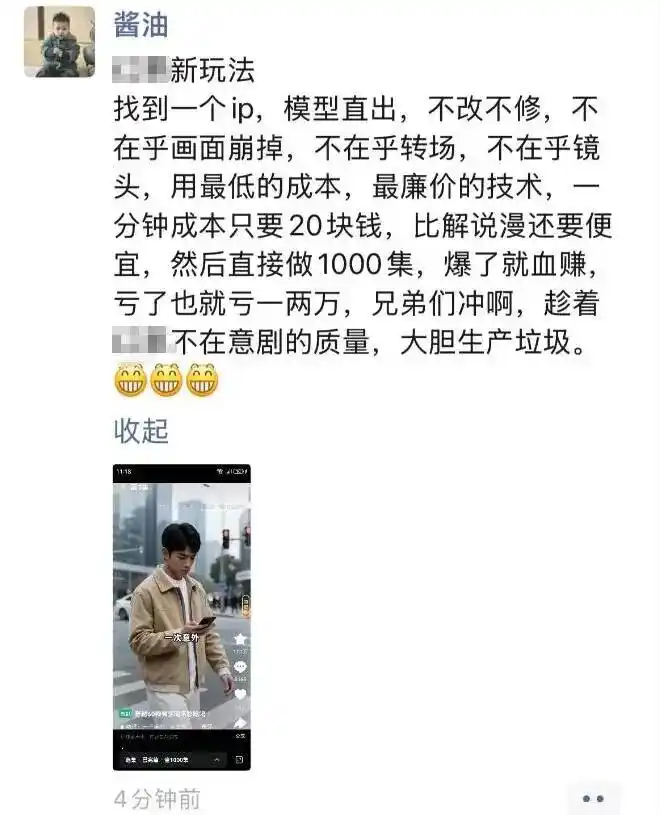
In September, Youjiang criticized a “thousand-episode” approach on WeChat Moments: using AI to generate content directly without editing or refinement, regardless of visual glitches or poor transitions. He estimated a cost of around 20 CNY per minute; launching large volumes of content, even if unsuccessful, results in losses of only 10k–20k CNY.
Lv Shaolong, head of Lingju Animation, observed that multiple anime adaptations exist for the same novel IP, extending competition beyond launch timing into serialization pace. Some teams pre-produce content to secure early release after resolving licensing issues, leveraging greater episode counts to attract users.
Content Factories Are Evolving
Lingju Animation once reached monthly production capacity of approximately 500 works, including both self-produced and collaborative content. Lv Shaolong explained that external observers, seeing the company’s high visibility in the first half of the year, assumed substantial profits—but numerous underperforming projects consumed revenues generated by successful titles.
Lv Shaolong notes that many highly visible top-tier works originate from smaller, agile teams. Beyond efficiency, narrative judgment plays an equally critical role in performance. While content factories excel in production speed, high-quality series require creators to iteratively refine specific storylines.
Currently, Lingju’s strategic focus lies in optimizing how production investment translates into actual revenue.
Lingju is reducing domestic production capacity while experimenting with offering skills, tools, computational power, and distribution support to external creators. The company retains core connection and service capabilities, delegating content production to smaller creative units. This shift responds to operational pressures and represents a strategic pivot toward collaboration with independent creators.
On the other hand, some teams that started small have gradually expanded staff after achieving success. Sustained serialization brings future development opportunities but also demands stable delivery, clear division of labor, and quality control. Even small teams face challenges related to cost and coordination when scaling up.
What’s evident today is that different teams are re-evaluating the relationship between scale and creativity. Some content factories are downsizing centralized production and seeking connections with external creators; successful micro-workshops are building sustainable delivery capabilities around existing franchises.
Source: Xingsheng Pro
Disclaimer: Contains third-party opinions, does not constitute financial advice


Douyin Releases 220,000 AI Animated Series in Half a Year, Most Creators Earn Less Than $10 Monthly
07-29
ByteDance's Douyin Beans priced at 68 RMB—worth it for 382 million monthly active users?
07-25
62 Yuan AI Community Collected 248,000 in 4 Days—First Lesson? Recruiting Referrals
07-23
Ditching Salesforce? U.S. Small Businesses Save $100K Annually with AI
07-23
Tensorlake npm package suffers supply chain attack, malicious version 0.5.144 injected with Shai-Hulud data-exfiltration worm
11 days agoTesla and Musk Have Yet to Define "Amazing Abundance" — Visionary Slogan Sparks Skepticism
17 days agoInstinct Launches Curated Recommendation Feature, Sparking Frustration Among Some Users Receiving Passive Product Suggestions
18 days ago


