The Yuque Team Open-Sources Void: Deploy Your Vite App Live with One Command
The Yuque Team Open-Sources Void: Deploy Your Vite App Live with One Command

2026-10-18 15:39
Introduction: The Yu Yu Xi team enables zero-configuration integration of Cloudflare’s full suite. What is Void? Void is an open-source full-stack development and deployment tool by the Yu Yu Xi team, comprising SDK, CLI, and a team deployment platform.
What is Void?
Void is an open-source full-stack development and deployment tool created by the Yu Yu Xi team, consisting of SDK, CLI, and a team deployment platform. Void streamlines the workflow from writing code in Vite applications to connecting databases and deploying to production. Local development automatically configures local resources, while deployment seamlessly integrates with Cloudflare’s D1, KV, R2, and other services with zero manual configuration; the team platform allows administrators to centrally manage cloud account permissions and enables secure internal application deployment for team members. Void supports mainstream frameworks such as Nuxt and SvelteKit, and is now deployable to individual Cloudflare accounts.
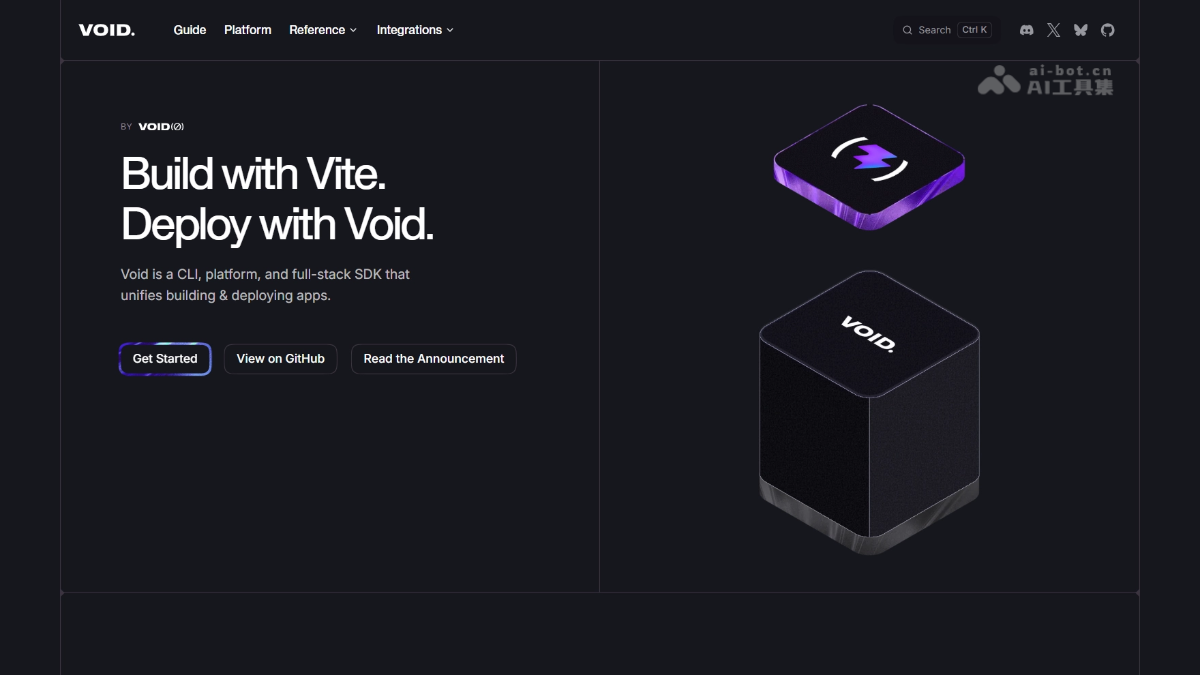
Key Features of Void
- Zero-Configuration Backend Integration: Provides type-safe backend capabilities for Vite applications. Pages can include
.server.tsfiles to read data, handle forms, and pass type-safe server-side data directly to components. - Automatic Resource Binding: Automatically infers and binds required resources based on application usage—local development uses local databases, while deployment automatically creates corresponding cloud resources.
- CLI One-Click Deployment: Running
npx void deploycompletes build, resource provisioning, database migration, and generates the deployment URL. - Native Cloudflare Ecosystem Integration: Natively integrates with D1 database, KV storage, R2 object storage, and other services without manual configuration.
- Multi-Framework Support: Compatible with Nuxt, SvelteKit, Astro, TanStack Start. Original framework handles routing and rendering; Void manages resources, migrations, and deployment.
- Team Deployment Platform: Administrators install the platform into their own Cloudflare account; team members connect to deploy without exposing cloud credentials.

Follow WeChat and reply “open source” to join the AI Open Source Project Community
How to Use Void
- Environment Setup: Install Node.js 24.21.0 or higher, and create an empty project directory.
- Install Void: Run
npm install -D voidinside the project directory to install development dependencies. - Initialize Project: Execute
npx void init, select UI framework and starter template, and choose Cloudflare as the deployment target. - Local Development: Run
npm run devto start the development server, automatically using local databases and other resources. - Build Application: Write server-side logic using
.server.tsfiles; page components automatically receive type-safe data. - One-Click Deployment: Run
npx void deploy; the first time will open a browser to log in to your Cloudflare account. - Go Live: The tool automatically handles build, resource configuration, database migration, and outputs the online access URL.
Core Advantages of Void
- Unified Code-to-Deployment Flow: Integrates writing code, connecting databases, and deploying to production into one seamless process—eliminating context switching across tools.
- End-to-End Type Safety: Server-side data and database query results are passed with types directly to page components, reducing front-end/backend integration errors.
- Zero-Configuration Resource Binding: Automatically detects and provisions required D1, KV, R2, and other resources, eliminating manual configuration overhead.
- Consistent Local & Cloud Experience: Uses local databases during local development and seamlessly switches to cloud resources upon deployment, drastically reducing environment discrepancies.
- Low Barrier to One-Click Deployment: A single command
npx void deployhandles build, resource provisioning, and database migration end-to-end.
Void Project Repository
- Official Website: https://void.cloud/
- GitHub Repository: https://github.com/voidzero-dev
Competitive Comparison with Similar Tools
| Comparison Dimension | Void | Vercel |
|---|---|---|
| Positioning | Full-stack development and deployment tool for Vite | Frontend full-stack deployment platform |
| Open Source Status | Supported: Fully open-source (MIT), self-deployable | Not Supported: Core platform closed-source, hosted service |
| Underlying Infrastructure | Cloudflare (Workers/D1/KV/R2) | Self-built edge network (hybrid AWS/GCP, etc.) |
| Resource Binding Method | Automatic inference, zero configuration | Manual configuration of environment variables and integrations required |
| Local Development Experience | Automatically provides local database locally, consistent with cloud | Requires manual setup of local simulation environment |
| Type Safety | Server-side data/database queries pass types directly to components | Requires third-party solutions like tRPC to implement manually |
| Deployment Command | `npx void deploy` — one command to complete all steps | `vercel` CLI, similar workflow |
| Framework Bias | Neutral: Vite ecosystem (supports React/Vue/Svelte equally) | Strong bias toward Next.js; other frameworks offer compatibility only |
| Team Permission Management | Self-hosted platform; credentials remain with administrators | Advanced team collaboration, but platform not self-hostable |
| Pricing Model | Open-source and free; only pay for Cloudflare resource usage | Per-seat + usage-based pricing; costs escalate significantly at scale |
| Vendor Lock-in Risk | Low (can switch runtime; source code fully accessible) | High (deeply integrated with Vercel ecosystem) |
Use Cases for Void
- Rapid Deployment for Individual Developers: Deploy a Vite project to Cloudflare with one command, obtain a live URL instantly—ideal for side projects and portfolio showcases.
- Internal Applications for AI Development Tools: Teams use AI-generated tools or admin dashboards, deployed uniformly via Void platform without each member touching cloud accounts.
- Medium-Sized Full-Stack Applications: Complete applications requiring databases (D1), caching (KV), and file storage (R2); Void automates resource binding and migration.
- Cost-Sensitive Startup Projects: Avoid high bills typical of Vercel-style pricing models; leverage open-source solutions combined with affordable Cloudflare resources to control costs.
- Enterprises/Organizations Requiring Data Sovereignty: Self-host the deployment platform; audit and modify source code; keep data within their own Cloudflare account.
Source: AI Tool Kit
Disclaimer: Contains third-party opinions, does not constitute financial advice


Step Code – The Open-Source Terminal Programming Agent by Jieyue Star
25 days ago
Hy4 Preview Lightweight Version – Tencent Hunyuan's Open-Source Hy4 Quantized Compression Model
09-02
Claude Fable 5.1 – Anthropic's Latest Flagship Large Model
09-02
Open-source Retool is here, drag-and-drop backend with 60+ components
08-19
Claude Opus 5 is Here: Half the Price Approaching Fable 5
07-25
Tencent Open-Sources 260 Real-World Tasks to Test AI Workforce Capabilities
07-25
Meituan Open-Sources AI Exam Platform: 813 Minecraft Tasks
07-25


