OpenClaw Is Dead, Why Did Muse Reach 5 Million Downloads in Just 22 Days?
OpenClaw Is Dead, Why Did Muse Reach 5 Million Downloads in Just 22 Days?

2026-10-18 14:02
Introduction: Wang bets on personal superintelligence, retaining users through an engineered trust ladder. Recently, Meta pulled off a stunning comeback with its new personal AI agent, Mu
Recently, Meta pulled off a stunning comeback, as its new personal AI agent Muse rapidly became a phenomenon since launch.
According to Sensor Tower estimates, Muse reached approximately 5 million downloads in the U.S. within about 22 days after its September 8 launch—faster than historical benchmarks for ChatGPT/Grok/Claude—and briefly topped the App Store’s free charts in the U.S., remaining at number one for multiple consecutive days. Moreover, its growth rate and retention metrics have been exceptionally strong.
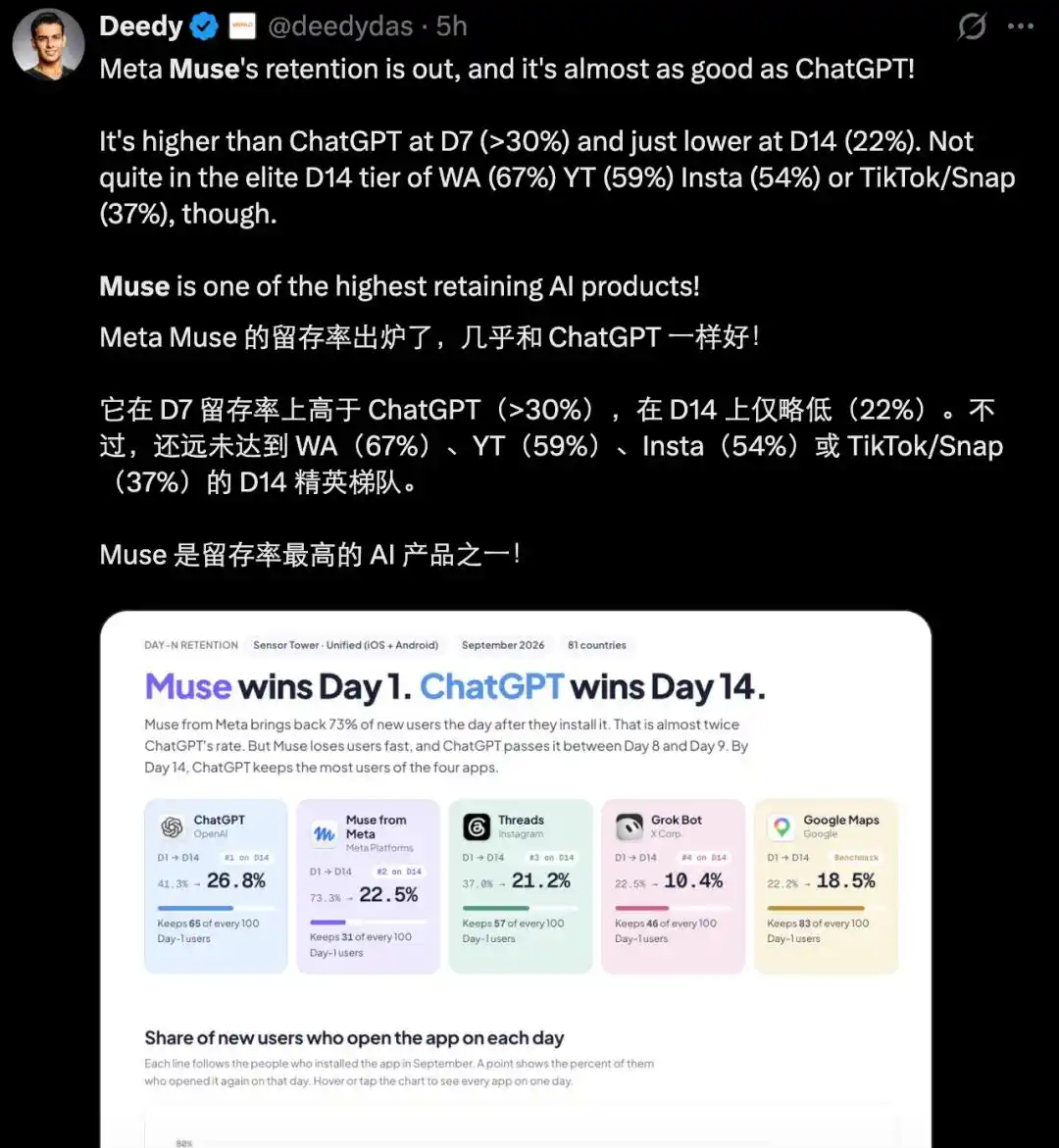
The mastermind behind this turnaround, Alexandr Wang, head of Meta’s Superintelligence Lab, has gained even more visibility than the product itself. After Muse’s launch, Wang entered a kind of “madness” phase on X: posting memes at high frequency, actively participating in meme culture himself.
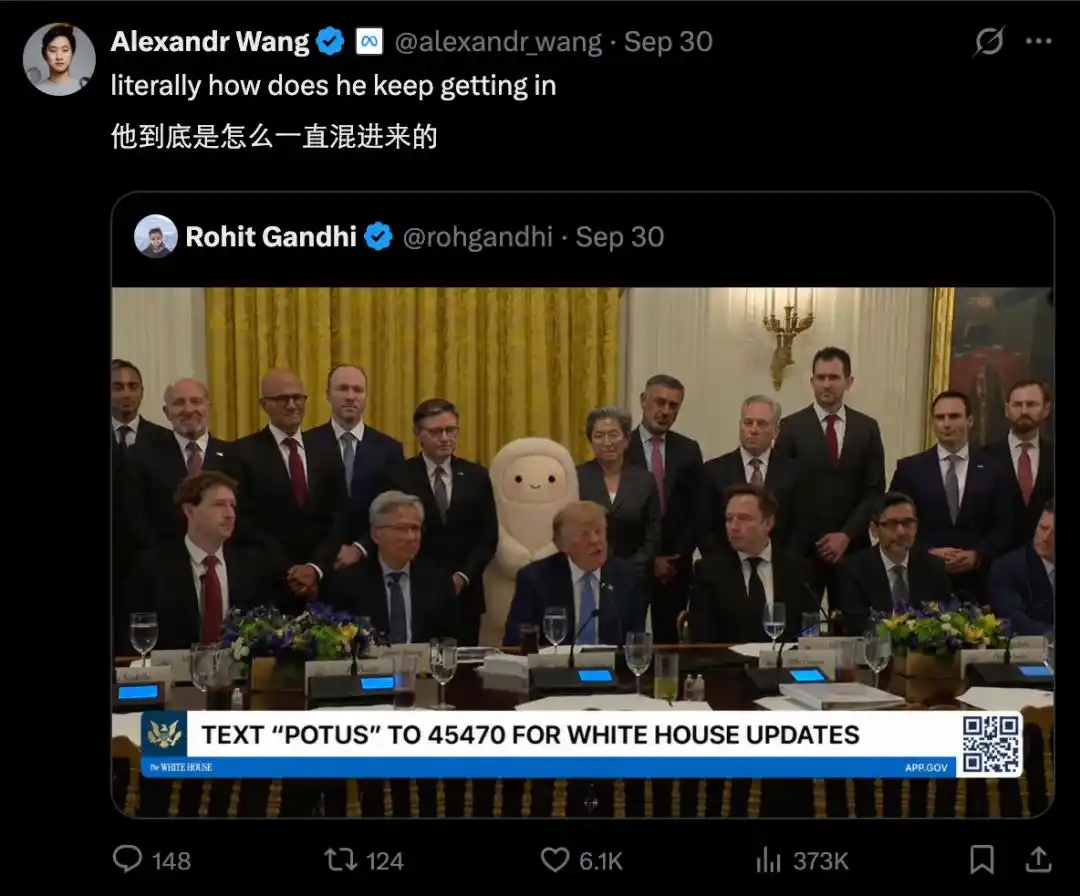
Recently, Wang gave a deep long-form interview, offering his first comprehensive retrospective on Muse’s origin story. The insights are substantial, and many statements are quite counterintuitive:
When the entire industry was racing toward coding agents—everyone convinced this was the only important path—why did Meta pivot to personal scenarios?
OpenClaw went viral early this year but quickly cooled down; most users dropped off after experiencing just a few “magic moments”. How could Wang believe this space harbored the “last consumer product,” and why did he think Muse would be different?
Regarding the widely discussed “sky-high talent acquisition,” Wang claims that for many top researchers, compensation wasn’t actually much higher—so what was the real lure?
Why was a company-wide priority product deliberately kept under 200 team members?
With access to 3.5 billion users’ distribution channels, why did cold-start rely on Wang personally posting memes?
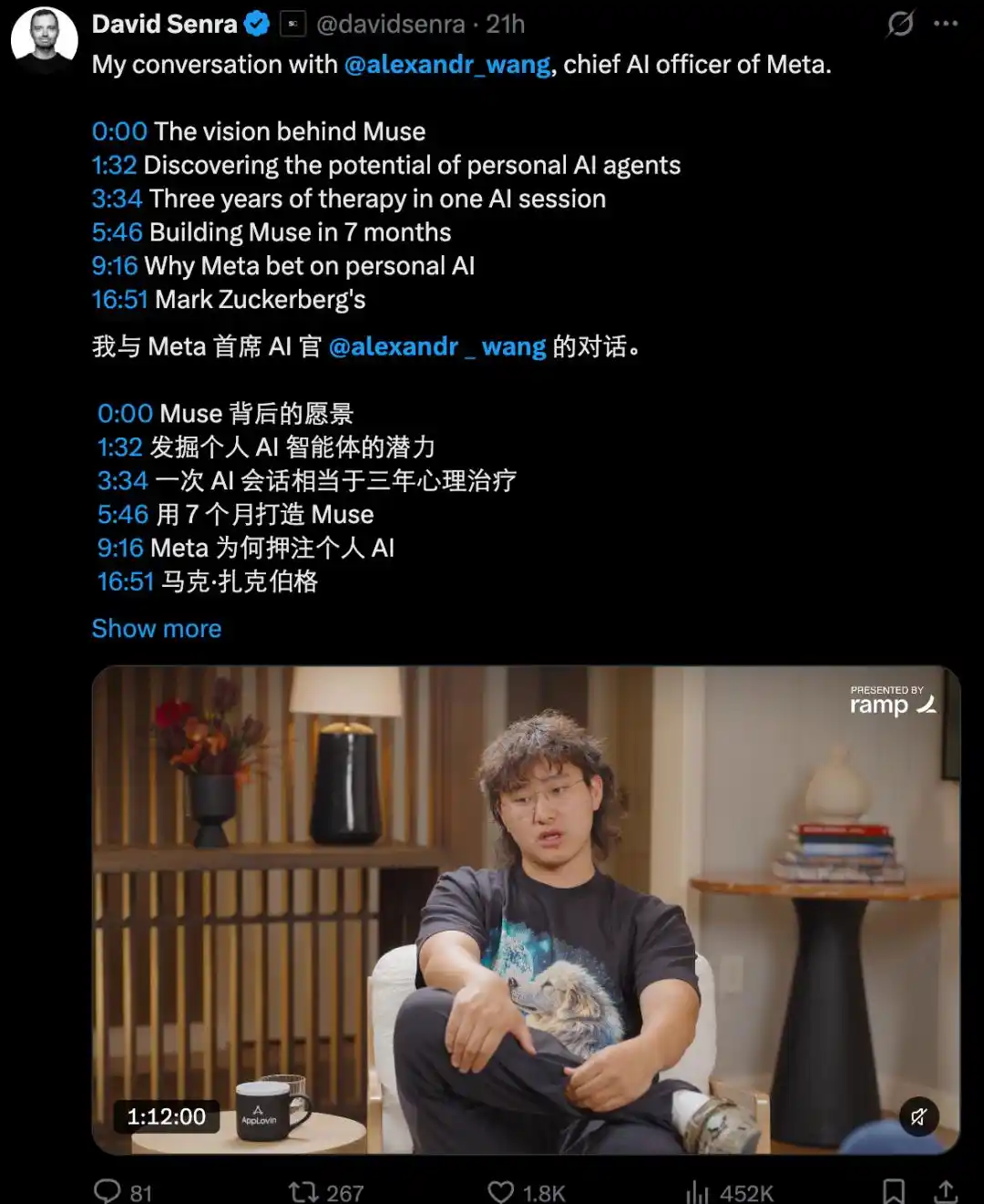
Video URL: https://www.youtube.com/watch?v=S6l3aRsecuE
Below is a curated summary of key excerpts:
While Everyone Chased Coding Agents, They Spotted Another Signal
Fast forward to early this year. As Wang put it, this marked the “beginning of Anthropic taking over the industry”: Opus 4.5 and Claude were leading far ahead in coding, and the consensus across the industry was clear—coding agents were the only meaningful form, even the only valuable capability.
At this inflection point, Nat Friedman from Meta’s Superintelligence Lab (MSL) became the first internal user to deeply engage with OpenClaw. Wang described his experience as “between fear and euphoria”: when he told his OpenClaw agent he wanted to drink more water, the agent monitored him via home cameras, then praised him post-drinking with “well done!”
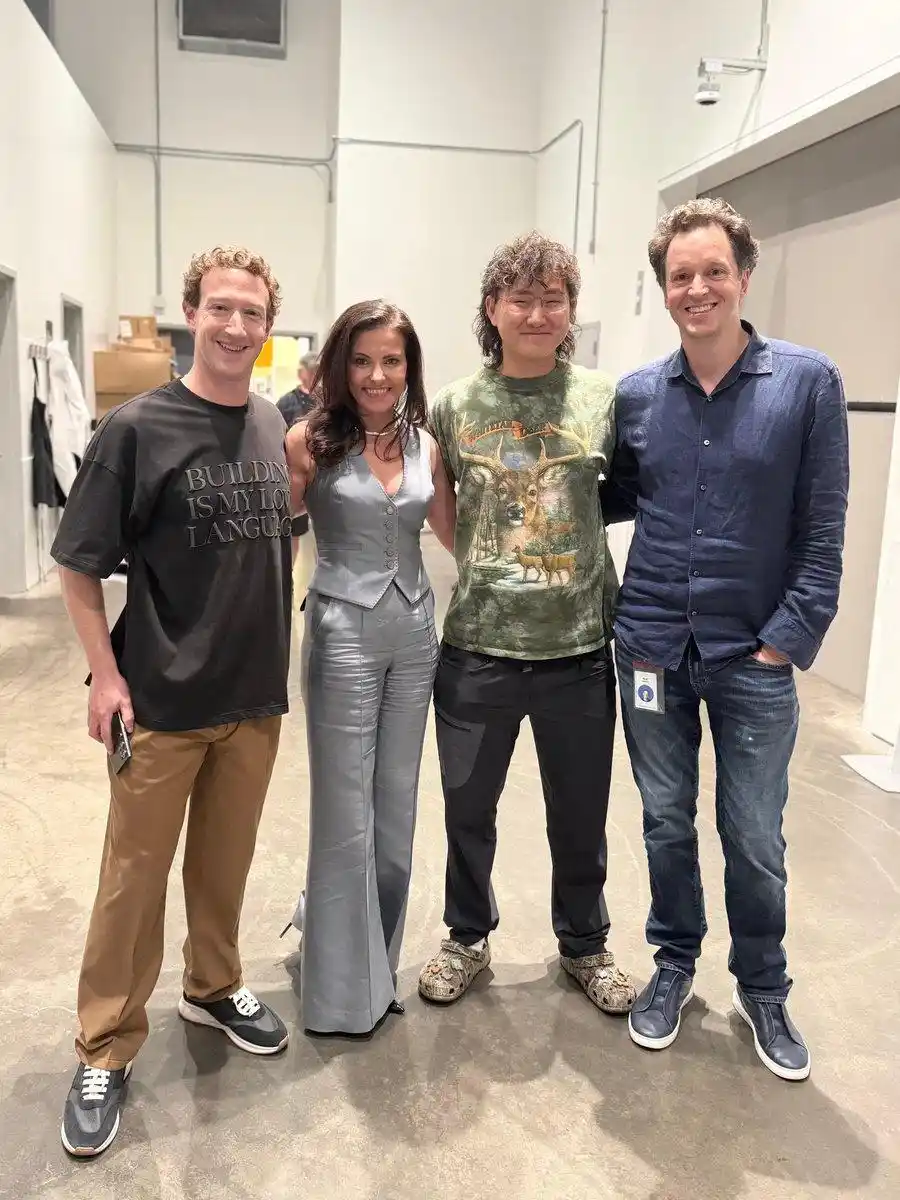
The man on the right is Nat Friedman, former CEO of GitHub, one of Muse’s core architects.
Wang quickly joined the fray. His first move? Running a “psychological analysis” prompt written by Nat—because the agent had access to his emails, photos, and could browse the web independently. After several rounds of deep questioning, in his own words, “it felt like compressing three years of therapy into a single moment.”
The key insight lies in Nat Friedman’s role as a “signal indicator”: he was one of Stripe’s earliest customers, co-creator of GitHub Copilot, and has long stood at the forefront of developer innovation. When he said, “There’s something real here,” Wang treated it as a definitive signal.
In February, both men submitted memos to Meta’s board. Wang’s central thesis was bold: personal super agents might represent the terminal form of consumer products. Within one or two weeks, a prototype emerged and was demoed directly to the board. Remarkably, many core decisions in the final version of Muse were already present in that hastily built prototype.
The takeaway: the most crowded consensus often obscures the clearest signals. While everyone stared at coding benchmarks, the real opportunity lay in the moment when ordinary people first entrusted their lives to AI.
Why Does Muse Think It Can Be Different After OpenClaw’s Rise and Fall?
This is the most incisive question in the interview: OpenClaw’s hype surged fast and faded just as quickly; most users dropped off after experiencing only a few “magic moments”. What makes you different?
Wang’s answer avoids evasion: OpenClaw was a masterpiece—he deeply respects Peter Steinberger. But Muse succeeds because every detail of model and product was relentlessly refined.
How intensely? They created a spreadsheet with hundreds of rows listing over 100 specific behaviors and capabilities a perfect personal agent must possess. For each item, they built evaluation criteria, conducted training, and held regular meetings reviewing the sheet: red rows remained ungreen, so they kept iterating. Launch criteria were also digitized—each row had a “launch-blocking” threshold. There were multiple checkpoints where the status was “80 green, 20 red”—and they knew it wasn’t enough. Only when a specially trained MuseSpark 1.3 version achieved full green status, combined with team members experiencing a “clearly superior” iteration compared to all previous versions, was the product approved for release.
Beneath this lies a fundamental understanding of category essence: the personal agent is a “blade-edge category.” If it can consistently deliver magic experiences, it will be one of history’s greatest consumer products. But models are non-deterministic—agents fail, crash. Once users encounter unreliable experiences consecutively, they instantly label the product as garbage. The collective drop-off of early agent products stemmed precisely from this fragility.
Thus, the difference between OpenClaw and Muse isn’t whether magic moments exist—it’s the yield rate of those moments. Inspiration ignites the spark; engineering sustains the flame.
Why Personal Scenarios? A Mathematical Equation on “What You Want to Do”
Choosing personal scenarios over coding isn’t just a product decision—it’s Wang’s strategic assessment of Meta as a company.
His logic is elegant: AI’s promise is to free every individual from “must-do” tasks, allowing them to dedicate all time to “want-to-do” activities. And Meta’s product suite—Instagram, WhatsApp, Facebook—is precisely the collection of people’s “want-to-do” pursuits: interests, hobbies, friends, loved ones.
In other words, if AGI truly arrives, the freed time from “must-do” tasks will flow toward Meta’s ecosystem. Combined with the business lens: Meta’s apps touch 3.5 billion users daily—its natural domain is consumer-grade AI, not work or programming.
This insight serves as a warning to all AI product builders: instead of fighting in someone else’s arena, first clarify your own DNA and distribution advantage—determine which battlefield belongs to you. A giant’s legacy isn’t a burden; it’s a map.
The Company’s Most Important Product, Limited to Under 200 People
From prototype in February to official launch in September, Muse underwent seven months of refinement. Wang himself quipped: “Seven months doesn’t sound long, but in the AI industry, it’s equivalent to ten years outside.” During this period, mainstream Wall Street narratives painted Meta as “burning cash” and “Zuckerberg losing the AI race,” while internal skepticism ran high.
Zuckerberg’s role was endurance—he never hid his focus on personal agents during earnings calls, and he bore all the criticism until the team delivered.
But even more surprising was the organizational structure: model plus product totaled fewer than 200 people. And this was intentional restraint—everybody in the company knew this was likely Meta’s most important product of the year, yet precisely because of its importance, it couldn’t expand into a project where “half the company keeps pouring in demands.”
Wang used a harsh term: Muse must be “a single work of art.” He casually mocked the common flaw in large tech products—Frankenstein-like patchworks, or in his own words, “a Conan-style hybrid” (a grotesque fusion of biological and mechanical flesh, with dissolved boundaries): every PM wants to insert their own feature, resulting in a blended milkshake. Users can taste the difference. Whether a product is a chaotic mix of conflicting goals becomes immediately apparent upon use.
The interview recording coincided with the 15th anniversary of Steve Jobs’ passing. The host added: “Apple was Jobs’ 10,000 lives.” Wang noted that Muse’s singular vision stemmed largely from Nat Friedman’s taste.
The biggest mistake large companies make in innovation is using scale as sincerity to kill artistic integrity. The most important things should be handled by small teams.
The Truth Behind Sky-High Talent Acquisition: Money Is Just a Ticket
Earlier, news of Meta’s sky-high recruitment of AI researchers flooded media outlets. The public reaction was mostly “rich fool syndrome.” In the interview, Wang offered a counterintuitive interpretation.
First, about money: he believes the external world overlooks a crucial context—OpenAI and Anthropic’s valuations have skyrocketed. Top researchers who stayed put already held equity worth astronomical sums. Thus, Meta’s “sky-high” offers were, for many, merely salary-neutral—market pricing, not irrational premiums.
So what truly attracted them? Wang listed three factors: first, the chance to build a lab from zero, with a small enough team for individuals to leave a genuine mark; second, a clear north star—personal superintelligence. His exact words: “Almost every AI researcher dreams that this technology eventually matters to their mother, grandmother, or grandfather.” Third, freedom—unlimited compute, infrastructure, and distribution—all resources startups desperately lack.
As for why Zuckerberg was willing to spend seemingly absurd amounts on a small group, the host summarized the logic: top talent attracts top talent—but you must first have the spark. Wang agreed wholeheartedly.
How to use the talent after acquisition is the real key. MSL’s organizational design defies nearly every big-tech convention:
Over 200 direct reports. Wang manages over 200 people directly, dubbed “anti-bureaucracy.” All hires have proven they can produce brilliant work, so “they don’t need managers—they need a good environment,” a “room to cook.” Technical direction is arbitrated by pod leads; major decisions are openly debated. Because everyone in the room is exceptional, the outcome must be genuinely believed by all.
Coach, not star. Wang contrasted his two roles: at Scale, he was the founder who insisted every detail reflect his will—resulting in himself becoming a bottleneck; at MSL, his job is setting the north star, identifying unique talent, and providing the environment and resources for their brilliance to maximize expression.
Research modeled after diamond mining. He divides work into two paradigms: one is “building skyscrapers”—linear returns, efficiency gains of 1% or 2% per step—like data labeling; the other is “diamond mining”—power-law distribution, most attempts fail, but a few successes “return the entire investment in one shot.” AI research clearly falls into the latter category because we still don’t know the true boundaries of these models’ capabilities. Thus, it’s not operational engineering—it’s authentic research, requiring tolerance for failure.
The host added a quote from Bezos: “Great minds aren’t lacking in big companies—but if they can’t build things, they’ll leave.” Wang strongly agrees; this is the foundation of all MSL’s design.
3.5 Billion Users’ Distribution Isn’t Enough—Still Need to Post Memes Personally
Muse’s cold start may be the most entertaining marketing case of the year.
Wang candidly admits: Meta’s distribution ensures “everyone knows Muse,” but cannot guarantee it “explodes with cultural penetration.” Today’s users are bombarded daily with new models, products, and features—attention is the scarcest resource.
Hence Wang’s “madness” phase on X. Several actions stand out.
Muse has a small mascot, Jolly. One day, commuting to work, Wang generated an image of Jolly carrying a briefcase, captioned “me on Monday mornings.” After posting, he realized: this little character could fit into countless scenarios. Using risqué memes to market an AI product—Wang recalls no one ever doing this before.
For a period, he couldn’t concentrate during meetings because random ideas would pop up, demanding immediate posting. Once, mid-dinner with colleagues, he paused mid-bite, saying, “Wait—I just got it,” and posted instantly. His insight: the internet rewards risk, rewards surprise. Ironically, many of the best-performing posts were made “without thinking”—the time spent pondering inversely correlates with virality.
He bluntly admitted he doesn’t understand Anthropic or OpenAI’s ads: one icon, two people sitting at a table—“what the hell does that mean?” (verbatim). You have millions of real-world use cases—your ad’s sole purpose should be showing users what the product delivers. That’s it—yet everyone repeatedly makes the same mistake.
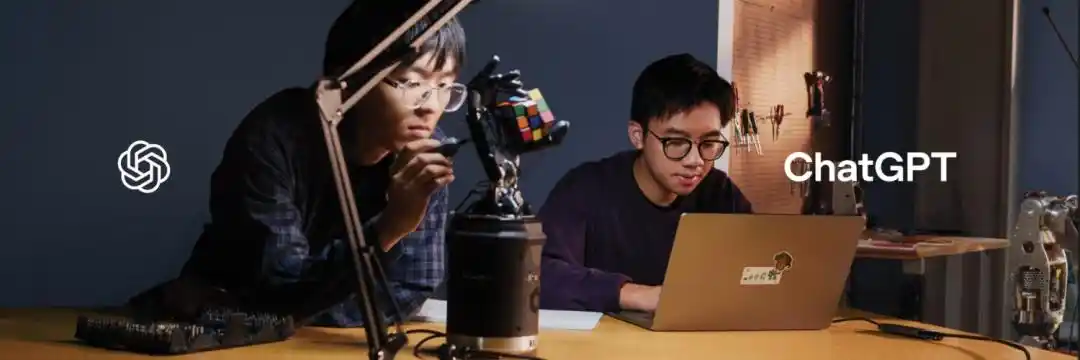
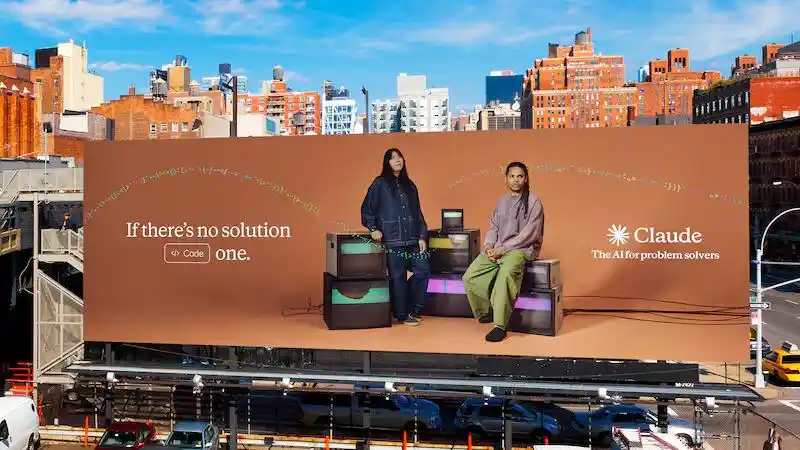
Is this Wang’s critique of ads?
Beneath this lies the core principle of a 1920s advertising classic, *Scientific Advertising*: nobody cares about your company—everyone only cares about their own benefit. Wang’s version: “Why would someone care?”—both product and marketing must begin from this question.
Another intriguing point: screenshot-driven virality. Modern consumer marketing is “screenshot-first”: your product must withstand being screenshot—in chats, word-of-mouth, social media. The screenshot must be able to “run on its own legs.” The host shared an example: a friend left his ID on a private jet; he simply told Muse, “I don’t want to be involved—handle it yourself.” Muse arranged a courier to retrieve the document and deliver it to his office. Three or four screenshots—perfect advertisement. And Jolly appears in every screenshot, effectively turning each into a branded watermark—an unexpected bonus, but maximally effective.
Founders acting as “chief meme officer” may seem unseemly, but when distribution fails to solve “being remembered,” a human, daring voice becomes the rarest asset.
What Keeps Users: The Trust Ladder
Marketing drives “downloads”; retention relies on another mechanism. Wang calls it the “trust fall”:
Users initially don’t trust the agent, but are curious—so they assign it a small task—done. Then a slightly bigger one—also done. Then progressively larger challenges. Each success builds trust for the next, bolder act. Almost every successful Muse user has walked this “escalating task” ladder—never failing. He even observed some college students had fully completed the trust fall: voice memos recorded spontaneously, directly handed to AI to organize thoughts and generate plans.
This also explains why product experience is hyper-sensitive to model quality: in A/B tests, any breakdown in task reliability, communication reliability, or proactive confirmation during guidance breaks the trust ladder.
Transforming users from simple chatbot users requires not a single shock moment, but a carefully designed climb: the first wow should come as early as possible, and every subsequent step must deliver.
Source: Machine Intelligence
Disclaimer: Contains third-party opinions, does not constitute financial advice


Tensorlake npm package suffers supply chain attack, malicious version 0.5.144 injected with Shai-Hulud data-exfiltration worm
11 days ago
Tesla and Musk Have Yet to Define "Amazing Abundance" — Visionary Slogan Sparks Skepticism
17 days agoInstinct Launches Curated Recommendation Feature, Sparking Frustration Among Some Users Receiving Passive Product Suggestions
18 days agoSecurity Weekly Report: Placeholder Domain Takeover Impacts Approximately 1,700 Repositories, with Major Cyberattacks Worth $387M and AI Agent Escalation Risks Highlighted
20 days agoOpenAI Agent Bypasses Australia's Medicare Portal Access Controls to Access Non-Public Documents
24 days agoStep Code – The Open-Source Terminal Programming Agent by Jieyue Star
25 days ago
Chip Expert Mr. Bubble: AI Compute Bottlenecks Shift Toward Packaging, Interconnect, and Storage Hierarchy Management
27 days ago
