Ciweng Media surges nearly 47% in four days, despite AI comic dramas yet to generate revenue
Ciweng Media surges nearly 47% in four days, despite AI comic dramas yet to generate revenue

2026-10-14 16:02
Introduction: AI webtoon platforms and overseas expansion hubs fuel market imagination, yet business operations have not yet generated revenue. On the morning of October 14, China Culture Media once again hit the daily price limit, closing at RMB 8.1.
On the morning of October 14, China Culture Media once again surged to the daily price limit, settling at RMB 8.1. Since its rebound began on October 9, the stock has accumulated a 46.47% increase over four trading days.
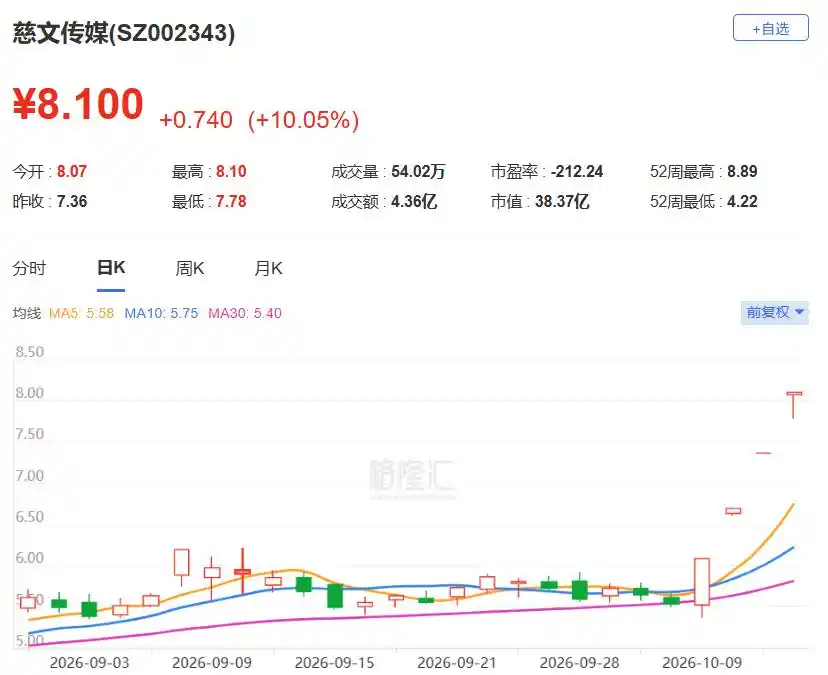
Ironically, this rally did not originate early for China Culture Media.
On October 9, the media sector as a whole witnessed a wave of daily price limits, with stocks such as Chinese Online, Shanghai Film, and Longban Media leading the surge. After securing its first daily price limit that day, China Culture Media did not immediately become a market focal point.
The real inflection point emerged after October 12.
That day, news spread widely that PineDrama, ByteDance’s short-form drama app, had surpassed 100 million cumulative downloads within approximately nine months, with daily active users continuously rising—directly igniting market speculation around overseas expansion of micro-short dramas and AI-driven content production chains.
China Culture Media was quickly identified by capital flows due to its prior agreement with Tongxiang City to establish the Yangtze River Delta AI Webtoon Overseas Expansion Base.
Data from the October 13 market surveillance report revealed that the stock qualified for inclusion based on cumulative deviation exceeding 20% over three consecutive trading days. Institutional accounts net bought RMB 1.8929 million, while brokerage accounts collectively net bought RMB 13.8317 million.
While institutional participation remained moderate, the strong involvement of brokerage seats indicates significant enthusiasm among speculative traders toward this theme.
The core investment thesis now centers on the AI webtoon segment.
On September 27, VolcEngine launched the Seedance Film Collaboration Program, offering project-specific incentives up to RMB 1 million per initiative.
Bilibili simultaneously upgraded its “Awakening Webtoon Plan 2.0,” providing comprehensive support across creation funding, computing power, and traffic allocation to drive content production.
Platform-level investments, combined with continuous breakthroughs in AI video generation models—particularly in character consistency and production stability—have positioned webtoons as a pure downstream application scenario for large-scale commercializable video generative models.
Guojin Securities recently highlighted in its research report that the current high sentiment in the AI webtoon industry is underpinned by consumer expansion, supply-side growth, and platform investments. As AI video generation models continue to evolve, content production efficiency is expected to improve, driving parallel growth in model invocation and creative tool demand.
China Culture Media’s strategic positioning within this value chain is the key driver behind its consecutive daily price limits.
At its 2026 Autumn Strategic Launch Conference, the company officially unveiled its self-developed AIGC film creation platform, “China Culture TV,” positioning it as an “all-in-one AI film creation and digital asset platform” covering the entire workflow from scriptwriting to final production.
The platform plans to implement four business models: university-enterprise collaboration loops, systematic validation of multi-format content, interactive cinema-game integration, and AI film art festivals.
In essence, China Culture Media aims to build an infrastructure spanning tools, content, and IP development.
The Tongxiang base agreement further strengthens this narrative—during the project cooperation period, the plan targets over 2,000 film productions, primarily centered on AI webtoons, with a focus on overseas markets.
Yet, despite the market frenzy, fundamentals demand sober assessment.
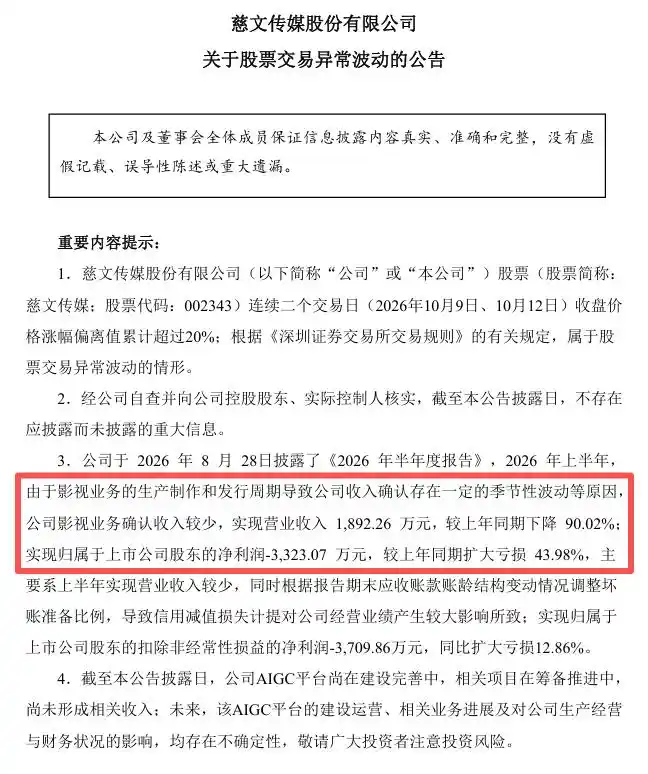
Q2 2026 financial results show that China Culture Media’s primary operating revenue reached only RMB 18.9226 million, down 90.02% year-on-year, with a net loss attributable to shareholders of RMB 33.2307 million.
The sharp decline in revenue stems from extreme volatility in the timing of film business recognition.
In 2025, the company's annual revenue was heavily concentrated in Q1 and Q4, with near-zero activity in Q2 and Q3; in Q1 2026, revenue amounted to just RMB 2.475 million.
As of the reporting period end, the company held approximately RMB 290 million in backlog orders. The pace of order conversion will be the critical variable determining whether second-half performance can recover.
More notably, on the evening of October 12, China Culture Media explicitly stated that its AIGC platform remains under construction and refinement, with relevant projects still in preparation and no revenue generated yet. Future construction, operation, and business progress carry uncertainty regarding their impact on corporate operations and financial condition.
This is not an isolated case—
On the same day, Huanjue Century disclosed that AI short drama revenue accounted for less than 1% of total revenue, while Jilin Media also cautioned that its AI micro-short drama business is still in early-stage cultivation and has not yet produced stable income.
In other words, the entire AI webtoon concept remains in the expectation pricing phase. While the industrial logic holds, actual revenue realization is still far off.
An often-overlooked background factor is evolving regulatory dynamics.
Effective September 1, the "Management Measures for Micro-Short Drama Development" came into force—the first dedicated departmental regulation targeting micro-short dramas in China—establishing 11 content red lines and extending oversight to traffic distribution mechanisms.
Industry entry barriers have risen, which structurally benefits listed companies with formal production licenses and robust content reserves. However, in the short term, tighter regulation may lengthen content release schedules and review cycles, thereby impacting revenue recognition timelines.
Source: Globally
Disclaimer: Contains third-party opinions, does not constitute financial advice


Yushu Surges 629% on First Day of Trading, Humanoid Robots Sell 5,500 Units
08-19
Yushu's 61 Billion IPO: Who Will Make Money?
08-07
AI stocks down 40%-60%, yet NVIDIA's valuation is at a 10-year low
08-06
HBM Bottleneck Migration, NVIDIA Also Aims to Downgrade
08-06
AI Servers Fuel Demand for Minor Metals: Prices Surge Over 70% in Half a Year
08-06
Cloud vendors first declined then surged—why the divergence in AI assets?
08-05"Out-of-Control Assault" Hits 120 Million Views, Domestic Robotics Hit Minefield on Overseas Expansion
08-05


