Old smartphones as "brains": UCLA team builds bipedal robot under 3,000 RMB
Old smartphones as "brains": UCLA team builds bipedal robot under 3,000 RMB

2026-10-14 14:02
Introduction: Used smartphones serve as robot Raspberry Pi, with hardware "barebones" systems potentially lowering development barriers. Robotics has surged in popularity these past few years, yet most robots remain priced beyond the reach of average consumers.
Robotics has surged in popularity these past few years, yet most robots remain priced beyond the reach of average consumers. Even with the emergence of players like Qiyuan offering “personal robots”, a fully functional, structurally complete humanoid robot still costs at least several thousand yuan, not to mention those priced in the tens or hundreds of thousands.
Recently, a research team from UCLA presented a particularly innovative solution: a bipedal robot weighing just 1.8 kg, with material costs totaling approximately $400 (around RMB 2,677). The approach seems almost miraculous—how was this achieved? After analyzing the project, Leitech’s RoboIntelligence Team (ID: leitech) found that the underlying concept is far more intriguing than the product itself.
A $400 Bipedal Robot Powered by a Smartphone
Recently, a paper appeared on arXiv, introducing a robot named PhoneBot, developed by researchers from UCLA’s RoMeLa Lab in the Department of Mechanical and Aerospace Engineering.
Specifically, PhoneBot stands 483 mm tall and weighs 1.8 kg, featuring 13 degrees of freedom, with each joint driven by a single servo motor costing $23.90. Most crucially, it is powered by a smartphone. More precisely, the phone is mounted on the robot’s torso, serving simultaneously as the robot’s sensor suite, onboard computer, and user interface.
The robot demonstrates capabilities including walking, standing up, following humans, capturing images, and conversational interaction.
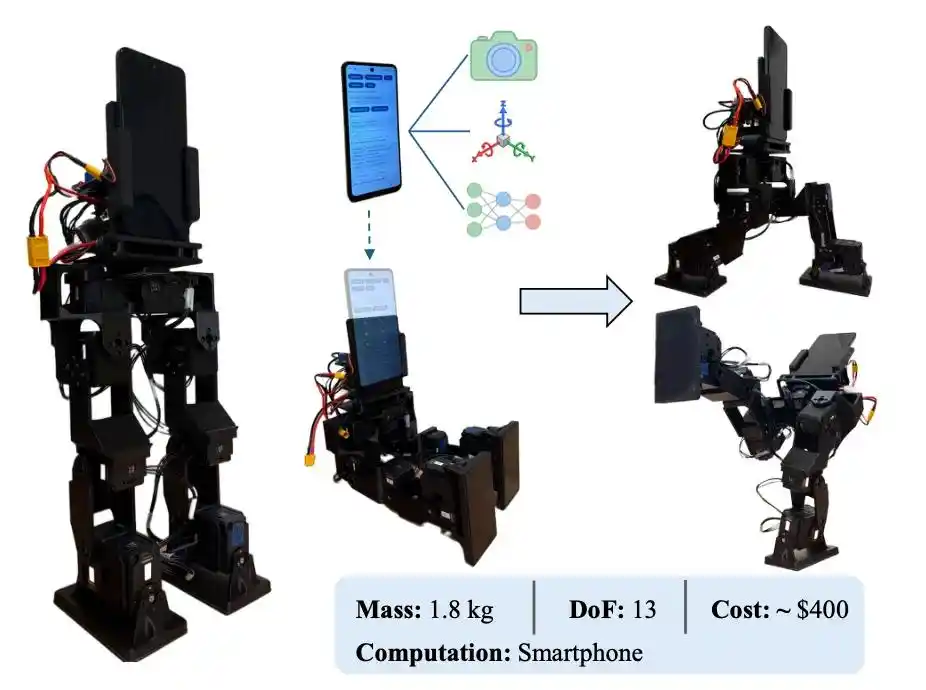
(Image source: PhoneBot)
Using a smartphone to power a robot sounds implausible—but PhoneBot makes it work. As today’s most ubiquitous consumer electronics, smartphones boast extremely high integration, incorporating cameras, SoCs, screens, Wi-Fi, batteries, and more—all components directly usable by robots. Equipped with a smartphone, PhoneBot leverages its camera for visual perception, its chip for computation and inference, and network connectivity to access cloud resources and remote compute power.
It should be noted that the quoted $400 material cost excludes the smartphone. During testing, the team used older models such as the Moto G2025 and Samsung Galaxy A15, all of which were secondhand and priced below $100.
Thus, even accounting for the smartphone’s hardware cost, the total material cost remains under $500—equivalent to just over 3,000 RMB—making PhoneBot an absolute powerhouse of cost efficiency.
Moreover, using smartphones to drive robots isn’t new. In 2021, OpenBot emerged as a project that used a standard Android phone to enable navigation and following for a four-wheeled robot. PhoneBot extends this idea into bipedal robotics—a significantly more complex challenge: bipedal robots must maintain real-time balance during movement. Achieving this isn’t simply a matter of plugging in a phone.
Letting the Smartphone Handle Perception, Compute, and Interaction
In short, PhoneBot’s architecture involves mounting the smartphone on the torso, making it the robot’s eyes, ears, and brain. The team divides its functions into three modules: motion control, image recognition, and speech processing.
Motor control is the most critical component. The Android app on the phone continuously reads data from the device’s gyroscope and accelerometer, while also monitoring the current angles of the 13 motors in the legs. Combined with user commands, this generates a real-time status report of the robot’s condition.
The phone also hosts a pre-trained lightweight model. Once it receives input data, it immediately computes optimal leg positions and transmits instructions via Wi-Fi to a small conversion board, which then sends signals to the motors. Walking, rising from the ground, and adjusting orientation are all executed through this mechanism.
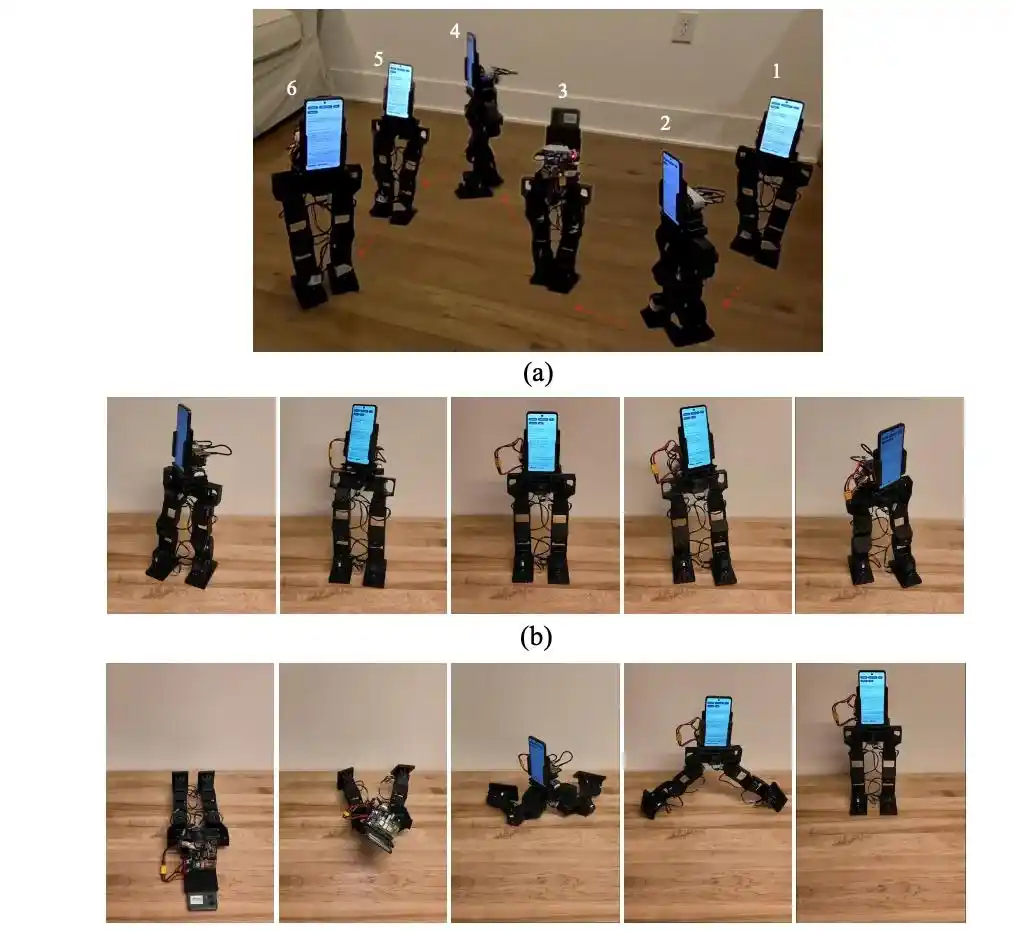
(Image source: PhoneBot)
All image recognition is performed locally on the smartphone. The rear-facing camera identifies people and objects, and when combined with directional commands, enables the robot to follow individuals or redirect its gaze. Localization is also handled by the phone, which calculates position using camera and gyroscope data—eliminating the need for additional GPS or localization hardware. The screen displays system status and video feed, allowing direct user control via the phone.
Speech processing is more complex. The phone handles audio recording and playback, but computationally intensive tasks like speech-to-text conversion and large language model inference rely on a nearby laptop. Results are sent back to the phone for playback.
As for learning to walk, the team first trained the robot in a simulated environment. They first calibrated the actual torque output of each motor, then ran repeated trials where the robot attempted to walk, fell, and restarted until stable locomotion was achieved. During training, they mirrored left-leg movements onto the right leg, enabling symmetrical learning. This process was repeated five times with mirroring, accelerating learning speed and improving stability.
As mentioned earlier, PhoneBot uses older smartphones with modest specs, yet their hardware utilization remains low during operation. According to data provided by the research team, CPU usage ranged from 8.5% to 13.4% when reading gyroscope data, 6.3% to 10.3% during gait calculation, 15.6% to 17.9% during person and object recognition, and 25% to 34.3% during localization—the most resource-intensive task.
This testing confirms that PhoneBot is not picky about smartphone models. It leverages the accumulated camera, gyroscope, computational power, and ecosystem advantages smartphones have built over the years. The specific brand or model matters far less than the available hardware resources. PhoneBot’s low cost stems from maximizing the utilization of existing smartphone hardware—using whatever is available, and cutting costs wherever possible.
Crucially, however, PhoneBot lacks arms. While technically a robot, its core mobility capability is limited to two legs for walking and dynamic movement. Its compact size also means no heavy lifting or stair-climbing tasks. Ultimately, it functions as a laboratory testbed.
Will Old Smartphones Become Catalysts for Robot Democratization?
Smartphones are likely the fastest-evolving consumer electronics category, with hundreds of millions discarded globally each year. These devices contain integrated cameras, screens, chips, and various sensors—all often still functional, merely deemed obsolete due to age. Too often, their final fate is disassembly for raw materials, representing a massive waste of hardware potential.
PhoneBot offers a new purpose for these discarded devices. Idle computing power and sensors can now be repurposed for small-scale robotics. It also introduces a novel paradigm: the robot’s “brain” can be treated as consumable hardware, while the body remains a durable, long-term component. With smartphones typically replaced every two to three years, outdated models become ideal candidates for integration. In this way, robots can be upgraded like batteries—modularized and easily refreshed.
Of course, the drawbacks are evident. Smartphones aren’t designed for robotics—thermal management, power delivery, and physical durability require significant reengineering. Variability across models affects performance consistency. Secondhand devices lack guaranteed reliability. And critically, smartphones cannot deliver high-end computational power. While PhoneBot relies on the phone for core operations, it still depends on external PCs for certain AI-intensive tasks. Moreover, PhoneBot itself is a minimalist design without arms, limiting its functionality.
Nevertheless, PhoneBot proves that smartphone-driven robotics is viable—and provides a replicable, low-cost blueprint for the industry. Its broader significance may not lie in immediate market success as a consumer product, but in dismantling the high hardware barrier to entry for bipedal robotics. For years, the exorbitant costs of biomimetic robot development have excluded countless developers, student teams, and startups.
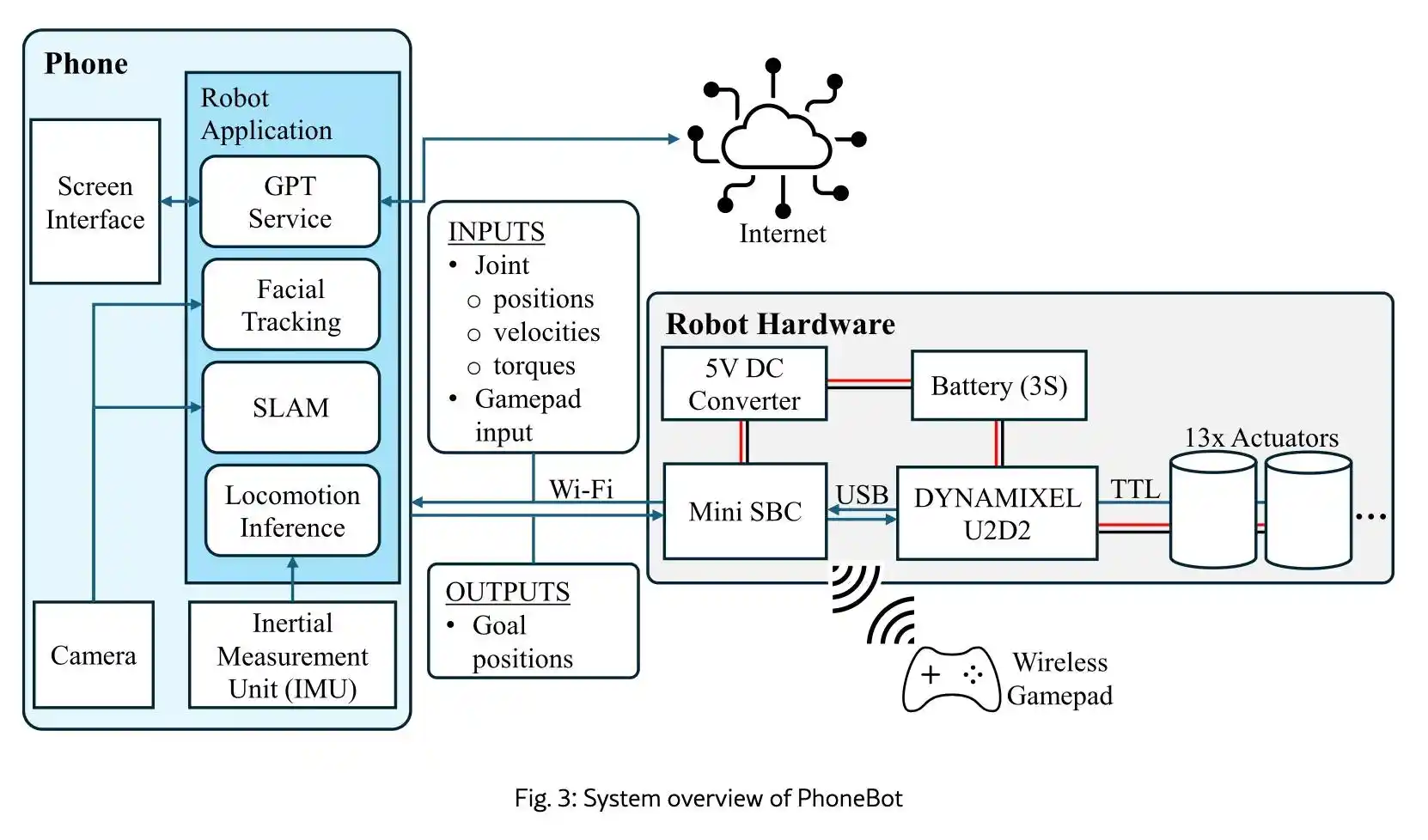
(Image source: PhoneBot)
PhoneBot’s “low-cost chassis + secondhand smartphone brain” architecture effectively serves as a Raspberry Pi equivalent in the robotics domain, with the potential to catalyze a vast, grassroots developer ecosystem—enabling more people to build and train their own bipedal robots.
Beyond that, as edge AI chips continue advancing in compute capacity, the current dependency on external PCs for complex voice processing will soon become obsolete. Modern flagship smartphone SoCs can already run billion-parameter edge LLMs smoothly, enabling sophisticated semantic understanding and natural conversation entirely on-device.
Imagine two or three years from now, when flagship SoC-equipped smartphones flood the secondary market. Their neural compute power and sensor precision will vastly surpass the older models currently used in PhoneBot tests. At that point, a single smartphone could endow such small robots with significantly enhanced intelligence.
From a business model perspective, a PC-like product form may emerge in robotics: so-called “barebones robots.” Hardware manufacturers would sell standardized robot bodies, batteries, and drivetrain components, driving down base hardware costs. Users would then simply insert their old smartphone into the robot’s chassis as the brain, download a dedicated app, and activate the device.
This approach not only aligns with global e-waste recycling and sustainability goals, but also paves the way for widespread adoption of home companion robots and educational robots.
Source: Leitech
Disclaimer: Contains third-party opinions, does not constitute financial advice


HuggingFace's "AI Duck" Goes Viral, Boosting Chinese Chip Supplier Rockchip
09-02
Yushu Surges 629% on First Day of Trading, Humanoid Robots Sell 5,500 Units
08-19
14 Executives Depart, Horizon Unleashes a Robot Legion
08-11
Yushu's 61 Billion IPO: Who Will Make Money?
08-07
Former Huawei Genius Youth: Building 5,000 Reliable Robots This Year Won't Exceed 3 Companies
08-05
China's climbing robotic vacuum cleaner captures 70% of the global market
08-05Musk spent nearly half of the Tesla earnings call discussing AI and robotics, with automotive business accounting for less than one-third of total revenue
08-05


