35B Model Inside a Smartphone: MiniCPM-V 4.7 Occupies Only 3GB of Memory
35B Model Inside a Smartphone: MiniCPM-V 4.7 Occupies Only 3GB of Memory

2026-10-14 10:21
Introduction: What is MiniCPM-V 4.7? MiniCPM-V 4.… What is MiniCPM-V 4.7? MiniCPM-V 4.
What is MiniCPM-V 4.7
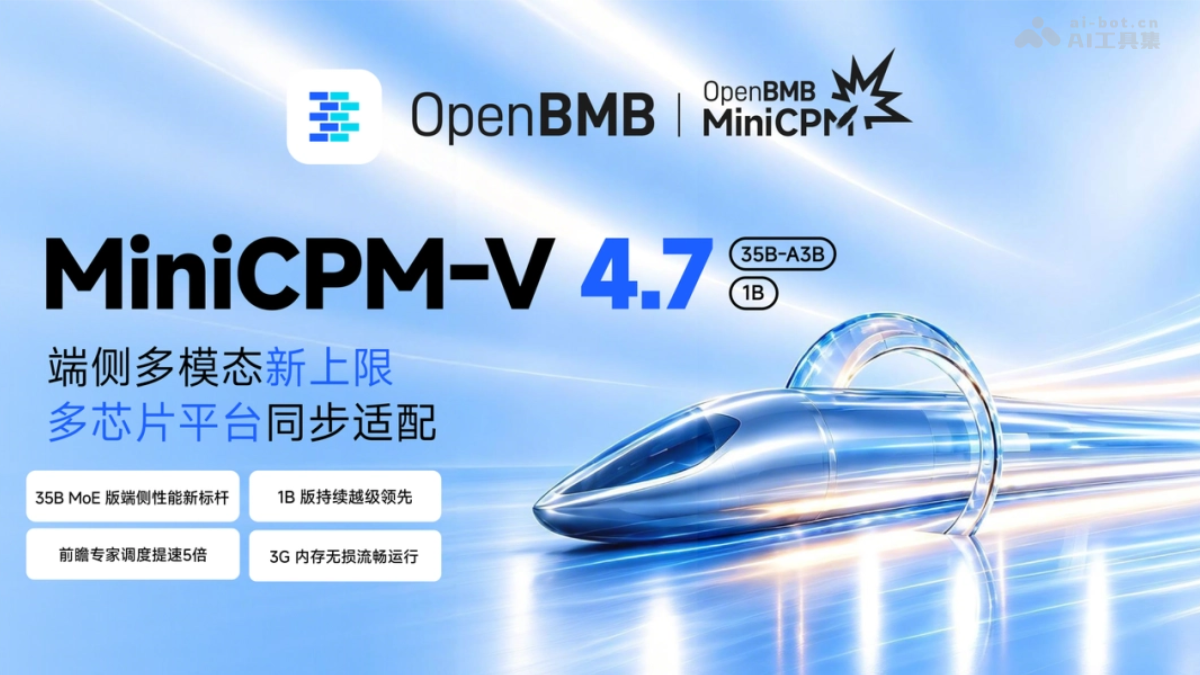
MiniCPM-V 4.7 is a mobile-side multimodal large language model jointly open-sourced by Minimax and OpenBMB, available in two versions: 35B-A3B (MoE) and 1B. The flagship 35B-A3B version is the world’s first open-source MoE multimodal model capable of lossless, smooth on-device inference. Leveraging pioneering expert scheduling technology, it achieves over 13 tokens/s on iPhone with just ~3GB memory, outperforming peer models across 34 benchmark tasks; the 1B variant targets entry-level devices.
Key Features of MiniCPM-V 4.7
- General Visual Understanding: Object recognition, multi-image comparison, visual QA; scores 91.72 on MMBench, leading peers.
- Document & OCR Parsing: Extracts text, tables, and charts from images/PDFs; scores 91.2 on OCRBench.
- Mathematical & STEM Reasoning: Solves math problems and scientific queries; scores 80.22 on MMMU and 88 on MathVista.
- Long Video Understanding: Interprets long-timeline video content and answers related questions; scores 68.9 on LongVideoBench.
- Smooth On-Device Inference: 35B model runs on iPhone with only ~3GB memory, generating over 13 tokens/s in real time.
- Low-Cost Custom Fine-Tuning: Open-source self-replay fine-tuning enables learning new tasks without forgetting prior capabilities.
Technical Principles Behind MiniCPM-V 4.7
- Look-Ahead Expert Scheduling (LES): The 65.6 GiB weight MoE model cannot fit entirely in memory—most experts reside on SSD and are loaded on-demand. However, layer-wise routing depends on previous layer outputs, causing frequent I/O stalls. LES exploits high similarity between adjacent layers’ inputs to predict next-layer expert requirements using current-layer routing features, enabling background prefetching. It prioritizes computation for experts already loaded and actually routed, achieving concurrent computation and I/O. This results in 5× speedup with zero output degradation.
- Weight Access Optimization: Mixed-precision quantization per layer reduces storage footprint and data transfer volume. Additionally, expert weights are reorganized in file layout to store parameters contiguously by ID, allowing complete expert retrieval via a single sequential SSD read, drastically reducing loading overhead.
- Visual Token Compression: Based on LLaVA-UHD v4, visual token compression is performed early within the vision encoder, reducing downstream computation from the source. Supports two compression ratios: 4× and 16×. At 16× mode, key metrics remain nearly lossless, balancing image detail and real-time interactivity.
- DSpark Speculative Decoding: A lightweight draft module generates multiple candidate tokens in one pass. The main model validates them in parallel and produces batched outputs. By amortizing fixed costs like MoE expert loading and routing across multiple tokens, this method increases generation speed by 1.17× on average without quality degradation.

Follow WeChat and reply “open-source” to join the AI Open-Source Project Community
How to Use MiniCPM-V 4.7
- Download Model: Obtain model weights and code from GitHub or Hugging Face.
- Local Quick Experience: Access the official Web Demo (MiniCPM-V-4.7-Demo) on Hugging Face Spaces for online trial without installation.
- Install App: Download iOS/Android clients from the MiniCPM-V-Apps repository on GitHub and install directly on mobile or tablet devices.
- Deploy with Inference Framework: Choose llama.cpp, Ollama, MLX, or vLLM/SGLang based on hardware platform to load the model and deploy local inference services.
- Enable LES Acceleration (Optional): When running 35B-A3B on-device, enable Look-Ahead Expert Scheduling per open-source documentation for smooth operation within ~3GB memory.
- Select Visual Compression Mode: Switch between 4× and 16× compression modes based on use case requirements.
Project Links for MiniCPM-V 4.7
- GitHub Repository: https://github.com/OpenBMB/MiniCPM-V
- Hugging Face Model Hub: https://huggingface.co/collections/openbmb/minicpm-v-47
Core Advantages of MiniCPM-V 4.7
- World’s First Mobile-Side Open-Source MoE Multimodal Model: First open-source MoE multimodal model globally capable of lossless, smooth on-device inference.
- Extreme Memory Efficiency: The 35B model with 65.6 GiB weights runs on ~3GB memory—just 1/4 of 16GB device RAM.
- Leading Inference Speed: Achieves 13+ tokens/s on iPhone 17 Pro Max, 17+ tokens/s on iPad Pro M4, with 5× speedup via LES technology.
- All-Around Superiority Over Peers: Outperforms Qwen3.6-35B-A3B across 34 authoritative benchmarks, even surpassing larger models like Qwen 27B and Gemma-4 31B.
- Pareto Optimal Performance-Efficiency Balance: Delivers higher overall scores in shorter inference time, pushing the frontier of on-device multimodal “performance-efficiency” trade-off.
- Dual-Version Coverage for Broad Accessibility: 35B flagship maximizes capability ceiling; 1B lightweight version enables high-quality multimodal inference on entry-level devices.
Competitive Comparison with Similar Models
| Comparison Dimension | MiniCPM-V 4.7 35B-A3B | Qwen3.6-35B-A3B |
|---|---|---|
| Inference Speed | 13+ tokens/s on iPhone 17 Pro Max, 5× speedup with LES | Slower (disadvantaged among peers) |
| Overall Score | Higher composite score in Instruct mode | Slightly lower composite score |
| General Vision | MMBench 91.72 / MMStar 80.67 | Below MiniCPM-V 4.7 |
| STEM Reasoning | MMMU 80.22 / MathVista 88 | Below MiniCPM-V 4.7 |
| OCR/Chart Analysis | OCRBench 91.2 / CharXiv Reasoning 75.6 | Below MiniCPM-V 4.7 |
| Long Video Understanding | LongVideoBench 68.9 | Below MiniCPM-V 4.7 |
| Lightweight Version | 1B version significantly outperforms Qwen3.5-0.8B | 0.8B version |
| Open-Source License | Apache-2.0 (code + weights) | Open-source |
| Chip Ecosystem | Day-0 support for domestic chips including Huawei Ascend, Hygon | Primarily optimized for Alibaba ecosystem |
| Fine-Tuning Support | SRFT Self-Replay Fine-Tuning (low-cost, no catastrophic forgetting) | Standard SFT |
Application Scenarios for MiniCPM-V 4.7
- Mobile Work & Document Processing: Directly capture photos or import PDFs on smartphones/tablets to perform real-time text recognition, table extraction, chart understanding, and document QA—no cloud upload required, preserving privacy while enhancing mobile productivity.
- Offline Education Tutoring: Students can perform photo-based problem search, mathematical reasoning, and science Q&A on offline devices. The 35B model’s on-device inference brings high-quality AI tutoring to regions with poor network connectivity.
- Vehicle & Robotics Vision: Leverages Day-0 chip compatibility to deploy on in-vehicle systems and robotic terminals, enabling real-time environmental perception, obstacle comprehension, and human-machine visual interaction.
- Video Content Understanding & Moderation: Long-video comprehension enables on-device summarization, key-frame QA, and compliance review of locally recorded videos—ideal for security patrols, content creation, and other applications.
Source: AI Tools Collection
Disclaimer: Contains third-party opinions, does not constitute financial advice


Step Code – The Open-Source Terminal Programming Agent by Jieyue Star
09-24
Hy4 Preview Lightweight Version – Tencent Hunyuan's Open-Source Hy4 Quantized Compression Model
09-02
Claude Fable 5.1 – Anthropic's Latest Flagship Large Model
09-02
Open-source Retool is here, drag-and-drop backend with 60+ components
08-19
Claude Opus 5 is Here: Half the Price Approaching Fable 5
07-25
Tencent Open-Sources 260 Real-World Tasks to Test AI Workforce Capabilities
07-25
Meituan Open-Sources AI Exam Platform: 813 Minecraft Tasks
07-25


