392 AI Tools Vanished in One Year—Who Will Survive?
392 AI Tools Vanished in One Year—Who Will Survive?

2026-10-14 10:02
Introduction: Monolithic models absorbing point tools, with compute power and compliance becoming life-or-death thresholds. The graveyard of AI products may be larger than you think. Recently, Tencent has announced the upcoming shutdown of two AI products.
The graveyard of AI products might be bigger than you imagine. Tencent has recently announced the impending closure of two more AI offerings.
On October 8, Tencent Yuanqi issued a service termination notice: full service will cease on November 9, rendering all user-built agents ineffective. Many WeChat public account creators used it to transform historical articles into knowledge bases and enable 7×24 automated replies for followers—now they must urgently migrate their workflows.
This is no longer breaking news. Two weeks prior, Tencent had already announced the December 24 shutdown of QClaw, dubbed “the most popular AI tool in China’s internet” due to its massive community-driven adoption; three months earlier, Douyin's Doudou and Qwen jointly announced the discontinuation of user-created agents. Globally, OpenAI has also shut down Sora and Atlas browser this year.
Looking back to after ChatGPT’s explosive rise in 2023, a clear pattern emerges: AI products launch rapidly but vanish just as fast. According to Zhidongxi statistics, at least 25 domestic AI applications ceased operations, were delisted, or entered long-term dormancy in 2025 alone. Meanwhile, the global AI Graveyard tracker reports 392 AI tools discontinued worldwide in 2025—roughly one per day.
This article compiles every major AI product shutdown by large tech firms and star startups from 2023 to present. The list is not exhaustive, but it reveals two critical truths: how AI products die, and what kind of products survive.
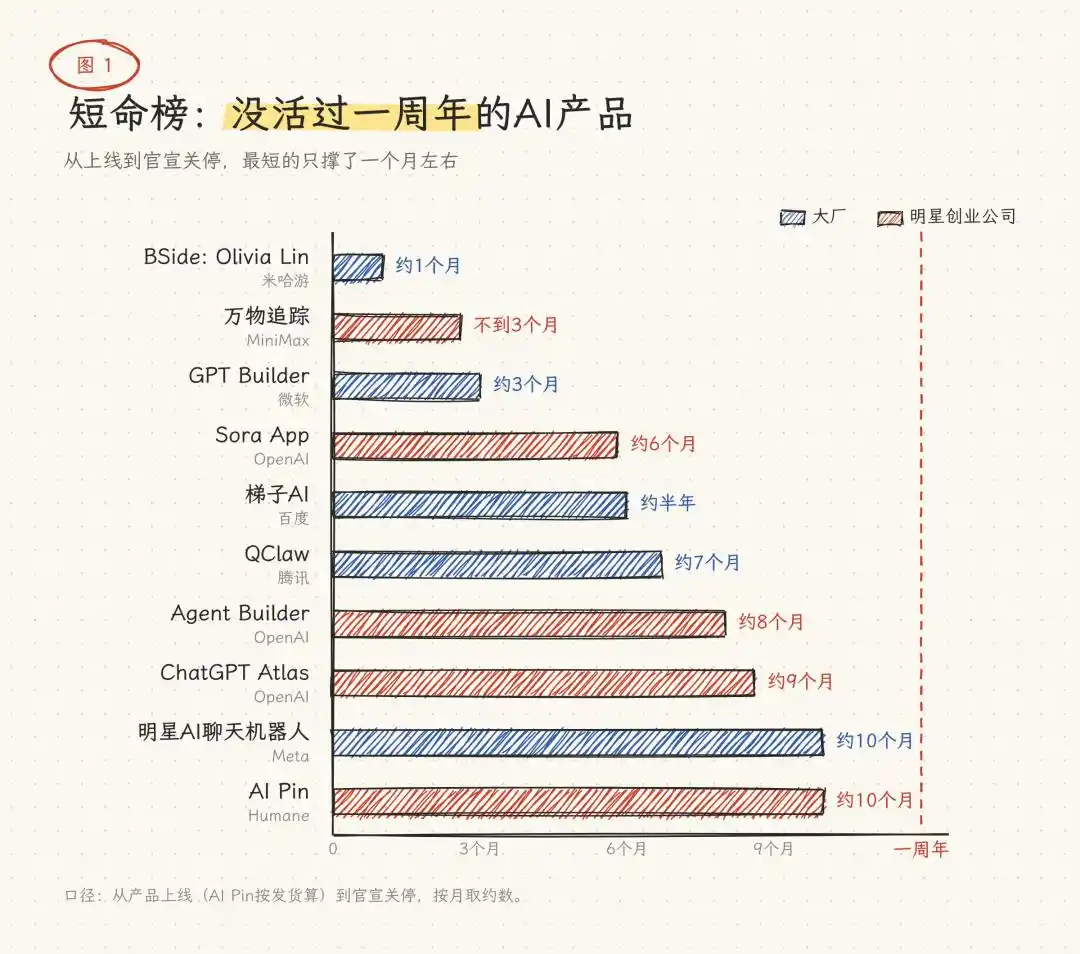
01 OpenAI: Even Its Star Products Are Being Cut
OpenAI is the most aggressive player in this list. Over three years, it has scaled down from small utilities to cutting flagship products.
The first casualty was the AI Text Classifier (AI Classifier), launched in January 2023 to detect whether text was generated by AI. Internal tests revealed it correctly identified only 26% of AI-generated content and mislabeled 9% of human-written text as AI-generated. On July 20, 2023, OpenAI quietly retired it due to insufficient accuracy—a symbolic moment: an AI company unable to distinguish its own output.
The second was ChatGPT Plugins, hailed as the “App Store moment” for ChatGPT when launched in March 2023. Within a year, it was superseded by GPTs and officially discontinued in early 2024.
GPT-4o’s exit was even more dramatic. When GPT-5 launched in August 2025, OpenAI briefly withdrew GPT-4o, only to restore it for paying users after backlash. On February 13, 2026, GPT-4o, along with GPT-4.1 and o4-mini models, was officially retired from ChatGPT—officially because less than 0.1% of daily users still actively selected it. Yet among that 0.1%, many had developed deep emotional attachments, especially Chinese users, leading to strong resistance.
Sora stands as this year’s largest monument to obsolescence. In late September 2025, Sora 2 launched alongside a vertical-scrolling app resembling TikTok, briefly topping the U.S. App Store charts. But novelty faded quickly—new downloads dropped 32% month-over-month in December 2025 and continued declining. On March 24, 2026, OpenAI announced its shutdown: the app and web interface went offline on April 26, and the API was fully terminated by September 24. The Disney partnership, worth $1 billion, was also scrapped.
ChatGPT Atlas Browser followed suit. Launched October 21, 2025, it was discontinued on July 9, 2026, with full cessation of function by August 9—lifespan under ten months. Its capabilities were absorbed into the new desktop version of ChatGPT and Chrome extension.
Two others are already scheduled for closure. The visual agent builder Agent Builder, unveiled at OpenAI’s DevDay in October 2025, was announced dead on June 3, 2026, and removed entirely—including the Evals platform—by November 30, lasting less than eight months. Even more telling is custom GPTs: having phased out plugins in 2024, OpenAI plans to retire them again by December 11, 2026, replaced once more by updated plugins. In two years, plugins and GPTs have traded positions.
When viewed collectively, OpenAI’s logic is clear: before IPO, focus on compelling commercial narratives, reserve compute for high-margin areas like coding, agents, and enterprise services. Reports indicate that application lead Fidji Simo reminded staff in March 2026 to avoid distractions from “side projects.” Sora and Atlas were exactly those side projects.
02 Google, Microsoft, Meta: Not Dead, Just Absorbed
Many AI products shuttered by overseas giants didn’t disappear—they were integrated into larger platforms.
Google’s strategy is the clearest example. In February 2024, Bard was rebranded as Gemini, retiring the Bard brand. Starting September 4, 2026, Google Assistant across phones, watches, earbuds, and Android Auto began being fully replaced by Gemini—updates prevent reverting. On May 4, 2026, Project Mariner, the browser-based agent experiment, was closed and its features merged into Gemini Agent and AI Mode. In June, core image-generation functions from Pixel Studio were disabled, redirecting users to Gemini and Nano Banana. Firebase Studio, launched in April 2025 as an AI development environment, was announced to close on March 22, 2027, with users redirected to Google AI Studio and Antigravity.
Microsoft’s path is similar. In June 2023, the standalone Cortana app on Windows was discontinued, succeeded by Copilot. More awkwardly, GPT Builder within Copilot Pro launched in March 2024 but was shut down by June, with user-built GPTs and data deleted by mid-July—lasting only three months. Microsoft stated the shift would focus on enterprise use cases, abandoning consumer-facing initiatives.
Meta paid twice for lessons learned. In September 2023, Meta launched celebrity avatars via influencers like Snoop Dogg, Tom Brady, and Kendall Jenner—reportedly spending millions per star. However, engagement remained a fraction of the celebrities’ own followings, and the bots were pulled in July 2024, pivoting to user-customized characters via AI Studio. Early in 2025, Meta’s own batch of AI virtual personas faced backlash for appearing “creepy,” and were quickly removed.
03 Overseas Startups: Hardware, Cloning, Companionship—All Three Paths Have Fallen
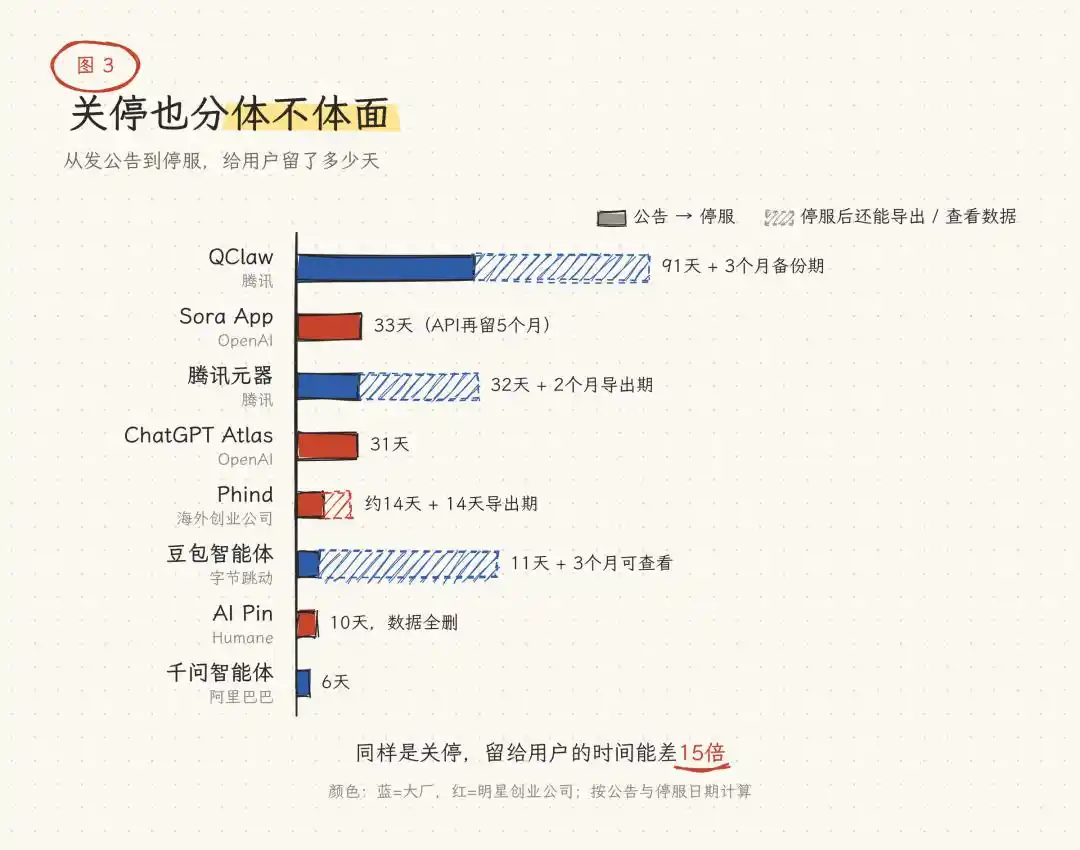
Humane AI Pin stands as the loudest “dud” in AI hardware. Founded by former Apple designers, the company raised $230 million, marketing the AI Pin as a “phone replacement.” After shipping in April 2024, it received widespread negative reviews—and warnings against using the charging case due to fire risks. In February 2025, HP acquired the team, patents, and OS for $116 million, abandoning the AI Pin itself: server shutdown on February 28, user data erased, devices turned into e-waste.
Phind is a textbook case of the “cloning trap.” This AI-powered search engine for developers raised ~$10 million in December 2025 but announced shutdown on January 16, 2026—with only two weeks for users to export data. The cause? OpenAI, Anthropic, and Google have all baked in online search and code generation directly into their core products, eroding the moat for independent search tools.
Similar fates befell two others. Tome was once one of the hottest AI PPT tools, amassing ~25 million users, yet revenue peaked at only ~$3 million by end-2024. On April 30, 2025, Tome Slides ceased service; the remaining six-person team pivoted to Lightfield, an AI-native CRM. High user volume doesn’t equal sustainable business. Yupp.ai, backed by a16z crypto with $33 million in funding and 1.3 million users, shut down in March 2026. Founder reflections were candid: users migrated to agents with memory and customizable tools, making chat-based crowd-sourced evaluations obsolete.
Three more can be added. Artifact, an AI news app by Instagram co-founders, shut down after one year in January 2024, citing insufficient market size. Supermaven, a code completion tool acquired by Cursor a year prior, announced discontinuation of independent development in November 2025, with capabilities merged into Cursor Tab. Notion Mail, which focused on AI-powered inbox classification, closed on September 22, 2026—foreign media interpreted this as users preferring agents to handle emails rather than managing another inbox.
An additional cautionary tale: Builder.ai claimed to automate app development with AI but collapsed in 2025 after exposing severe revenue inflation, becoming one of the biggest scandals in this AI wave.
Character.AI, the benchmark in AI companionship, hasn’t shut down—but cut a core business line. Under mounting pressure from youth-related lawsuits and regulatory scrutiny, beginning November 25, 2025, users under 18 can no longer engage in open-ended chats with AI characters.
04 Domestic Giants: From “Must Be Present” to “Consolidating Entry Points”
Over the past three years, domestic Chinese tech giants have shut down AI products in three categories: legacy tools from the previous AI era, hastily launched “must-have” experiments in 2023, and intelligent agent platforms forced to scale back in 2026 due to compliance pressures.
Tencent has led in recent closures. On March 13, 2025, the decade-old Tencent Translation King was fully decommissioned, with translation services migrated to Yuanbao. Tencent Zhiying, launched in March 2023 with digital avatar focus, was overhauled and user data cleared by June 30, 2025. This year saw even more activity: QClaw, launched in March with “remote PC control” functionality, once drew nationwide queues, but on September 24 announced shutdown by December 24, with data transfer options to WorkBuddy; then on October 8, Tencent Yuanqi—a no-code agent platform launched in May 2024—was terminated on November 9, with official recommendation to migrate to Tencent Cloud’s Agent Development Platform.
Beneath this lies the classic internal competition problem. Tencent maintained multiple AI entry points simultaneously: Yuanbao, WorkBuddy, QClaw, and Yuanqi—all solving increasingly overlapping problems, confusing users and competing for R&D resources and traffic. Early multi-team experimentation was beneficial, but once core products emerged, someone had to step aside.
ByteDance’s situation follows a similar arc. Huoshan Writing, launched in 2023, had its core AI writing and full-text polishing features suspended on September 13, 2024, then fully shut down by December 31, redirecting users to Douyin. Historical content was not migrated due to data security and compliance concerns. XiaoWukong, formerly Wukong Search, integrated over 200 AI tools and reached nearly 2 million downloads, but stopped updates after October 2024 and was gradually delisted from app stores through 2025. On July 15, 2026, Douyin removed its agent feature, guiding users to the standalone CatBox App for continued role-playing experiences.
Alibaba bid farewell to a pre-AI model era star: Lu Ban, created in 2015 and dubbed the “end of graphic designers,” ceased all services on June 30, 2025. Tongyi Tingwu, an AI transcription tool, no longer exists as a standalone app, now fully integrated into Qwen. On July 10, 2026, Qwen also discontinued anthropomorphic interactive agents and user-created agents.
Baidu shut down its AI search app Tizi AI on March 4, 2026, migrating services to Wenxin App. From rebranding to integration, Tizi AI lasted barely half a year.
Other players weren’t idle. Xiaohongshu’s Guofeng AI art app Trik AI was taken down after plagiarism lawsuits from illustrators; its successor, QiYu AI, also shut down on June 30, 2025. Meituan’s first AI chat app Wow closed its servers on December 18, 2025. iFLYTEK’s Xunfei Writing ceased operations on November 30, 2025, with total downloads under 130,000.
Two more major domestic AI companion apps fell this year. NetEase Music’s AI emotional companion app Miaoshi, launched in December 2022 with “AI lover” positioning, shut down on July 14, 2026. MiHoYo’s desktop companion BSide: Olivia Lin launched early access on July 13, 2026, but closed online services and was delisted from Steam by August 31—leaving only an offline version—lasting just one and a half months.
A notable milestone: reportedly, in July 2026, platforms including Douyin, Qwen, and Yuanbao collectively deactivated user-created agents, affecting over 8 million AI personas. The direct trigger was the implementation of the Interim Measures for the Administration of Anthropomorphic Interactive Services on July 15. Two years ago, big tech pushed hard for “Agent Hubs”; now, they voluntarily shut them down.
05 Star Startups: Cut Side Projects First, Then Protect the Core
Over the past few years, top-tier AI unicorn companies have adopted remarkably consistent product strategies: wide C-end experimentation, ultimately consolidating around a single core product.
Moonshot AI quietly tested two products in early 2024 abroad: Ohai, an AI character chat app, and Noisee, a music video generator. By September of the same year, the company decided to halt content and updates for both—officially stating they were “experiments never formally launched”—focusing exclusively on Kimi. Looking back, this decision was correct. After Kimi K3 launched in July, user demand approached compute capacity limits, forcing temporary suspension of new C-end subscriptions.
Jiequ Star’s companion app Paopao Ya, launched in April 2024 with over 6 million downloads across platforms, was merged into the company’s main team as focus shifted to foundational models and Jiequ AI, officially shutting down on November 5, 2025.
MiniMax suffered the most setbacks in the companionship space. Glow, its first product launched in October 2022, amassed over 5 million users in four months, but was delisted in March 2023 due to compliance issues. Later relaunched as Xingye (domestic) and Talkie (overseas). Talkie was removed from Apple’s App Store in the U.S., Japan, and other regions in December 2024 due to content compliance issues, restored only two months later. The information tracking product Wanwu Tracking, launched in January 2025 for public beta, gained positive reviews but was fully delisted under three months later.
XEVA, Xiaoice’s AI clone platform, with over 3 million downloads across platforms and also focused on emotional companionship, ceased all services on November 30, 2025.
Anuttacon, founded by MiHoYo co-founder Cai HaoYu, launched its AI cat companion AnuNeko in late 2025 but shut down on July 29, 2026—officially citing limited team bandwidth and the need to reallocate resources to other projects.
Zero One Universe took a different route: on August 3, it announced the closure of its public large model open platform; starting September 3, model trials and API calls were halted, citing strategic focus on enterprise-grade AI solutions.
06 Five Ways AI Products Die
Reviewing these dozens of cases, death causes fall into just five categories.
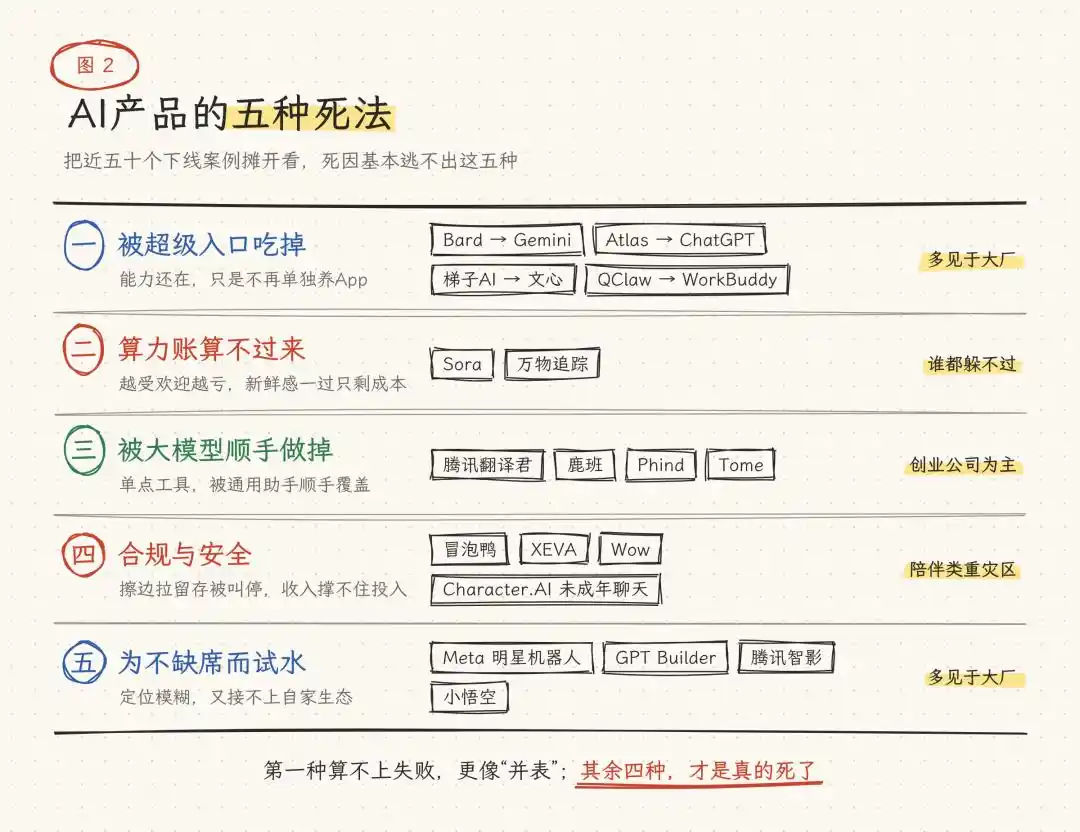
Death Type 1: Consumed by a super-entry point. Bard and Google Assistant absorbed into Gemini; Atlas absorbed into ChatGPT Desktop; Tizi AI merged into Wenxin; Tongyi Tingwu into Qwen; QClaw into WorkBuddy. These aren’t failures—more like “consolidation”: capabilities remain, but maintaining a separate app isn’t worth it anymore. As corporate AI strategies become clearer, resources concentrate on core models and primary interfaces.
Death Type 2: Compute economics don’t add up. Sora exemplifies this: each video generation burns GPU resources. Once novelty fades, only costs remain. MiniMax’s Wanwu Tracking faces the same issue—24/7 monitoring of global info becomes increasingly unprofitable as popularity grows. In today’s world where compute is the scarcest resource, projects with low ROI are inevitably cut.
Death Type 3: Eaten by general-purpose models. Tencent Translation King, Lu Ban, Phind, Tome, and countless AI writing tools—each served a single function. When general models make translation, search, writing, and PPT creation trivial tasks, the value of point tools is reevaluated. In 2023, standalone AI writing could charge; today, you can write instantly in Douyin, Qwen, or Yuanbao.
Death Type 4: Compliance and safety. This is the collective downfall of AI companions. Domestically, there’s the 2025 “Clear Web Campaign” targeting AI misuse, and the new anthropomorphic interaction regulations effective July 2026; internationally, Character.AI faced youth lawsuits and Talkie was removed from Apple Stores. Features that boosted retention—edge cases, ambiguity, emotional dependency—are now restricted, reducing willingness to pay, undercutting revenue, degrading experience, and triggering vicious cycles. Companion product shutdowns hurt deeper: replacing a writing tool is easy, but losing a character you’ve chatted with for months means losing chat logs, memories, and emotional bonds.
Death Type 5: Rushed launches to “not miss out.” In 2023, many products launched with the logic: “if others have it, we must too”—Meta’s celebrity chatbots, Microsoft’s GPT Builder, Tencent Zhiying, ByteDance XiaoWukong, iFLYTEK Writing. Vague positioning, poor ecosystem fit, and fading buzz left them as liabilities.
Among these five types, Death Types 1 and 5 mainly affect large corporations; Types 3 and 4 hit startups hardest; Type 2 affects everyone.
07 Key Takeaways
For regular users and content creators: Don’t put all your eggs in one basket. The recent shutdown of Tencent Yuanqi hit hardest those who built knowledge bases and auto-replies on it—after shutdown, agents linked to WeChat Official Accounts and Service Accounts became non-responsive. Phind gave only two weeks for data export; Humane went from announcement to cutoff in just ten days. Whether using Kouzi, Yuanqi, or Dify to build agents, always keep local backups of prompts, knowledge bases, and workflow configurations. Regularly export chat history and generated content. Enterprises choosing AI services should ask: Can data be exported? Can workflows be migrated? A cheaper token cost doesn’t compensate for the cost of relocating entire operations.
For AI entrepreneurs: Ask yourself: Will your product become just a button inside someone else’s app? If yes, your window may last only one or two model iterations. Surviving products integrate AI into indispensable user scenarios and workflows, selling outcomes—not the fact that “we have AI.”
For corporate product teams: Shutdowns have become routine—what matters is doing it gracefully. Tencent did well twice: QClaw offered a three-month transition, backup download windows extended to March 24, 2027, with migration tools and credit incentives provided; Yuanqi also allowed a two-month data export window. Contrast this with Humane and Phind, which offered almost no preparation time. How you shut down defines your brand.
08 The Graveyard Is Growing, So Is the Garden
After reviewing this list, one might conclude the AI application bubble has burst—but data doesn’t support it. Sensor Tower reports that generative AI app downloads doubled in 2025 to 3.8 billion, in-app purchases grew nearly threefold, surpassing $5 billion.
A more accurate view: the AI application layer hasn’t shrunk—it’s simply harder to enter. In 2023, connecting an API and slapping a UI could launch an AI product; by 2026, model capabilities are as ubiquitous as electricity—“having AI” is no longer a selling point.
Each tombstone in the graveyard reminds newcomers of one truth: first find a genuine, high-frequency, monetizable need—then apply AI.
Finally, I’ve compiled a complete list of the 48 products mentioned in this article, convenient for saving and sharing.
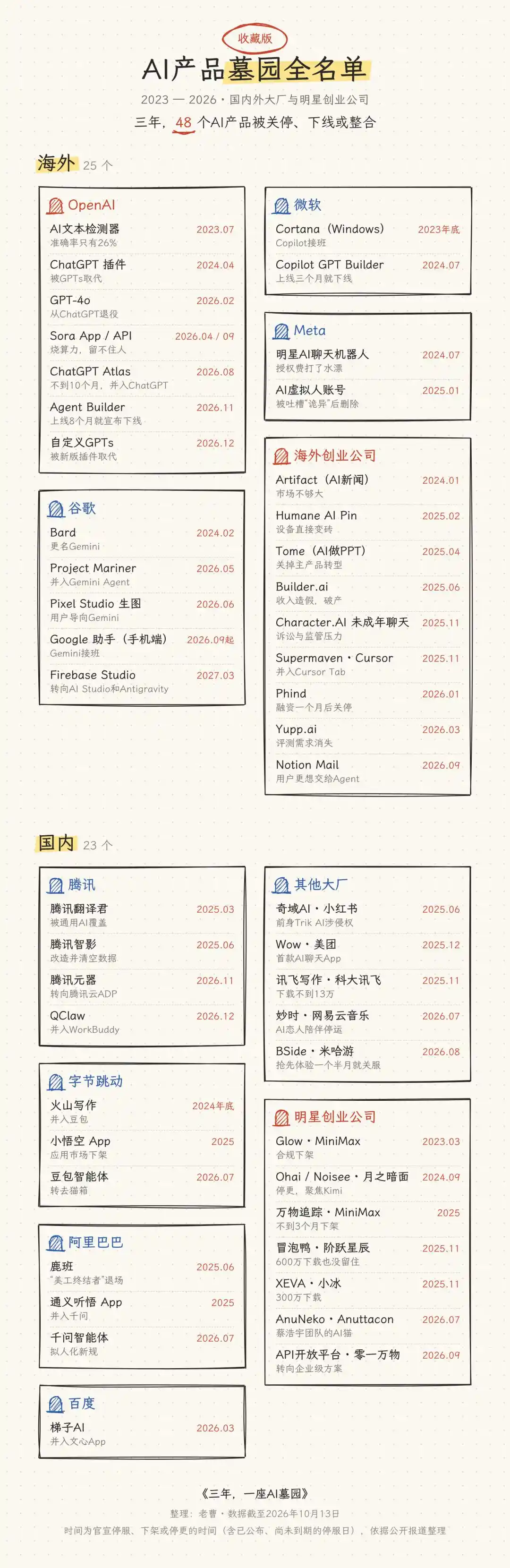
Notes: This article is compiled from publicly available online information. Some data references include Zhidongxi, Phoenix News, Sina, Pinwan, Titanium Media, IT Home, Investment World, 36kr, etc. The content does not represent the platform’s views. All products have lifecycles; discontinuation or shutdown is normal. Please approach such events rationally.
Source: Everyone is a Product Manager
Disclaimer: Contains third-party opinions, does not constitute financial advice


AI is not a search bar—it's a supercomputer costing just a few dozen dollars
08-05
Anthropic Locks in 6 Years of Compute with $10 Billion Commitment
08-05Not building robots—why is it worth $14 billion?
07-31AI is no longer competing on benchmark scores, but on profitability
07-25
ByteDance's Douyin Beans priced at 68 RMB—worth it for 382 million monthly active users?
07-25
Fields Medalist Concerned About AI Extinction Heads to OpenAI
07-25
Meta gives away models for free—who dares to price AI now?
07-24


