K2.8 Preview – Moonshot Kimi Launches Next-Generation Primary Model
K2.8 Preview – Moonshot Kimi Launches Next-Generation Primary Model

2026-09-13 11:54
Introduction: Free-tier users get access to 1M context, with performance approaching flagship K3. What is Kimi K2.8 Preview? Kimi K2.8 Preview is Moonshot AI's primary model launched across Kimi Code and Kimi Work, officially claimed to match the comprehensive performance of flagship Kimi K3, with enhanced coding and Agent capabilities and significantly improved reasoning efficiency over K2.7. The model supports low/high/max reasoning tiers, image and video input, and 1M ultra-long context is now open to all members.
What is Kimi K2.8 Preview?
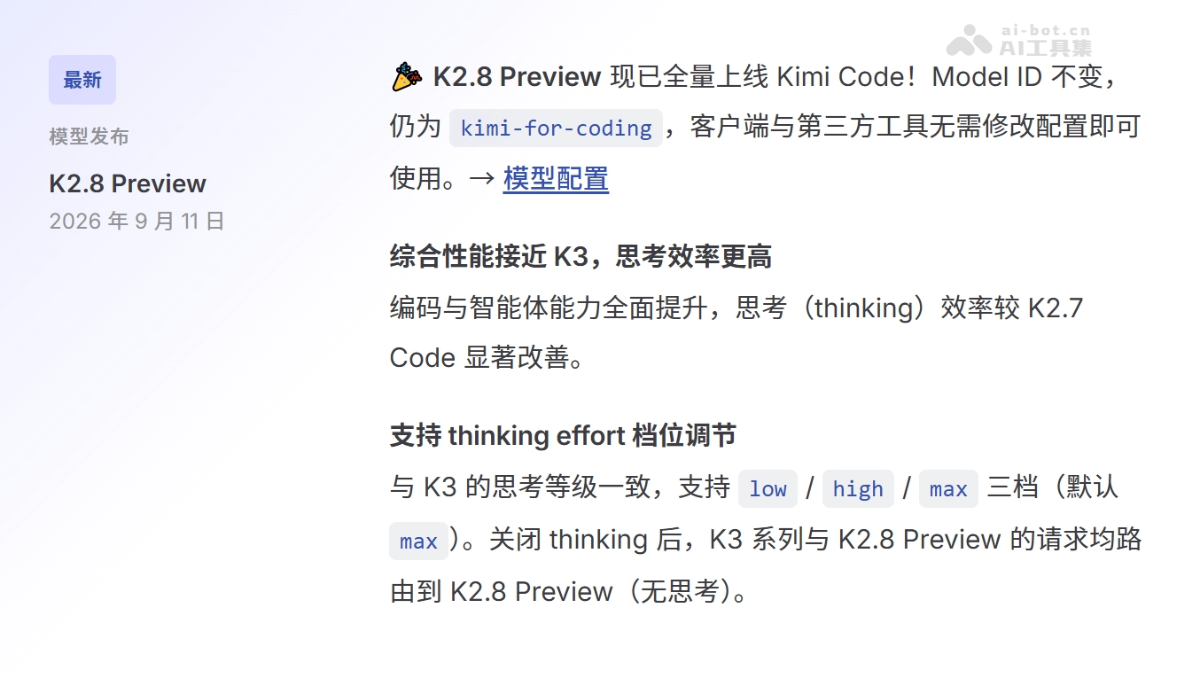
Kimi K2.8 Preview is Moonshot AI’s core model fully deployed across Kimi Code and Kimi Work. Officially described as achieving performance close to the flagship Kimi K3, it features upgraded coding and Agent capabilities, with notable improvements in reasoning efficiency compared to K2.7. The model supports three reasoning tiers (low/high/max), accepts image and video inputs, and offers 1M token ultra-long context to all subscription tiers.
Key Features of K2.8 Preview
- Code Generation & Completion: Designed as the primary model for daily development workflows, optimized for well-defined tasks such as code completion and modification.
- Agent Capabilities: Significantly enhanced coding and agent abilities over K2.7 Code, enabling autonomous execution of multi-step engineering tasks.
- Three Reasoning Tiers: Supports low / high / max reasoning effort levels, aligned with K3’s tier system, defaulting to max.
- Multimodal Input: Accepts image and video inputs, capable of processing visual development assets.
- 1M Ultra-Long Context: All subscription tiers gain access to up to 1 million tokens of context, enabling single-pass processing of large-scale codebases.
- Seamless Upgrade: Model ID remains
kimi-for-coding; no configuration changes required for clients or third-party tools. - Smart Routing: When thinking is disabled on K3 series models, requests are automatically routed to the no-thinking version of K2.8 Preview.
Technical Principles Behind K2.8 Preview
- Tiered Inference Control: Leverages a reasoning effort mechanism to balance computational budget—low tier sacrifices depth for speed, max tier allocates more reasoning tokens to improve success rate on complex tasks. Fundamentally, this enables explicit scheduling of “reasoning token” resources.
- Long Context Handling: The 1M context window is powered by efficient attention mechanisms. Key technical references include K3’s KDA hybrid linear attention and Attention Residuals approach (explicitly reducing computation overhead for long sequences).
- Request Routing Layer: On the product side, the orchestration system dynamically switches session traffic between K3 and K2.8 based on model availability and thinking state, ensuring seamless user experience continuity at the same entry point.
How to Use K2.8 Preview
- Zero Configuration, Ready to Use: K2.8 Preview is fully rolled out. The
kimi-for-codingmodel ID undergoes a seamless upgrade; existing clients and third-party tools (Claude Code, OpenCode, Codex, etc.) require no configuration changes. - Accessible to Any Subscription Tier: Available to all tiers from Adagio (free) to Allegro, with immediate access to 1M context.
- Kimi Code CLI: After installing the CLI and logging in, normal session initiation uses K2.8 Preview. Enter
/modelto check or switch the current model. - Adjust Reasoning Tier: Use
/effortto toggle between low / high / max tiers. Use low for simple tasks to save tokens; use max for complex tasks to boost success rate. - Third-Party Tool Integration: Simply set the model ID to
kimi-for-codingin your tool’s config. For users on Allegretto or higher seeking faster performance, switch tokimi-for-coding-highspeed. - Kimi Work Scenarios: Directly initiate tasks in Kimi Work, where the platform automatically routes them to K2.8 Preview.
Core Advantages of K2.8 Preview
- Near-Flagship Performance: Comprehensive performance closely matches K3, with significant upgrades in coding and Agent capabilities over K2.7, and markedly improved reasoning efficiency.
- Zero Barrier to Entry: Accessible to all tiers—including free-tier Adagio—breaking the previous ¥99 minimum requirement for K3 access.
- Faster Response Time: User benchmarks indicate significantly faster response than K3, ideal for high-frequency interactions like code completion.
- More Controllable Behavior: Compared to K3’s tendency to be overly proactive in ambiguous tasks and sensitivity to historical reasoning, K2.8 is better suited for daily development with more stable behavioral boundaries.
- Seamless Migration: Model ID remains unchanged at
kimi-for-coding, allowing zero-code upgrades for clients and third-party tools. - Flexible Reasoning Tiers: Toggle freely between low / high / max tiers—save tokens on simple tasks, ensure quality on complex ones.
- Multimodal Capability: Supports image and video input; the 1M context window can ingest entire large-scale codebases in one pass.
Competitive Comparison: K2.8 Preview vs. Alternatives
| Comparison Dimension | Kimi K2.8 Preview | Claude Sonnet 5 |
|---|---|---|
| Positioning | Low-cost primary model, handling daily traffic previously served by K3 | Mid-tier workhorse, default model for Claude.ai free and Pro tiers |
| Overall Performance | Officially claims performance close to K3 (no public benchmark) | SWE-bench Pro 63.2%, OSWorld-Verified 81.2% |
| Context Window | 1M tokens, open to all members | 1M tokens |
| Multimodal Support | Image + video input | Text + image, no video input |
| Reasoning Tiers | Three tiers: low / high / max, aligned with K3 | Adaptive reasoning (adaptive thinking) |
| API Pricing | Included in subscription tiers (¥0–699/month), not billed per token | $2 / $10 per million tokens (reverting to $3 / $15 after August 31, 2026) |
| Open Weights | Not disclosed (K-series has an open-source tradition; K3 is already open-source) | Closed-source, API-only access |
Use Cases for K2.8 Preview
- Large-Scale Codebase Understanding & Refactoring: The 1M context allows ingestion of entire repositories in a single pass, enabling cross-file dependency analysis, bulk refactoring, and architectural-level change recommendations.
- Daily Code Completion & Development: Positioned as the “everyday model,” offering more predictable behavior and faster responses than K3—ideal for frequent code completion, debugging, and small feature iterations.
- Multimodal Development Assistance: Supports image and video input—users can directly upload screenshots of error interfaces, record screen demonstrations of bugs, or generate frontend code from design mockups.
- Agent-Powered Automation Workflows: Enhanced coding and Agent capabilities enable end-to-end automation—running tests, fixing failed test cases, and submitting PRs in a closed-loop process.
- Long Document & Log Analysis: The 1M context window accommodates extremely long logs, technical documentation, or meeting transcripts—enabling full-text search-based Q&A and summary extraction at zero additional cost within member tiers.
Source: AI Tools Hub
Disclaimer: Contains third-party opinions, does not constitute financial advice


Hy4 Preview Lightweight Version – Tencent Hunyuan's Open-Source Hy4 Quantized Compression Model
19 days ago
Claude Fable 5.1 – Anthropic's Latest Flagship Large Model
19 days ago
Open-source Retool is here, drag-and-drop backend with 60+ components
08-19
Claude Opus 5 is Here: Half the Price Approaching Fable 5
07-25
Tencent Open-Sources 260 Real-World Tasks to Test AI Workforce Capabilities
07-25
Meituan Open-Sources AI Exam Platform: 813 Minecraft Tasks
07-25
Microsoft's Image Model Integrated into PPT, GPU Costs Reduced by 84%
07-24


