JPMorgan Bullish on Meta: Muse, Model API, and Subscriptions Drive $820 Price Target
JPMorgan Bullish on Meta: Muse, Model API, and Subscriptions Drive $820 Price Target

2026-09-11 16:05
TL;DR · JPMorgan upgrades Meta from "Neutral" to "Overweight", with target price raised from $640 to $820
TL;DR · JPMorgan upgrades Meta from "Neutral" to "Overweight", raising its 2027 target price from $640 to $820, implying approximately 25% upside from current levels. · Muse Spark 1.3 has entered the frontier model tier, marking Meta’s initial transition from follower to key competitor. · The consumer-grade agent Muse reached No. 3 on the U.S. App Store Free Charts within two days of launch, with early user engagement intensity 10x that of internal test groups. · Meta is expanding AI monetization beyond advertising into transaction fees, paid subscriptions, enterprise agents, and model APIs, establishing multiple new revenue streams. · JPMorgan forecasts Meta’s capital expenditures to reach $243B in 2027 and $284B in 2028, with free cash flow expected to face significant pressure. · The report argues that current forecasts have already priced in most AI capex, but fail to account for upcoming revenues from products like Muse and model APIs, thus likely underestimating Meta’s profit potential.
Why Is Meta Worth Re-rating?
Meta’s stock has rebounded ~20% from recent lows, yet remains down 1% YTD, while the S&P 500 has risen ~12%. Amid ongoing market concerns over excessive AI capex and deteriorating free cash flow, JPMorgan upgraded Meta from "Neutral" to "Overweight", raising its December 2027 target price from $640 to $820.
Based on Meta’s share price of $653.69 as of September 9, the new target implies ~25% upside. JPMorgan values Meta at ~23x forward GAAP EPS of $35.44 for 2028—well above the S&P 500’s ~16x valuation multiple.
The core rationale behind this valuation premium is Meta’s transformation from a social platform leveraging AI to optimize recommendations and ads, into an AI platform offering frontier models, consumer agents, enterprise agents, developer APIs, and subscription services. While markets previously focused on capex, Meta is now demonstrating how these investments are translating into revenue.
Model capability forms the foundation of this commercial ecosystem. In summer 2025, when rebuilding Meta Superintelligence Labs, the company committed to launching a frontier-tier model within one year. Following the release of Muse Spark 1.1 in July 2026, Meta rapidly iterated to Muse Spark 1.3.
Third-party benchmarks indicate Muse Spark 1.3 now ranks among frontier models across agent capabilities, coding, instruction following, and long-context processing, with performance gaps to leading models like Claude and GPT significantly narrowed. JPMorgan concludes Meta has largely achieved its prior model competitiveness targets.
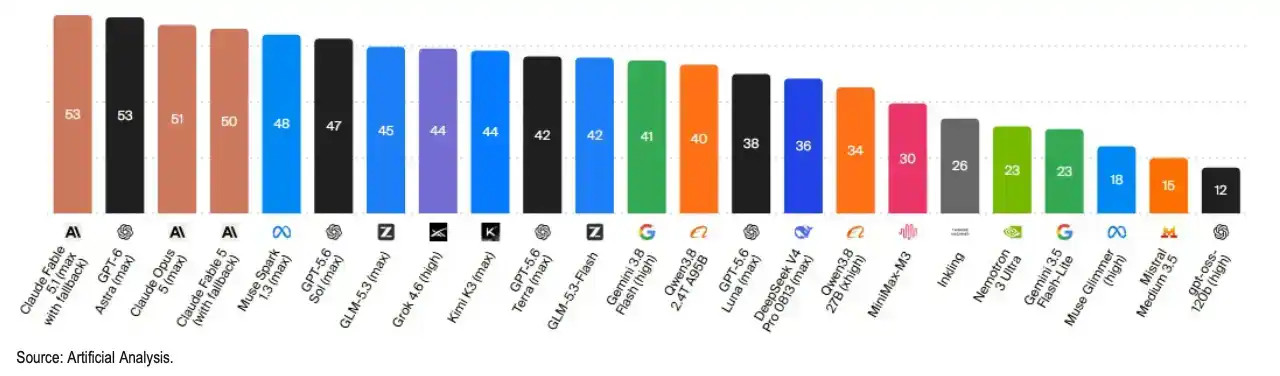
Artificial Analysis Model Intelligence Index. Muse Spark 1.3 has entered the frontier model tier, demonstrating competitive strength in agent, coding, and instruction-following capabilities.
The next-generation model Watermelon is expected to further enhance model performance. Leveraging higher-level pretraining, future models will begin large-scale training on Meta’s Prometheus gigawatt-class compute cluster in Ohio.
Meta’s true competitive edge lies not just in the model itself, but in its integration with distribution channels. With access to ~4 billion users and connections to hundreds of millions of businesses and advertisers, once the foundational model reaches frontier level, Meta can rapidly embed it into Facebook, Instagram, WhatsApp, and Messenger—creating scale advantages difficult for other AI labs to replicate.
From Muse to Meta One: AI Finds Its Monetization Pathway
Muse is Meta’s recently launched consumer-grade AI agent, now available on iOS, Android, and web. It operates via a virtual computer to browse websites and interact with UIs, automating tasks such as e-commerce purchases, restaurant reservations, form filling, email, and message sending.
Muse currently integrates with platforms including Instagram, WhatsApp, Spotify, DoorDash, Etsy, Reddit, Yelp, Outlook, and Gmail. Within two days of launch, it surged to No. 3 on the U.S. App Store Free Charts, with early user engagement exceeding internal test group activity by 10x—surpassing Meta’s own expectations.
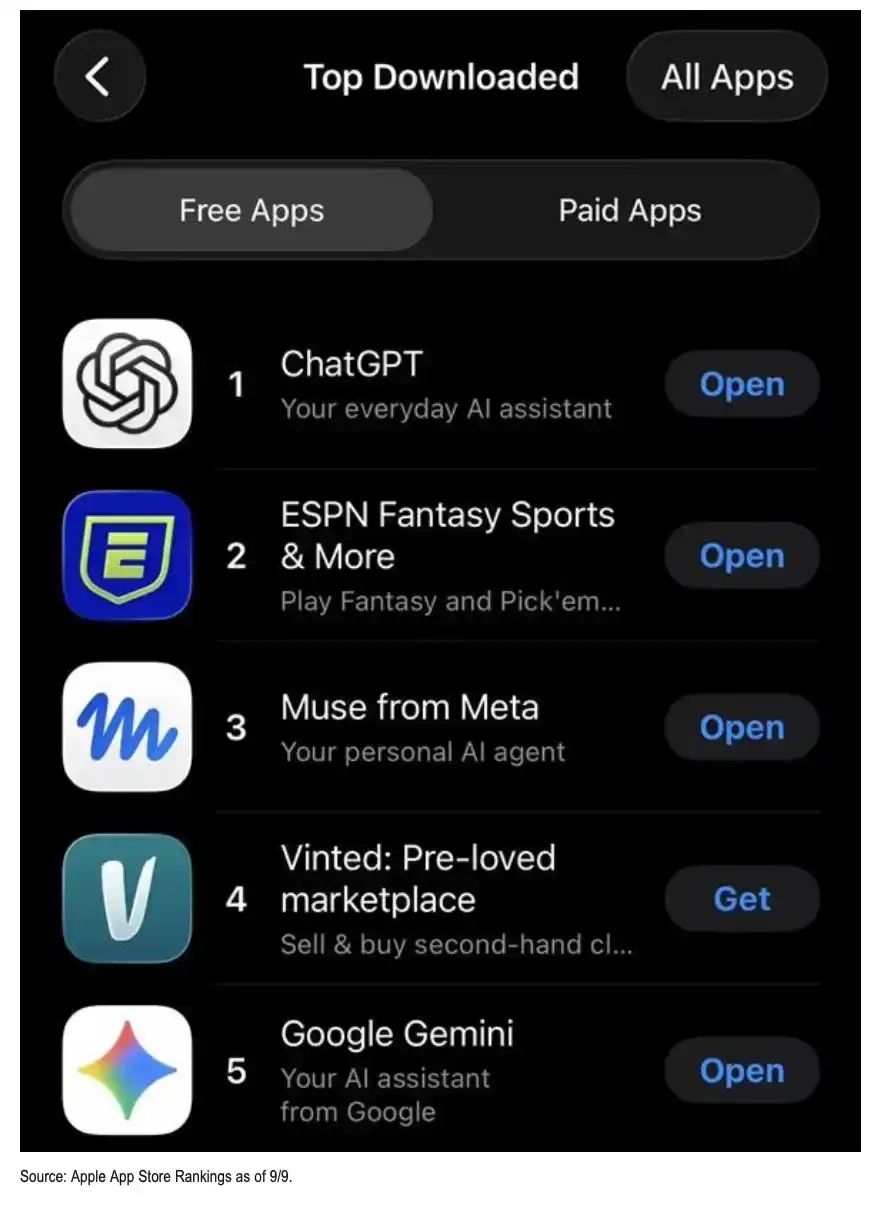
Muse’s ranking on the U.S. App Store Free Charts. Muse reached No. 3 within two days of launch, signaling strong early user acquisition potential.
Muse offers free users 100 million tokens per week, with two paid tiers at $20 and $100 monthly. However, Meta does not plan to rely solely on subscriptions. Since Muse can directly complete transactions, Meta is more likely to capture revenue through transaction commissions in the future.
This positions Muse not just as a chatbot subscription play, but as a gateway into a consumer transaction market potentially worth tens of trillions of dollars. As autonomous agent interactions increase, merchants may gain more orders, customers, and operational data via Muse.
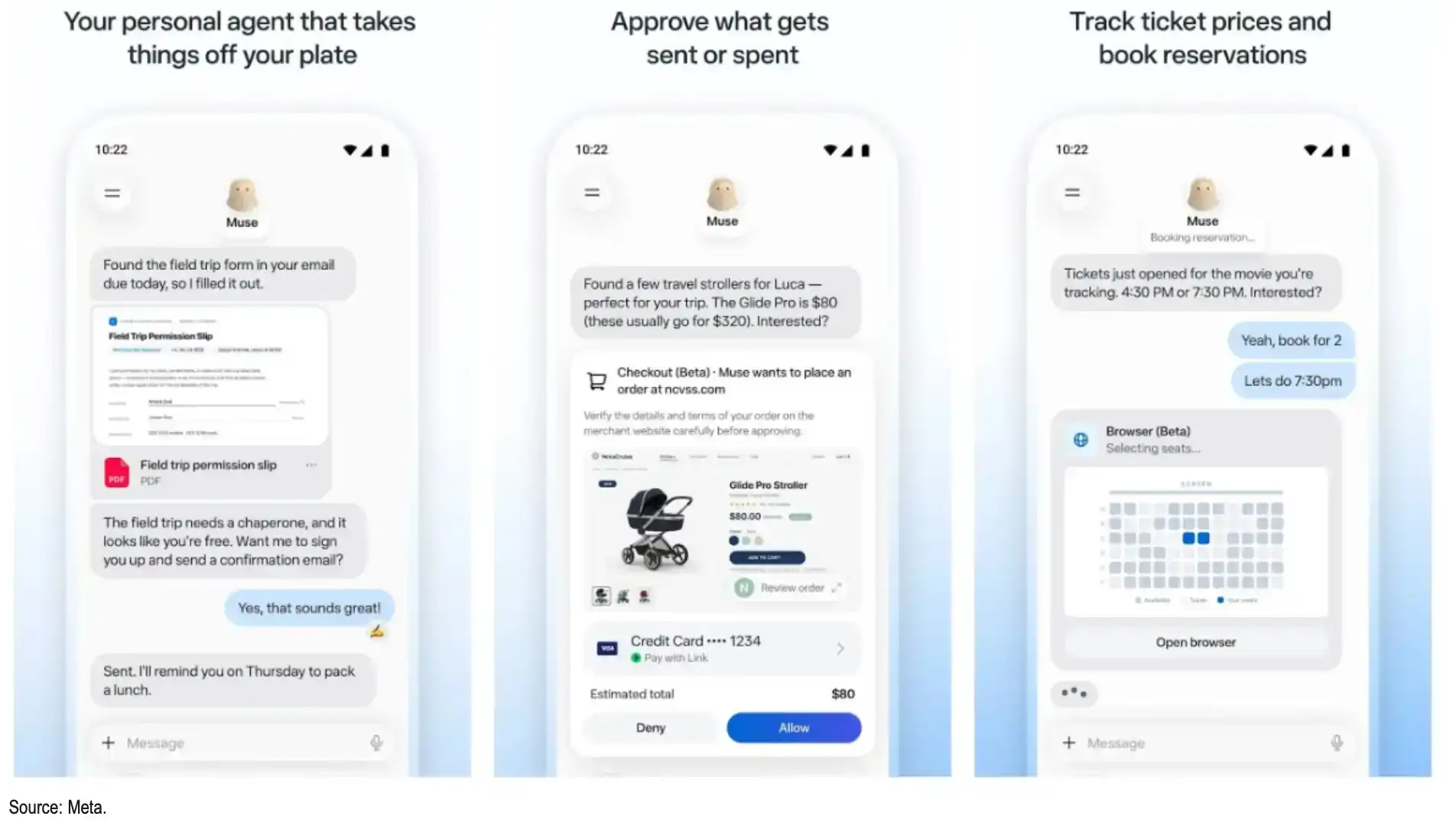
Muse use cases and task execution workflow. Muse uses a virtual computer to invoke various websites and apps, completing search, decision-making, and transaction tasks on behalf of users.
Enterprise monetization is further advanced. Meta Business Agent enables businesses to answer questions, recommend products, schedule services, and qualify sales leads. By Q2 2026, over 1 million enterprises were using the product weekly on WhatsApp and Messenger.
The enterprise-focused Business Agent Platform connects to hundreds of external systems including Shopify, Zendesk, and Shopee, allowing agents to perform operations on behalf of companies. Launched on August 1, the platform now implements token-based billing: $2 per 1 million tokens, with each message interaction costing ~$0.04–$0.05.
Looking ahead, Meta may adopt a “pay-for-results” model akin to ad auctions, where enterprises bid based on real outcomes such as sales, appointments, or lead conversions. Given Meta’s existing relationships with hundreds of millions of advertisers and small businesses, Business Agent doesn’t need to build sales channels from scratch.
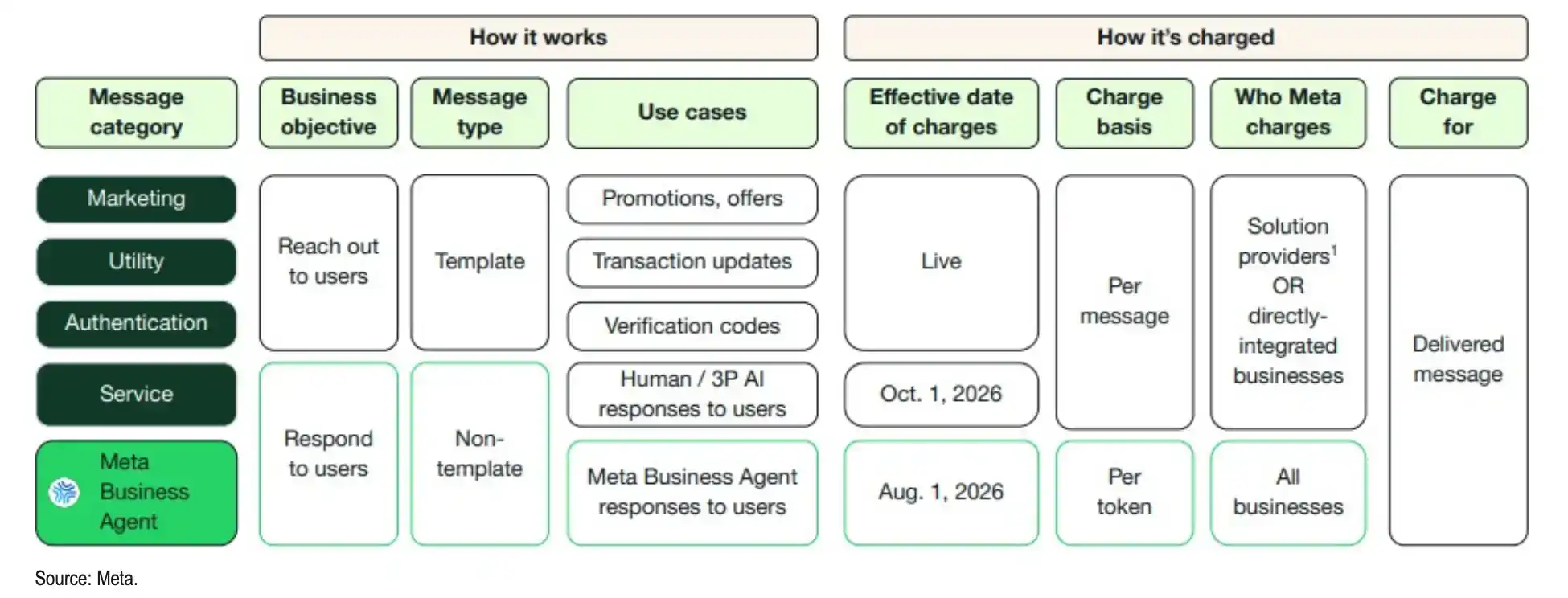
Meta Business Agent Platform pricing. Enterprise agents have launched token billing, giving Meta a new entry point for business service revenue.
The developer market represents another monetization path. Meta Model API allows developers to call Muse Spark to build agents and multimodal workflows, while Muse Code handles complex software engineering tasks.
Muse Spark 1.3 Standard Edition is priced at $1.25 per million input tokens and $4.25 per million output tokens. The contributor version—where users allow Meta to improve the model using their data—costs only $0.10 and $0.20 respectively. Muse Code also offers three subscription tiers: $5, $15, and $50 monthly.
The low pricing reflects Meta’s current focus on driving adoption and usage scale. Early signals are positive: the Muse Spark 1.3 contributor version leads in market share on OpenCode, having processed ~31 trillion tokens since launch across 212,000 unique users.
Beyond agents and APIs, Meta is also selling subscriptions via Meta One to individual users, enterprises, and creators. Personal plans are priced at $7.99 and $19.99 monthly, offering higher Meta AI usage quotas and premium features on Instagram, Facebook, and WhatsApp.
JPMorgan estimates that with average revenue per user (ARPU) of $182 and penetration rates of 2%–3%, personal Meta One subscriptions could generate $14.2B–$21.3B in revenue, contributing $3.30–$4.96 in GAAP EPS. If ARPU rises to $211, revenue could reach $16.4B–$24.6B.
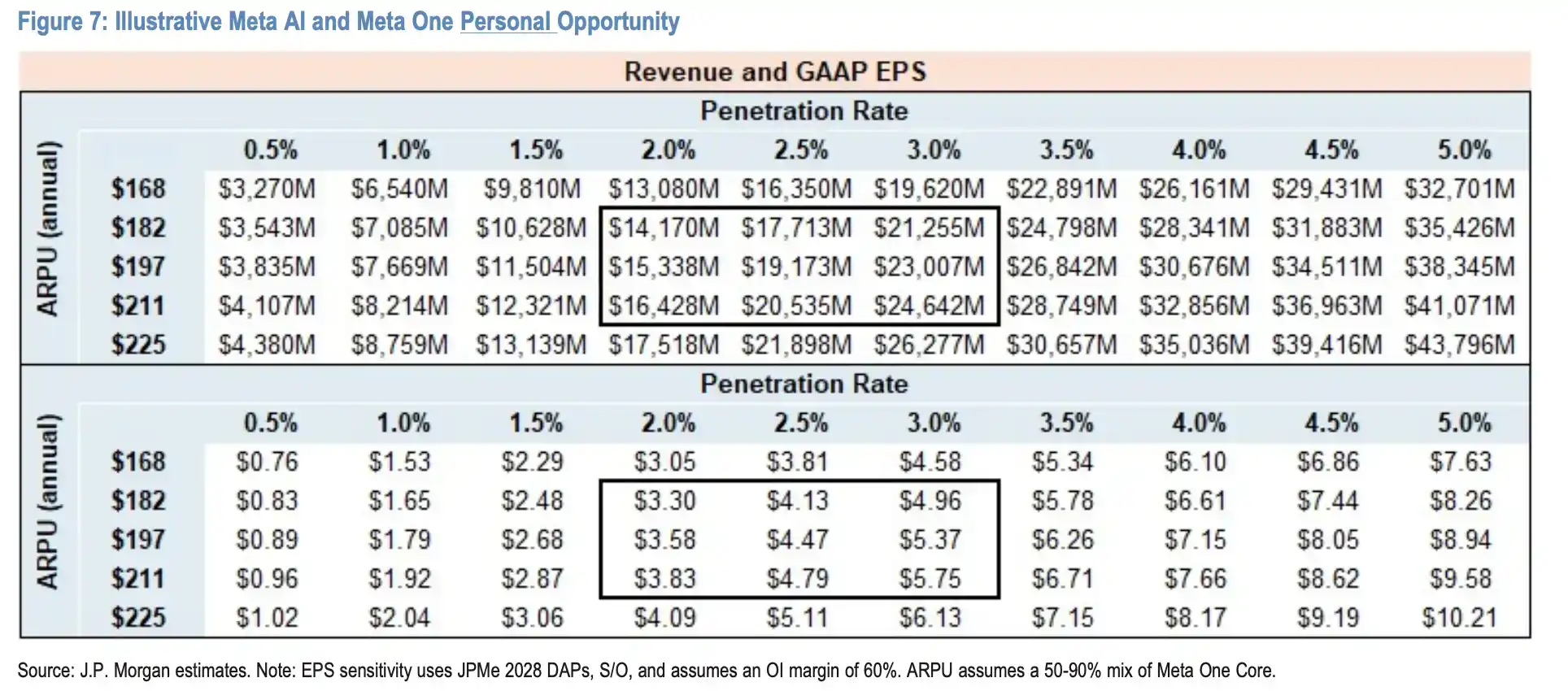
Meta One personal subscription revenue and EPS sensitivity analysis. At 2%–3% neutral penetration, personal subscriptions could contribute $14.2B–$24.6B in revenue.
Enterprise and creator tiers carry higher prices, ranging from $14.99 to $499.99 monthly. Meta currently serves over 200 million enterprises and tens of millions of professional creators. Under neutral scenarios—$600–$1,200 ARPU and 8%–12% penetration—this segment could generate $12B–$36B in revenue by 2028, contributing $2.80–$8.40 in GAAP EPS.
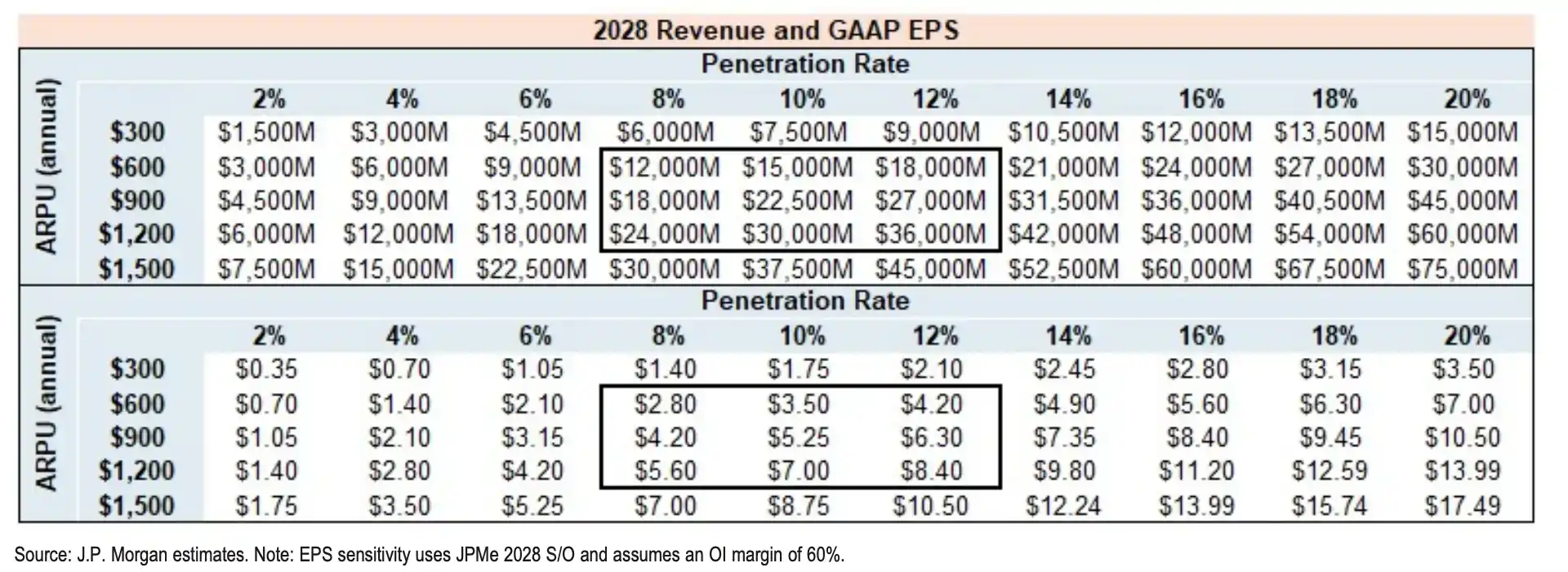
Meta One enterprise and creator subscription revenue and EPS sensitivity analysis. With over 200 million enterprise users, enterprise and creator subscriptions could become Meta’s more elastic AI revenue stream.
The above projections do not include potential ad revenue from Meta AI. In the future, Meta AI itself may become a new ad placement channel, while user interaction data with AI assistants could enhance ad targeting precision across Facebook, Instagram, and WhatsApp.
Massive Investment Continues, But Revenue Not Fully Priced In
Meta’s AI commercialization path is becoming clearer, but this does not mean capex risks have disappeared. On the contrary, investment may intensify over the next two years.
JPMorgan forecasts Meta will maximize compute capacity in 2026 and 2027. Reports suggest the company aims to reach ~7GW of compute capacity in 2026, doubling to 14GW by 2027.
Capex is projected to rise from $69.7B in 2025 to $142.5B in 2026, then grow 70% to $242.7B in 2027, reaching $283.5B in 2028—significantly above market consensus.
Such massive capex will directly pressure cash flow. JPMorgan forecasts Meta’s free cash flow to decline from $47.1B in 2025 to -$1.4B in 2026, then fall to -$58B in 2027 and -$49.6B in 2028. The company may shift from net cash to net debt in 2026, with net debt reaching ~$165.2B by 2028.
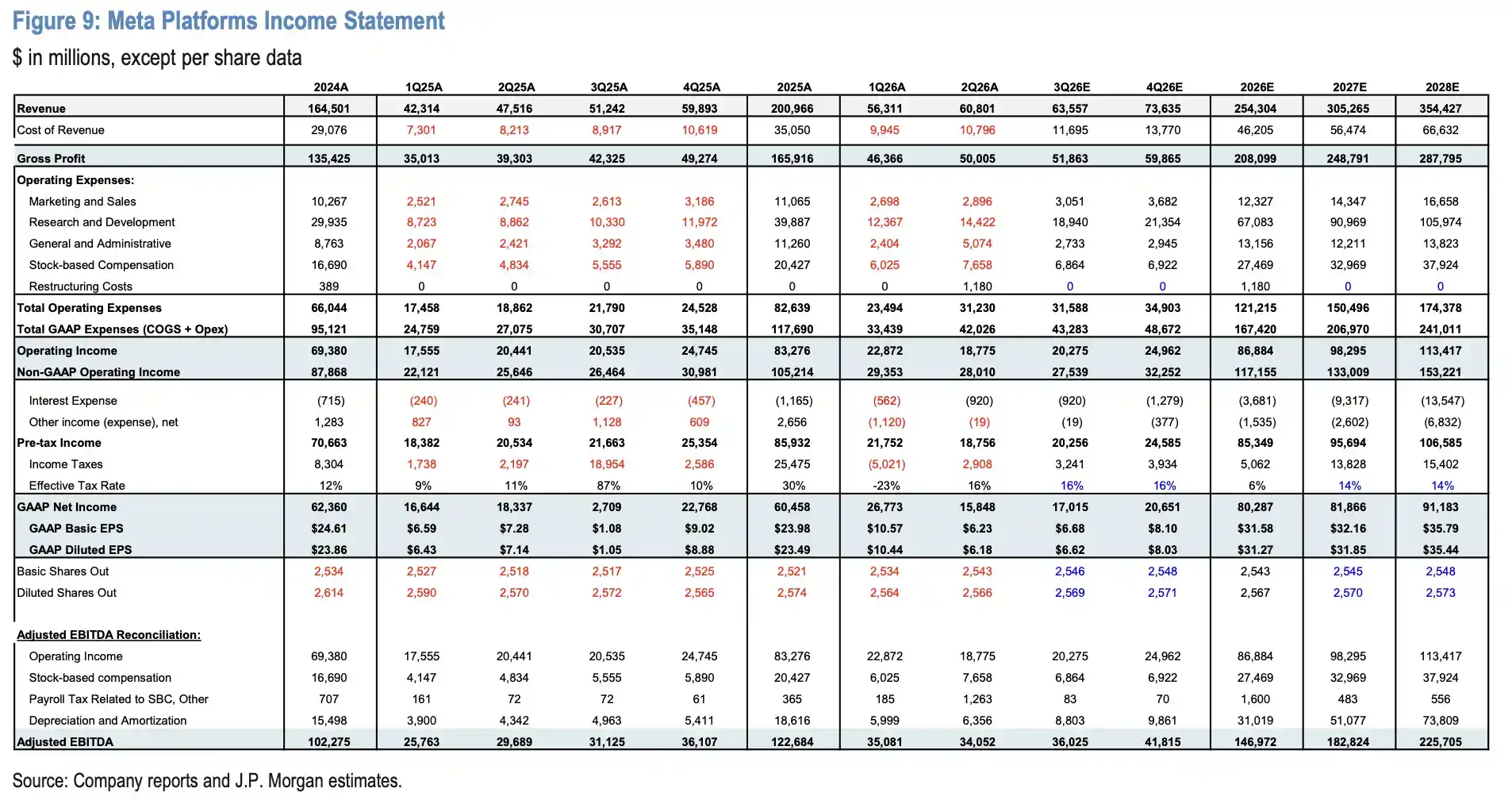
Meta’s income statement and capex forecast. Capex will surge in the next two years, continuing to exert pressure on free cash flow.
Yet this is precisely why JPMorgan has turned bullish: current financial forecasts have already priced in most AI infrastructure costs, but have not yet accounted for new revenues from Muse, model APIs, and other emerging AI products. In short, costs are baked in, but potential revenue remains under-calculated.
If Meta ends up with excess compute capacity, it could rent out surplus capacity to external clients. Recent high-end compute contracts command $30–$50 per watt—higher than typical cloud providers’ $10–$20 per watt. However, JPMorgan expects Meta will prioritize internal use for ad optimization, frontier model training, and its own AI products, as these internal applications likely yield higher ROI.
Meanwhile, core advertising remains Meta’s foundation for absorbing AI investment. AI improves content recommendation, increases user engagement time, enhances ad targeting efficiency, and enables bulk generation of ad creatives for advertisers. JPMorgan forecasts Meta’s revenue to grow from $201B in 2025 to $254.3B in 2026, then reach $305.3B in 2027 and $354.4B in 2028.
Risks remain clear: AI spending may exceed expectations, monetization pace may lag, Muse and other agents may fail to retain users long-term, and competitors like Google, TikTok, and OpenAI continue to vie for user attention and ad budgets.
Thus, whether the $820 target is achievable hinges not just on Meta’s ability to keep investing in AI, but on whether Muse, Business Agent, model APIs, and Meta One can generate real revenue within the next two years. JPMorgan’s view is that Meta has crossed the threshold of inadequate model capability, and AI spend is now transitioning from pure cost into a monetizable, subscription-based, API-accessible, and transaction-participating commercial system.
Source: BlockBeats
Disclaimer: Contains third-party opinions, does not constitute financial advice


Yushu Surges 629% on First Day of Trading, Humanoid Robots Sell 5,500 Units
24 days ago
Yushu's 61 Billion IPO: Who Will Make Money?
08-07
AI stocks down 40%-60%, yet NVIDIA's valuation is at a 10-year low
08-06
HBM Bottleneck Migration, NVIDIA Also Aims to Downgrade
08-06
AI Servers Fuel Demand for Minor Metals: Prices Surge Over 70% in Half a Year
08-06
AI is not a search bar—it's a supercomputer costing just a few dozen dollars
08-05Cloud vendors first declined then surged—why the divergence in AI assets?
08-05


