Last night, Silicon Valley witnessed the battle among AI deities
Last night, Silicon Valley witnessed the battle among AI deities

2026-09-03 10:00
Introduction: AI inference costs are plummeting from three distinct directions simultaneously, signaling a paradigm shift in the intelligent economy. Three major developments unfolded in Silicon Valley last night. Google unveiled Gemini 3.8 Flash.
Three pivotal events occurred in Silicon Valley last night.
Google launched Gemini 3.8 Flash, Meta released Muse Spark 1.3, and an obscure startup named Mostik secured a feature interview with the prestigious WIRED magazine.
If we focus only on the first two, this might appear to be another routine AI benchmark race night.
Google had just pushed Gemini to the top of DeepSWE, but hours later, Meta announced even higher scores—leaving the title of "world’s best" vacant for mere hours.
By 2026, such rapid iterations have already become commonplace, almost mundane.
Model release, benchmark update, brief celebration on X, then waiting for the next company to break records.
But when viewed collectively, what truly matters lies not in the rankings themselves.
The economics of AI is undergoing a fundamental transformation.
For years, the dominant metric for AI cost has been price per million tokens.
Yet with the rise of Agents, this measurement framework is increasingly inadequate.
What may matter most in the future isn’t “how much per million tokens,” but rather: how much does it cost to fix a bug, complete a research task, or sustain an Agent’s continuous operation for three hours?
Last night, inference costs were declining simultaneously across three entirely different dimensions.
Google is compressing frontier-tier capabilities into ever-cheaper models; Meta is enabling Agents to achieve the same tasks with fewer tokens and tool calls; and Mostik is pushing further—challenging the very foundation:
If both communication parties are AI, why must they still rely on human-designed languages?
PART.01: Gemini Makes a Comeback
First, Google.
Google introduced its new flagship model, Gemini 3.8 Flash, officially described as their most powerful reasoning and code model to date.
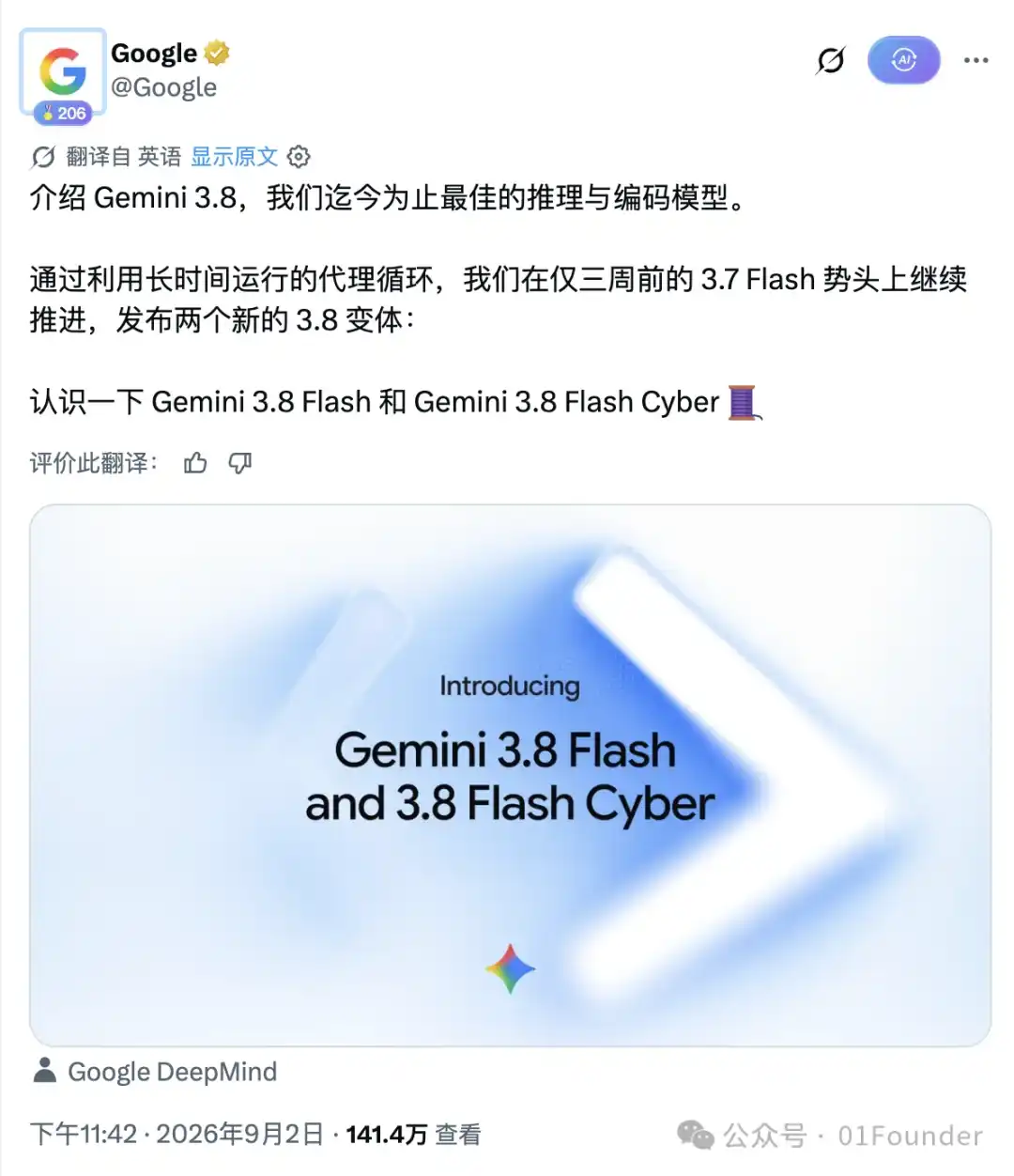
This marks the third update to the Flash series within six weeks, progressing from 3.6 to 3.7 and now to 3.8.
Historically, Flash models were perceived simply: faster, cheaper—but slightly weaker than the top-tier models.
Google is now gradually redefining that perception.
The core enhancement in 3.8 Flash centers on long-horizon coding and agentic workflows.
In DeepSWE v1.1—a benchmark measuring AI's sustained software engineering capability—it achieved approximately 74% accuracy.
The key distinction between DeepSWE and traditional code benchmarks is that it doesn’t just present a single algorithmic challenge. Instead, it places the Agent directly inside a real code repository.
The model must understand the problem, search through codebases, modify files, invoke tools, run tests, and if it fails, backtrack to identify root causes.
A full task may span dozens or even hundreds of steps.
Under these conditions, Gemini 3.8 Flash briefly claimed the top spot globally.
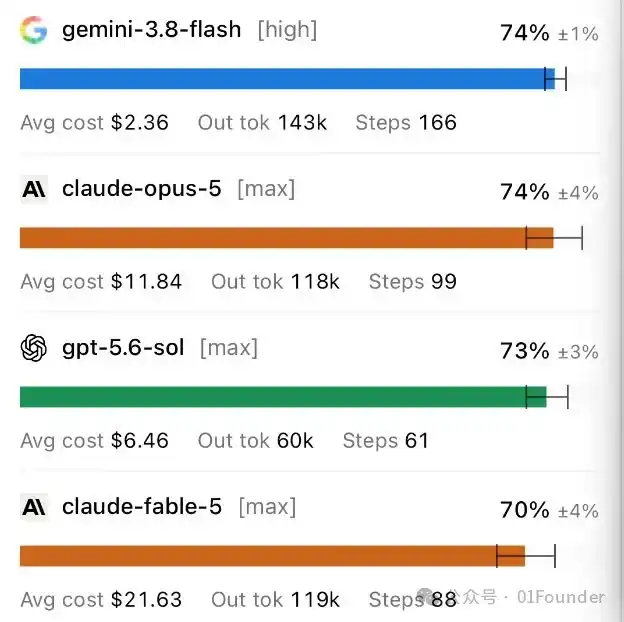
Claude Opus 5 scored similarly (~74%), GPT-5.6 Sol ~73%, while the previous leader Fable 5 hovered around 70%.
When comparing raw capability, the gap among these top models is now negligible.
What’s truly staggering is another number: cost.
Gemini 3.8 Flash maintains its initial API pricing at $0.75 per 1M input tokens and $3.75 per 1M output tokens.
To complete a full task on DeepSWE, its average cost is only $2.36.
For comparison, Claude Opus 5, also scoring ~74%, averages $11.84 per task; GPT-5.6 Sol (~73%) clocks in at $6.46.
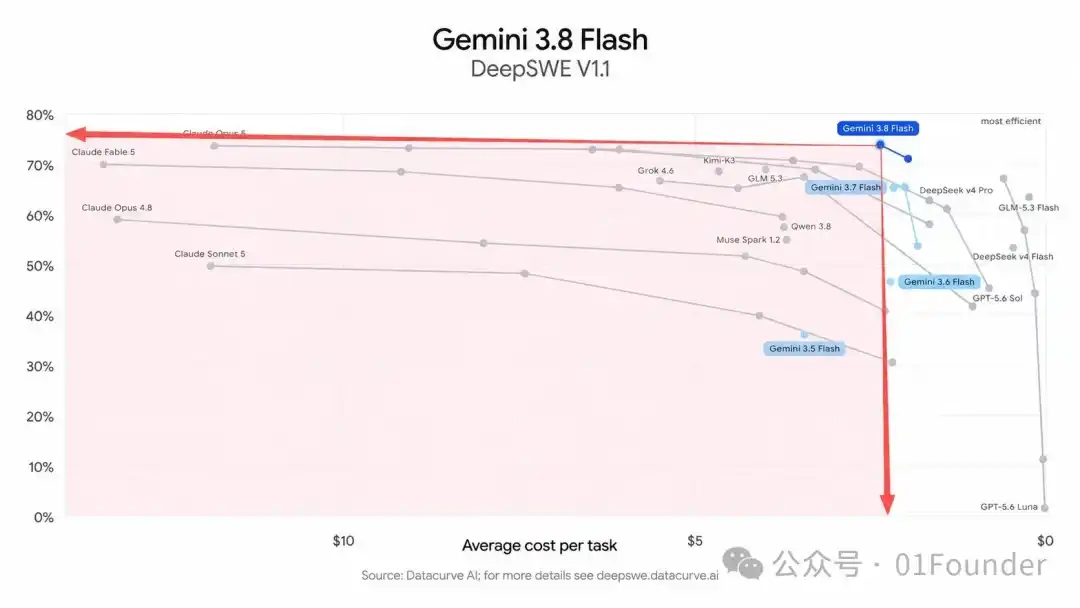
Thus, at the same level of software engineering performance, execution costs can differ by several times.
This will be critical in the Agent era.
In the chatbot era, minor differences in cost per response were imperceptible to most users.
But Agents are fundamentally different—an agent performing coding may execute 100+ steps; a research agent could scan dozens of web pages and read hundreds of documents; future enterprise agents may operate continuously for hours.
Google itself noted that 3.8 Flash proactively works harder on complex tasks, engaging in deeper reasoning and more tool calls.
Google didn’t sacrifice intelligence to cut costs. Rather, because token prices are now low enough, it allows longer inference loops.
Therefore, the true significance of 3.8 Flash isn’t securing another world-first ranking.
It’s about forcing frontier-level capabilities—previously available only in premium models—into the Flash pricing tier.
PART.02: Meta Strikes Back 3.5 Hours Later
While Google teams celebrated the launch of Gemini 3.8 Flash, Meta suddenly returned with a counterstrike.
Meta unveiled Muse Spark 1.3.
According to Meta’s published results, Muse Spark 1.3 achieved 75.4% on DeepSWE v1.1—surpassing Gemini 3.8 Flash, Claude Opus 5, and GPT-5.6 Sol.
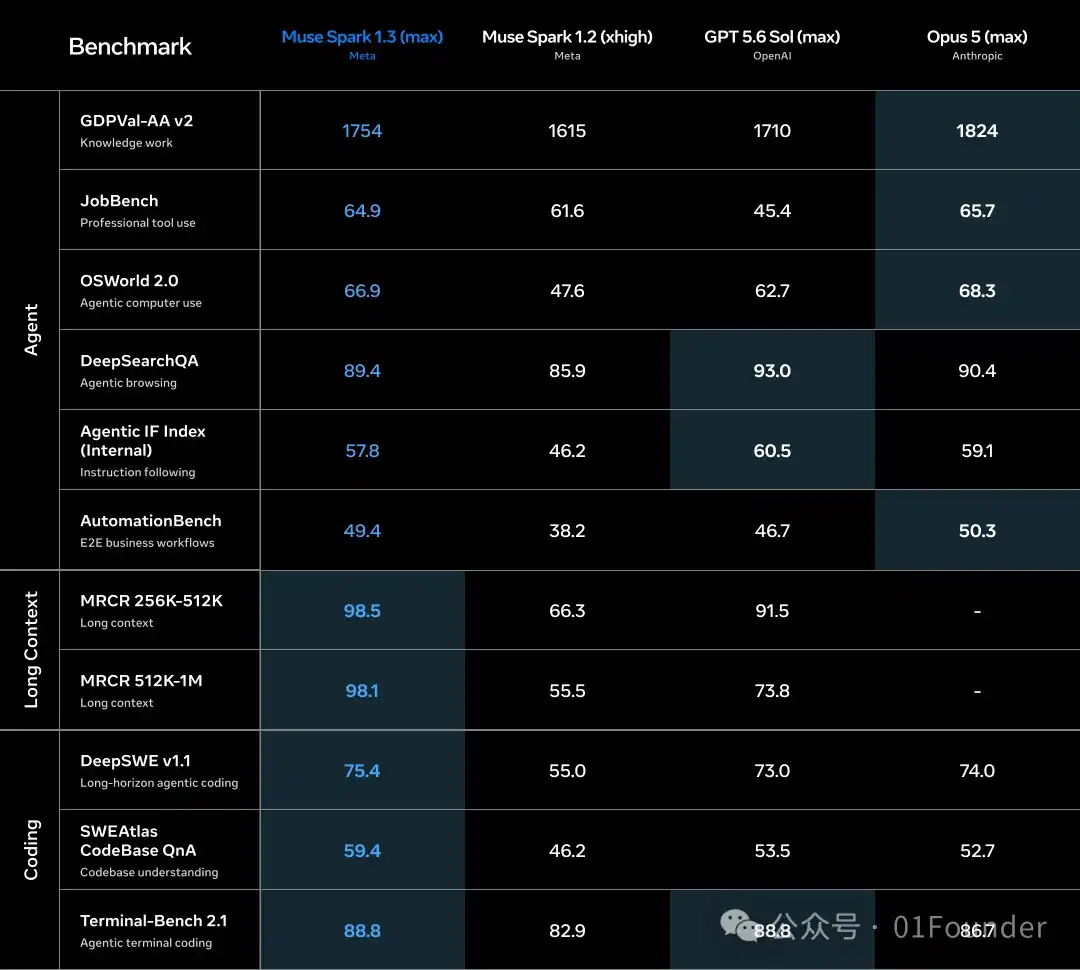
Even more striking: Muse Spark 1.2 scored only ~55% on the same test.
From version 1.2 to 1.3, a minor update delivered a ~20 percentage point improvement.
Yet I argue Meta’s most significant contribution isn’t the 75.4% score.
Two other metrics stand out: a ~20% reduction in tool calls and a ~25% drop in token consumption.
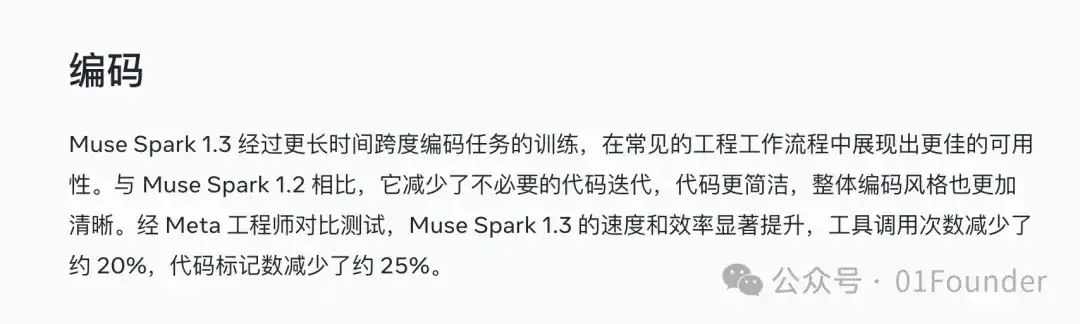
This aspect is easily overlooked—but it gets to the heart of the most pressing issue once Agents reach commercial maturity.
The biggest cost sink in many Agents isn’t normal reasoning, but deviation.
For example, a coding Agent misinterprets a requirement at step 20, then modifies five files, runs three test cycles, searches extensive code—only to realize the entire path was wrong, requiring a full restart.
Tens of tool calls and tens of thousands of tokens vanish in waste.
Thus, a model capable of detecting ambiguity earlier, recognizing when it’s stuck, or proactively seeking user clarification, directly reduces operational costs.
Muse Spark 1.3 strengthens precisely these abilities: it maintains multiple workflows simultaneously within long threads, actively queries when tasks are ambiguous, requests help when overwhelmed, confirms irreversible actions, and retains initial constraints over extended execution—even after many rounds.
Meta is even emphasizing the model’s awareness of its own capability boundaries: knowing what it can do, and crucially, what it cannot.

These traits may seem unimpressive on a benchmark sheet—gaining 20 points is far sexier—but in the Agent era, they translate directly into dollars.
Each error avoided is an optimization in reasoning.
When viewed together, Google and Meta are quietly shifting the unit of measurement in large model competition.
Going forward, people will care less about “cost per million tokens” and increasingly focus on one key figure:
How much does it actually cost to run a real-world task from start to finish?
PART.03: Mostik – A Disruptive Breakthrough
If Google and Meta are refining how to accomplish tasks using cheaper, leaner tokens, Mostik is tackling a deeper question:
Why do these tokens even need to exist?
"Mostik" means "bridge" in Russian.
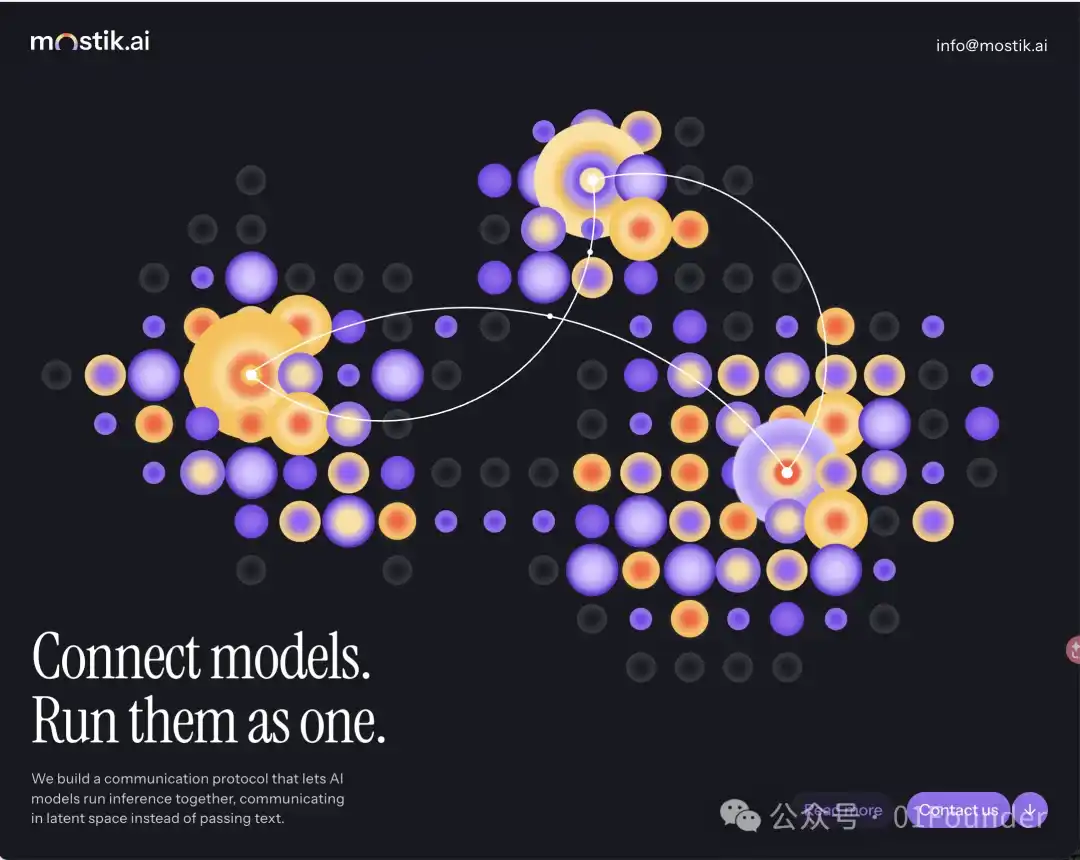
CEO Sasha Malysheva is the principal architect behind this approach; the Chief Scientist is Professor Stanislav Smirnov of the University of Geneva, a 2010 Fields Medalist.
They’re attempting something deceptively simple yet profoundly challenging: enabling two AI models to communicate without relying on natural language.
Today, nearly all multi-agent systems work like this:
Model A receives data, generates hundreds or even thousands of tokens expressing conclusions in natural language; Model B then reads every word, reconstructs internal representations, and continues reasoning.
But here’s the flaw: the actual computation inside large models isn’t Chinese or English—it’s:
high-dimensional continuous mathematical representations.
This is like two computers having direct data transfer capability, yet Computer A prints the file onto hundreds of pages, and Computer B uses a camera to OCR each page back in.
We’ve spent years trying to reduce printing costs. Mostik wants to eliminate the printer entirely.
Instead, they aim to build a Bridge between internal representations of different models—enabling direct exchange of latent representations, bypassing natural language generation altogether.
An experiment disclosed by WIRED is particularly compelling.
Mostik connected the full GLM-5.2 753B model with Qwen 3.5 (only 4B, capable of running on mobile devices).
The resulting hybrid system exhibited performance between the two models—but inference cost was only 1/20th of the full GLM-5.2.
Naturally, declaring Mostik has solved model communication prematurely.
Latent communication isn’t new—researchers have explored exchanging embeddings, hidden states, KV caches, and other internal representations for years.
The real difficulty lies in architectural, parametric, training data, and coordinate system mismatches across models—how to align and interpret each other’s latent spaces remains a formidable challenge.
Smirnov himself admits that no mature mathematical language currently exists to describe shared representations across models.
Yet the 1/20 figure fills me with excitement.
It’s prompting me to seriously envision an entirely different future architecture for AI.
PART.04: In the Future, You’ll Only Need a Sub-0.1B Model
For the past two years, discussions on edge AI have centered on squeezing larger models into phones: 7B, 4B, 3B, 1B—continual distillation, quantization, compression.
But if Mostik’s approach ultimately succeeds, perhaps future smartphones won’t need a “jack-of-all-trades” large model at all.
Your device might only host a small model—0.xB or a few billion parameters.
It would be inexpensive, always-on, responsible for understanding your current app context, recent actions, device state, and handling most simple, frequent tasks.
Only when encountering difficult problems would it invoke remote large models via latent-space communication.
Crucially, unlike today’s practice of resending tens of thousands of tokens of context to the cloud, the remote model wouldn’t have to re-read everything from scratch.
Instead, it might transmit only a highly compressed latent state.
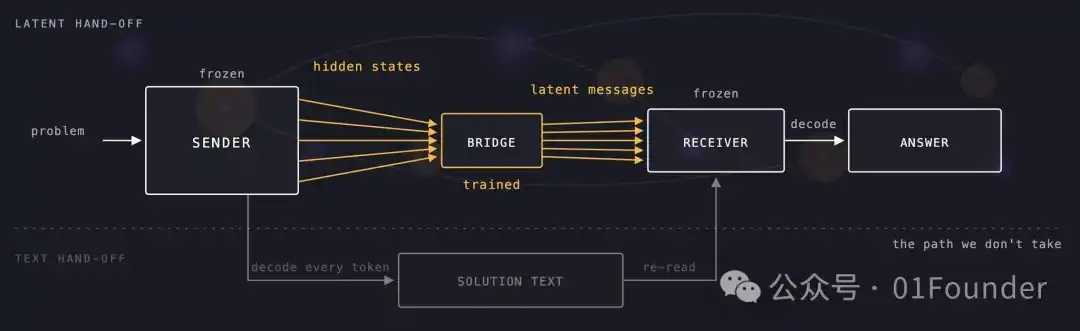
After completing complex reasoning, the remote model doesn’t need to generate thousands of tokens of natural language explanation. It can directly return updated internal representations.
Thus, the local model handles high-frequency, low-cost, continuous operations; the cloud-based frontier model performs rare but hard reasoning; and a Bridge enables efficient communication in between.
If this vision becomes reality, the drop in inference cost could far exceed today’s 30% or 50% API price cuts.
It might fundamentally reshape how we organize AI computation.
PART.05: Conclusion
Looking back at last night’s events, they appeared as three separate stories.
Google released Gemini 3.8 Flash, compressing frontier-tier capabilities into Flash-level pricing;
Meta launched Muse Spark 1.3, enabling Agents to achieve more with fewer tokens and tool calls;
Mostik went further—attempting to eliminate certain tokens from the outset.
Yet all point to the same transformation:
Intelligence is becoming astonishingly cheap, at an accelerating pace.
And this price drop goes beyond mere API rate reductions.
Model prices are falling, computational requirements per task are shrinking, and now even the way models exchange information is being redesigned.
The implications may dwarf the impact of a few extra benchmark percentage points.
Because technological breakthroughs rarely happen at “first use”—they occur when something finally becomes so cheap it can be used freely.
Today, spending tens of dollars on an Agent to perform a trivial human task is clearly impractical.
But if future costs drop to just a few cents, countless applications currently deemed impossible suddenly become viable.
We can’t yet run dozens of Agents 24/7 around a person. But if inference costs drop by one or two orders of magnitude, that could become the default state.
It’s already morning, and I should have gone to bed hours ago.
Yet after Gemini’s release, Meta followed hours later, and then I saw Mostik’s 1/20 experiment.
Lying in bed, my mind kept circling around these ideas—thinking of the 0.xB model on my phone, the massive model in the cloud, and how they might no longer need to speak natural language to each other.
The more I thought, the less I could sleep. Eventually, I got up and finished writing this piece.
Gemini’s 74%, Muse’s 75.4%—new numbers will likely surpass them in days.
But right now, I can’t shake this sense of exhilaration.
Because beyond who claims another world-first, I’m increasingly focused on a different question:
How cheap can such intelligent AI truly become?
Once powerful intelligence becomes affordable enough to be invoked freely, I suspect many AI products that seem wildly implausible today may only just be beginning.
Source: 01Founder
Disclaimer: Contains third-party opinions, does not constitute financial advice


AI is not a search bar—it's a supercomputer costing just a few dozen dollars
29 days ago
Anthropic Locks in 6 Years of Compute with $10 Billion Commitment
29 days agoNot building robots—why is it worth $14 billion?
07-31AI is no longer competing on benchmark scores, but on profitability
07-25
ByteDance's Douyin Beans priced at 68 RMB—worth it for 382 million monthly active users?
07-25
Fields Medalist Concerned About AI Extinction Heads to OpenAI
07-25
Meta gives away models for free—who dares to price AI now?
07-24


