Leverage the scarcity dividend of shared computing power, domestic chips diverge into specialized paths
Leverage the scarcity dividend of shared computing power, domestic chips diverge into specialized paths

2026-09-03 08:00
Introduction: Escalating supply-demand imbalance, capacity and cash flow become the critical divergence points. With the semi-annual report disclosure window closed, domestic AI chips have entered their optimal revenue growth phase amid acute compute scarcity.
The semi-annual report disclosure window has closed, and under the backdrop of severe compute shortage, domestic AI chips have finally entered their strongest revenue growth period. Multiple vendors achieved year-on-year doubling or even multiple-fold growth, with momentum accelerating from Q1 to Q2.
This reflects the rapid expansion of domestic compute infrastructure. According to MIIT, as of the first half of the year, China’s intelligent computing capacity reached 2,185 EFLOPS (FP16), up 177% year-on-year; based on prior data, national intelligent computing capacity increased by approximately 303 EFLOPS in just Q2.
For the industry, this favorable period is expected to continue—driven by persistent supply-demand imbalance. The U.S. continues to restrict Chinese model developers from accessing NVIDIA’s most advanced AI chips, and plans are underway to extend control from "physical hardware" to "compute usage rights." Meanwhile, domestic chip production remains in ramp-up phase, while integration and operations with models and cloud providers still require further refinement. According to CAICT data, China’s AI compute demand growth rate is roughly three times that of supply growth.
Cloud providers and model developers are rushing to raise capital. Faced with insufficient AI chip supply, what matters more than fundraising speed is how quickly capital is deployed. Alibaba and Tencent spent over RMB 120 billion in the latest quarter alone; DeepSeek has already invested over RMB 10 billion in AI compute this year. Liang Wenfeng believes that domestic AI chips are at a historic inflection point—historical shortcomings in CUDA ecosystem can be overcome via AI-native programming—and the core bottleneck in the next two years will remain capacity. Wu Yongming, meanwhile, forecasts scarcity will persist through at least 2030.
If demand and capacity continue growing at current pace, leading AI chip firms may cross the breakeven line sequentially around 2027. Despite years of substantial losses, Cambricon turned profitable last year; its equity incentive plan sets 2028 revenue targets between RMB 47.6 billion and RMB 59.5 billion. Market hopefuls such as Molexion, Mimosa Tech, and Shuiprime, often dubbed “the next Cambricon,” have all issued guidance indicating profitability could arrive as early as late 2026 or early 2027.
Yet for chip companies, profitability may not be the most critical metric. Profits can grow with revenue recognition, but cash must actually return to the company’s balance sheet. From semi-annual reports, domestic AI chip firms generally face dual cash drain: upstream costs to lock capacity, downstream receivables still pending—leaving the gap borne entirely by chip firms themselves.
Molexion recorded a cash outflow of -RMB 1.3 billion, while Molexion’s net outflow expanded to around -RMB 2.1 billion; although Huawei did not disclose Ascend-specific details, the company’s overall operating cash flow shifted from net inflow of RMB 31.18 billion last year to net outflow of RMB 39.89 billion in H1; simultaneously, inventory surged to RMB 277.5 billion, up 45% from year-end 2025.
This implies that the true competition among domestic AI chips will quietly unfold within an extended period of prosperity. On one hand, the ability to rapidly penetrate top-tier customer ecosystems, establish customer stickiness, and even achieve closed-loop co-optimization becomes paramount. On the other, long-term competitiveness hinges on supply chain strength—particularly network and memory layers, which are becoming key bottlenecks in AI infrastructure. Relevant players are now vying with logic chip manufacturers for definition rights over next-generation AI compute infrastructure.
In this context, the alignment and positioning of China’s domestic AI chip players will gradually diverge.
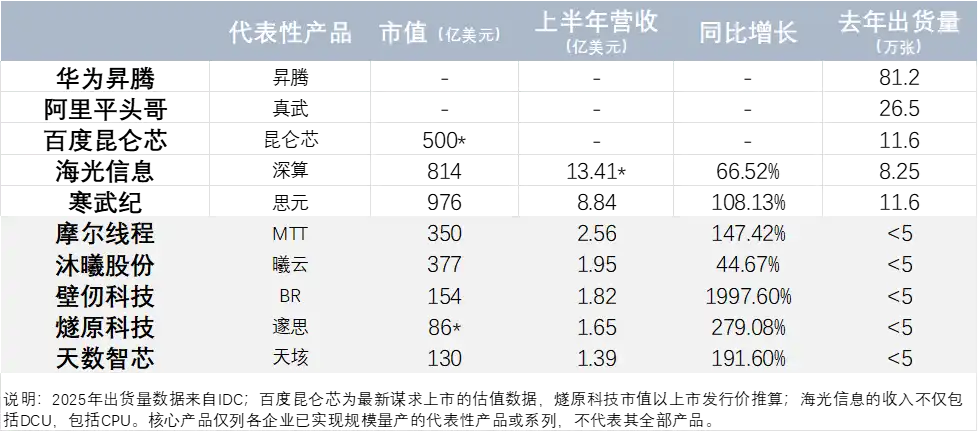
If we rank domestic Chinese AI chips by shipment volume and commercial maturity, by 2026, a rough three-tier structure has emerged.
The first tier includes Huawei Ascend, Alibaba Pingtouhai, Baidu Kunlun Core, Cambricon, and Higon Information—vendors already achieving scale shipments. Last year, they crossed the 100,000-card threshold; excluding Huawei and Alibaba-affiliated chips lacking external market valuation, the other three firms each boast market caps exceeding $50 billion.
The second tier comprises Molexion, Moxi Technology, Banshee Tech, TianShu ZhiXin, and Shuiprime—last year’s shipment volumes mostly under 50,000 cards. These firms recently went public, generating strong sentiment value, yet current market caps remain below $50 billion.
The third tier consists of unicorn startups like Xiwang and Dongfang Suanxin—valued above $1 billion in primary markets but not yet achieving large-scale shipments. They pursue differentiated strategies focused on inference optimization, aiming to avoid direct confrontation with the first two tiers.
Alibaba Pingtouhai is poised to be the biggest variable. As China’s largest cloud provider and the model developer with the broadest open-source model coverage and highest download volume, Alibaba naturally enables full-stack synergy with self-developed AI chips. Although rumors of Pingtouhai’s spin-off surfaced earlier, no follow-up has emerged. Nevertheless, during the latest earnings call, Alibaba executives intentionally highlighted Pingtouhai—a previously low-profile business—with notably open statements, sparking significant market speculation:
(Because) this generation of chips, we are one of only two companies in the Chinese market capable of scaling up deployment across super nodes; possibly the only one with large-scale training and inference commercial clients;
Next-generation chips will begin tape-out and output this second half, delivering extremely strong compute power and interconnect bandwidth—we believe they can fully replace large-scale model training;
I don’t think there exists any government-led compute supply that could deliver a chip with truly competitive capability…
The term “only two” immediately evokes Huawei’s Ascend 950 series. Last week, China Mobile announced the winning bid for the Hohhot Intelligent Computing Center expansion project, procuring 3,840 cards and 480 AI super-node systems based on Huawei Ascend CANN ecosystem, with total bid price around RMB 1.296 billion; earlier in April, China Mobile completed its first-phase procurement of 6,208 cards and 776 similar units, totaling RMB 2.06 billion. Reuters reported Huawei plans to ship approximately 750,000 Ascend 950PR chips by 2026.
Huawei still commands the largest AI compute capacity in China, deeply integrated with telecom operators, local intelligent computing centers, and AI-native model developers—making it an unshakable member of the first tier for the foreseeable future. Moreover, per the Ascend 950 NPU Architecture Whitepaper, the Ascend 950DT is specifically engineered for the full lifecycle of large models, covering pre-training, post-training, and inference (including Decode and Prefill), particularly suited for generative AI training and inference tasks. It will enter mass shipment this second half—slightly ahead of Pingtouhai’s next-gen chip. Whether a chip can handle large-scale training remains one of the core indicators of strategic value.
Chip firm positioning isn’t necessarily about who you are—but who you’re tied to. Within the current first tier, Baidu Kunlun Core’s parent, Baidu Cloud, still lags behind Alibaba and major telecom operators in scale; its Wenxin large model also lacks strong market traction. Conversely, from the perspective of cloud or model providers, Cambricon’s ecosystem role is shifting—market chatter increasingly suggests collaboration with ByteDance, though ByteDance itself is developing in-house chips.
The most challenging yet most resilient may well be Shuiprime. Currently, its financial performance stands out as unremarkable even within the second tier. While not officially a Tencent in-house chip, Tencent holds over 20% stake and accounts for more than 80% of its revenue—effectively making it a “core” AI chip within Tencent’s ecosystem. If Tencent’s Hy model continues to close the gap, and if its B-side intelligent agent platform WorkBuddy and C-side platform WeChat Xiaowei gain market traction, Shuiprime—deeply embedded with Tencent—could secure a stronger competitive position.
But don’t underestimate the third tier. Inference demand is becoming increasingly refined—from “filling the plate” to “eating well.” New opportunities are emerging. At this year’s WAIC, Zhou Zhifeng, Partner at Qiming Venture Partners, noted that new technical pathways and chip architectures are rapidly emerging in China, combining inference needs with memory optimization, high-speed interconnects, and AI-driven EDA and automated compilation. A wave of AI chip startups founded just one or two years ago have already attracted valuations exceeding hundreds of billions of RMB.
Thus, what may truly unfold in 2027 is not sudden industry-wide consolidation, but rather the emergence of selection effects within sustained prosperity. Demand keeps rising, capacity remains tight—but as profitability expectations diffuse from a few leaders to broader firms, the intrinsic value of every AI chip enterprise will subtly diverge. Only when industry growth slows will genuine Darwinian survival-of-the-fittest dynamics take effect.
Source: Weijin Research
Disclaimer: Contains third-party opinions, does not constitute financial advice


HuggingFace's "AI Duck" Goes Viral, Boosting Chinese Chip Supplier Rockchip
1 day ago
Yushu Surges 629% on First Day of Trading, Humanoid Robots Sell 5,500 Units
15 days ago
14 Executives Depart, Horizon Unleashes a Robot Legion
23 days ago
Nokia Snatches AI Optical Chip Race, Stock Soars 52%
27 days ago
Yushu's 61 Billion IPO: Who Will Make Money?
27 days ago
AI stocks down 40%-60%, yet NVIDIA's valuation is at a 10-year low
28 days ago
HBM Bottleneck Migration, NVIDIA Also Aims to Downgrade
28 days ago


