Tsinghua's "Chips Billionaire Class" Gains Another Company Worth $60 Billion
Tsinghua's "Chips Billionaire Class" Gains Another Company Worth $60 Billion

Abstract:
The Tsinghua EE85 class (formerly the Department of Radio Engineering at Tsinghua University, later renamed the Department of Electronic Engineering) holds a position in China's semiconductor industry analogous to that of the Tsinghua Yao Ban in artificial intelligence. Zhao LIDONG, founder of Horizon Robotics, graduated from this cohort. Unlike his classmates who surged into capital markets as early as 2017 and became China’s "richest chip entrepreneur," Zhao LIDONG is the last member of this elite Tsinghua "Dream Class" to enter the wealth creation wave—yet he bears an even greater mission.
The Four Little Dragons of Domestic GPU are now assembling their final piece.
Horizon Robotics has opened subscription today, with an issue price of 142.18 RMB per share, corresponding to a valuation of approximately 61.2 billion RMB—a company that has incurred nearly 5 billion RMB in losses over three and a half years, yet commands such a valuation. What justifies this?
The answer lies in one name: Tencent. Prior to issuance, Tencent Technology directly holds about 19.95%, and the Tencent ecosystem collectively holds 20.26%, making it the largest institutional shareholder; additionally, 83.79% of Horizon Robotics’ revenue in 2025 comes from Tencent.
Tencent’s confidence in committing six rounds of investment over eight years and betting its core AI business on Horizon stems from two AMD veterans: Zhao LIDONG and Zhang YALIN.
Subscription Today: A Single Lot Requires Payment of 71,100 RMB
Today (September 2), Horizon Robotics, one of China’s “Four Little Dragons” in domestic GPUs, officially begins subscription. With an issue price of 142.18 RMB per share, and assuming a standard lot size of 500 shares under the Sci-Tech Innovation Board rules, investors must pay approximately 71,100 RMB to win one lot.
Initial price inquiry has already attracted 337 offline investors and 11,805 allocation entities. After excluding invalid and highest bids, the total offline subscription volume reaches 72.959 billion shares—2,648.93 times the initial offline issuance scale.
From the strategic placement list, names such as Xiaomi, MACOM Technology, Fujian Fortune Microelectronics, ZTE Corporation, and the National Social Security Fund are all included.
What does this signify? It shows institutions aren’t just verbally bullish—they’re actively competing. But for ordinary investors, is investing in an unlisted domestic GPU company truly worthwhile?
If we only look at recent performances of its “senior peers,” the answer may not be hard to guess.
On December 5, 2025, Moortech Semiconductor was first listed on the Sci-Tech Innovation Board, with an issue price of 114.28 RMB. Its intraday peak gain reached 425%, pushing market cap above 300 billion RMB. For investors holding one lot of 500 shares, maximum unrealized profit exceeded 200,000 RMB.
Following closely, Muxi Semiconductor saw even more frenzied trading: intraday peak gains surpassed 700%, with maximum single-lot profit nearing 400,000 RMB, setting a new record for single-lot gains on China’s A-share market in the past decade.
In January 2025, Biren Technology listed on HKEX, though it didn’t replicate the earlier two’s surge, still rose 75.82% on debut, with market cap briefly exceeding 100 billion HKD.
As the oldest among the four, yet the last to go public, Horizon Robotics finally steps into the spotlight of capital markets after eight years of development.
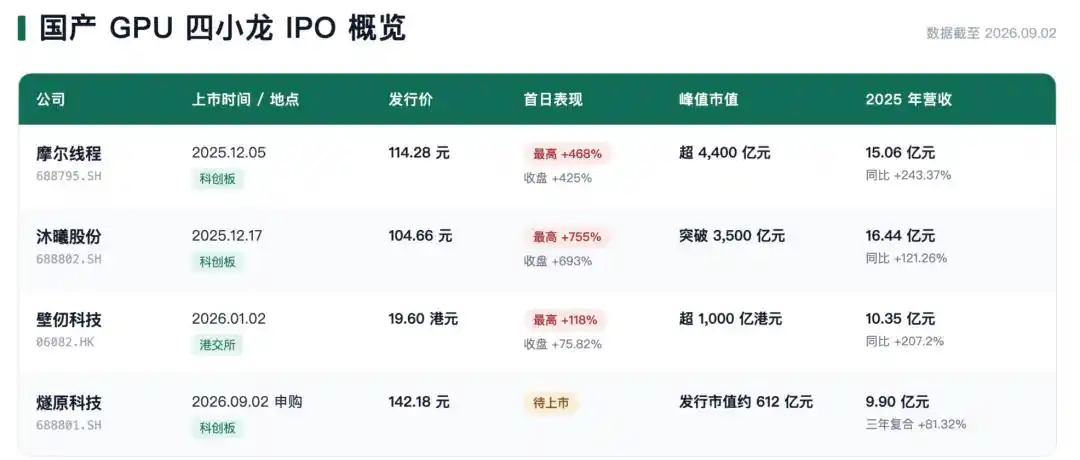
Figure | First-day performance of the Four Little Dragons of Domestic GPU upon listing
The first three companies have already established a strong market impression: “domestic GPU IPO = profitable.” Will Horizon continue this trend?
Looking at financial performance, Horizon has indeed been growing rapidly in recent years.
Revenue for Horizon Robotics was 301 million RMB in 2023, 722 million RMB in 2024, and 990 million RMB in 2025, achieving a three-year CAGR of 81.36%.
This year’s momentum is even stronger. In the first half, the company achieved revenue of 1.12 billion RMB—more than the full-year revenue of 2024 in just six months. The company forecasts Q1–Q3 revenue between 2.3 billion and 3 billion RMB, with potential year-on-year growth up to 455%.
While revenue climbs, losses are narrowing. For an eight-year-old GPU company, the past market concern was whether products could sell. Now, the key question is: when will it become profitable?
The prospectus provides a timeline: break-even by 2026, with profitability no later than 2027.
If this pace holds, Horizon may become the first among these domestic AI chip firms to achieve full-year profitability.
Yet investors must assess valuation: based on the 142.18 RMB issue price, Horizon’s 2025 diluted PS ratio is around 61.8x, below the industry average. On the surface, this figure doesn’t seem unreasonable—but post-listing trading prices often diverge significantly.
Just recently, Yushu Technology experienced such a divergence. Pre-listing, its issue valuation was ~61 billion RMB, with market optimism reaching ~200 billion RMB; however, after opening on August 19, its stock soared to 1,100 RMB, implying a market cap of 444.9 billion RMB. Subsequently, the price declined sharply. By September 2, market cap had fallen back to ~221 billion RMB—nearly 50% correction from its peak.
Naturally, this cannot be directly applied to Horizon, but it does indicate that the opening day price and the institution’s perceived fair value can be entirely different.
Back to Horizon: Is a 61.8x PS ratio expensive? Ultimately, it depends on whether its future performance can meet expectations.
Internet Giants' NVIDIA Anxiety Fuels a 60-Billion-RMB Horizon Robotics
One name consistently shadowing Horizon Robotics is Tencent.
The story began in 2018. As U.S.-China tech tensions escalated, Chinese internet giants collectively faced acute anxiety over their dependence on NVIDIA.
As one of China’s largest buyers of AI compute capacity, Tencent relies heavily on compute power for WeChat, ad recommendation systems, content safety, and later, the Hunyuan large model. Thus, securing stable domestic supply chains became imperative—and urgency was paramount.
At the time, Moortech, Muxi, and Biren hadn’t even been founded. Few mature domestic options existed. Horizon was among the rare teams already working on this challenge. Hence, in March 2018, immediately after Horizon’s founding, Tencent led the Pre-A round investment.
Additionally, Zhao LIDONG, a graduate of Tsinghua EE85, was a key reason behind Tencent’s bold bet. In 1992, as a high-tech talent, Zhao pursued further studies in the U.S., then spent years working in Silicon Valley, serving in critical roles at AMD—including Senior Director of Compute Business Unit and Senior Director of Product Engineering. He also played a pivotal role in establishing AMD’s China R&D center. In 2014, amid the launch of China’s first national chip fund, Zhao resigned and returned home to join Unigroup Communications Technology Group as Vice President, overseeing semiconductor investments.
A crucial turning point arrived again in 2018, when Zhao left Unigroup and brought in another AMD veteran, Zhang YALIN.
Zhang has been engaged in chip design since 2000, joining AMD where he served as Senior Chip Manager and Technical Director of the China R&D Center. As one of AMD’s primary global chip R&D leaders, he spearheaded the development and mass production of multiple products, including Microsoft’s Xbox One main chip.
In its second year, Tencent and Horizon initiated collaboration. Over the following six years, Horizon’s chips advanced from peripheral applications like Tencent Meeting and OCR recognition into Tencent’s core AI operations. By end-2024, the Gansu Qingyang 10,000-card inference cluster went live, with Horizon’s S60 becoming a core compute product—marking the first real-world test of domestic AI chips at a 10,000-card scale.
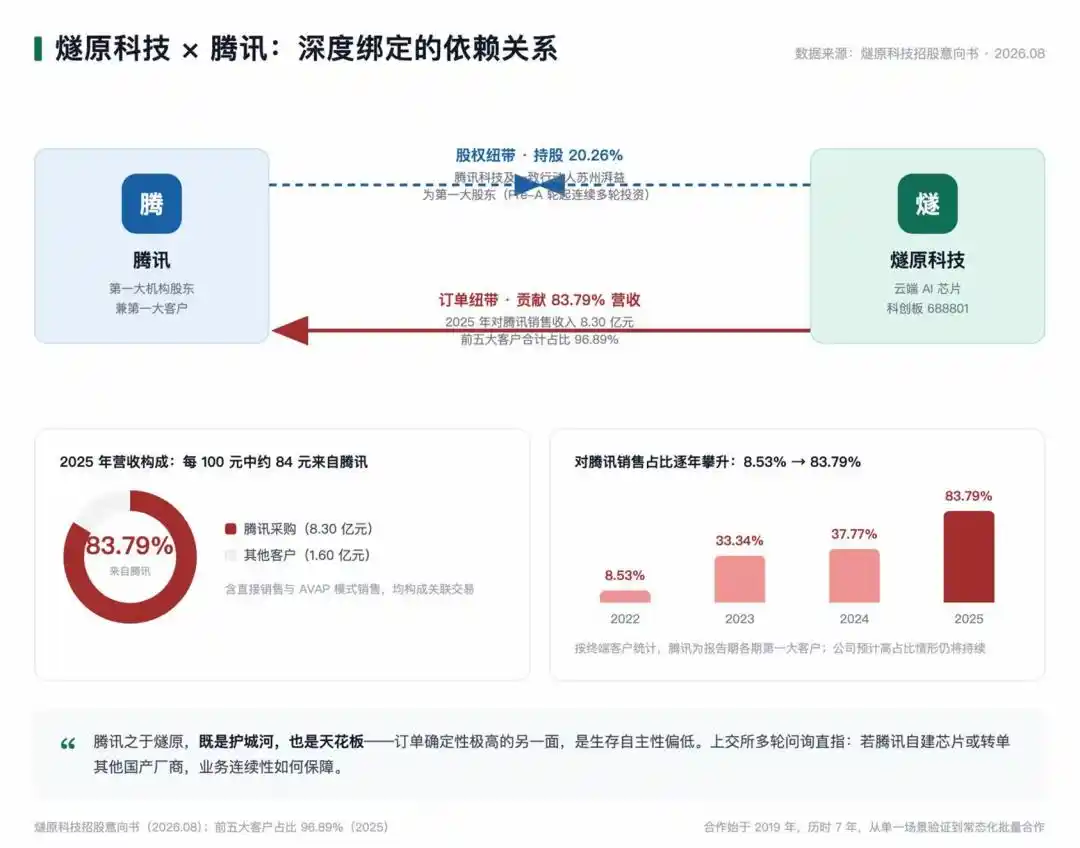
This partnership later became a defining feature of Horizon: Tencent is both its earliest investor and one of its most important clients. Yet every coin has two sides.
For a chip startup, having a major client willing to co-test core business operations is life-saving. Horizon’s eight-year journey through four architectural generations and five chip variants—all successfully taped out on the first attempt—was made possible by rigorous real-world validation.
But for other investors, concerns arise here. In 2025, direct and related-party sales to Tencent accounted for 83.79% of Horizon’s revenue, up from just 33.34% in 2023. In other words, the more resources Horizon has drawn from Tencent, the deeper its dependency has grown.
Especially given Tencent’s dual role as the largest institutional shareholder and the largest customer, skepticism persists regarding Horizon’s ability to independently acquire customers. Even in the prospectus, Horizon explicitly states: “We expect reliance on Tencent sales to remain high in the foreseeable future.”
Horizon also admits: if Tencent alters its procurement strategy significantly or fails to attract new customers as expected, its performance will face direct impact.
Furthermore, product structure poses another risk: current offerings primarily serve inference scenarios. Although Horizon’s fourth-generation training-inference integrated product, the L600, has completed tape-out, it hasn’t yet entered mass production and delivery. This means Horizon remains unestablished in the larger market of large model training.
The convergence of the Four Little Dragons marks the transition of the domestic GPU narrative into its second half—listing is merely gaining entry, and the real competition lies in capturing market share from NVIDIA.
Horizon holds a solid hand: self-developed DSA architecture, independence from CUDA ecosystem, a major client in Tencent, and a clear path to profitability.
Yet, ultimately, all these advantages must translate into actual orders and profits to justify sustained market confidence.
Source: Phoenix New Media Tech
Disclaimer: Contains third-party opinions, does not constitute financial advice


HuggingFace's "AI Duck" Goes Viral, Boosting Chinese Chip Supplier Rockchip
1 day ago
Yushu Surges 629% on First Day of Trading, Humanoid Robots Sell 5,500 Units
15 days ago
14 Executives Depart, Horizon Unleashes a Robot Legion
23 days ago
Nokia Snatches AI Optical Chip Race, Stock Soars 52%
27 days ago
Yushu's 61 Billion IPO: Who Will Make Money?
27 days ago
AI stocks down 40%-60%, yet NVIDIA's valuation is at a 10-year low
28 days ago
HBM Bottleneck Migration, NVIDIA Also Aims to Downgrade
28 days ago


