Where Did the $2.13 Trillion AI Debt of Google, Meta, and Others Go?
Where Did the $2.13 Trillion AI Debt of Google, Meta, and Others Go?

2026-07-29 22:06
Introduction: SPVs, unleased leases, and credit guarantees—wrapping computational power frenzy into off-balance-sheet shadow borrowing, now flagged as a top-tier risk by the Bank for International Settlements
August 2025, seven companies were successively registered in Delaware, all bearing the word "Beignet" in their names.
Beignet, a fried dough pastry, is a staple of New Orleans street food—thickly dusted with powdered sugar, inevitably leaving traces on one’s clothes when picked up.
No matter how many glasses you change, you won’t see any connection between this dessert and AI.
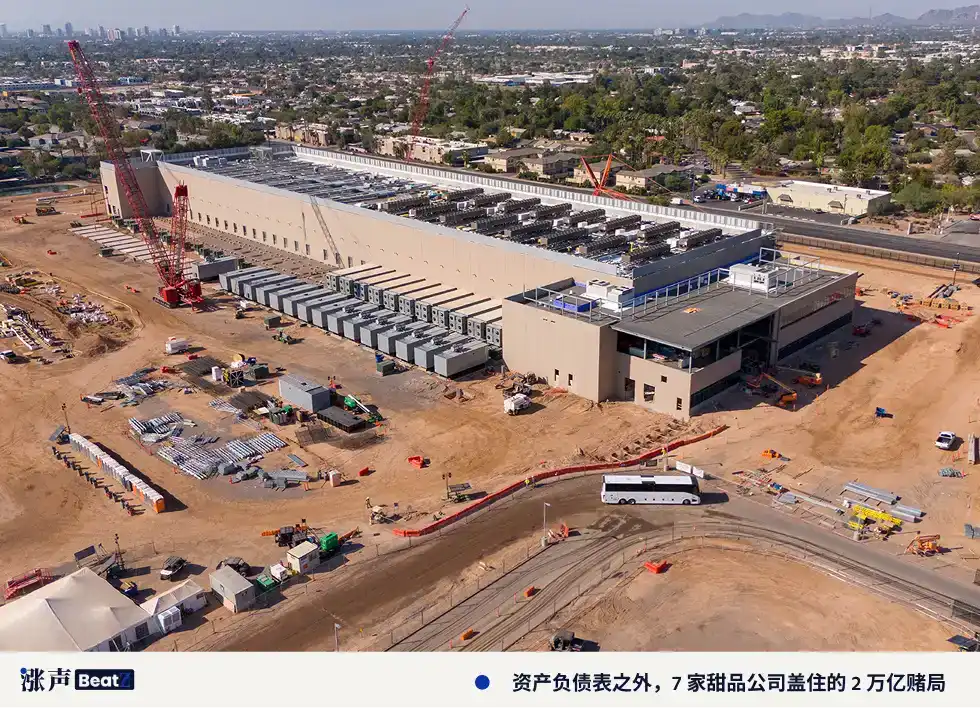
One month after Beignet companies emerged, Meta constructed a data center in Louisiana named Hyperion, spanning an area equivalent to four Central Parks in New York.
To build this massive facility, Meta secured $27.3 billion in financing.
Yet if you meticulously review Meta’s financial statements, you’ll find that only $2.37 billion of related records appear on its balance sheet—this project's entire investment disclosure.
The remaining $20+ billion in debt has vanished.
This is not an isolated case.
On July 22, Japan’s Nikkei published a report revealing that U.S. tech giants have hidden up to $1.65 trillion in debt beyond public view—exceeding their total reported liabilities of $1.35 trillion on balance sheets.
We reviewed all filings submitted by these five companies to the U.S. Securities and Exchange Commission (SEC), and found the actual scale exceeds even that report.
On July 23—the day after the Nikkei article was released—Alphabet, Google’s parent company, filed its latest quarterly report. Its procurement commitments surged from $33.24 billion three months prior to $81.1 billion, up from $6.21 billion a year earlier.
Within a year, it grew thirteenfold—pushing the Nikkei’s figure from $1.65 trillion to $2.13 trillion.
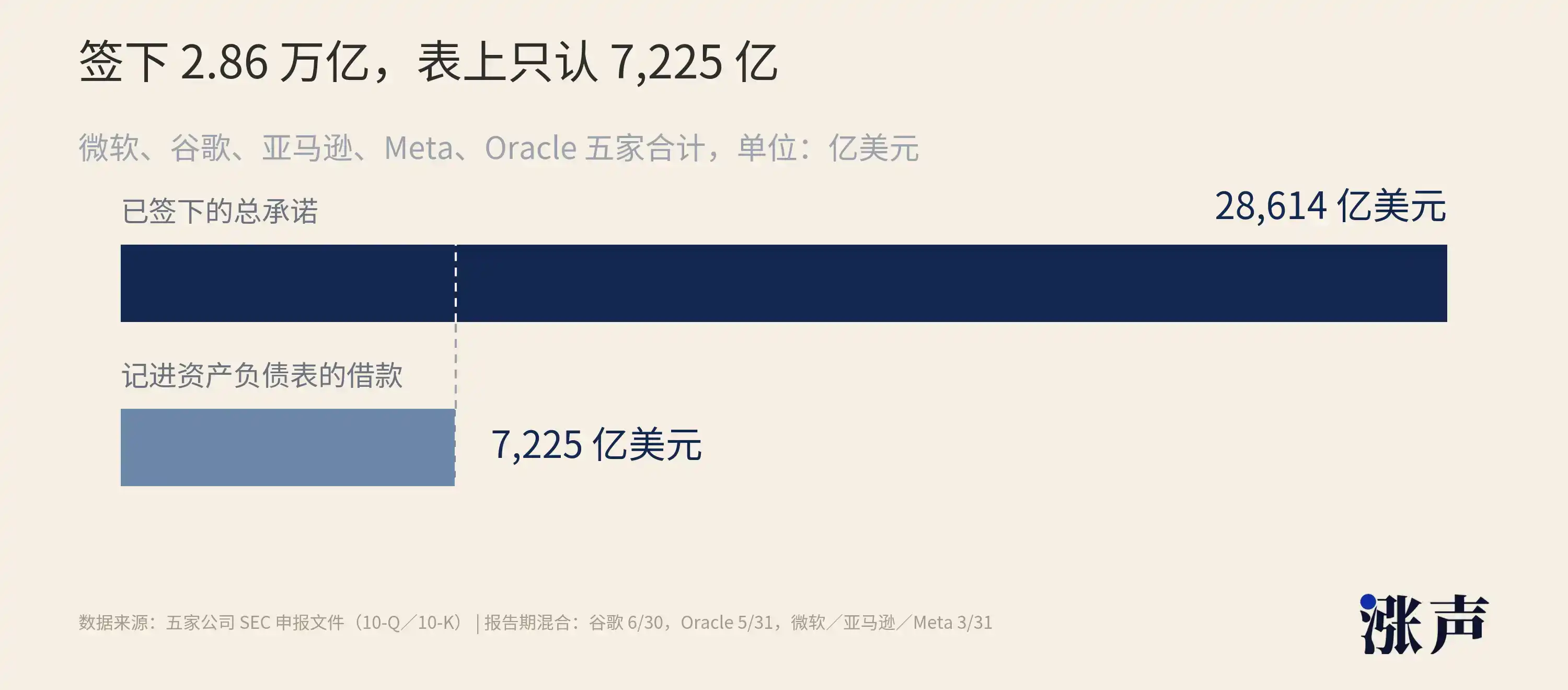
Over the past year, the five tech firms—Microsoft, Google, Amazon, Meta, and Oracle—have generated debt totaling $1.55 trillion in data center investments, up from $71.08 billion a year ago. Including GPU hardware procurement and construction contracts, the figure rose from $10.2 trillion to $28.6 trillion—an increase nearly doubling within one year.
Only one-quarter of this total appears on their official balance sheets. A staggering $2.13 trillion in “data center debt” has effectively disappeared from corporate ledgers.
Where did this debt go?
The Bank for International Settlements (BIS) has already taken note. In its Q1 2026 report, it coined the term Shadow Borrowing to describe such arrangements. The report notes these structures are economically indistinguishable from debt but largely remain off-balance-sheet.
In its subsequent annual report three months later, the BIS unusually ranked AI bubbles and circular financing alongside sovereign debt as primary risks to the global financial system.
After reviewing filings across the five companies, at least five distinct mechanisms emerge: SPVs, credit-enhanced derivatives, lease financing, residual value guarantees, and unleased lease agreements.
And those enabling these shadow debts are turning this practice into a new financial business model.
Tech Giants’ Collective Return to Poverty
For two decades, tech giants have been the most comfortable class of corporations in U.S. capital markets. They generate profits, hold cash reserves, and actively repurchase their own shares.
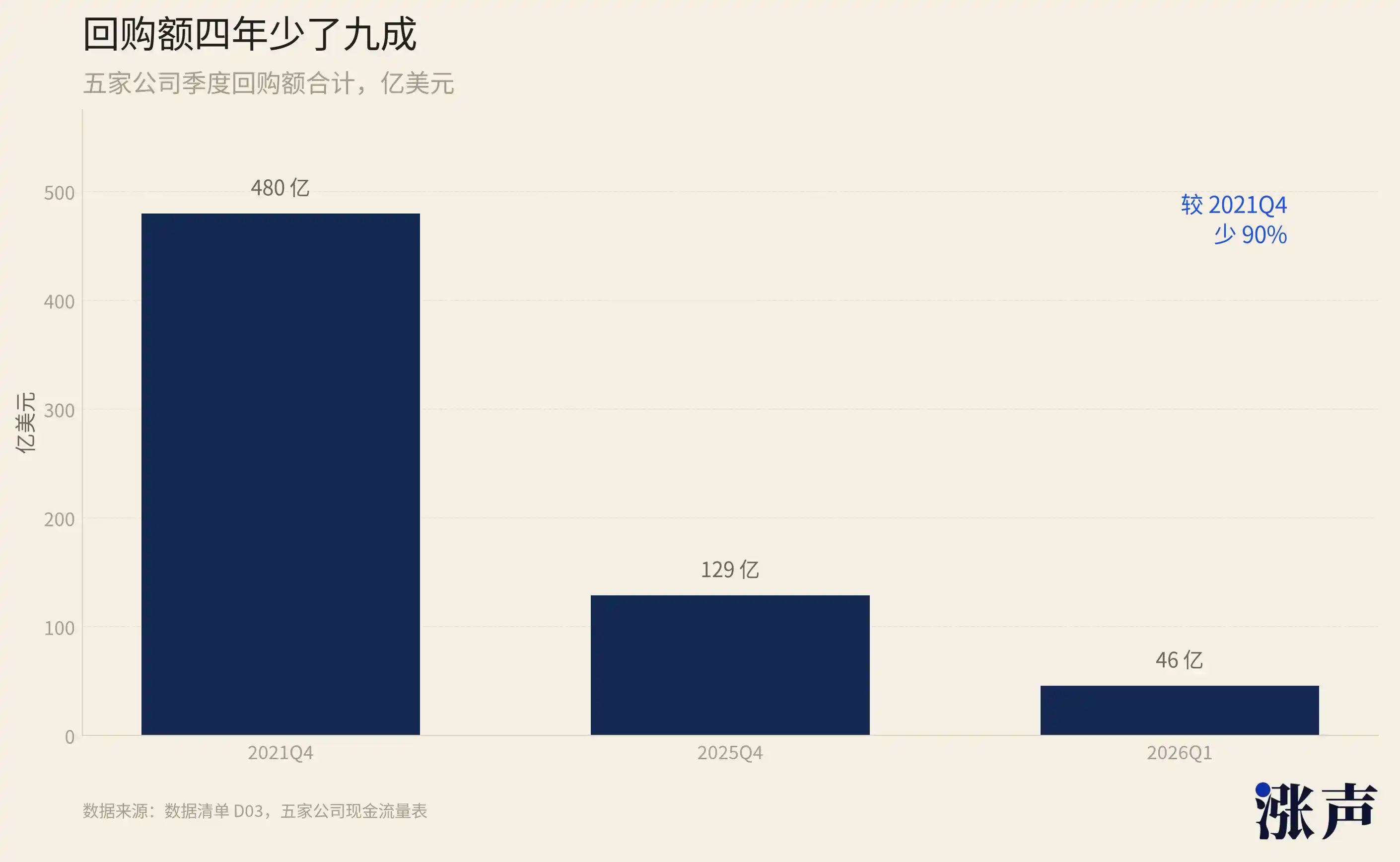
In Q4 2021, the five companies—Microsoft, Google, Amazon, Meta, and Oracle—repurchased $48 billion in stock, with Meta alone spending $20 billion. With such vast liquidity, shareholders never worried about funding shortfalls.
But in Q1 2026, their combined buyback volume plummeted to just $4.6 billion.
Over the past two years, capital expenditures linked to AI have increased by over 1.5 times, while operating cash flow growth has reached less than 60%. At this pace, by mid-2027, tech giants will collectively return to deficit status—re-entering a period of sustained losses.
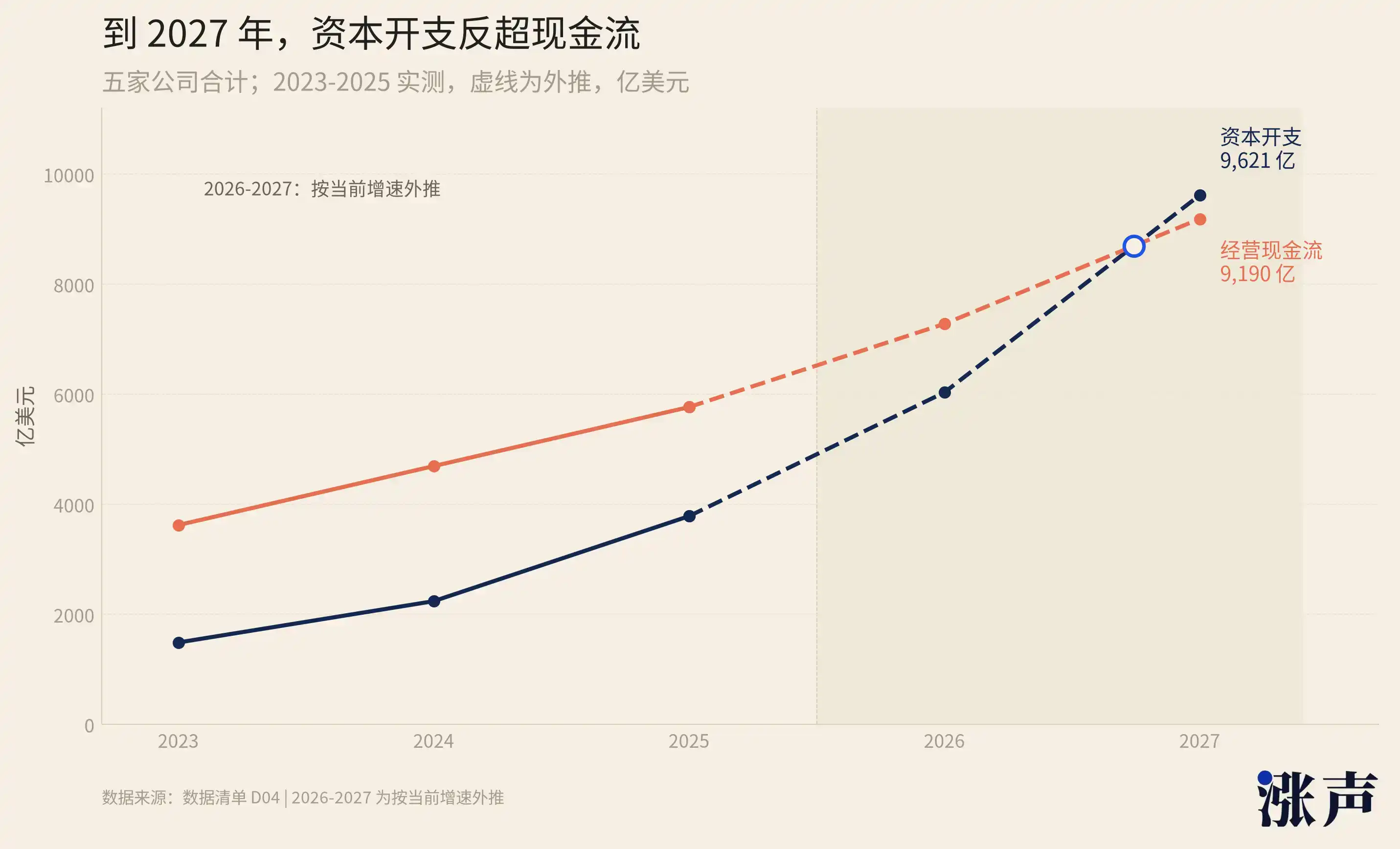
Morgan Stanley estimates that by 2028, tech firms will spend approximately $2.9 trillion on AI, yet can internally generate only around $1.4 trillion. The gap of $1.5 trillion must be sourced externally from operating cash flows.
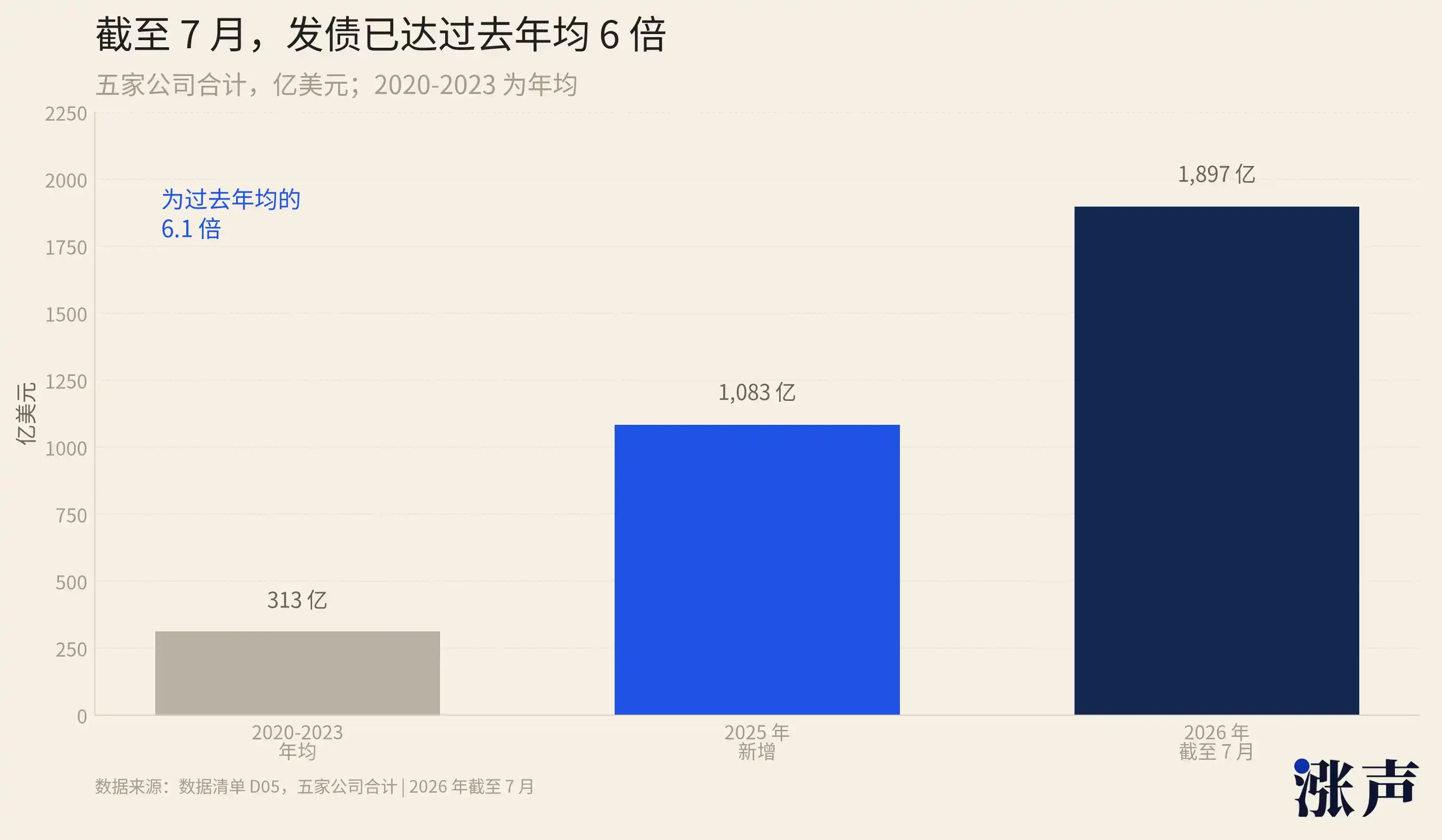
Thus, they began borrowing. From 2020 to 2023, the five firms averaged $31.3 billion in annual bond issuance. By July 2026, that figure had soared to $189.7 billion—six times the historical average.
Massive corporate bond issuance is already overwhelming markets. Over the past nine months, Amazon’s bond oversubscription ratio has declined sharply—from 5.3x in November 2025 to just 1.6x by July 2026.
Bond pricing has also worsened. This year, the average investment-grade bond market required only an additional 4 basis points to sell new issues. But Amazon’s July offering demanded 18–21 basis points before closing.
Google and Oracle went further—raising funds via equity dilution, raising nearly $80 billion, then launching a $60 billion ATM (At-the-Market) equity program.
Finance media collectively complain that tech giants have broken the unwritten covenant with investors. Previously, buying these stocks implied acquiring net-cash positions, low leverage, and consistent share buybacks. Now, they’re issuing large-scale debt and halting buybacks.
But the real trouble lies on the balance sheets.
The more debt listed, the more cautious rating agencies become, reducing investor demand. Oracle was the first to hit this wall. Its capital expenditure jumped from $21.2 billion to $55.7 billion within a year. In July 2026, S&P downgraded Oracle from BBB to BBB−—just one notch above junk status. If downgraded again, global insurers and pension funds would be forced by regulation to divest Oracle bonds.
So these giants don’t just need more money—they need stealthier, longer-term, and lower-accountability capital. And such capital simply doesn’t exist in public markets.
When SaaS Fails, Wall Street Seeks New Opportunities
As tech firms scramble for capital, another corner of Wall Street is seeking exit routes.
During H1 2026, a fund managed by Blue Owl faced redemption requests approaching 40% in two consecutive quarters, with actual payouts barely exceeding 10%. The company’s stock price dropped from $24 to $9.
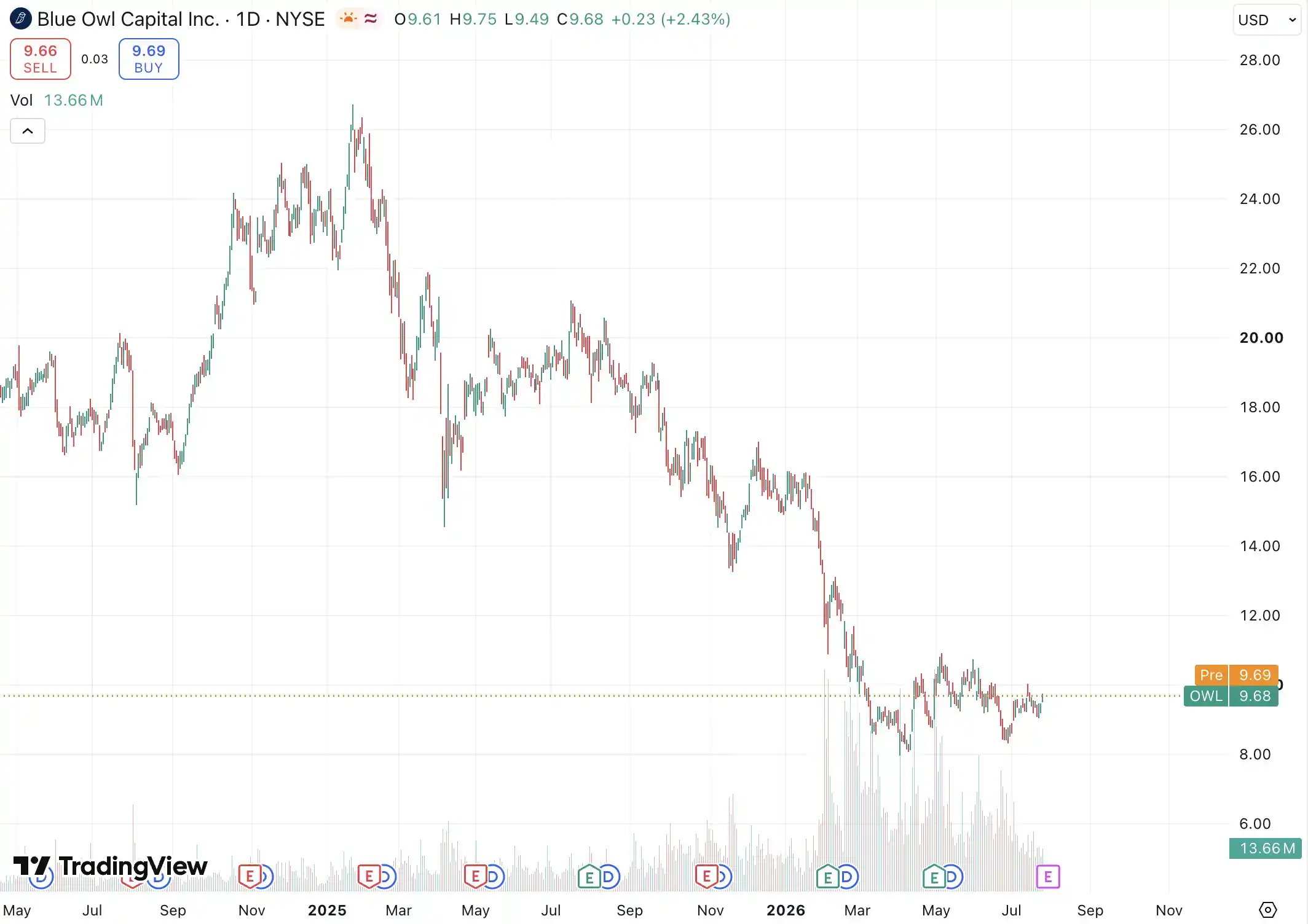
Blue Owl is one of the world’s largest private credit managers, overseeing over $31 billion in assets. The troubled fund specializes in software lending, where software loans account for over 60% of its portfolio.
Yet in 2026, Wall Street was unwilling to retain software loans.
Since the October 2025 peak, software stocks have fallen nearly 40%. Market consensus is simple: AI will kill software. Historically, high valuations stemmed from predictable customer renewals—revenue seen as perpetually growing under long-term contracts. Now, renewal certainty has evaporated.
Yet fundamentally, software companies aren’t performing poorly. Microsoft 365 subscription revenue growth rose from 15% to 19%. ServiceNow, Salesforce, Snowflake—all saw accelerating revenue growth across five consecutive quarters. Gartner has even upgraded its forecast for global software spending.
But in finance, confidence often outweighs fundamentals.
In its shareholder letter, Blue Owl admitted that concerns over AI’s impact on software firms have significantly altered investor perceptions of software credit exposure.
Wall Street urgently needs a new narrative to re-attract investors. That story is data centers.
Software loans bet on whether customers will renew next year. Data center loans bet on whether AI firms will need compute power. The former question grows increasingly uncertain; the latter seems almost guaranteed. The stronger AI becomes, the more valuable data centers grow.
Data center lending is now Wall Street’s hottest business. In December 2025, Blue Owl rejected Oracle’s Michigan data center project due to non-compliance with underwriting standards. But soon after, Pacific Investment Management Company (PIMCO) acquired the deal at a higher price. Such competitive takeovers occur nearly every month on Wall Street.
On one side, tech giants lacking sufficient capital. On the other, asset managers with excess capital and nowhere to deploy it. Thus, they converged.
Their first major project? Beignet—the sweet treat mentioned earlier.
How Meta Concealed $28 Billion in Debt Through a Dessert
The Hyperion hyperscale data center in Louisiana—co-developed by Meta—is registered under Laidley LLC. The campus is operated by it, and it signed a 15-year power supply contract with the local utility.
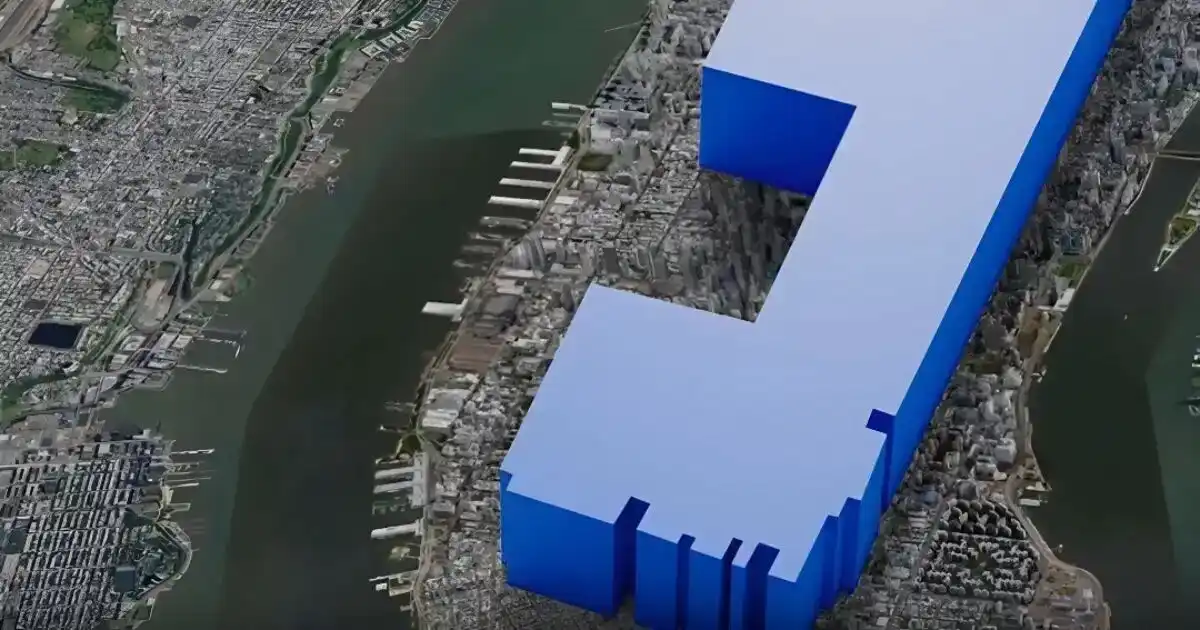
Hyperion’s footprint compared to Manhattan, source: Bloomberg
Laidley is part of Project Beignet Holdings, a joint venture. The data center’s ownership resides here.
The joint venture’s major shareholder is Beignet Investor. The $27.3 billion in bonds were issued through it.
The debt isn’t placed on the entity owning the data center—it’s placed on its shareholder.
Further up the chain is Beignet Pledgor. In legal terms, a pledgor is a party providing collateral. It fully owns Beignet Investor and pledges all its equity to a trustee.
This gives creditors a straightforward security interest. In default, the trustee need not evaluate, sell, or litigate over a data center in Louisiana. Instead, they execute the pledge—transferring equity. The campus continues operations, leases persist, and rent collection merely shifts hands.
Beignet Pledgor is backed by four other entities, one being Beignet Net Lease Aggregator. At the top sits OSNL, a net lease real estate trust managed by Blue Owl, along with its co-investors.
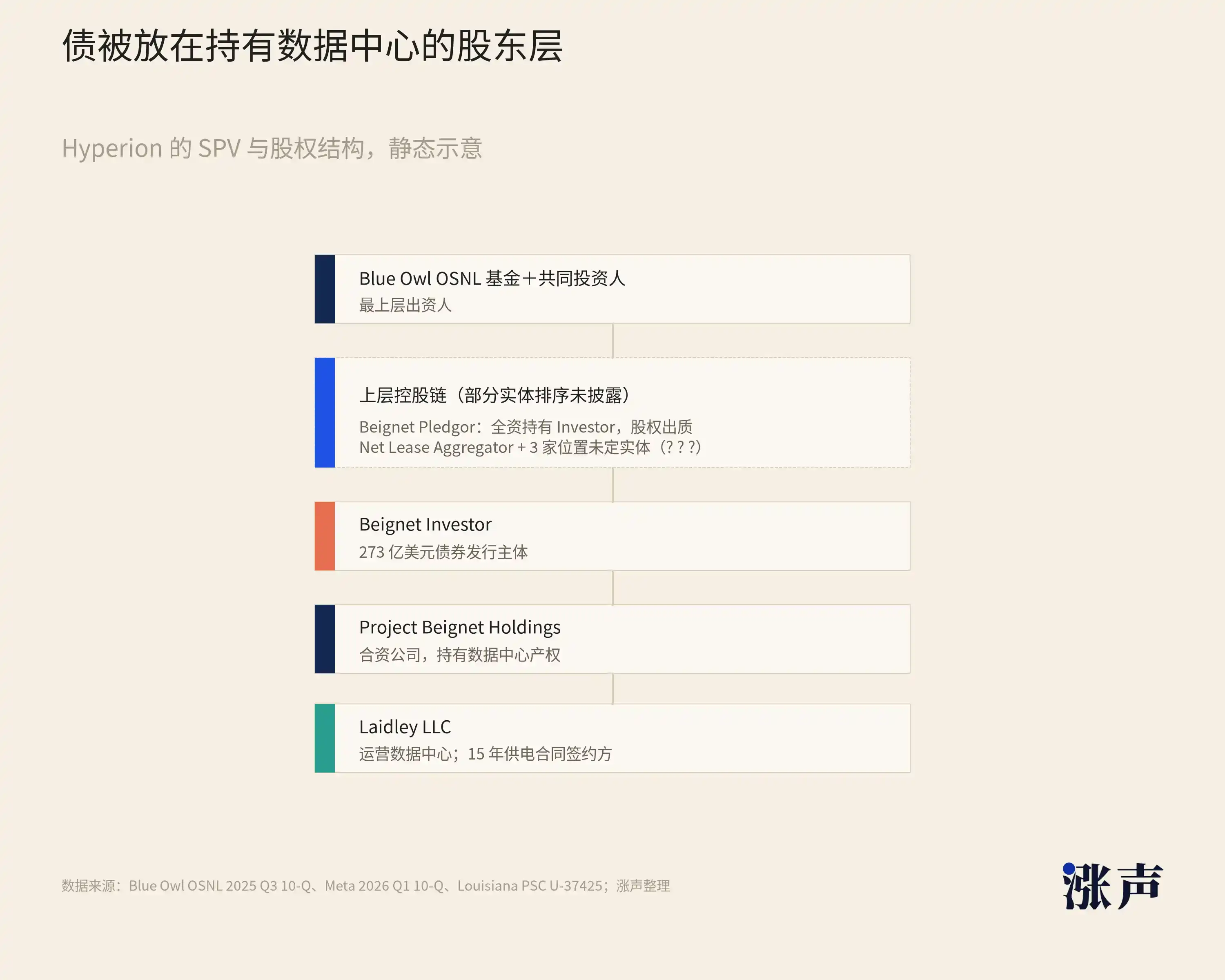
All seven companies are registered in Delaware, where limited liability companies need not disclose members or capital contributions.
The $27.3 billion in debt was not publicly offered. It was issued via Rule 144A, sold exclusively to qualified institutional buyers, without filing a public prospectus. To access terms, investors must sign a confidentiality agreement. It remains a permanent 144A issue—never converting to a registered public bond.
In the SEC’s full-text search system, searching “Beignet” yields only one narrative reference: a post-period footnote in Blue Owl’s quarterly report. By the annual report, it disappears alongside “Meta” and the project’s county name—replaced by a single line: “Net Lease Data Centers” in aggregate.
This is already dizzying—but it’s only legal isolation.
SPVs are not novel. They’ve been used in real estate and infrastructure for decades. Accounting standards anticipate such maneuvers and impose two key thresholds: whether an entity should consolidate into the parent’s financial statements depends not only on ownership stakes but also on who controls critical operations, bears the majority of losses, and captures most of the gains.
Meta is the sole tenant of Hyperion, pays for it, provides credit support, and manages construction and property operations. By this standard, the debt should be consolidated onto Meta’s balance sheet.
Yet Meta retains only 20%.
Blue Owl’s OSNL fund and its co-investor hold 100% of Beignet Investor through Beignet Pledgor and four other holding companies. Beignet Investor then holds 80% of the joint venture. Meta owns the remaining 20%.
Eighty and twenty—two numbers recurring throughout this narrative.
Meta’s financial statement asserts that it lacks control over key activities affecting the joint venture’s performance, thus is not the primary beneficiary and does not require consolidation. Since the joint venture isn’t included in Meta’s books, the $27.3 billion debt naturally stays off.
The debt hasn’t vanished—it’s merely relocated.
From Mortgages to Leases: Silicon Valley’s Art of Debt Repayment
The debt isn’t on Meta’s balance sheet, but that doesn’t mean Meta isn’t paying.
Meta operates a leasing subsidiary called Pelican Leap. It signed a four-year lease with Laidley. Starting in 2029, Pelican Leap pays rent monthly to Laidley. Funds flow from Laidley to the joint venture, then to Beignet Investor, ultimately servicing bond principal and interest.
After a long circuit, the rent still comes directly from Meta’s pocket.
The $27.3 billion bond carries a coupon of 6.581%, maturing in May 2049, structured with full amortization. Unlike traditional corporate bonds, which repay principal in a lump sum in 2049, this structure gradually repays principal over 24 years—one installment at a time.
It resembles a mortgage.
Meta’s initial four years of rental payments total $12.3 billion—averaging $3.08 billion annually. This covers annual principal and interest payments exactly, with the extra 12% allocated to equity investors.
The drama begins at lease inception.
The bond matures in 24 years. The initial lease is only four years. Starting in 2029, it includes renewal options extending up to 20 years. By 2033, Meta could theoretically opt out and leave.
What happens to the remaining $20+ billion?
The answer lies on another page of the lease. Beyond monthly rent, Meta provides a residual value guarantee capped at approximately $28 billion—slightly above the debt amount—with the cap declining over time. If Meta doesn’t renew, it must cover any shortfall between the site’s value and this threshold.
Placing $28 billion alongside $27.3 billion makes the link impossible to ignore.
Thus, the bond’s true backing is neither the building nor the equipment inside.
It relies on Meta’s creditworthiness.
This explains the rating: S&P assigned the bond an A+ rating—down from Meta’s own AA−. The rating agency didn’t value it based on an unoperational facility but adjusted Meta’s credit rating downward by one notch.
Meta provides capital, credit, operations, and is the sole tenant—yet in its financials, it claims it is not the primary beneficiary.
This clean balance sheet isn’t free. If Meta issued comparable debt publicly, its cost would be ~5.5%. Through this structure, it rises to 6.581%. For the same capital, Meta pays nearly $300 million more in interest annually.
Investors willing to pay such a premium clearly aren’t buying a building.
In July 2026, a second similar project emerged—Sopaipilla, another deep-fried pastry from the American Southwest. Located in El Paso, Texas, it raised $12 billion, also structured 80/20—but with BlackRock replacing Blue Owl as the 80% holder.
Meta once internally named its next-generation large models “Avocado” and “Mango.” Financial naming, however, clearly has greater appetite.
Meta’s structure is the most sophisticated—but not the only one.
Microsoft avoids shell entities and doesn’t show significant debt increases. Over the past two years, its total debt fell from $44.9 billion to $40.3 billion. Yet during the same period, its lease financing liabilities surged from $27.1 billion to $62.9 billion—more than doubling, exceeding total debt by over $200 billion.
Those $62.9 billion appear on Microsoft’s balance sheet—but not under “Debt.” Instead, they’re split into “Other Current Liabilities” and “Other Long-Term Liabilities.” From the most visible line, it looks quiet.
Lease financing is straightforward: nominally a lease, practically an installment purchase. When the lease term covers most of the asset’s useful life, accounting treats it as a purchase—just paid in installments. Thus, it must be fully recognized as debt—but not reported under the “Debt” line.
Google uses no shell. It provides payment guarantees for others’ data centers, enabling them to secure loans. In its financials, it notes: “In case of default, Google retains the right to assume the underlying lease.”
Such guarantees are recorded as credit derivatives. Their nominal size rose from $16.9 billion to $43.8 billion in six months. Only $815 million—less than 2% of nominal value—was actually recognized on the balance sheet.
Amazon appears most direct. In March 2026, it issued over $50 billion in bonds to self-fund construction. It also holds $106.3 billion in leases—same as Oracle—still unconsolidated on its balance sheet.
Oracle’s approach is simpler: it signs contracts. Nearly all $260 billion in leases relate to data centers, with terms spanning 15 to 19 years, beginning lease payments only in FY2027. Until then, these obligations won’t appear on the balance sheet.
Meta uses joint ventures. Microsoft uses lease financing. Google offers credit guarantees. Amazon and Oracle pre-sign leases.
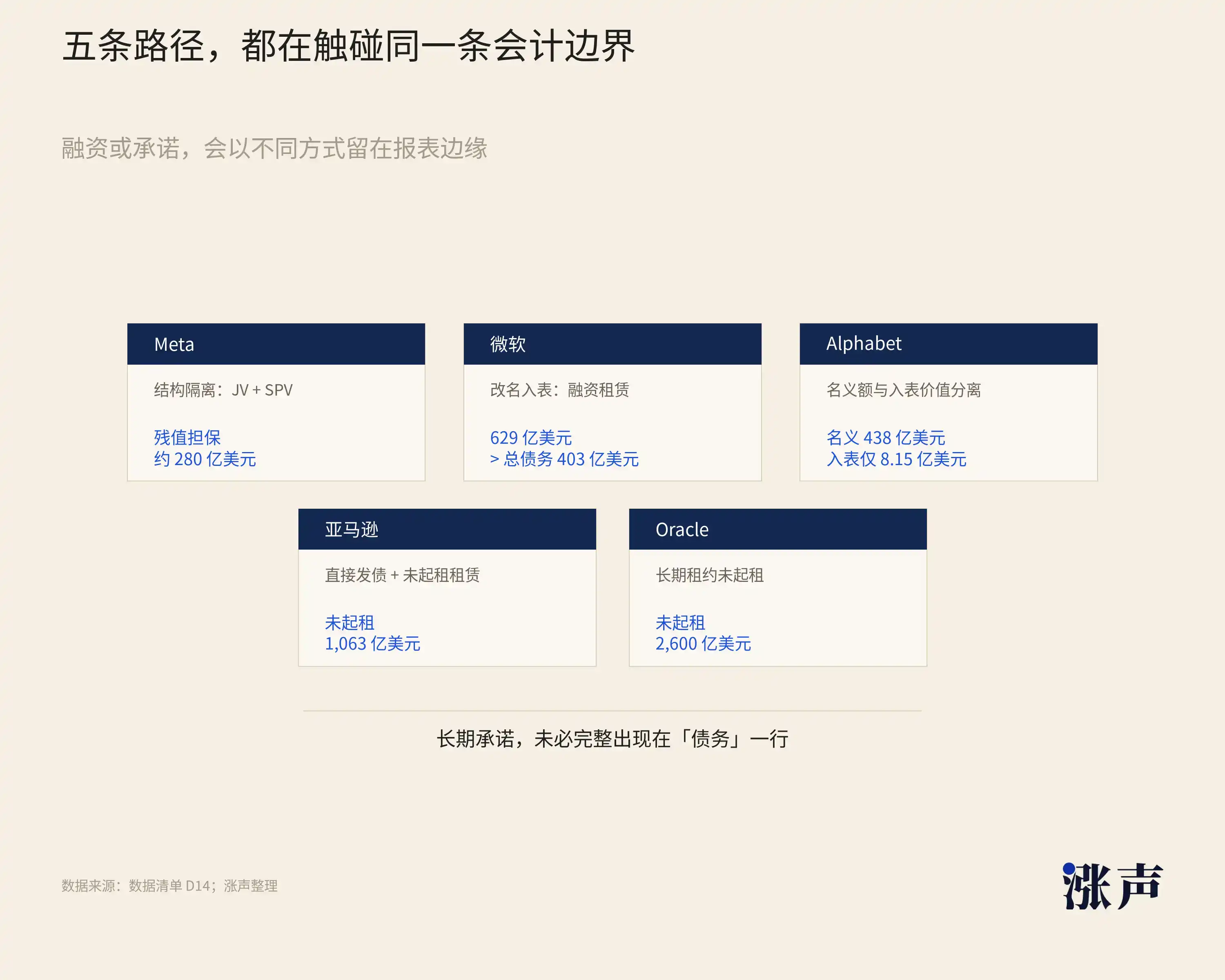
Different paths, same destination.
If we roughly categorize future corporate outflows into three layers, the dividing line becomes clear. First layer: funds already borrowed—bonds, notes, loans—money received, debt recorded. Second layer: liabilities arising after goods/services are delivered or assets are used—includes rent already paid. Third layer: contractual commitments with services/assets not yet delivered or operational—typically disclosed in footnotes.
The boundary between second and third layers defines the balance sheet edge.
Accounting doesn’t ask whether you intend to repay. It asks whether you’ve received value. Once you receive cash, goods, or usable facilities, the obligation must be recorded. Until delivery, the liability can remain off-balance-sheet.
This clarifies everything: don’t buy buildings. Sign leases. Don’t start leases today—wait years.
Leasing also varies in depth. Finance leases appear on the balance sheet—though buried under “other liabilities,” as Microsoft’s $62.9 billion. Operating leases appear too—but only a small portion of present value of rent, as Meta’s leases. Unleased leases record nothing—Amazon’s $106.3 billion and Oracle’s $260 billion sit farthest out.
Building data centers is slowly being rewritten as leasing them.
Aggregating the five firms’ figures: $44.58 billion already raised. $83.1 billion in signed but unrecorded leases—nearly double. Adding procurement and construction commitments, the total reaches $2.13 trillion.
This is what the original $20+ billion debt looked like after amplification.
Wall Street Saw Data Center Potential Five Years Ago
If the story ended here, it might be mistaken as a novel invention born from the AI boom.
It is not.
Fast forward to 2021: global data center M&A volume hit $49 billion—a record at the time. In 2022, it stood at $48 billion, with 91% of the $187 deals funded by private capital. Of the twelve largest transactions, ten were acquired by private equity.
Blackstone bought data center operator QTS for ~$10 billion. KKR and GIP acquired CyrusOne for $15 billion. DigitalBridge and IFM purchased Switch for $11 billion. Average deal size grew from $80 million in 2018 to $235 million in 2022.
They weren’t buying servers.
They were buying land. Buildings. Power connections.
With rate hikes in 2023, global data center M&A dropped to $26 billion. But in 2024, it surged to $73 billion—surpassing all prior records. In 2025, it set a new high. From early 2024 to now, 575 transactions totaling $151 billion—84% financed by private capital.
Because tenants are strong, contracts are long.
Data centers are capital-intensive. Hosts often cannot build alone and seek partners. But occupants are top-tier cloud giants with decade-long contracts. For infrastructure funds, pensions, and sovereign wealth funds seeking stable returns, this isn’t a tech play—it’s a ready-to-rent, electrified building.
Even Hyperion’s ownership structure had been used before.
In December 2023, Blackstone and Digital Realty formed a $7 billion development JV—Blackstone held 80%, Digital Realty retained 20%. In October 2024, Equinix partnered with Singapore’s GIC and Canada’s CPP to form a $15+ billion JV—Equinix kept 25%.
Blackstone’s 80% and Digital Realty’s 20% mirror Blue Owl’s 80% and Meta’s 20%—no change.
The structure was already in place before AI. Assets existed. Long-term tenants existed. Even the ownership split was established. Only one thing remained: who would fund the ever-larger capital requirement?
Rationally, it should be banks.
But banks stepped back in 2023. After Silicon Valley Bank’s collapse, U.S. regulators unveiled the final version of Basel III capital rules in July. Banks must now allocate more internal capital for long-term, large-scale, highly customized loans.
Data center projects fit all three criteria: long, large, non-standard.
Banks began deleveraging, and private capital stepped in. These funds are backed by insurance, annuities, and pensions—whose capital horizons align with 20-year leases.
This transition was crucial for private credit. Over the past decade, its dominant theme was software: software lending grew from under $8 billion in 2015 to over $50 billion by end-2025—19% of all direct lending. AI-related lending expanded from near zero to over $20 billion—rising from less than 1% to nearly 8% in recent years.
The proportion of private credit funds investing in AI-related sectors rose from 5% a decade ago to 20%. By transaction count, AI-related deals now make up 34%—up from 17% average in the previous five years. Rule 144A private placements in data centers were virtually nonexistent by end-2025—now exceeding $40 billion. Over the next three years, AI infrastructure is expected to draw $80 billion from private credit.
Software took ten years to build its scale. AI aims to catch up in under three.
But whether private capital can maintain this position remains uncertain. In March 2026, Basel III Final Rules were substantially relaxed. Risk weights for corporate loans were reduced, restoring private fund capital requirements from four times the draft level to baseline. Regulators estimate this will release over $1 trillion in new lending capacity for banks. JPMorgan has already earmarked $50 billion in direct lending lines.
Banks are preparing to return.
Subprime in the Age of AI?
Today, the market dubs these shadow loans “subprime for the AI era.”
Before the 2008 crisis, everyone assumed housing prices would keep rising. Today, people hold two “defaults”: first, that data centers will be completed on schedule. The IMF estimates 60% of planned data centers haven’t broken ground—yet their debt has already been sold. Hyperion is scheduled for completion in 2029. Oracle’s $260 billion lease starts in FY2027. Sopaipilla’s campus targets 2028 operation.
Second, that the machines inside will retain value after construction.
The Hyperion bond runs until 2049—24 years. GPUs typically depreciate over 5–6 years per tech company accounting. Short-sellers argue real lifespan is only two to three years. Used H100s fetch only 45% of new prices by Year 3.
The market is already pricing this uncertainty. The cost of buying credit default swaps (CDS) reflects perceived default risk. Oracle’s CDS spiked above the 2008 crisis peak in March 2026—and hit a new record four months later.
Current valuations bet not on a building already generating rent, but on a series of events yet to happen: timely construction, reliable power delivery, sustained compute demand, machines lasting through 24 years of repayment, and tenants renewing leases...
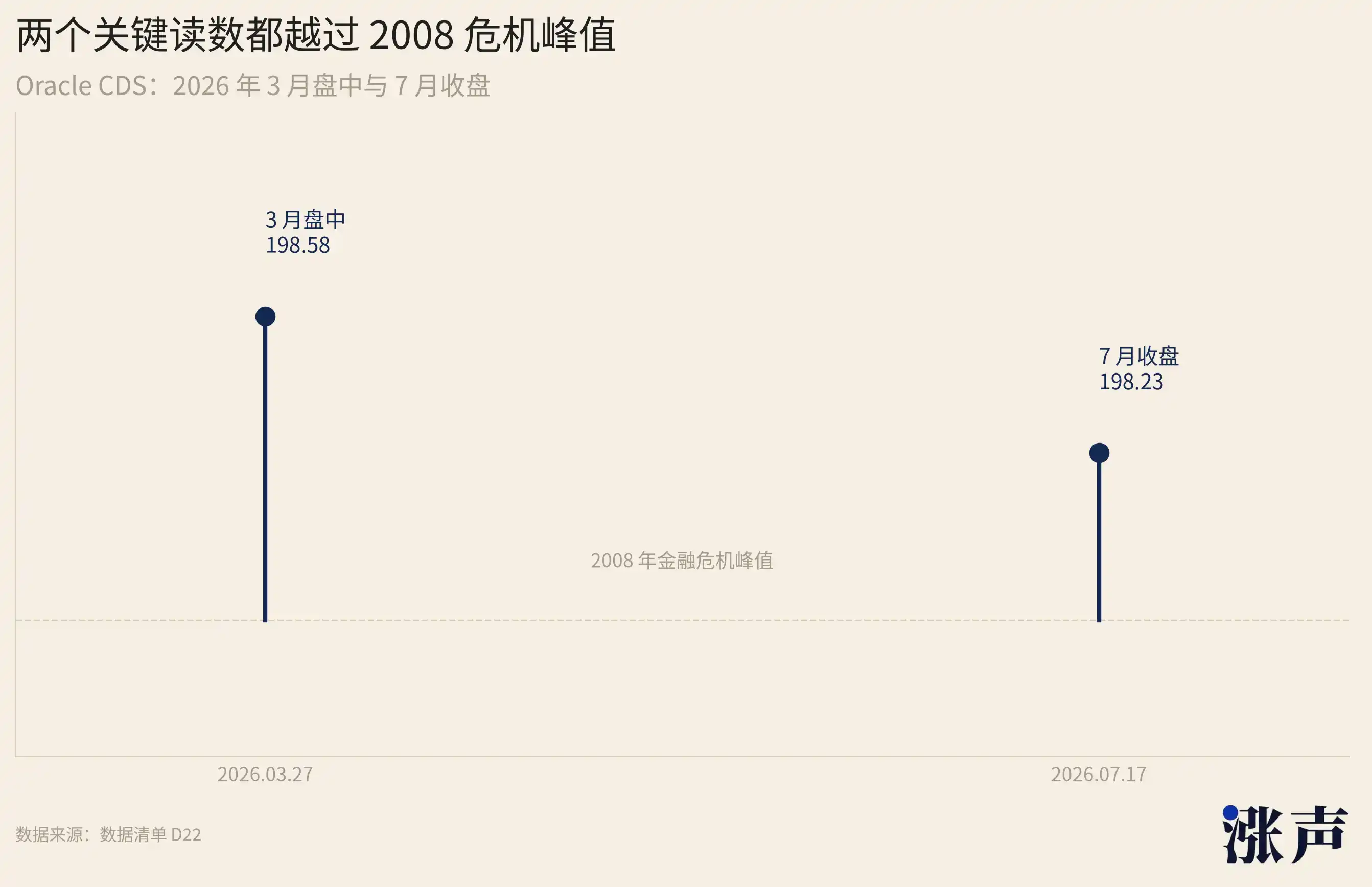
Funds themselves are increasing leverage. In Q2 2026, investors requested $15.6 billion in redemptions—only $5.9 billion redeemed. That quarter, Apollo, BlackRock, Ares, and Blue Owl all raised new debt.
Old investors can’t exit—but funds keep borrowing fresh capital.
However, in the subprime crisis, borrowers unable to repay mortgages were ordinary households. Today, borrowers are globally credit-rated top-tier corporations. So, can they uphold their credit and commitments?
Source: BlockBeats
Disclaimer: Contains third-party opinions, does not constitute financial advice


AI drives SK Chairman's divorce settlement bill to KRW 94.4 billion
4 days ago
AI is no longer competing on benchmark scores, but on profitability
4 days ago
NVIDIA Exposed to Spend $10 Billion on Underground Fiber Optic Cables
4 days ago
30 Million KRW Threshold, AI Chip Leverage Cooling Down
5 days ago
$13.7 Billion Prediction Market: Are Retail Investors Making Way for AI?
5 days ago
Will Google Cut AI Spending First? Markets Panic the Night Before Earnings Release
7 days ago
$230 Mini Hardware Just Released, OpenAI Sued by Apple Immediately
13 days ago


