$12.2 Billion on the Balance Sheet, Zhongji Xuchuang Raises $53.4 Billion in Hong Kong IPO
$12.2 Billion on the Balance Sheet, Zhongji Xuchuang Raises $53.4 Billion in Hong Kong IPO

2026-07-29 22:01
Introduction: NVIDIA and North American cloud providers continue to ramp up capital expenditures, with optical module upgrades accelerating to 1.6T/3.2T—market window is rarer than cash
Over the past month, the A-share AI supply chain has experienced a clear correction.
From optical modules and PCBs to storage and AI servers, nearly the entire AI hardware sector has seen broad pullbacks. Markets are once again revisiting familiar concerns amid panic-driven sell-offs: How much longer can North American cloud providers sustain their capital expenditure? Is AI infrastructure already overextending future growth? Is this two-year-plus AI bull run nearing its end?
As sentiment toward the AI supply chain turns cautious, China’s leading optical module player, Zhongji Xuchuang, is set to list on the Hong Kong stock exchange shortly, raising HKD 53.41 billion, making it the largest IPO in Hong Kong history since Alibaba’s listing seven years ago.
At first glance, A+H share listings for fundraising have become commonplace in recent years. Yet what’s noteworthy is that Zhongji Xuchuang is not a company in need of capital.
Over the past two years, the AI compute investment boom has fueled the rise of China’s “Three Giants” in domestic optical modules—Yi Zhong Tian—driving surging demand that propelled Zhongji Xuchuang’s performance to record highs. Cash flow has continuously improved, and the balance sheet remains robust. Given this financial strength, why would Zhongji Xuchuang pursue such a massive fundraising effort in Hong Kong?
For Zhongji Xuchuang, proactive preparation is essential for long-term resilience. While cash may not be the immediate constraint, the window of opportunity in capital markets vanishes swiftly—time waits for no one.
Not short on cash, but unwilling to miss the funding window
If GPUs are the brain of AI compute, then optical modules are the neural vasculature—responsible for converting data between electrical and optical signals. As the world’s largest optical module manufacturer, Zhongji Xuchuang has genuinely benefited from the capital expenditure surge driven by the AI wave, reaping substantial profits.
From 2023 to 2025, revenue grew from RMB 10.718 billion to RMB 38.24 billion, achieving a CAGR of approximately 89%; net profit attributable to shareholders rose from RMB 5.17 billion to RMB 10.797 billion, with a CAGR of about 44.3%.
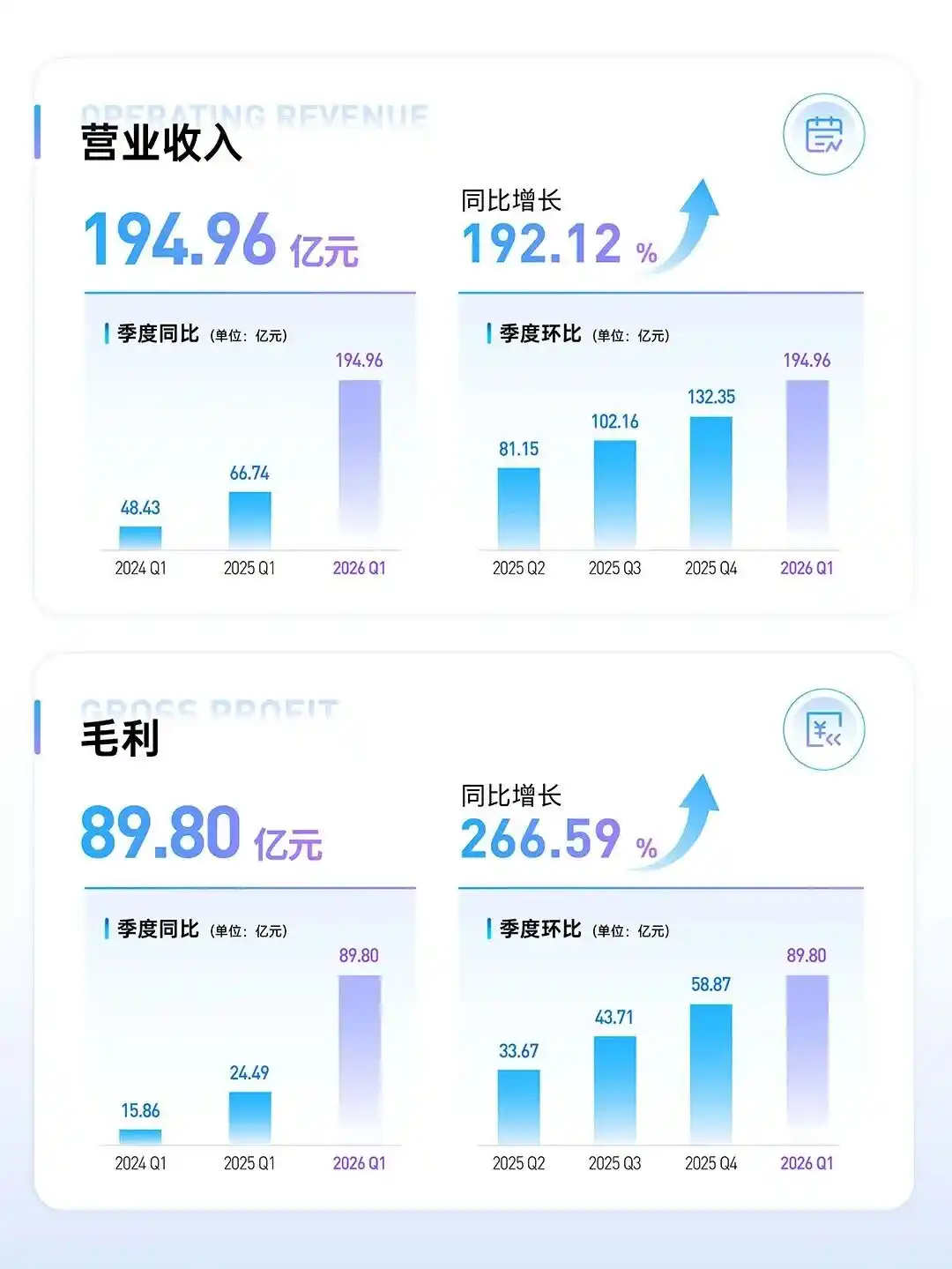
In Q1 alone this year, Zhongji Xuchuang’s net profit attributable to shareholders reached RMB 5.735 billion—exceeding half of last year’s total. Gross margin also hit a new high, at 46.06%, placing it among the top-tier performers in the manufacturing sector.
Exponential earnings growth has generated abundant cash flow. In 2025, operating cash flow netted RMB 10.9 billion; in Q1 2026, it reached RMB 3.368 billion, up 55.58% YoY. As of Q1 2026, the company held RMB 12.176 billion in cash and cash equivalents.
What does RMB 12.176 billion in cash and cash equivalents mean? It equates to roughly 112.8% of the company’s full-year 2025 net profit—indicating that the company’s cash reserves now exceed its annual net profit. Generally, a cash-to-net-profit ratio of 60%-80% is considered stable for most enterprises.
Yet despite this strong liquidity, Zhongji Xuchuang still plans a massive fundraising on the Hong Kong market. For public companies, the real determinant of financing cost isn’t bank loan interest rates—it’s the valuation premium the market is willing to assign.
A senior secondary market analyst told Node Finance: “When industry sentiment is high and investor risk appetite is strong, firms can raise more long-term capital with less equity dilution. But once market pricing resets, even if fundamentals remain unchanged, financing costs can spike rapidly. Truly mature companies rarely wait until they’re cash-strapped before raising funds.”
Take an example: Under identical net profit of RMB 10 billion, if the market assigns a P/E ratio of just 10x, the company’s market cap is RMB 100 billion—financing RMB 10 billion requires only 1% equity issuance. But if the market offers a 100x P/E, the valuation skyrockets to RMB 1 trillion, allowing the same RMB 10 billion raise with just 0.1% equity dilution.
When Zhongji Xuchuang launched its Hong Kong IPO, global AI infrastructure investment remained in an expansionary phase. To capital markets, AI infrastructure remains one of the easiest sectors to command valuation premiums.
But such windows don’t last forever. Once market confidence wavers on AI ROI, valuation models could undergo structural reconfiguration. By choosing to raise capital this year, Zhongji Xuchuang is not merely replenishing funds—it’s strategically capturing the current capital window.
Optical modules enter burn-mode era
Differing from the previous internet-era “light-asset” transformation, the AI industry now features increasingly heavy asset structures alongside technological breakthroughs. Arms race has become an unavoidable reality for global AI leaders.
Whether it’s building foundational compute infrastructure upstream or investing in downstream customization R&D, companies must maintain ample cash reserves. Optical modules, occupying a pivotal link in the value chain, are no exception.
Zhongji Xuchuang’s status as the world’s largest optical module vendor stems from its dominant market share in mainstream 800G high-speed modules, backed by large-scale production capacity, stable yield rates, and rapid delivery—enabling deep integration with two super-giants: Google and NVIDIA.

These capabilities have built a certain moat today—but do not guarantee perpetual dominance. The optical module space remains fiercely competitive, with rapid technological iteration.
Examining Zhongji Xuchuang’s product rollout timeline: 400G launched in 2018, 800G in 2020, 1.6T in 2023—roughly every two years marks a new generation. This means the advantages Zhongji Xuchuang enjoys today could be overturned within two to three years.
For optical module firms, the greatest risk isn’t declining demand—it’s falling behind during next-generation transitions. Once production timelines lag competitors, customer switching to alternative suppliers often happens faster than anticipated.
In its prospectus, Zhongji Xuchuang disclosed that 35% of proceeds will fund R&D, focusing on next-gen technologies like 1.6T, 3.2T optical modules, and CPO, NPO interconnect solutions. Meanwhile, around 30% of the raised capital will go toward expanding production capacity. Over the next three years, the company aims to add 50 million units of optical module output, with over 80% dedicated to 1.6T and above.
Given that Zhongji Xuchuang’s client base is predominantly overseas, securing additional offshore capital for global capacity deployment makes listing on Hong Kong the most efficient and practical path for most Chinese tech firms. Thus, Zhongji Xuchuang’s dual listing on Hong Kong is entirely logical.
It’s valuation, not logic, being slashed
Undeniably, global markets currently cast a dark shadow over AI-themed stocks. But fundamentally, the global AI industry continues advancing rapidly—the prevailing pessimism stems more from valuation pressures and shifting market risk appetite.
As of Q1, 81.9% of Zhongji Xuchuang’s revenue came from its top five clients. In other words, NVIDIA plus four major North American cloud providers account for the vast majority of its sales. Assessing the business health of upstream suppliers like Zhongji Xuchuang essentially reflects the capital expenditure rhythm of these AI giants. Capital flows where orders follow.
Currently, these five clients show no signs of slowing down their AI Capex pace. For FY2026: NVIDIA Capex reaches USD 6.1 billion, up 79% YoY; Amazon AWS Capex hits USD 200 billion, up 53%; Microsoft Capex at USD 190 billion, up 61%; Google Capex estimated at USD 180–190 billion, nearly doubling; Meta Capex at USD 125–145 billion, up 73%.

Regardless of how strongly these AI titans emphasize no cuts to AI Capex, the market remains unconvinced—prices keep falling.
An efficient market cannot sustain one-way upward momentum indefinitely. The past two years saw explosive gains across many AI stocks, already pricing in excessive future expectations. Even with continued fundamental execution, valuations struggle to justify further upside.
Previously, markets traded on AI demand surges. Now, they trade on AI return-on-investment—imposing stricter scrutiny on AI supply chain players. Combined with the Federal Reserve’s uncertain rate policy, global tech valuations are under pressure, and markets remain fearful of high-interest-rate environments eroding high-multiple businesses.
The recent downturn in global AI tech stocks has inevitably introduced emotional noise into Zhongji Xuchuang’s Hong Kong IPO process. On July 27, the final issue price was set at HKD 980/share—a 3% discount from the upper end of the IPO range (HKD 1,010), and a 21% discount versus the A-share closing price of RMB 1,077 on the same day.
The issuer intended to offer concessions to attract long-term foreign capital and Southbound funds, but instead triggered a sharp drop in the A-share price on July 28. The safety cushion provided by the Hong Kong discount was quickly erased by the A-share plunge.
Last night, Zhongji Xuchuang urgently announced a massive buyback plan—allocating RMB 4 to 8 billion for stock repurchases—offering a temporary lifeline. Today, the stock rebounded 4.74%.
In reality, the HKD 49,000 subscription price for Zhongji Xuchuang’s IPO presents a high barrier to entry. International allocation accounts for 90%, Hong Kong allocation 10%, with only 5.45 million shares reserved for retail investors. 33 cornerstone investors—including Temasek, BlackRock, Alibaba, Tencent—have locked in approximately 50% of shares, with a six-month lock-up period, ensuring limited short-term selling pressure.
Additionally, Zhongji Xuchuang benefits from a 15% full greenshoe stabilizing mechanism, making a significant first-day drop unlikely. The main uncertainty remains potential spillover effects from A-share price movements.
Ultimately, the market’s sensitivity toward AI stocks is extreme—but what’s adjusting is valuation, not the underlying industry logic. Unlike 2022 when the new energy sector entered a hyper-competitive phase, there’s no fundamental doubt about AI industry development.
What the AI industry is undergoing isn’t demand disappearance, but a restructuring of valuation frameworks. For truly core players in the ecosystem, market cooling may accelerate industry consolidation—only after the storm can true value be revealed.
Source: Node Finance
Disclaimer: Contains third-party opinions, does not constitute financial advice


AI drives SK Chairman's divorce settlement bill to KRW 94.4 billion
4 days ago
AI is no longer competing on benchmark scores, but on profitability
4 days ago
NVIDIA Exposed to Spend $10 Billion on Underground Fiber Optic Cables
4 days ago
30 Million KRW Threshold, AI Chip Leverage Cooling Down
5 days ago
$13.7 Billion Prediction Market: Are Retail Investors Making Way for AI?
5 days ago
Will Google Cut AI Spending First? Markets Panic the Night Before Earnings Release
7 days ago
$230 Mini Hardware Just Released, OpenAI Sued by Apple Immediately
13 days ago


