Douyin Releases 220,000 AI Animated Series in Half a Year, Most Creators Earn Less Than $10 Monthly
Douyin Releases 220,000 AI Animated Series in Half a Year, Most Creators Earn Less Than $10 Monthly

2026-07-29 21:06
Lead: Production cycle compressed to within half a month, cost reduced below RMB 1,000, supply surge collides with limited attention span—hit rate barely 0.47%
If one sentence were to encapsulate the current viral "criminal wife" template in the manhua drama space, it would be this: The female protagonist is exiled to the frontier at the outset, forced into marriage, and then embarks on a journey of agricultural development and infrastructure building under harsh conditions. Through intelligence and resilience, she revitalizes barren land and, during the transformation process, forges genuine love and deep familial bonds.
This narrative has spawned variants such as the interstellar, beast-world, and post-apocalyptic versions—swap the world setting, and you have another eye-catching title. The origin of this IP? A pair of "95-posters" who handcrafted Exiled to the Frontier: The Criminal Wife Cultivates a War God. Now up to Season 9, six titles from the series have entered the Top 15 of the "First-Half 2026 AI Drama/Manhua Drama Red Fruit Top 100."
Producing over 600 episodes with just two people, amassing billions of views—the story's reach extends far beyond “how much money this couple made.” What truly shakes the market is another layer of information: AI is unlocking content creation capacity like never before.
When production cycles shrink from 30–40 days to 8–15 days, teams reduce from over 30 members to single digits, and per-minute costs drop from traditional animation’s 2,000–5,000 RMB to under 1,000 RMB… slashing costs unleashes productivity like an opened floodgate.
But when we zoom out across the entire industry, does this entrepreneurial myth still hold its shine?
The Manhua Drama "Gold Rush" Has Turned Into a "Meat Grinder"
“Last month’s manhua drama revenue came in—luckily, not just a few cents, but over 5 RMB.”
“Expected 0 earnings—no traffic push, so natural views and collections are low. The first series was just a formality. The second is almost ready; we’ll push it next time to see if things improve.”
“I uploaded one series—8 episodes (10 minutes each), only 40,000 views last month, earned 16.8 RMB. Luckily I used free credits to work on it for three days. Otherwise, I’d be vomiting blood.”
Online, similar complaints abound—mirrors reflecting the brutal reality behind the booming AI manhua drama scene. While success stories like “Criminal Wife” inspire countless creators with the immense potential of AI in short-form content production, those who dive into this blue ocean soon realize that replicating success isn’t easy.
According to iMedia Research, China’s AI manhua drama market reached 18.98 billion RMB in 2025, surging 276.3% year-on-year. DataEye monitoring shows 46,931 AI manhua dramas launched that year, with total online views exceeding 70 billion. By the first half of 2026, DataEye-ADX data reveals that original AI dramas and manhua dramas newly launched on Douyin alone totaled 221,900, averaging over 1,200 new releases daily.
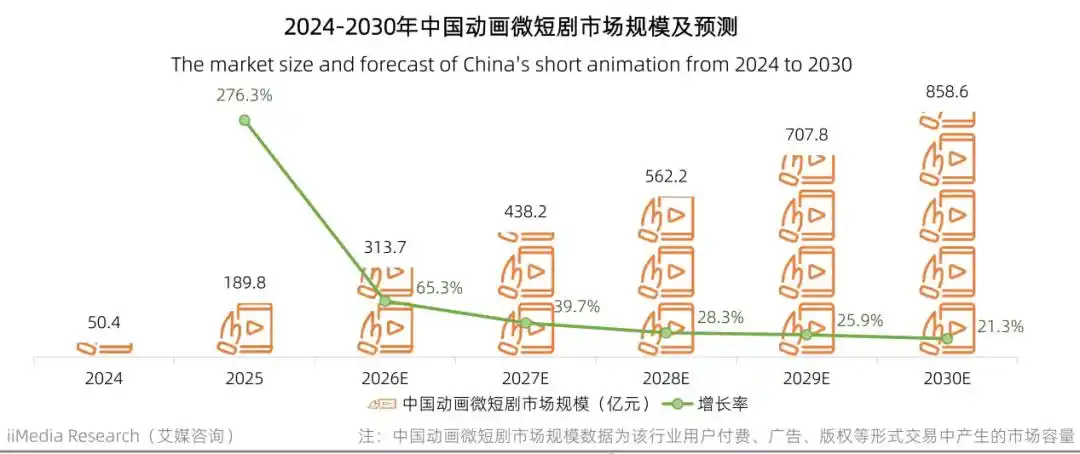
Source: iMedia Network
The problem? Supply explodes while the traffic pool fails to expand in tandem. In December 2025, over 50,000 AI manhua dramas were live in China—only 96 surpassed 100 million views, with a hit rate of just 0.18%. By February 2026, live manhua dramas surged to 120,000, yet only fewer than 150 broke the 100 million mark—hit rate plummeting to 0.12%. Focusing on new AI dramas and manhua dramas on Douyin in the first half of 2026, the proportion surpassing 100 million views stands at only 0.47%. Clearly, as supply continues to flood the market and attention becomes increasingly diluted, over 90% of new entries fail to break through, turning countless mass-produced works into industry casualties.
Has anyone made money? Of course. The Exiled to the Frontier: The Criminal Wife Cultivates a War God series has accumulated over 4.1 billion views on Douyin, becoming a textbook example of a grassroots team creating a long-term hit in the AI manhua drama space. Industry reports indicate top-tier AI manhua studios can achieve revenue scales reaching ten billion RMB. Revenue polarization is extreme—some top individual creators earn up to 100,000 RMB monthly, with elite practitioners approaching one million RMB.
But most haven’t. Industry estimates suggest only less than 1% of top creators achieve high income; the vast majority of creators earn less than 10 RMB per month, with input-to-output ratios severely imbalanced. The situation is equally grim for enterprises—over 90% of manhua drama companies operate at a loss or in vain. An industry sentiment summarizes it: “Few have tasted the meat, but the losers are lining up.”
In short, AI has never lowered the cost of producing “great content”—it only reduces the cost of “producing anything.” When everyone can rapidly generate visuals using AI, “knowing how to use tools” ceases to be an entry barrier.

Similar works under the "Criminal Wife" template
Homogenized content floods the market, user churn rates skyrocket; abandoned accounts pile up, ad acquisition costs crush ROI (Return on Investment); platform reviews tighten, approval rates drop sharply… These compounding factors result in a paradox: the more you produce, the more likely you are to lose money.
Under these conditions, the ecology of the AI manhua drama industry reveals its complex and harsh reality. New entrants arrive with dreams and passion, only to find the market already a red sea—competition fiercer than imagined.
When Infinite Supply Collides with Finite Attention
Similar plots are unfolding simultaneously across multiple creative domains including AI art, AI music, and AI writing.
In 2026, mainstream AI art tools have achieved high usability—single-image generation costs now range between $0.01 and $0.04, enabling zero-entry users to master basic image generation within 1–2 weeks. Market supply has grown nearly 20-fold over two years. Since then, the AI image generation and editing sector has moved past its early chaotic phase, entering full maturity, shifting from expansion to competition over existing shares. Homogeneous tool applications lacking core data assets, weak copyright compliance, and monotonous business models are accelerating exit.
Craftsmen must confront a brutal truth: the artwork they spend three days perfecting can be replicated by someone else in hours using AI. Only then do they realize the other side of technological democratization—inevitable technological devaluation.
The “production explosion” in music is even more staggering. In 2025 alone, Suno—a single production software—generated over 7 million songs daily. At this pace, roughly two weeks could produce content equivalent to Spotify’s entire existing catalog. Creation barriers have never been lower: with just text or image prompts, complete tracks can be generated in seconds.
Yet, countless songs are tagged “strong AI feel,” “crude.” AI-generated tracks “feel like a generic face—neat, acceptable, but lacking distinctiveness and soul.” Those relying on assembly-line orders for lyrics and composition feel the impact first. Many report: what once required five people now can be done by two using AI.
Online literature is also deeply entangled in the crisis of AI-driven overproduction. Reports reveal that over 60% of new book openings are dominated by the “broken engagement, rebirth, system” trinity—AI-generated web novels resembling pre-packaged meals, devoid of humanity. Platform governance intensifies: Tomato Novel’s official announcement states that in June 2026, over 100,000 low-quality books were rejected for signing, and more than 40,000 low-quality or rule-breaking books were dealt with. Platforms continue tiered crackdowns on AI-generated fluff, hollow content, and rampant plagiarism.
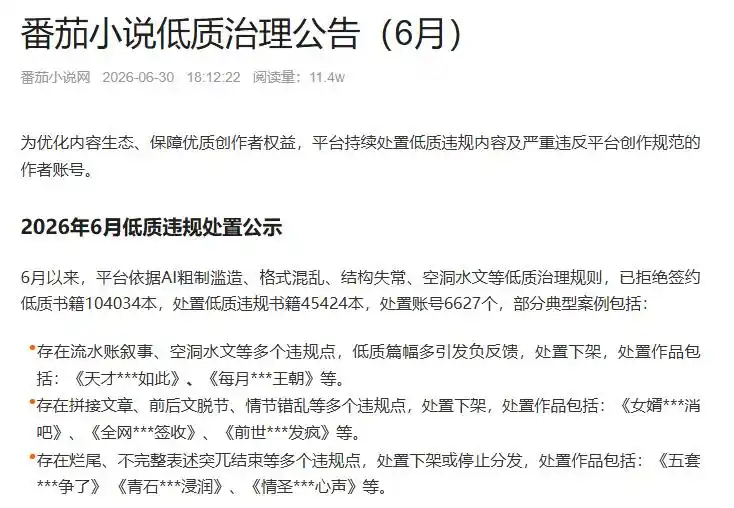
Source: Tomato Novel Network
Mass-produced AI texts crowd out new release charts, squeezing visibility for original authors; repetitive AI novels deliver poor reading experiences; low-quality AI content features identical settings and rampant copying. Of course, this round of platform crackdowns targets not AI technology itself, but the flood of watered-down, factory-style content produced via AI pipelines.
From AI manhua dramas to AI art, AI music, and AI writing, the underlying logic is strikingly consistent: technology drastically lowers entry barriers, leading to massive supply influx—but user attention and consumption time remain finite. When everyone uses the same tools, runs the same model, and feeds the same prompts, the output naturally converges.
What’s truly scarce in the market is never “what can be produced,” but rather “what deserves to be seen.” As Tencent Research Institute Director Si Xiao put it: “When scarcity is broken, infinite supply inevitably leads to devaluation.”
This may be the hard truth confronting countless creators: technology makes “production” incredibly cheap, but “being seen” has become the most expensive luxury in this era.
The reason the story of these “95-poster” couples is repeatedly told is precisely because it’s a low-probability event—like lottery winners chased by media, not because winning is common, but because it’s rare. Behind the billions of views lie countless unnoticed works buried in the traffic pool, leaving no ripple at all.
AI hasn’t abolished the “content is king” rule—it’s simply raised the bar beyond the reach of most. When everyone can produce, what’s worth producing becomes rarer. This isn’t a failure of technology, but a higher demand placed on creators: they must go beyond merely “knowing how to use tools,” cultivating aesthetic judgment, critical discernment, and authentic expression that resist tool homogenization.
Those who survive the AI deluge won’t be the fastest runners, but the ones with the clearest direction. They understand: AI can generate a thousand faces, but the one “worth remembering” still requires a human eye to choose.

The author’s hand-crafted AI manhua drama male lead “Yan Jiming” leaves viewers unable to forget
In an era of infinite supply, attention is the final hard currency. And attention flows only to one place: what is truly worth seeing. As for what “worth seeing” means, the answer has never lain in algorithms or model parameters—it resides in every real human heart.
Technology can replicate everything—except the ability to move hearts.
Source: ZincScale
Disclaimer: Contains third-party opinions, does not constitute financial advice


ByteDance's Douyin Beans priced at 68 RMB—worth it for 382 million monthly active users?
4 days ago
62 Yuan AI Community Collected 248,000 in 4 Days—First Lesson? Recruiting Referrals
6 days ago
Ditching Salesforce? U.S. Small Businesses Save $100K Annually with AI
6 days ago
Baidu's stock closed up 0.35% on Wednesday, ending six consecutive trading days of declines
Just now
Tencent Hunyuan team open-sources the speculative decoding framework AngelSpec, and releases drafter weights and training code for Hy3-A21B
2 hours agoNVIDIA fell 5% on Monday, during which retail investors bought $108 million, marking the weakest accumulation since early 2025.
2 hours agoOpenAI provides free access to cutting-edge ChatGPT models, including GPT-5.6-Sol Pro, for academic researchers
2 hours ago


