Microsoft and Google Ramp Up GPU Purchases—Could Returns Reach 50%?
Microsoft and Google Ramp Up GPU Purchases—Could Returns Reach 50%?

2026-07-29 19:06
Lead: Morgan Stanley attributes the math to token economics: 75% GPU utilization and proprietary model API pricing determine whether AI capex turns a profit
TL;DR · Morgan Stanley estimates GenAI infrastructure can achieve ~25%-50% capital return under base-case scenarios. · Key assumptions hinge on 75% GPU utilization, GB300 rental rates, token throughput, and API pricing. · Microsoft, Amazon, Google, and Meta stand to benefit most, but price wars and open-source models could compress margins.
Morgan Stanley’s July 27 report calculates the break-even point for AI capital expenditures: if GPU utilization, rental costs, token throughput, and API pricing meet base-case assumptions, generative AI infrastructure and Model API businesses could generate approximately 25%-50% capital returns.
This directly addresses the market’s primary concern regarding large tech firms. Microsoft, Amazon, Google, and Meta continue expanding GPU capacity and datacenter investments, driving up capex—investors now question whether these outlays will translate into profits or merely inflate depreciation, energy consumption, and R&D expenses.
The analysis breaks down GenAI monetization into three pathways: leasing GPU compute as IaaS, offering Model APIs via proprietary infrastructure, and renting third-party compute to provide Model APIs. The first two are better suited for large tech platforms with existing datacenters, customer touchpoints, and product distribution channels, while the third is more vulnerable to GPU rental cost pressures.
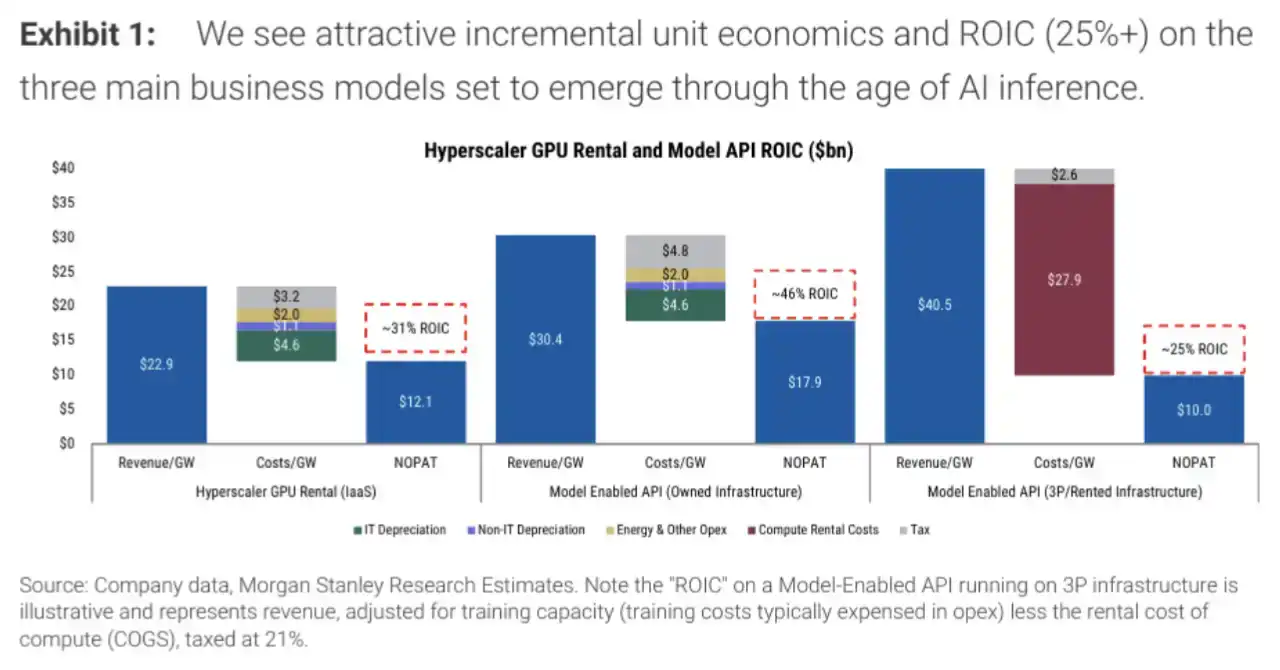
Comparison of three GenAI business model returns: GPU IaaS ~31%, proprietary infrastructure Model API >40%, third-party infrastructure Model API ~25%.
$1.4 Trillion Capex, But It's Not Just About Buying GPUs
The context behind this analysis is the shift toward heavier capital intensity in AI datacenter construction. Publicly reported estimates suggest Morgan Stanley forecasts hyperscalers’ capex will exceed $1.4 trillion by 2028, with computing capacity potentially quadrupling from 2025 to 2028, reaching ~120GW.
This capacity won’t immediately convert into revenue. Frontier model training, model maintenance, and iterative scaling across different model sizes will continue consuming substantial compute—training itself isn’t directly charged, yet incurs depreciation, energy, and operational costs.
True profitability hinges on whether residual compute capacity can be fully absorbed by inference workloads, API usage, enterprise software, and cloud services. In plain terms, how many GPU hours can one card sell annually, at what rate per hour, how many tokens per second, and how much can be charged per million tokens—all determine whether AI capex generates positive cash flow.
This is precisely where the report gains its newsworthiness. Previously, markets focused on rising capex figures; now Morgan Stanley provides a unit economics framework: under base-case assumptions, AI infrastructure can offset high depreciation burdens and approach the return profiles of high-quality cloud or software businesses.
Renting GPUs: 75% Utilization Yields ~31% IaaS Return
The first path involves large cloud providers leasing GPU compute as IaaS. Base-case assumption: 1 GW capacity corresponds to ~410,000 NVIDIA GB300 GPUs, with 75% utilization and an hourly rental rate of $8.50.
Under these assumptions, GPU leasing generates ~$2.29 billion in annual revenue per GW, incremental EBIT margin ~67%, and capital return ~31%. As long as GPU supply is sufficiently demand-driven, IaaS transforms from low-margin hardware leasing into a high-utilization infrastructure play.
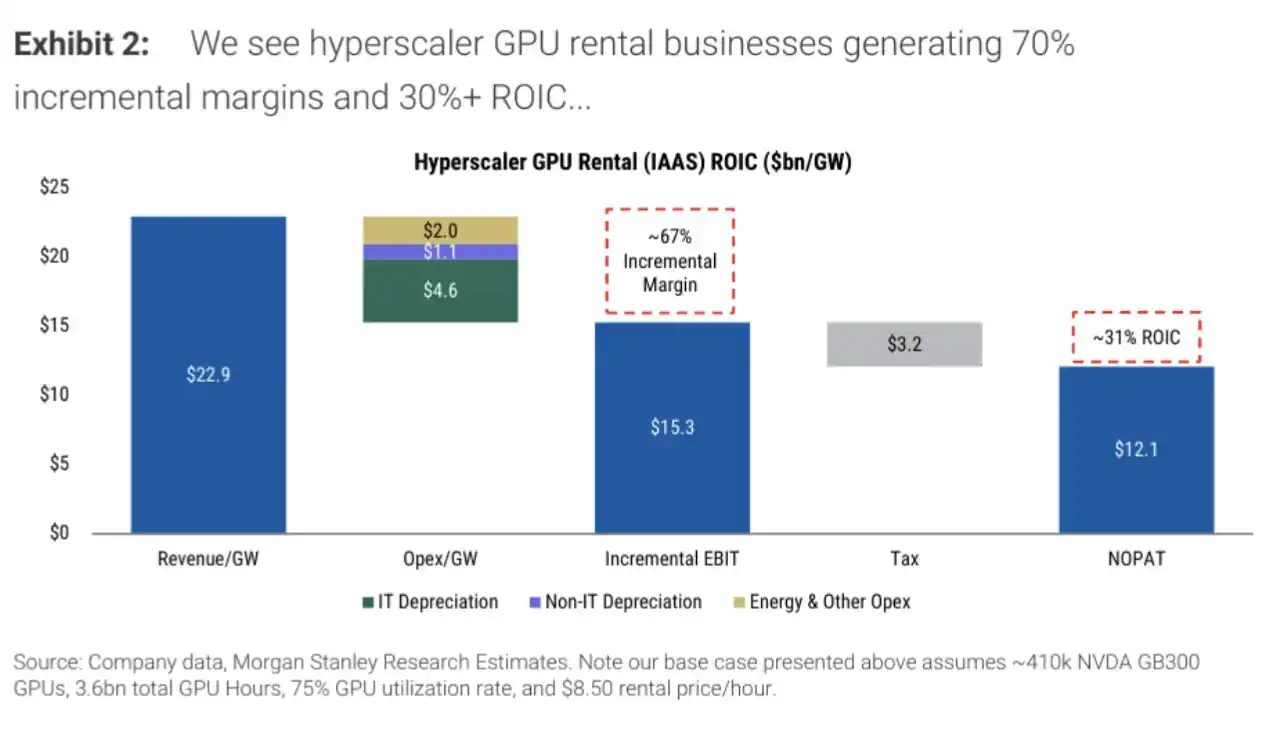
GPU leasing return breakdown and sensitivity analysis: Base-case IaaS return ~31% under 75% utilization and $8.50/hour rental.
Advantages stem from existing cloud providers’ power infrastructure, datacenter footprint, customer relationships, and established cloud sales channels. New GPU capacity integrated into existing demand pipelines enables faster revenue conversion.
However, this path is highly sensitive to pricing and utilization. Downward pressure on GPU rents, suboptimal utilization, and rising energy costs all erode returns. With increasing entrants, ASICs, and next-gen GPU rollouts, unit compute prices may decline, casting uncertainty over the sustainability of the $8.50/hour rental rate.
Model API Is More Profitable—It’s All About Token Consumption
The second path involves delivering Model APIs using proprietary infrastructure. Base-case assumption: 65% capacity allocated to inference, with each GPU processing ~2,750 tokens per second, and hybrid pricing of $1.75 per million tokens.
In this scenario, Model API generates ~75% incremental EBIT margin and capital return exceeding 40%. Different reports cite returns between 40%-46%, but consensus aligns: combining in-house compute with model services yields higher returns than pure GPU-hour leasing.
The rationale is straightforward. Cloud providers and model vendors aren’t selling individual GPU hours—they’re monetizing model capabilities, inference services, and API calls. Revenue scales with token consumption, enabling wider profit margins.
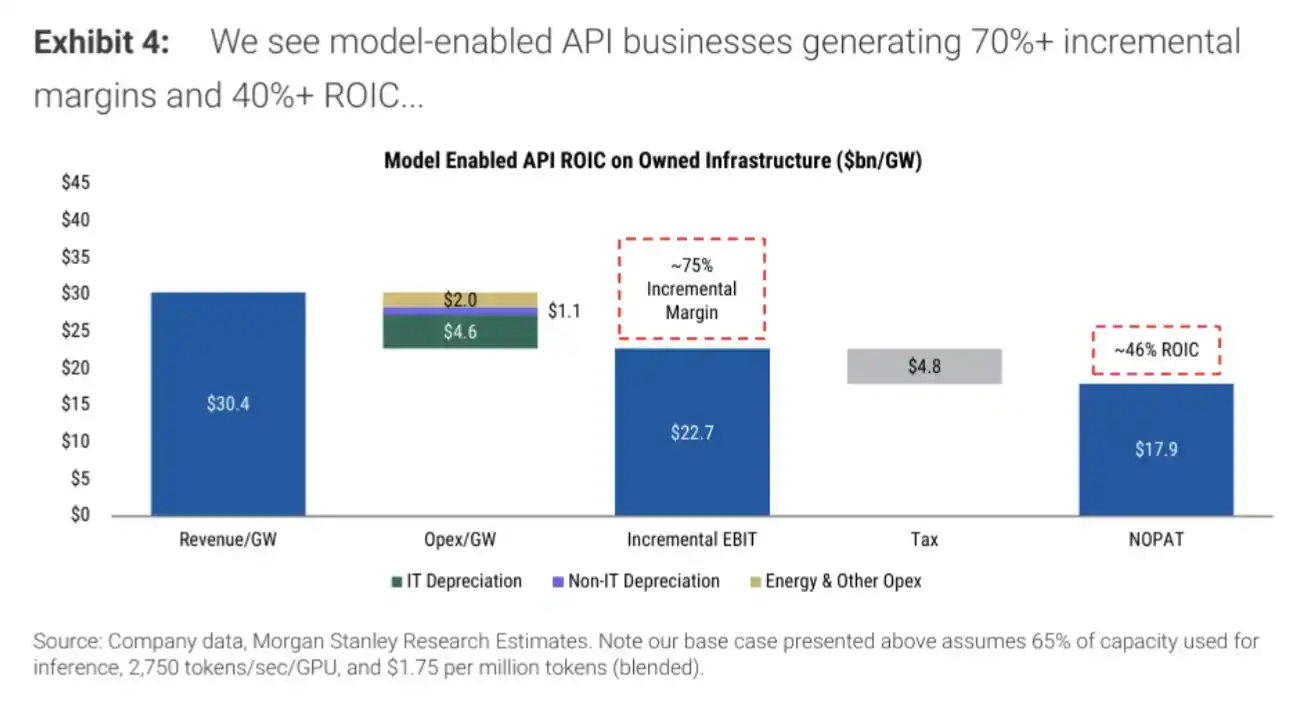
Proprietary infrastructure Model API scenario: Return exceeds 40% under 2,750 tokens/sec/GPU and $1.75/million token pricing.
This also explains why major tech firms are embedding AI features into search, office suites, advertising, e-commerce recommendations, and developer tools. Their goal isn’t merely to lease idle compute—it’s to transform inference into high-frequency, billable, and embeddable revenue streams within existing products.
Risks center on token-level dynamics. Token throughput isn’t solely determined by chip specs—it depends on model parameter scale, software stack efficiency, input/output ratios, and inference optimization. More efficient models increase tokens per GPU, boosting returns. Conversely, open-source models and price competition could compress revenue per million tokens, diluting margins.
Renting Third-Party Compute for APIs: Margins Easily Eroded
The third path involves model companies renting third-party infrastructure to deliver Model APIs. Under base-case conditions, GPU rental costs ~$7.75/hour, incremental EBIT margin ~31%, and post-tax return or margin ~25%.
This path remains profitable but lags behind platforms with proprietary infrastructure. Renting entities must first pay compute rents, then absorb costs of model training, inference, service delivery, and sales—leaving narrower profit margins.
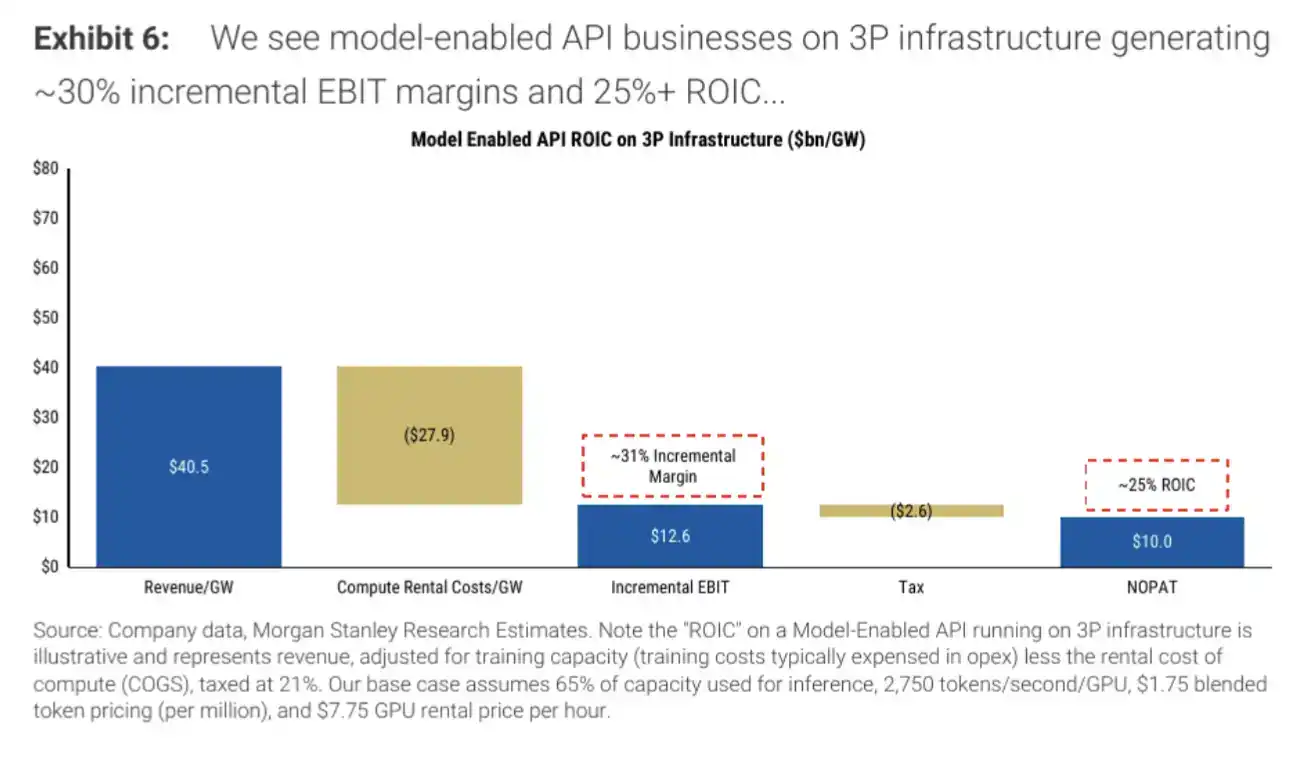
Third-party infrastructure Model API scenario: $7.75/hour GPU rent, with token pricing, throughput, and cost structure jointly determining ~25% post-tax return.
This explains why Microsoft, Amazon, Google, and Meta hold relative advantages. They possess capital strength, datacenter ownership, customer access points, and product distribution networks, enabling them to choose optimal monetization paths between IaaS and APIs. Pure model startups or mid-tier applications without strong pricing power risk being squeezed by compute costs.
This doesn’t mean third-party model firms lack opportunity. High-quality models, vertical-specific solutions, enterprise customization, and application-layer distribution can still create differentiation. But from a capital return perspective, entities with low-cost compute and high-utilization infrastructure are better positioned to capture sustainable profits.
The Bottom Line: Four Giants Benefit, But High Returns Remain Unrealized
Morgan Stanley maintains a favorable outlook on Microsoft, Amazon, Meta, and Google under this framework. Their shared advantage lies in both expanding AI infrastructure and having ready-made products and customer entry points to absorb inference demand.
Microsoft receives an Overweight rating with a target price of $600. Alphabet (Google’s parent) has a target of $400, while Meta is rated Top Pick with a target of $775. Amazon is similarly included among major beneficiaries of AI infrastructure expansion, though published target prices vary—no single figure should be taken as definitive.
These stock targets shouldn’t be interpreted as current realization of AI capex returns. Short-term financial statements for these four companies may still reflect pressure from depreciation, energy costs, chip refresh cycles, and R&D spending. Whether AI investment translates into shareholder value ultimately depends on whether inference revenue growth outpaces cost inflation.
The 25%-50% return range is a scenario projection, not actual financial outcome. 75% utilization is a high bar—slow enterprise AI adoption could leave GPUs idle, directly dragging down returns. Token pricing is also unstable; open-source models, more efficient smaller models, and cloud provider price wars could suppress revenue per million tokens.
Ultimately, this report functions more like a measuring stick: as long as large tech firms maintain high utilization of their AI infrastructure and convert token consumption into revenue via Model APIs, cloud services, and existing products, AI capex ceases to be a black hole. Conversely, if rental rates, utilization, and inference adoption fall short, the 25%-50% return will remain confined to spreadsheet models.
Source: BlockBeats
Disclaimer: Contains third-party opinions, does not constitute financial advice


AI drives SK Chairman's divorce settlement bill to KRW 94.4 billion
4 days ago
AI is no longer competing on benchmark scores, but on profitability
4 days ago
NVIDIA Exposed to Spend $10 Billion on Underground Fiber Optic Cables
4 days ago
30 Million KRW Threshold, AI Chip Leverage Cooling Down
5 days ago
$13.7 Billion Prediction Market: Are Retail Investors Making Way for AI?
5 days ago
Will Google Cut AI Spending First? Markets Panic the Night Before Earnings Release
7 days ago
$230 Mini Hardware Just Released, OpenAI Sued by Apple Immediately
13 days ago


