24 New Unicorns in Beijing, 18 of Them in Haidian
24 New Unicorns in Beijing, 18 of Them in Haidian

2026-07-29 19:01
Introduction: The convergence of Tsinghua research, ByteDance talent, and Zhongguancun early-stage capital within walking distance has accelerated the growth and valuation of AI and robotics startups
Latest data from ITJUZI shows that as of July 2026, China has added 73 new unicorns with a total valuation of $190.5 billion. On average, a company crosses the $1 billion threshold every other day.
The last time such density was observed was in the second half of 2021—when the historical peak reached 76 companies. However, the drivers behind these two waves differ significantly: the previous wave was diversified across new energy, biopharma, and consumer internet, with fragmented sectors; this round is highly concentrated, with AI and robotics together accounting for 38 companies—over 52% of the total.
An overlooked issue is that despite similar bets on AI, startup outcomes vary dramatically across cities. Hangzhou’s valuation of $61.5 billion is driven solely by DeepSeek, Shenzhen has rapidly spawned five robotics firms but with an average valuation under $2.2 billion, Shanghai sees frequent spin-offs from institutional ecosystems—while Beijing stands out, with over half of its 24 new unicorns founded by teams bearing one common label: Tsinghua University.
Not all cities can sustain this wave.
This article attempts to dissect a more fundamental question: what unicorn incubation model has emerged victorious in this AI cycle?
First, city-level overview: Beijing leads with 24 unicorns and $56.4 billion, but true concentration lies in Haidian District
The 73 new unicorns are distributed across 14 cities, with Beijing leading at 24, followed by Shanghai (20), Shenzhen (9), and Hangzhou (4). These four cities account for 57 companies—78% of the total.
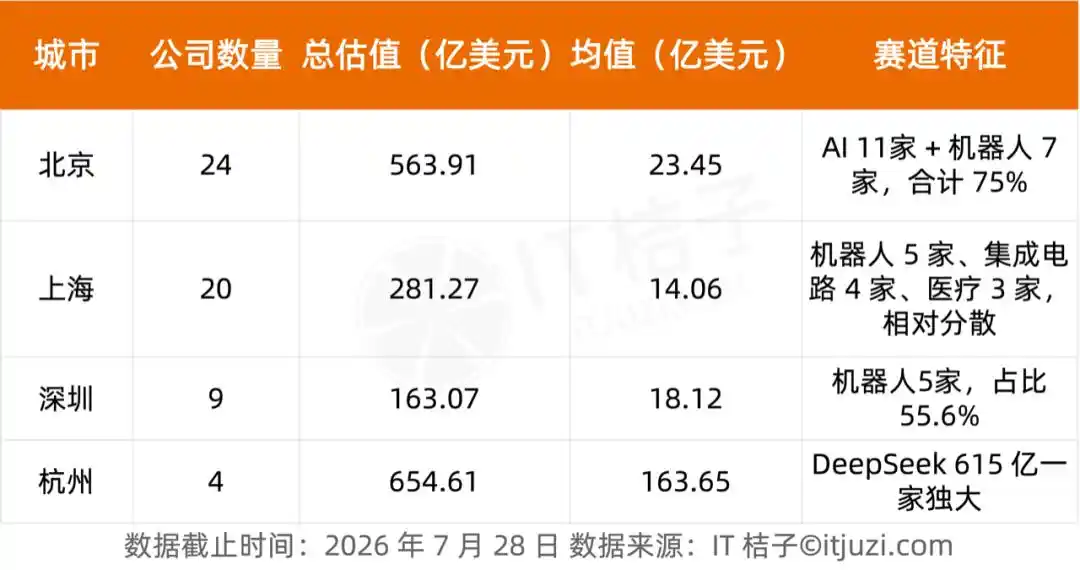
Beijing ranks first with 24 unicorns, while Shanghai follows closely with 20. Yet Beijing's total valuation ($56.39 billion) far exceeds Shanghai's ($28.13 billion). Beijing not only leads in quantity but also in the quality of fast-growing unicorns.
Of Beijing’s 24 unicorns, 18 are registered in Haidian District, 5 in Economic and Technological Development Zone, and 1 in Chaoyang District. Haidian alone accounts for 85% of Beijing’s new unicorn valuations. In essence, Beijing’s “24 unicorns, $56.4 billion” is really Haidian’s performance in this cycle.
Haidian’s sector purity is also high: among the 18, 10 are AI-focused and 6 are robotics-related—combined, they make up 89% of the total. Companies like Keling AI, Huashen Zhiyao, and Qianxun Intelligence lead in video generation, AI-driven drug discovery, and humanoid robotics, respectively.
When slicing the “fast unicorns”—those reaching unicorn status within less than three years—by city: Beijing leads with about 8, followed by Shanghai (~6), and Shenzhen and Hangzhou each with ~2. Beijing’s 8 include Kunlun Robotics (0.4 years), Zhiyan Huisheng (0.6 years), Natural Will (0.6 years), Mode Xinghe (0.8 years), Wujiem Power (1.4 years), Qianxun Intelligence (2.6 years), Qujing Technology (2.8 years), and Silicon Flow (2.9 years)—7 of which are registered in Haidian.
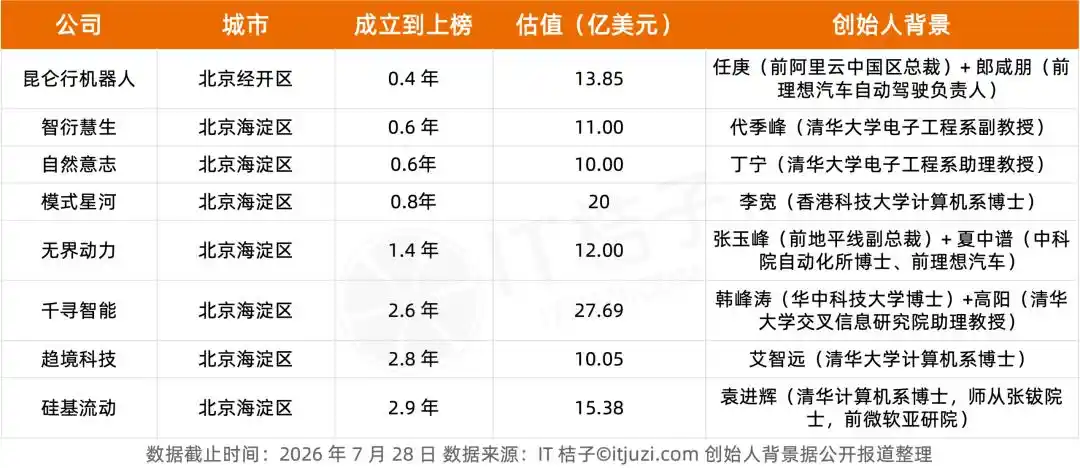
Thus, the real landscape is this: Beijing’s rapid emergence of new unicorns is essentially the concentrated release of original innovation from Haidian District.
Why Haidian Can Produce “Fast, High-Valued, Dense” Unicorns
If quantity and valuation represent the “face,” incubation efficiency is the “essence.” By analyzing the founding team backgrounds, capital structures, and geographic distributions of Haidian’s 18 new unicorns, we identify three overlapping supply lines—physically co-located—which explain why Haidian achieves the trifecta of “fast, high-valued, dense” unicorns in this cycle.
Line One: Academic Research Supply
At least 10 of Haidian’s 18 new unicorns have founders or core teams with Tsinghua University affiliations: Keling AI’s Gaikun (Tsinghua B.S./Ph.D.), Silicon Flow’s Yuan Jinhui (Tsinghua Ph.D. in Computer Science, mentored by Academician Zhang Bo), Shengshu Tech’s Zhu Jun (Professor at Tsinghua CS Department) and Luo Yihang (Ph.D. in Automation, Tsinghua), Jiasuhua’s Cheng Hao (B.S./M.S. in Automation, Tsinghua), Zhiyan Huisheng’s Dai Jifeng (Tsinghua B.S./Ph.D., Associate Professor in Electronic Engineering), Natural Will’s Ding Ning (Ph.D. in EE, Assistant Professor at Tsinghua), Qujing Tech’s Ai Zhiyuan (Ph.D. in Computer Science, Tsinghua), Jijia View’s Huang Guan (Innovation Leadership Doctoral Program, Tsinghua), and Qianxun Intelligence’s Gao Yang (Assistant Professor, Interdisciplinary Information Sciences, Tsinghua). Zhao Hao, Chief Scientist at Guanglun Intelligence, also holds a B.S./Ph.D. in Electronic Engineering from Tsinghua.
Beyond Tsinghua, CAS-affiliated institutions form another core force: Huang Guan (Master’s, Institute of Automation, CAS), Xia Zhongpu (Ph.D., Institute of Automation, CAS), and Wang Fuquan (Ph.D., Institute of Acoustics, CAS; postdoc at Institute of Computing, CAS) — founder of Suanmiao Tech, whose entire core team comes from the CAS ecosystem.
Peking University contributed Guanglun Intelligence (Xie Chen, B.S. in Physics, PKU). Overseas elite universities also play a role: Huashen Zhiyao’s Peng Jian (Ph.D. from University of Chicago, Postdoc at MIT), Guanglun Intelligence’s Xie Chen (Ph.D., Columbia University). Most of these founders first pursued advanced studies abroad before returning to Beijing to launch ventures.
Line Two: Talent Spillover from Big Tech Headquarters
At least 10 of Haidian’s 18 new unicorns have founders or core teams with experience at major tech firms. ByteDance-affiliated talent is especially dense: Jiasuhua’s Cheng Hao (former VP of Feishu Product, ByteDance), Shengshu Tech’s Luo Yihang (former AI head, Volcano Engine, ByteDance), Aishike’s Wang Changhu (former Vision Lead, ByteDance AI Lab), LiblibAI’s Chen Mian (former Global Commercialization Head, CapCut, ByteDance; youngest 4-1 executive). Four unicorns across different sectors—all carry the ByteDance imprint. Alibaba-affiliated talent contributed Keling AI’s Gaikun (former P10 at Alibaba Mama).
Microsoft Research Asia serves as another talent reservoir: Yuan Jinhui (Silicon Flow), Wang Changhu (Aishike), Huang Guan (Jijia View), and Dai Jifeng (Zhiyan Huisheng) all previously worked there. Additionally, Horizon Robotics-affiliated (Wujiem Power’s Zhang Yufeng, Jijia View’s Sun Shaoyan), Li Auto-affiliated (Wujiem Power’s Xia Zhongpu), and NVIDIA-affiliated (Guanglun Intelligence’s Xie Chen) teams each contribute.
More noteworthy is the “dual gene” profile—simultaneous academic research background and industry experience.
Keling AI’s Gaikun (Tsinghua + Alibaba/Kuaishou), Silicon Flow’s Yuan Jinhui (Tsinghua + Microsoft), Jiasuhua’s Cheng Hao (Tsinghua + ByteDance), Shengshu Tech’s Luo Yihang (Tsinghua + ByteDance), Aishike’s Wang Changhu (USTC + Microsoft/ByteDance), Jijia View’s Huang Guan (Huazhong USTC/CAS/Tsinghua + Microsoft/Horizon), Guanglun Intelligence’s Xie Chen (PKU/Columbia + NVIDIA/NIO), Zhiyan Huisheng’s Dai Jifeng (Tsinghua + Microsoft).
This blend of academic depth and industrial pragmatism is the foundational condition for “unicorn at birth”—investors don’t see a business plan, but a proven track record.
Line Three: Precision Early-Stage Venture Capital Intervention
Haidian has ranked first for two consecutive years in the “China’s Most Valuable VC District” list by InvestChin. With 435 registered private equity fund managers under the AMAC, it accounts for nearly 40% of Beijing’s equity financing volume. In 2025, over 80% of Haidian’s AI funding occurred before Series B. It is also among the first national pilot projects for science and technology finance integration—truly a high-density early-stage capital district.
In 2026, Haidian’s state-owned venture platform, Zhongguancun Science City, launched two funds totaling RMB 10 billion: an RMB 8 billion Science & Technology Growth Fund IV and a RMB 2 billion Science & Technology Transformation Fund. The former focuses on partnering with early-stage investment-capable sub-managers; the latter targets seed, angel, and Pre-A rounds directly, adhering to the principles of “investing early, small, and in hard tech.” These funds, combined with top-tier institutions like Sequoia China, Hillhouse Capital, Junlian Capital, and Golden Gate Ventures, form a multi-layered capital synergy model of “state guidance + ecosystem co-building.”
Among Haidian’s 18 new unicorns, investors such as Zhongguancun Science City appear in the cap tables of seven companies including Keling AI, Guanglun Intelligence, Jiasuhua, Silicon Flow, and Shengshu Tech. As the Public Affairs Director of Guanglun Intelligence put it: “Zhongguancun Science City’s guiding fund combines long-term industrial vision and acts more like a ‘family’ companion to growing enterprises.”
Startups in Haidian, universities in Haidian, early-stage capital in Haidian—three pillars physically overlap. Universities supply technological depth, big tech headquarters supply industry talent, and early-stage VCs provide the first vote of confidence. Only Zhongguancun possesses all three supply chains nationwide—and they converge spatially. This is the underlying structure behind Beijing’s “fast, high-valued, dense” unicorn boom.
Other Cities’ Strategies: Shanghai – Spin-offs from Big Tech Dominant
Shanghai’s 20 new unicorns have a total valuation of $28.13 billion, averaging $14.06 billion each. The dominant model is “big tech spin-offs”: Critical Point AGILINK ($1.54 billion) spun off from the dexterous hand division of Zhiyuan Robotics, and Jingtian Rent ($1.08 billion) originated as a robot leasing platform under Zhiyuan. One company split into two unicorns. Bulag Tech ($2 billion) was founded by Lin Junyang, former lead of Alibaba’s Tongyi Qianwen large model team; he secured a $2 billion post-money valuation just three months after leaving Alibaba.
Shanghai’s strength lies in diverse industrial ecosystems: semiconductors (Gateron, Xinsi Semiconductor, Cixin Tech, Yunmai Xinlian) and healthcare (Yuanqi Biotech, Jiyu Pharma, SenseTime Healthcare) have deep roots here—areas where Beijing is relatively weaker. However, in the hottest 2026 sectors—AI infrastructure and embodied intelligence—Shanghai lags behind Beijing in both valuation density and startup velocity.
Shenzhen – Mass Production Incubator
Of Shenzhen’s 9 new unicorns, 5 are robotics-focused—the most concentrated humanoid robotics ecosystem in China. Zidian Robotics ($3.08 billion) and Zhi Ping Fang ($3.08 billion) tie for highest valuation. Combined, the 9 companies reach $16.31 billion, averaging $1.81 billion. Most fall between $1.2–$1.8 billion. The robotics sector is defined by production capability and real-world scenario validation setting the ceiling—requiring time. Shenzhen excels in supply chain and manufacturing but lags in AI infrastructure and algorithmic layers.
Hangzhou – Super Single-Entity Driver
Hangzhou’s 4 new unicorns have a total valuation of $65.46 billion—accounting for 34.4% of the national share—but DeepSeek alone contributes $61.54 billion. Excluding DeepSeek, the remaining three total just $3.92 billion, averaging ~$1.31 billion—comparable to Shanghai. DeepSeek is exceptional: nurtured by Fantasy Quant, personally funded by Liang Wenfeng, and raised RMB 51 billion in its Series A with a top-tier investor lineup including IDG, Tencent, NetEase, JD.com, and CATL. This “super single-entity” model is rare and non-replicable.
Where Is the Highest Incubation Efficiency Cluster?
Returning to the initial question: what incubation model has won in this AI cycle?
It’s not about which city has the most unicorns or the highest individual valuations. From data analysis, the highest-performing clusters—measured by incubation efficiency (time-to-$1B × valuation premium × sector hardness)—are concentrated in regions where “university + big tech HQ + early-stage VC” intersect.
Haidian covers less than 3% of Beijing’s total area but hosts the densest concentration of top-tier academic resources: Tsinghua University, Peking University, and various CAS institutes—all located within a 15-minute drive of each other. Meanwhile, ByteDance, Kuaishou, Baidu, and NetEase’s Beijing headquarters are all based in Haidian. Add to this Zhongguancun Science City and other district-level state-owned VC platforms focused on early-stage hard tech—three supply chains meet within walking distance.
This mirrors the story of the previous mobile internet cycle. Over a decade ago, Zhongguancun gave rise to ByteDance and Xiaomi—both benefiting from early investors like Hainan Asia and Wang Qiong, and relying on Tsinghua and Motorola technical cores. That cycle’s logic was “mobile internet + hardware manufacturing”; this one is “AI infrastructure + embodied intelligence”—but the underlying structure remains unchanged: universities supply technology, big tech supplies talent, early-stage VC supplies the first trust.
The sector changes, but the ecosystem persists.
Among the 73 new unicorns in 2026, the region with the highest concentration of companies matching the “triple overlay” profile is precisely the same area that produced ByteDance and Xiaomi in the prior cycle. This is no coincidence—when a place simultaneously offers technological supply, talent supply, and capital supply, and all three converge within walking distance, incubation efficiency skyrockets compared to other regions.
Source: ITJUZI
Disclaimer: Contains third-party opinions, does not constitute financial advice


DoorDash Secures FAA Part 135 Certification to Launch Its Own Drone Delivery Division, DoorDash Air
7 hours ago
1.6 Billion-Parameter Robot Foundation Model LDA-1B Enters the Domain of Embodied Intelligence
4 days agoRLDX-1 drives the new robotic hand to complete face-to-face business card exchange; model set to be open-sourced within two weeks
4 days agoAsimov Open-Source Humanoid Robot Asimov v1 Mechanical Design, Simulation Files, and Full BOM
4 days agoKevin Zakka trains a grasping policy using mjlab's new feature, demonstrating pivot-grasp behavior on planar objects
4 days agoSMASH Project Deployment of Outdoor Humanoid Robot Table Tennis System Based on Unitree G1
4 days agoUber Introduces Hertz to Manage Lucid Autonomous Taxi Fleet, Service Planned for Launch in San Francisco Bay Area by End of 2026
4 days ago