Former Kimi Head Enters AI Matchmaking, Raises $15M in 3 Hours
Former Kimi Head Enters AI Matchmaking, Raises $15M in 3 Hours

2026-07-29 11:32
Introduction: 20-minute registration, 1v1 matching, "refund if not married"—transforming dating platforms from time-based monetization to success-rate-driven betting. Intelligent Things reported on July 28, 2026, that Shenzhen-based AI+dating startup Liangpei Tech has launched its product "Liangpei," following a $1.5 million angel round led by Today Capital.
Intelligent Things reported on July 28, 2026, that recently, Shenzhen's "AI+Dating" startup Liangpei Tech announced the launch of its product "Liangpei." The company had previously secured a $1.5 million angel funding round, with investors being Today Capital.
Liangpei Tech’s founder and CEO Zeng Xinxin told Intelligent Things that he initially planned to raise RMB 10 million at a 15% equity stake. After approximately three hours of conversation with Xu Xin, founder of Today Capital, she proposed increasing her equity stake to 20% and raising the investment amount to the final RMB 15 million.
The closing of this round was highly serendipitous. Prior to this, Zeng had engaged with about ten investors, receiving largely pessimistic feedback. Some believed the marriage market was too small; others questioned whether emotional issues could be solved through technology; some expressed concerns that a purely technical team lacked marketing capabilities.
During a hackathon in Hangzhou, Zeng happened to meet Today Capital’s investment manager Evan at a coffee shop. They chatted for only about 15 minutes, but the next day, he received an invitation to meet Xu Xin.
Zeng recalled that Xu Xin had previously invested in BOSS Zhipin, and her husband Li Song is the founder of Zhenai.com. She has long observed both “job hunting” and “relationship seeking” as two types of “people-finding” businesses. With the rise of the AI wave, Today Capital has been actively searching for teams capable of leveraging AI to transform recruitment and dating industries.
"When I came downstairs, my feeling was that fundraising and dating are essentially the same—both require mutual commitment," he said.
Liangpei Tech was founded in 2025, headquartered in Shenzhen, positioning itself as an AI Native product tailored for serious daters. Its first mini-program version has entered public beta testing, while the full app is currently under review in app stores. As of the interview, Liangpei had been live for about ten days, with over 9,000 users already onboarded.
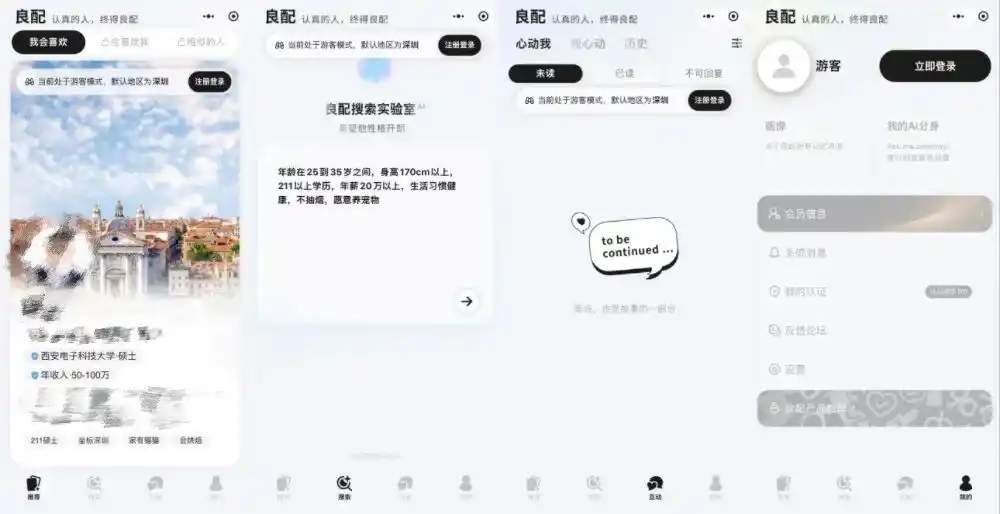
Liangpei Mini Program Interface
Compared to conventional dating platforms, Liangpei implements several notably aggressive rules:
Users must engage in a ~20-minute conversation with an AI matchmaker during registration;
Each user can maintain only one active match at a time;
Members may opt for a paid plan offering "refund if not married."
The company also aims to train a highly specific model: when given the profiles of two users, the model will output whether they are compatible and the probability of a successful relationship.
Zeng previously managed search and recommendation operations at WeChat and TikTok, and his last role was as head of AI search technology at Kimi. In his view, finding a partner is fundamentally a human-to-human search problem. Traditional dating platforms expand user reach but lack the ability to understand complex personal information and relational needs.
When leaving Kimi, Zeng’s unvested stock options were worth several hundred thousand RMB. With Kimi’s valuation surging, these options now represent tens of millions in value.
For this decision, he showed little hesitation.
Even as a sophomore at Southern University of Science and Technology, Zeng once took a leave of absence to launch a food delivery platform. The project covered Shenzhen, Dongguan, and Huizhou, amassing tens of thousands of users before ultimately failing due to massive subsidies from Meituan and Ele.me. After returning to school, he resumed studies in computer science and later joined WeChat, TikTok, and Kimi.
After his first entrepreneurial failure, he waited patiently for the next opportunity. It wasn’t until the stability, cost, and ecosystem of large models underwent significant changes that he felt the conditions for AI application entrepreneurship were finally ripe.
A more direct product inspiration stemmed from his own over-a-year-long online dating experience.
Zeng once wrote a 2,000-word personal profile on a dating app but still endured numerous inefficient interactions. Just as he was preparing to uninstall the app, he met his current wife. Both had written detailed profiles; after chatting for one day online, they decided to meet in person and confirmed their relationship on the first date.
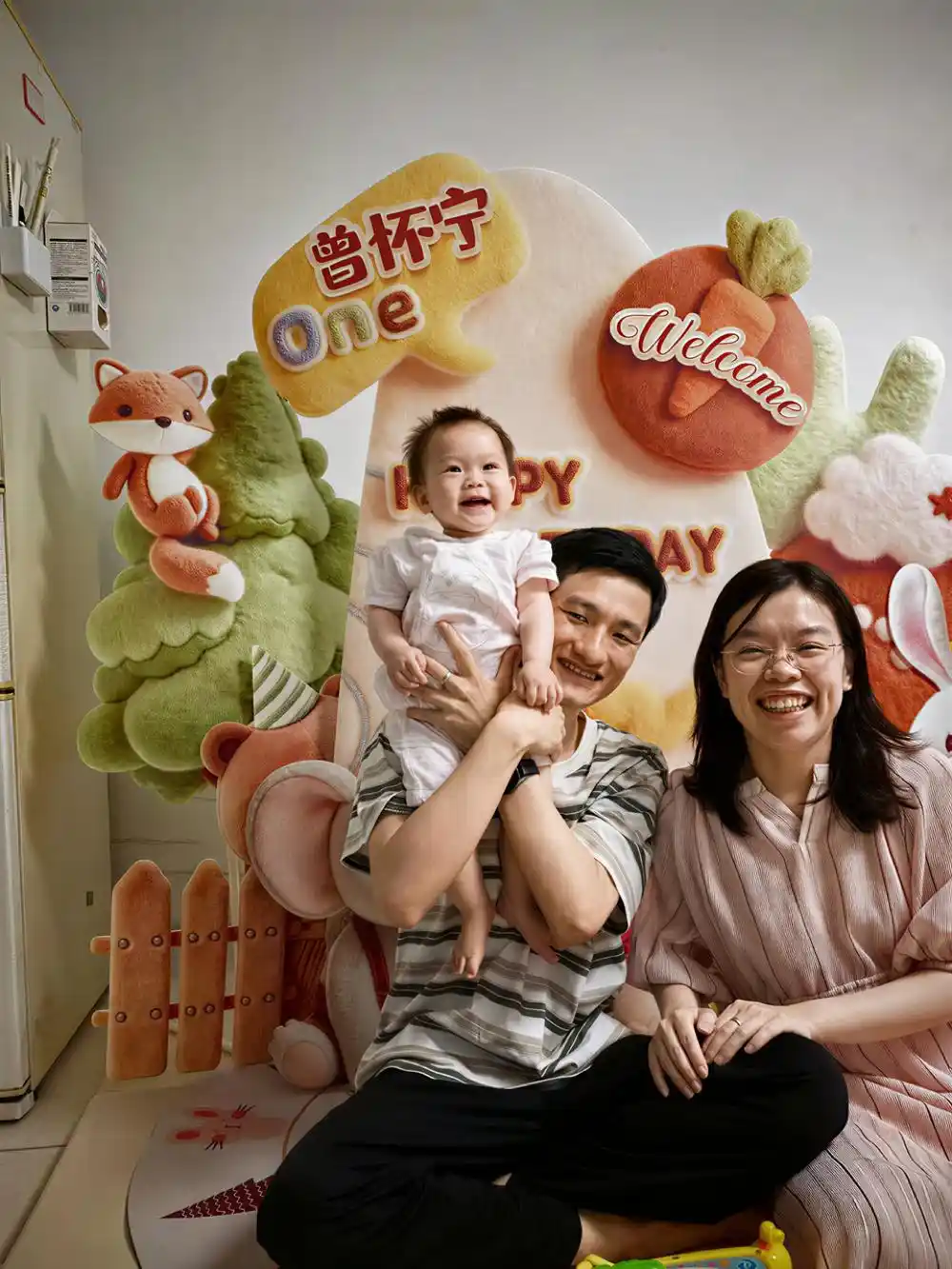
Family photo of Zeng Xinxin (celebrating daughter’s first birthday)
This experience led him to conclude: online dating doesn’t lack candidates—it lacks richer context, deeper platform understanding, and more focused communication environments.
To address these challenges, Liangpei designed features like AI Matchmaker, AI Avatars, AI Strategist, and AI Recommendation, setting “average user matchmaking success rate” as its North Star metric.
Intelligent Things conducted nearly two hours of in-depth interviews with Zeng Xinxin. We sought to understand why a search technology lead chose the seemingly traditional field of serious dating; how large models handle the vast amount of ambiguous, implicit, or even unconsciously recognized information in mate selection; and why a dating platform would proactively limit user activity and promise full refunds if users didn’t marry within three years.
Below is a transcript of our conversation, edited for clarity without altering original meaning.
01. Xu Xin Invests $1.5M in 3 Hours – Team Phones Up and Moves to Shenzhen
Intelligent Things: You met Xu Xin for three hours and quickly closed the deal. What happened?
Zeng Xinxin: Before meeting Xu Xin, I had met around ten investors and received various objections.
Some believed the market was too small; others thought dating was too emotional to be solved by tech; some viewed AI as mere buzzword packaging; others worried that the dating industry relied heavily on marketing and growth, and as a tech background founder, I might build a great product but fail to sell it.
After meeting Xu Xin, none of these concerns arose.
I was looking for an investor who truly believed in the industry. She was searching for capable, motivated people ready to execute such a vision.
Today Capital previously invested in BOSS Zhipin, and Xu Xin’s husband is the founder of Zhenai.com. She has deep, long-term insights into both “job hunting” and “relationship seeking.” With the arrival of the AI era, she has been actively scouting teams capable of using AI to reinvent recruitment and dating industries.
My background aligned perfectly with this direction. I’ve worked on search recommendations and AI search; I’ve personally experienced online dating struggles and eventually met my wife via a dating app. I’ve lived through grassroots entrepreneurship, big tech, and AI unicorns—my journey is more diverse than most.
So it’s hard to say who convinced whom. She was seeking such a team; I was seeking an investor who understood the space. We clicked instantly.
Intelligent Things: How was the $1.5 million figure determined?
Zeng Xinxin: My initial target was RMB 10 million at 10% equity—valuing the company at RMB 100 million. After three hours of discussion, she asked if we could increase her stake to 20%.
My first reaction was, “Is she trying to get 20% for just RMB 10 million?” I thought the chance to secure her investment was extremely rare, so I agreed quickly—even if it meant giving up 5% more.
Then she pulled out paper and started writing formulas. That’s when I realized she intended to scale up the investment based on the original valuation—not taking free equity.
The final amount calculated was RMB 14.16 million. She said, “Let’s round up,” so the final investment became RMB 15 million at 20% equity, implying a post-money valuation of RMB 75 million.
Later, when I spoke with other investors, I found few actually increased pricing for founders—most prefer to negotiate down.
Intelligent Things: How was Liangpei’s core team assembled?
Zeng Xinxin: The founding team originally consisted of seven people, now expanded to 17.
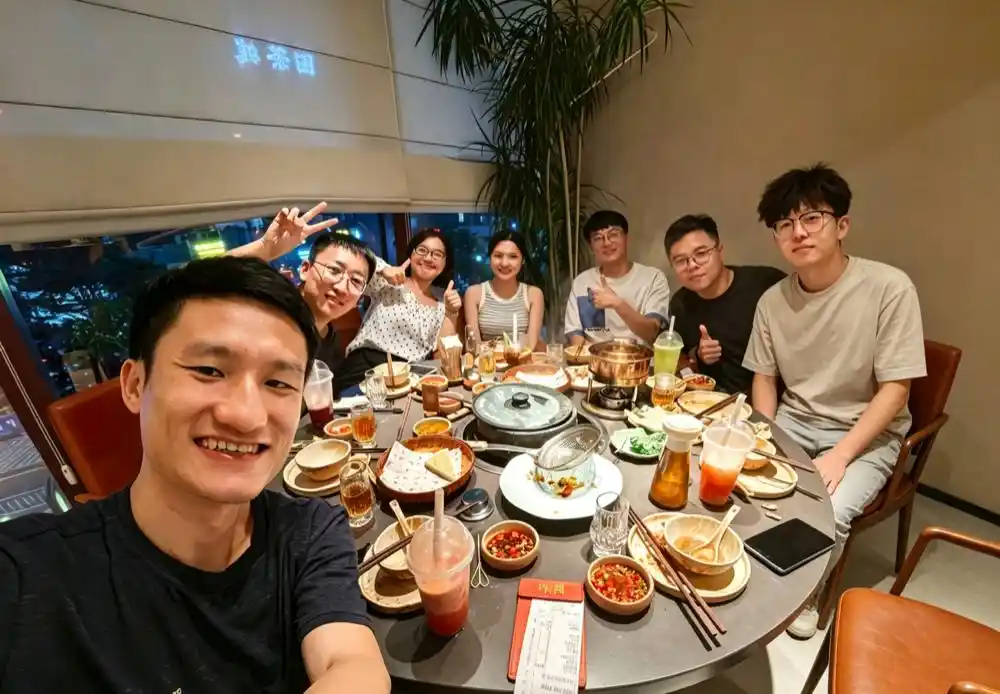
Liangpei Tech Founding Team Photo (initial 7 members, 5 of whom resigned from out-of-town jobs and relocated to Shenzhen)
After my first failed startup, I consciously cultivated relationships with potential future co-founders during my years at big tech companies. They knew my work ethic, personality, and approach, and understood I’d eventually start another venture.
When I decided to launch, I secured funding within a week and began recruiting. For these long-standing colleagues and friends, this wasn’t a sudden invitation. They’d observed me for years and were mentally prepared for entrepreneurship.
Most team members joined immediately after my first phone call introducing the project. Only one required more than one conversation.
Our operations lead Wang Qian has continuously founded startups for seven years since university, worked at P&G, and excels at rapidly identifying solutions amid ambiguity. Many tasks lacking clear methodology are first explored by him.
Our tech lead is my junior from SUSTech. We co-authored papers and competed together during school, building trust through long-term collaboration. He primarily handles engineering development.
Though I come from a tech and algorithm background, I’ve always maintained strong product instincts, so I now serve mainly as product lead. Decisions about feature design and rationale are primarily mine.
Our growth lead previously helped Soul scale from zero to 100 million users. We discussed for just one hour, and both agreed to collaborate immediately. About half a month later, he moved from Beijing to Shenzhen.
Our current goal is to become China’s leading serious dating platform. Once we complete international talent integration, we aim to expand globally.
02. Leaving Kimi to Start a Business – A Decade-Long Opportunity Finally Arrives
Intelligent Things: Your career path is quite diverse. You dropped out of SUSTech in your second year to start a business, later led search-related work at WeChat and TikTok, and eventually served as head of AI search at Kimi. Why did you give up Kimi’s equity to enter the dating industry?
Zeng Xinxin: When I left Kimi, those unvested options were worth hundreds of thousands of RMB—now, with Kimi’s rising valuation, they’re worth tens of millions.
My first startup was in 2013, during my sophomore year, when I launched a food delivery platform. Later, Meituan and Ele.me entered the market with massive subsidies, and our project collapsed.

Zeng Xinxin delivering food in a typhoon (left) vs. peak order volume (right)
After that first failure, I knew I’d try again. I returned to school, relearned computer science, and built skills and opportunities for the next venture.
But when I graduated, mobile internet was nearing maturity. Products like Pinduoduo, Xiaohongshu, Kuaishou, and Douyin had already emerged—few truly new opportunities remained. So I joined big tech firms, accumulating experience, resources, and networks while waiting for the right moment.
Whether at WeChat, TikTok, or Kimi, I always informed my leaders and HR that I’d eventually start a company. I’d contribute value while knowing I’d leave at the right time.
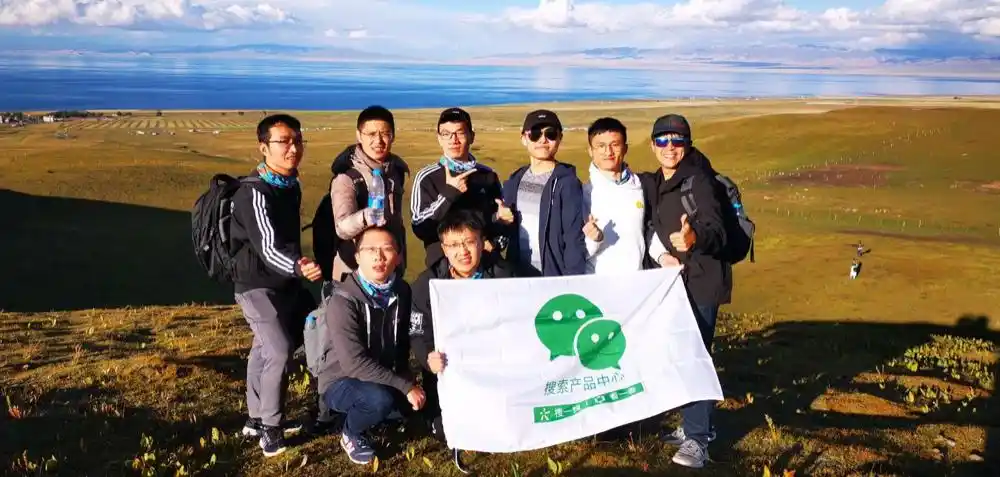
WeChat Search Team Building
Since ChatGPT launched late 2022, I’ve been hunting for AI application entrepreneurship opportunities. By 2025, I felt the perfect moment had arrived. Regardless of how many options I held or which company they belonged to, this decision wouldn’t change.
Intelligent Things: Why do you believe 2025 was the ideal time for AI application entrepreneurship?
Zeng Xinxin: When ChatGPT first appeared in 2023, I began tracking AI application ventures. My background leans toward applications, not foundational model training, so opportunities lay primarily in the application layer.
I participated in one of China’s earliest AI hackathons, with over 300 teams. We made it into the top ten. Afterward, I identified three major issues with existing large models at the time.
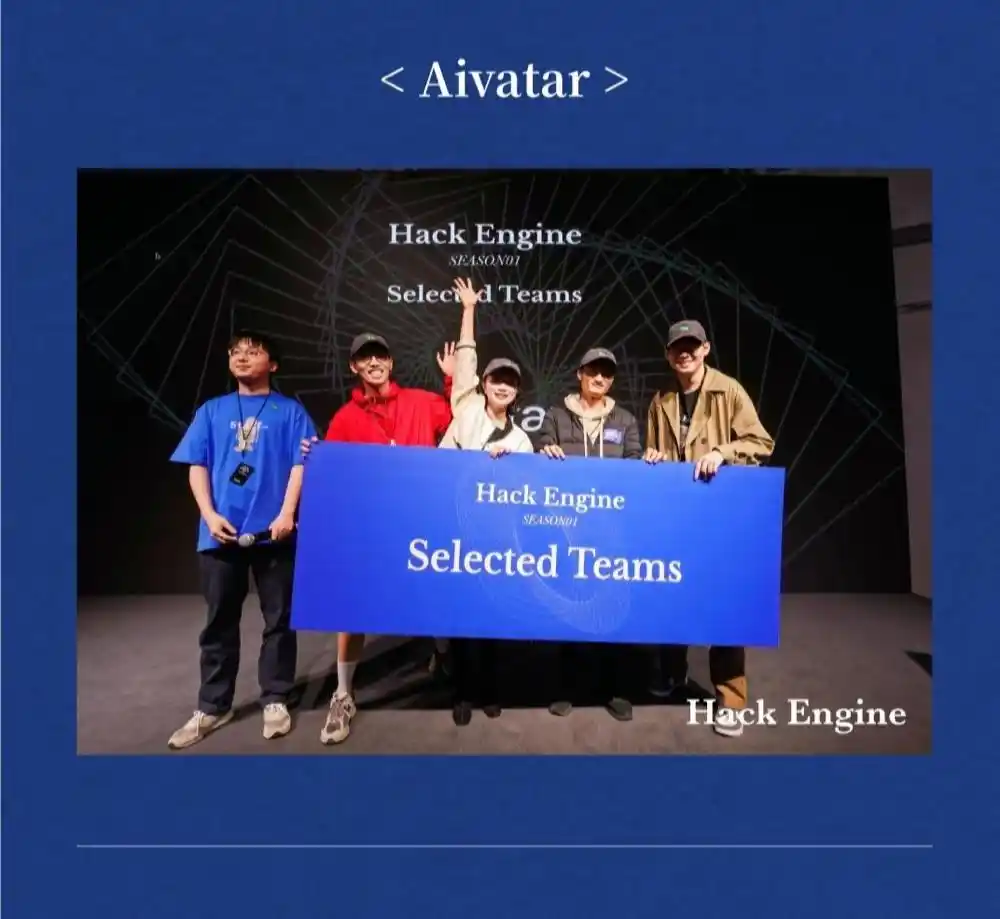
Hackathon Top 10 Finish
First, model performance was unstable. It occasionally delivered stunning results but frequently failed. A product can’t rely on occasional brilliance—it must deliver consistent value.
Second, costs were prohibitively high. During our 48-hour hackathon, we spent hundreds of dollars in token fees. If turned into a commercial product, user payments might not cover model costs.
Third, the ecosystem was heavily dependent on OpenAI’s closed-source APIs. If a product’s value rested entirely on a single proprietary model, any interface, pricing, or service changes from the supplier could directly disrupt the application.
By 2025, all three issues had significantly eased. Leading models now perform reliably across most tasks; million-token costs have dropped to a few yuan; open-source models like Qwen, DeepSeek, and Kimi have reached stable, usable levels, deployable across various cloud providers.
At this stage, large models are approaching utility-grade status—like water, electricity, or cloud computing. Developers pay and receive them without fear of being locked into a single vendor. I believe the infrastructure for AI application entrepreneurship is mature enough to act. Thus, I decided to enter the arena.
Intelligent Things: There are many directions for AI applications. Why specifically choose dating and relationships?
Zeng Xinxin: My entrepreneurial habit is to focus only on problems I’ve personally experienced and deeply understand.
When I launched the food delivery platform, it was because I was a heavy user. At the time, no mature online platforms existed—I ordered food 100–200 times a year, repeatedly encountering pain points, so I wanted to build a better solution.
Similarly, I met my wife through a dating app. After using one for over a year, I noticed systemic flaws—some tied to product philosophy and capability, others constrained by technical limitations at the time.
When choosing a venture, I consider three criteria: Does it have social value? Can I do it? Do I genuinely want to do it?
Helping people form lasting relationships has clear social value, and users are willing to pay for it. Technically, dating is fundamentally a human-to-human search problem—highly relevant to my past work in search and recommendation. I’m also a typical user who’s faced setbacks and ultimately found my wife through online platforms. I’m driven to fix the bad experiences I’ve lived through.
03. Traditional Platforms Expand Choice, AI Solves “Who to See First”
Intelligent Things: Your personal experience on traditional dating apps—how did it shape Liangpei’s product design?
Zeng Xinxin: People use dating apps because there are limited single opposite-sex individuals in their immediate circles. An urban dweller might know only dozens of singles, while Shenzhen alone has millions. Dating apps first expand the candidate pool.
Older-generation apps mainly solved the “connect with more people” problem but didn’t adequately address “connect with the right people earlier.”
They resemble moving offline matchmaking events online. Users fill out basic info, and the platform pushes profiles—subsequent understanding and judgment remain entirely user-driven. Many differences in values, personality, and life planning could have been detected early, but users often discover them only after lengthy chats or in-person meetings.
So I decided to write a much more detailed profile. I described who I was, what kind of person I wanted, what lifestyle I envisioned, and how I’d evolved into my current self.
My idea: if I couldn’t judge suitability from someone else’s profile, at least I could let others judge my suitability from mine.
Later, I met my wife this way. This taught me that the first step in online dating is providing rich context.
Context serves two purposes. First, it allows others to assess compatibility. Second, it enables the platform to understand the user. With 300,000 users, how does the platform decide which 10 people to recommend daily? Without understanding the user, it cannot answer.
Intelligent Things: What role can AI play here?
Zeng Xinxin: Historically, users provided minimal profiles due to both intent and capability. Some merely browsed casually without serious intentions; others had intent but struggled to express themselves clearly in hundreds or thousands of words, or lacked clarity about their own needs.
The AI Matchmaker lowers the expression barrier. Users spend 20–30 minutes engaging in 30+ rounds of dialogue with the AI, generating roughly 4,000 tokens of context. This content fuels profile generation and helps the platform understand users.
Currently, our average user profile length is ~463 characters—four times the average of competitors (~110).
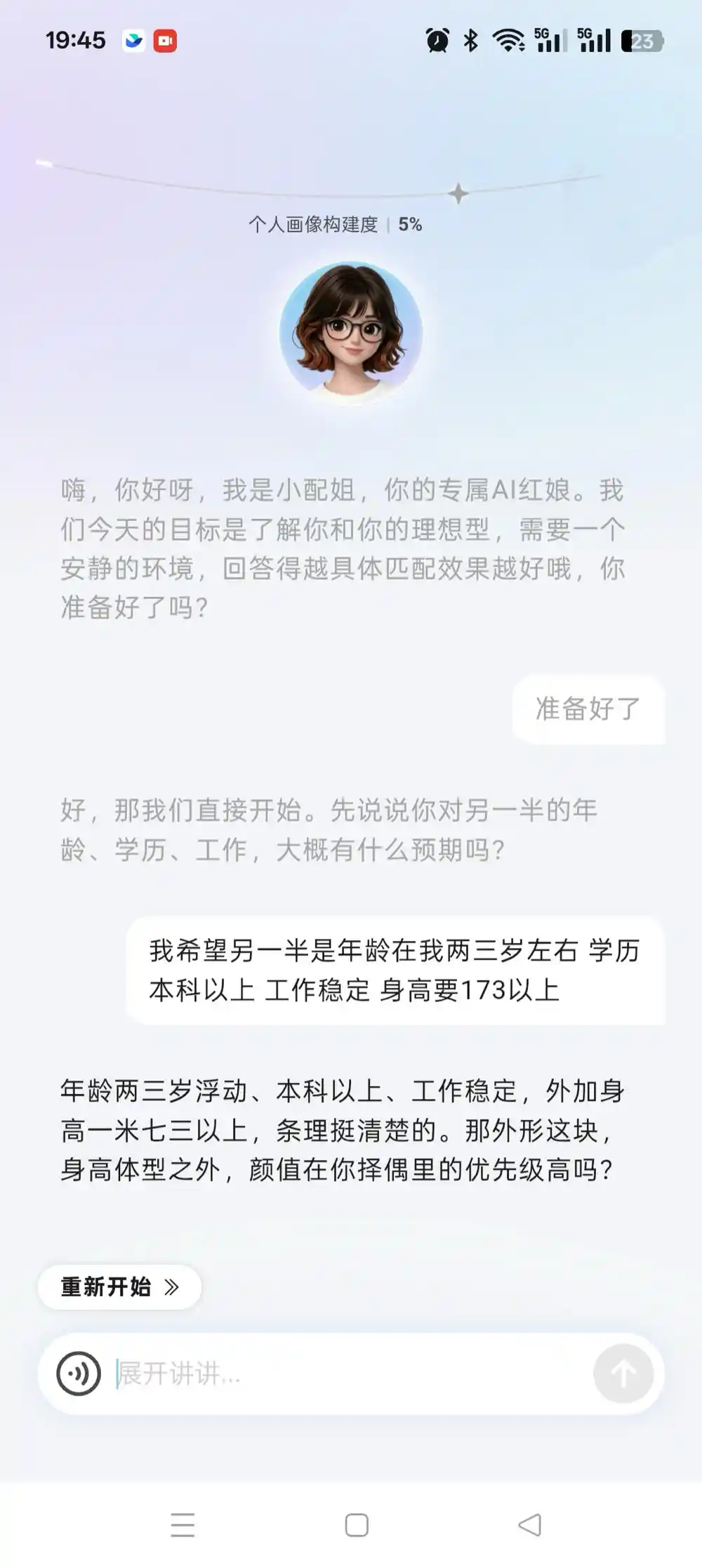
AI brings a second transformation: enhanced comprehension.
Even with 2,000-character profiles, platforms struggled to truly understand content. To traditional algorithms, it was just a 2,000-character text block. Large language models can parse personality traits, life experiences, values, and future plans, enabling deeper analysis.
My wife and I both wrote extensive profiles, yet the platform never proactively matched us—we met by luck. Liangpei aims to truly understand and leverage fully expressed profiles to recommend the best possible matches upfront.
Intelligent Things: Mate selection involves many subjective preferences. How does the platform interpret unspoken or implicit user preferences?
Zeng Xinxin: User input can be categorized as explicit and implicit. Many requirements don’t need mechanical checklist fulfillment—what matters is understanding the underlying reasons.
For example, my wife once listed “born after 1992, master’s degree or higher”—I didn’t meet either.
Her real desire was for a more mature partner. Her requirement for a master’s degree stemmed from her own PhD education—she wanted shared intellectual grounding and common topics. Someone with a bachelor’s degree but possessing the maturity and scientific literacy she valued might be far more suitable.
Surface-level traits like age, education, gentleness, or extroversion mask deeper characteristics. Users may not articulate these clearly. Deep learning models, through training, can map explicit expressions into implicit parameters.
“Want someone older” and “want someone mature” may converge to similar parameters in the model. The system must grasp the underlying inclination—not turn dating into a tick-box exercise.
04. 20-Minute Registration with AI Matchmaker – Completion Rate Over 80%
Intelligent Things: Liangpei currently features AI Matchmaker, AI Avatar, and AI Strategist. What problems do these Agents solve?
Zeng Xinxin: The AI Matchmaker primarily handles registration and data collection.
During registration, users spend ~20 minutes conversing with the AI Matchmaker. It asks targeted questions about life experiences, personality, relationship views, lifestyle, and future plans—helping users clarify and express themselves. Post-conversation, the platform generates a comprehensive profile and matchmaking persona.
Its core function is ensuring every user provides sufficient information—readable by others and understandable by the platform for intelligent recommendations.
The AI Avatar acts as an intermediary. Users can anonymously chat with any candidate’s AI Avatar—asking about gaming habits, sports routines, tennis skill level, or sensitive topics like dowry and mortgage.
If the answer exists in the profile or was previously given, the AI Avatar replies directly. If not, the question is forwarded anonymously to the user, who can choose to respond or not.
This reduces pressure in real-person conversations.
Asking a sensitive question directly from a real person risks associating the question with the asker, triggering resistance. Anonymized queries diffuse emotion. For the recipient, the AI Avatar also minimizes repetitive answers.
The AI Strategist appears during real-user chats.
It reads both profiles and chat history, helping users analyze whether the other party shows interest, what topics to introduce during lulls, and what subjects the other finds engaging.
Previously, people would consult friends, girlfriends, or family to review chat content. The AI Strategist assumes a similar third-party role—but with full access to both parties’ profiles, enabling more targeted advice.
Intelligent Things: Will users really treat the AI Strategist as a relationship counselor?
Zeng Xinxin: During user interviews, one user voluntarily shared a story about using the AI Strategist.
A woman chatted with a Ph.D. candidate for several days. The man suddenly stopped responding. She didn’t know if he was busy in the lab or ending the relationship, so she consulted the AI Strategist.
The Strategist analyzed several possibilities and advised her to wait three days. On the third day, she returned: “It’s already been three days. I’ll wait until 8 PM tonight—if he hasn’t replied, I’ll end the relationship.”
She genuinely treated the AI Strategist as someone to discuss with. Without it, such emotions and judgments might lack an outlet.
Two users in conversation—one male, one female—each asked their AI Strategist: “Does the other have feelings for me?” We’re planning to add a feature: when both ask the same question, the system unlocks a hidden achievement called “Telepathic Connection.”
Intelligent Things: Large models suffer from hallucination, repetition, and logical inconsistencies. How does Liangpei ensure smooth long-form conversations?
Zeng Xinxin: We’ve done extensive tuning. The AI Matchmaker requires continuous 20–30 minute interaction—users must stay immersed.
It must respond quickly, logically, and reference prior context. It shouldn’t repeat questions asked minutes ago or split related questions across distant turns.
To optimize this process, I personally conversed with the AI Matchmaker hundreds of times, investing about two months. Now, the completion rate exceeds 80%. Few products achieve such sustained 20-minute registration engagement—this surpasses our expectations.
The difficulty lies in determining which steps can safely be entrusted to the model, and which require process and context design constraints.
I’ve dealt with similar issues during my time at Kimi, giving me familiarity with model boundaries and Agent design. Teams lacking such experience may face more trial-and-error.
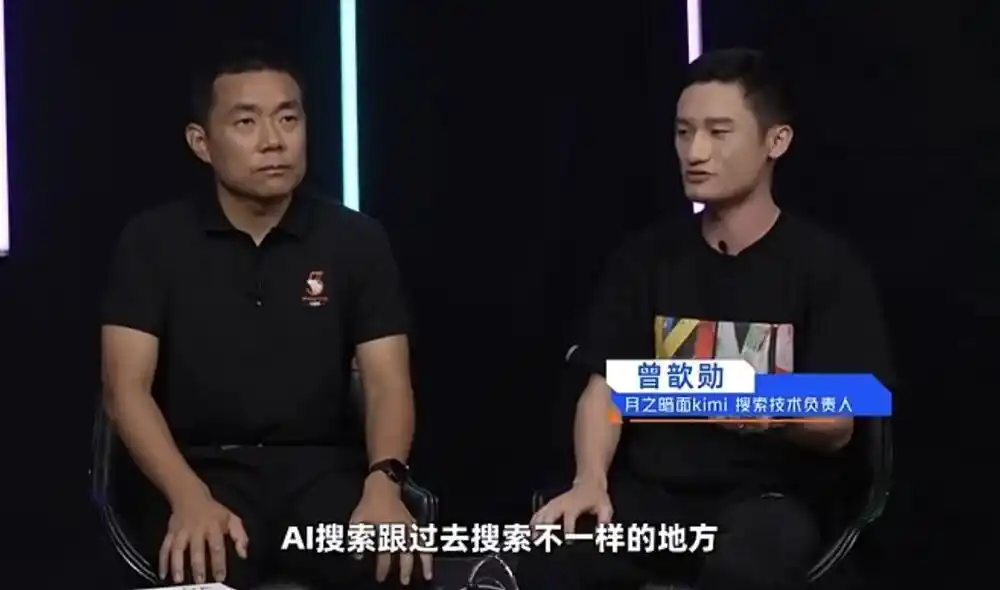
Zeng Xinxin speaking at the 2024 Cloud Computing Conference as head of Kimi Search (source: Phoenix Tech)
05. One-on-One Only – Platform Abandons Chat Duration Metrics
Intelligent Things: Liangpei requires each user to maintain only one active match at a time. Why adopt this mechanism?
Zeng Xinxin: Liangpei has one mission: help users succeed faster. Our North Star metric is average matchmaking success rate.
All technology, business models, and product mechanics serve this goal. If Liangpei becomes a platform with high success rates, word-of-mouth and revenue will naturally follow.
AI solves recommending the right person. But even with the right match, relationships don’t automatically succeed. The traditional “one-to-many” messaging model still impacts outcomes.
Conventional dating apps allow users to chat with multiple people simultaneously. Platforms may enjoy high engagement metrics, but this dilutes investment in any single relationship.
When you know the other person is chatting with others—or you have multiple candidates—you struggle to focus. A slow reply triggers suspicion. Even if compatible, insecurity often leads to breakup.
Thus, we designed the 1v1 matching mechanism. Once in 1v1 mode, users temporarily see no new recommendations and receive no messages from others. They focus solely on one question: Is this person right for me?
Users can exit anytime. Only after exiting can they match another.
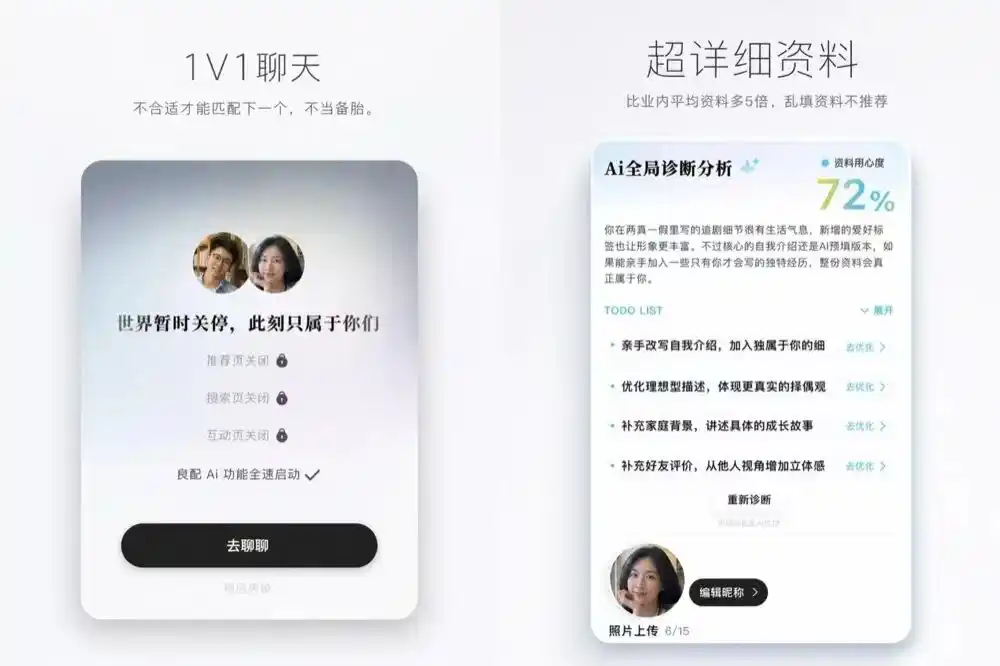
Intelligent Things: Won’t this reduce platform engagement?
Zeng Xinxin: Yes, it reduces traditional engagement metrics—but those aren’t our goals.
Currently, about 10% of users are in 1v1 matching. Of established 1v1 relationships, over half were later dissolved, but ~40% remain intact since first connection. This outcome surprised us, especially so early in launch.
The 1v1 mechanism also yields unexpected benefits.
Many platforms restrict users from exchanging WeChat IDs, fearing users will leave and abandon platform engagement. Liangpei does not block WeChat sharing. As long as the 1v1 relationship persists, switching platforms doesn’t matter.
Users can’t easily bypass the mechanism by adding WeChat. If one party adds WeChat and immediately exits 1v1 to pursue others, the other sees the relationship ended.
More importantly, this mechanism provides a success signal hard to obtain on traditional platforms.
If two users enter 1v1 mode and both stop logging in long-term, they likely formed a relationship. If unsuccessful, one usually returns to dissolve the match and seek others.
General platforms only know users stopped using—they don’t know if the user found a partner or abandoned the platform. Liangpei can identify who successfully paired, becoming crucial training data for future matching models.
06. “Marriage Guarantee” Plan: Refund if Not Married Within 3 Years
Intelligent Things: Why did Liangpei introduce the “refund if not married” membership plan?
Zeng Xinxin: We believe dating apps shouldn’t profit from user session duration.
If revenue depends on subscription length, longer usage means higher income—making it hard for the platform to prioritize helping users solve problems quickly.
Thus, we designed two main membership tiers.
The first is the RMB 2,000 “Marriage Guarantee Membership,” valid for three years. If the user doesn’t marry within three years, they can apply for a full refund.
The second is a RMB 1,000 lifetime membership, with no refund guarantee, allowing indefinite platform use.
We believe “lifetime access” is sustainable in dating products. Unlike tools for generating videos, images, or code where users can endlessly consume tokens, finding a partner isn’t infinite. Users will either succeed and leave, or eventually quit after prolonged failure.
Both pricing models reduce the link between platform revenue and user dwell time.
Intelligent Things: How has the paid conversion been since launch?
Zeng Xinxin: The product is very new. All new users currently receive a free three-month membership to accelerate early user acquisition—so real conversion rates aren’t visible yet.
From user comments and feedback, most understand this model. While not certain it will succeed, users generally agree that time-based pricing creates misaligned incentives and are open to trying a new approach.
As of the interview, registered users exceeded 9,000, growing daily.
Intelligent Things: If users don’t marry within three years, where does the company’s long-term revenue come from?
Zeng Xinxin: We earn from users who successfully marry.
Our goal: eventually, 1 in every 10 newlyweds in China will meet through Liangpei. This benchmark reflects the U.S. serious dating market, where top platforms capture a significant share of new marriages.
China sees over 10 million marriages annually. If 10% of these couples met via Liangpei, and each pays ~RMB 2,000 in membership fees, annual revenue could reach billions.
Unmarried users get their money back—those revenues effectively vanish.
Whether the model sustains depends on whether we can help enough users succeed. It forces the team to constantly focus on product efficacy—not prolonging user sessions for revenue.
07. Training a Small-Scale Model to Answer “Are They Compatible?”
Intelligent Things: How does Liangpei match suitable partners?
Zeng Xinxin: Traditional dating apps struggle to interpret long-text profiles. Recommendations are often based on limited signals. Large models can understand thousands of words of user input and extract personality, background, preferences, and values.
Eventually, we’ll train a dedicated Liangpei model. It won’t handle general tasks like coding or writing—it will solve one problem: judging compatibility between two people.
Input: both users’ thousands-of-words profiles. Output: compatibility verdict and probability of successful relationship.
Training data comes from real platform interactions: who liked whom, who responded, how many messages exchanged, whether they met, whether a relationship formed, who rejected whom.
The model learns regional, demographic, and societal mating patterns.
While individual needs vary, broad patterns exist. MBTI classifies people into 16 types—we could imagine dividing users into 64 or 128 categories. But we don’t predefine categories; the model discovers hidden clusters based on data distribution.
New users trigger system classification: which type of person they’re most likely to connect with. We don’t claim our prediction guarantees success—just that we rank higher-probability matches first, letting users explore them first.
Intelligent Things: How large should this model be?
Zeng Xinxin: This is a post-training model.
We don’t need a massive general model—7B or 14B scale may suffice. The base model provides natural language understanding; post-training teaches it the specific task of judging compatibility.
Currently, we haven’t formally trained this model. We’re relying on general large models’ generalization for recommendations.
Training a specialized model requires sufficient real-world data. Next phase: gradually collect relationship development samples from existing users, then begin post-training.
Early data accumulators can train sooner; improved model performance attracts more users and data—creating a data flywheel effect.
Intelligent Things: Which models does Liangpei currently use? What’s the approximate cost per user?
Zeng Xinxin: We use Douba, DeepSeek, Qwen, and Kimi—each excelling in different scenarios.
For voice scenarios, we use Douba—the voice sounds more natural. So the AI Matchmaker’s voice capabilities are powered by Douba.
When strict formatting and accuracy are needed, we use Qwen.
For more natural, human-like dialogue, we choose DeepSeek.
When Agents need to manage long workflows and autonomously decide next steps, we use Kimi.
One user’s full AI interaction during registration costs ~RMB 1. Ongoing daily recommendations, AI Avatar, and AI Strategist usage incur additional costs, depending on login frequency and usage volume.
Over a user’s lifecycle, total model cost may reach tens of RMB.
08. Declining Marriage Rates – Online Dating May Grow
Intelligent Things: China’s marriage numbers have declined in recent years—will the serious dating market shrink?
Zeng Xinxin: Overall marriage numbers are indeed falling, but the number of people turning to online channels may be increasing. The online dating market has grown in recent years.
More people realize that relying solely on classmates, coworkers, or friends rarely yields enough suitable partners. Beyond the few who develop relationships with peers, most need to meet strangers.
Referrals are inefficient—often lacking information before meeting. Online platforms showcase job, education, appearance, personality, interests, and self-descriptions—providing richer basis for judgment.
In the U.S., 50% of people have used dating apps, and 30% of marriages originate online. In China, the proportion of marriages starting online remains low—indicating room for growth.
Total marriage numbers may decline, but online channels’ share in romantic relationships may keep rising.
Also, marriage rates won’t drop to zero. East Asian societies can look to Japan’s trajectory. After rapid decline, Japan still sees most people marry in their lifetime. Long-term, serious dating demand won’t vanish.
Intelligent Things: Will AI dating soon become a crowded market?
Zeng Xinxin: I don’t think it will be overly crowded in the short term.
Xu Xin previously tracked both AI recruitment and AI dating. In AI recruitment, six or seven teams were active; in serious dating, only ours existed at the time.
Dating entrepreneurship involves natural filtering. Past dating app founders often faced personal dating struggles. A tech or search expert without such experiences likely lacks motivation to build a dating product.
Recruitment differs—everyone has searched for jobs, making it easier for many teams to emerge.
Overall, AI entrepreneurs are relatively young and many haven’t entered the dating phase. Even if they do, they must endure difficulties and find solutions before understanding the core problems of serious dating products.
These conditions collectively narrow the pool of viable founders.
Intelligent Things: What are Liangpei’s key challenges at this stage?
Zeng Xinxin: The priority is maintaining agility and iterating based on real user feedback.
Even in the first version, we launched a dedicated feedback forum. Users can report issues with match quality, interaction flow, or AI behavior. Forum content syncs to our team’s Feishu—promptly addressed upon receipt.
Initial product testing relied on internal simulation. Now with real users, we observe their pain points and resolve them swiftly.
Next phase’s technical focus is training the relationship prediction model. Currently, we depend on general large models’ generalization. Specialized models need substantial real interaction and outcome data.
Once sample size reaches critical mass, we’ll enter post-training. Improved model performance boosts match success, attracting more users and data—enabling further optimization.
For Liangpei, early data accumulation and the resulting training loop centered on real relationship outcomes will be key competitive advantages.
09. Conclusion: Dating Apps Can Also Proactively Let Users Go
Dating products have a unique trait: the day a user achieves their ideal result is also the day they no longer need the app.
Traditional platforms are trapped by metrics like engagement, chat duration, and subscription renewal. Liangpei instead aligns technology, product mechanics, and revenue model around one goal: maximizing matchmaking success rate.
The AI Matchmaker ensures users express fully; the recommendation model finds better matches; AI Avatar and Strategist reduce friction in stranger interactions; the 1v1 mechanism demands focus on one relationship; and the “refund if not married” policy ties revenue directly to final outcomes.
Whether this design improves real relationship success remains to be validated by time and data.
Yet early on, over 80% of Liangpei’s users completed the ~20-minute AI Matchmaker flow; ~40% of 1v1 relationships remain active after establishment; and registered users are approaching 10,000 within ten days.
For Zeng Xinxin and the Liangpei team, the next pressing questions are concrete: How to train a model capable of judging “are they compatible?” And meanwhile, can a platform that actively limits user activity and encourages early departure sustain a viable business?
Source: Intelligent Things
Disclaimer: Contains third-party opinions, does not constitute financial advice


AI drives SK Chairman's divorce settlement bill to KRW 94.4 billion
4 days ago
AI is no longer competing on benchmark scores, but on profitability
4 days ago
ByteDance's Douyin Beans priced at 68 RMB—worth it for 382 million monthly active users?
4 days ago
Fields Medalist Concerned About AI Extinction Heads to OpenAI
4 days ago
30 Million KRW Threshold, AI Chip Leverage Cooling Down
5 days ago
Meta gives away models for free—who dares to price AI now?
5 days ago
$13.7 Billion Prediction Market: Are Retail Investors Making Way for AI?
5 days ago


