Qwen-Image-3.0 – Alibaba Tongyi Launches Third-Generation Foundation Model for Image Generation
Qwen-Image-3.0 – Alibaba Tongyi Launches Third-Generation Foundation Model for Image Generation

What is Qwen-Image-3.0
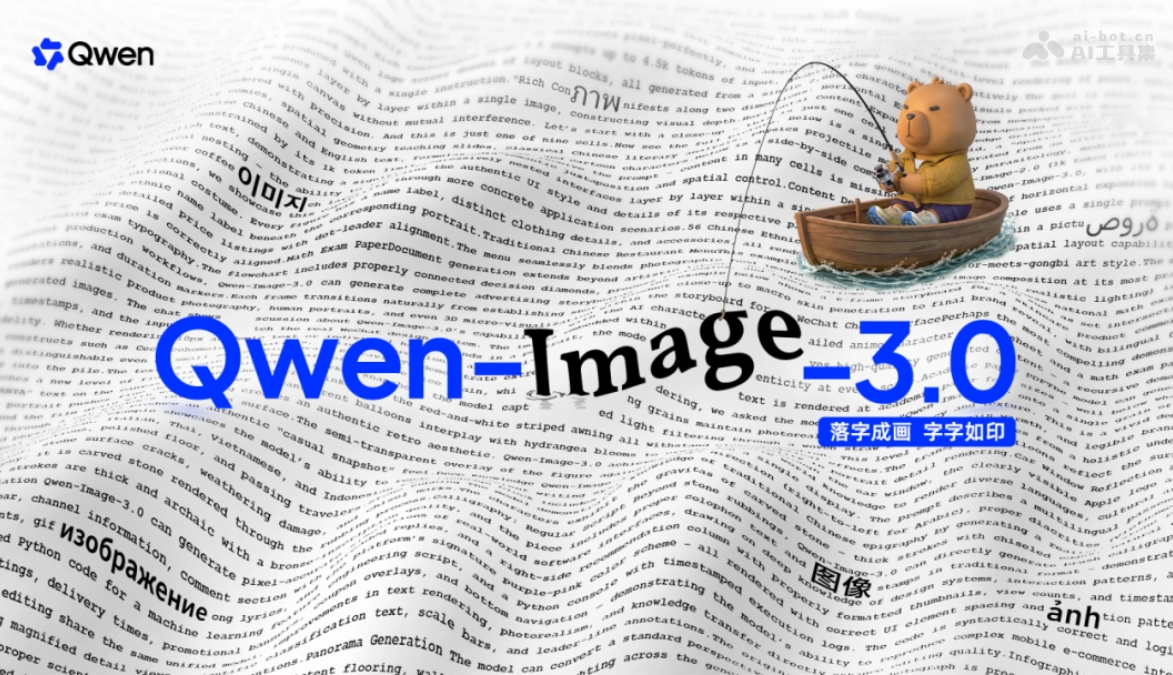
Qwen-Image-3.0 is the third-generation foundational image generation model launched by Alibaba's Tongyi Qianwen team. The model supports ultra-long input of up to 4.5k tokens, enabling single-pass rendering of complex nine-grid knowledge infographics; it features precise layout for text as small as 10px, making academic papers, formula derivations, and handwritten annotations clearly legible; equipped with native rendering capabilities for 12 languages and rich world knowledge, it can simulate web pages, games, live streams, and other interface styles. It is currently available for API invitation testing via Alibaba Cloud BaiLian and the Qwen AI platform, with Qwen Studio and Qwen APP soon to launch free trial access.
Main Features of Qwen-Image-3.0
-
Ultra-Long Context Generation: Supports a maximum input of 4.5k tokens, enabling comprehension and rendering of highly complex, information-dense visual layouts such as newspapers, storyboards, and examination papers.
-
Semantic Placing and Spatial Control: Possesses horizontal content expansion capability, allowing orderly layout of multiple parallel elements within a single frame without interference.
-
Semantic Decomposition and Logical Nesting: Features depth-aware content processing, enabling step-by-step rendering of multiple nested interfaces within one image, achieving a "picture-within-picture-within-picture" effect.
-
Micron-Level Detail Rendering: Text as small as 10px remains crisp and readable; individual pores, strands of hair, and skin texture are rendered with photorealistic precision.
-
Native Multilingual Rendering: Supports accurate presentation of 12 languages within images, not merely through overlay techniques.
-
Interface Simulation: Capable of simulating mainstream web, gaming, and live-streaming interface styles and fine details.
-
Knowledge Infographic Generation: Can generate complex educational infographics containing extensive text, illustrations, formulas, and charts.
Technical Principles of Qwen-Image-3.0
-
Ultra-Long Context Understanding Architecture: By extending the maximum acceptable instruction length to 4.5k tokens, the model can process intricate spatial relationship descriptions and multi-element layout instructions.
-
Fine-Grained Text Rendering Technology: Optimized for small-font scenarios, ensuring readability and layout accuracy of text at 10px level even on complex backgrounds.
-
Embedded Multilingual Generation: Internalizes language knowledge into the generation process, enabling native rendering of 12 languages rather than post-processing overlays.
-
World Knowledge Integration: Embeds extensive domain-specific knowledge to ensure professional accuracy in generated content.
-
Layered Semantic Control: Achieves precise control over complex layouts through semantic placing and semantic decomposition.
How to Use Qwen-Image-3.0
-
API Invitation Testing: Access the Alibaba Cloud BaiLian platform or the Qwen AI platform to apply for API access permissions to Qwen-Image-3.0.
-
Prompt Engineering: Use natural language to describe scene content, layout, textual elements, style, etc., supporting complex instructions up to 4.5k tokens.
-
Wait for Launch: Qwen Studio desktop and Qwen APP mobile will soon open free trial access, allowing direct input of requirements in a graphical interface to generate images.
-
Application Scenario Invocation: Suitable for education courseware, academic paper illustrations, UI design mockups, knowledge infographic creation, poster layout, and other scenarios requiring precise text and complex layouts.
Core Advantages of Qwen-Image-3.0
-
Practical Orientation: Unlike generative models focused on artistic aesthetics, it targets real-world productivity applications, emphasizing usability and practicality.
-
Natively Generated Complex Layouts: No need for multi-image stitching—complex layouts including nine-grid structures and multi-layer nested UIs can be generated in a single image.
-
Industry-Leading Text Rendering Precision: Supports precise rendering of 10px text, LaTeX formulas, and academic paper typesetting.
-
Knowledge Accuracy: Leverages Tongyi Qianwen’s knowledge base to ensure professional accuracy in generated content (e.g., mathematical theorems, biological facts).
-
Chinese-Native Optimization: Deeply optimized for Chinese typesetting, character rendering, and Chinese knowledge infographics.
Competitive Comparison with Similar Models
| Comparison Dimension | Qwen-Image-3.0 | GPT-Image 2.0 |
|---|---|---|
| Core Positioning | Productivity tool, focused on precise layout of complex visual compositions and practical deployment in Chinese contexts | General-purpose visual execution system, emphasizing reasoning planning and multilingual text rendering |
| Input Length | Supports 4.5k tokens, capable of describing extremely complex layouts like nine-grid and nested UIs | Supports kilo-character-level long prompts; Thinking mode can decompose complex requests, but input length lags behind Qwen |
| Small-Text Rendering | 10px text clearly legible, with precise rendering of formulas, academic typesetting, and handwritten annotations | Claims ~99% text accuracy, supports multilingual small text, but stability in complex academic layouts remains unverified |
| Multilingual Support | Native rendering of 12 languages, with deep optimization for Chinese long texts, vertical layout, and mixed text-formula formatting | Supports rendering of over 50 languages at character level; significant improvement in Chinese performance, but slightly weaker understanding of local cultural nuances |
| Complex Layouts | Natively supports complex structures like nine-grid, multi-layer nested UIs, and “picture-within-picture-within-picture” layouts generated in one shot | Excels in grid systems, UI layouts, and information hierarchy; uses Thinking mode to pre-plan composition |
| Reasoning Capability | Relies on Qwen’s knowledge base to ensure content accuracy; layout control leans toward semantic placing and spatial control | Natively integrated O-series reasoning, autonomously plans layout, performs online searches, and analyzes uploaded documents before generation |
| Knowledge Accuracy | Integrated Tongyi Qianwen knowledge; high accuracy in Chinese content such as mathematical theorems and biological science | Can perform real-time web search, accurately renders technical artifacts and current events, but depends on external retrieval |
| Continuity Consistency | No emphasis on multi-image consistency; focuses on single-image complexity | One prompt can generate up to 8 images with consistent style and character, ideal for storyboarding |
| Output Resolution | Not explicitly stated; emphasizes layout complexity over single resolution | Supports 2K (2048×2048) and various aspect ratios; API maxes out at 4K (3840×2160) |
Application Scenarios of Qwen-Image-3.0
-
Educational Publishing: The model can generate math exams, physics formula illustrations, biology knowledge infographics, and annotated Chinese literature materials for teaching.
-
Academic Research: Automatically generates complex academic paper illustrations with intricate formulas and multi-column layouts, as well as conference posters.
-
UI/UX Design: Rapidly produces high-fidelity prototypes and nested interface mockups for websites, apps, and game interfaces.
-
Content Operations: Creates infographics, long-format posters, and multilingual social media assets, ensuring accurate transmission of textual information.
-
Digital Publishing: Generates magazine layouts, newspaper typesetting, comic storyboards, and other content requiring precise mix of text and imagery.
Disclaimer: Contains third-party opinions, does not constitute financial advice


Wan-Streamer v0.2 – A Multimodal Understanding and Generation Model Launched by Alibaba Tongyi
4 days ago
StaffDeck – Open-source Enterprise-grade Digital Employee Platforms by Membrane Intelligence and Others
4 days ago
Nemotron 3 Embed – NVIDIA's Open-Source Text Embedding Model Series
4 days ago
Inkling – A multimodal foundational model launched by Thinking Machines Lab
5 days ago
Backup – K12 Primary and Secondary School Teachers' AI Lesson Planning Platform Launched by 360
5 days ago
X2.0 – The World's First Real-Time Interactive Video Generation Model Launches by Xmax AI
6 days ago
Xiaomi-Robotics-U0 – Xiaomi's Unified Embodied Synthetic Model
6 days ago


