Trillion-dollar robotics deployment stuck at distribution cabinets and batteries
Trillion-dollar robotics deployment stuck at distribution cabinets and batteries

Previously, in my article "After the Demo: The Next Trillion-Dollar Opportunity for Humanoid Robots Lies Neither in the Brain Nor the Body," I highlighted a core thesis: the real bottleneck for robots transitioning from "lab demos" to "factory deployment" lies in sustained operational capability. Crossing this threshold isn't achieved by adding more degrees of freedom—it requires an entire hidden infrastructure beneath the surface: training and data collection, maintenance networks, spare parts supply chains, insurance, leasing, and financing...
In today’s piece, we’ll dive deep into one particularly critical yet rarely quantified component of this ecosystem: energy replenishment infrastructure.
At the end of that article, I used the Ford Model T as a metaphor. The Model T's launch in 1908 didn’t immediately transform America; it was the next two decades of quietly building gas stations, 4S shops, car insurance, and driving schools in every small town that turned the U.S. into a nation on wheels.
In the humanoid robot ecosystem, what does the first "gas station" look like? Will large-scale robot deployment intensify factory power shortages? Let’s examine a few foundational business calculations.
First Ledger: What’s Missing Isn’t “kWh,” But “kW”
In June this year, the Ministry of Industry and Information Technology (MIIT) and the State-owned Assets Supervision and Administration Commission (SASAC) jointly issued the Notice on Jointly Conducting the 2026 Practical Application Training Action for Humanoid Robots and Embodied Intelligence, explicitly stating that by the end of 2026, the goal is to "drive the deployment capacity to a scale of ten thousand units."

Let’s start with a macro-level electricity calculation based on this target.
Current mainstream industrial humanoid robot power consumption: Figure 03 officially claims a 2.3 kWh battery supports five hours of peak operation, translating to an average power draw of approximately 460 watts; Tesla’s Optimus Gen-3 claims the same 2.3 kWh enables light-load operation for 10 hours, equating to roughly 230 watts.
Considering actual field runtime typically falls short of stated specs, we take 500 watts as our benchmark. For continuous 7×24 operation, a single unit consumes about 12 kWh per day. With ten thousand units fully deployed at full load, annual electricity usage would reach ~44 million kWh. National annual power generation stands at around 10 trillion kWh—so 44 million kWh is equivalent only to a mid-sized data center’s yearly consumption.
From a macro perspective, the grid faces no pressure. But the real financial ledger lies at the factory-level distribution panel.
The notice provides two figures: over 100 high-value application scenarios, and a deployment capacity of ten thousand units. Dividing these yields an average of 100 units per scenario. One hundred robots require ~1,200 kWh daily for recharging. At China’s average industrial-commercial electricity rate, this amounts to just ¥700–800 per day.
The real cost hides in the other half of the electricity bill.
Industrial and commercial users with transformer capacities of 315 kVA or higher are subject to a two-part tariff system: they pay not only by kilowatt-hour but also by transformer capacity or maximum demand. If 100 robots charge simultaneously during peak windows, the incremental maximum demand could range between 100–200 kW. According to the fourth regulatory period transmission and distribution pricing table, the demand charge for such practical application training across ten provinces ranges from ¥35 to ¥52 per kW·month—amounting to an additional ¥40,000–120,000 in basic electricity fees annually.
This cost has nothing to do with how many kWh are consumed—it depends solely on the instantaneous power peak at that moment.
A harder constraint is transformer capacity.
If the factory’s transformer is already operating above 80% load, any new load must undergo grid capacity expansion approval. Capacity upgrade projects typically span months—while robot delivery cycles are measured in weeks.
This time lag implies a stark industrial reality: whether a factory can deploy robots may not depend on its production line layout, but rather on the capacity of its electrical panel.
Second Ledger: Electricity Costs Are Just the Surface — Batteries Are Consumables
Industry often cites a misleading figure when assessing robot labor costs: robots consume about half a kWh per hour, costing less than ¥0.40 in electricity. Compared to human workers’ hourly wages of ¥20–30, robot economics seem self-evident.
But this calculation omits the largest hidden cost: battery depreciation.
Robot battery packs typically range from 1 to 2 kWh, supporting ~2 hours of operation per pack. This means:
If operating continuously 7×24, a single robot consumes 12 battery packs per day.
Even under a two-shift schedule (16 hours), it still needs 8 packs.
If three packs rotate in use, each battery undergoes 3–4 full charge-discharge cycles daily. With a typical lithium iron phosphate (LFP) battery cycle life of 3,000 cycles, one battery lasts only 2–3 years.
When we amortize battery degradation into electricity cost: assuming a 1 kWh-grade swappable battery pack costs ¥3,000–6,000, and delivers ~2,700 kWh over its lifetime, the battery wear cost per kWh is ¥1.1–2.2.
Thus, for every kWh consumed, the robot incurs battery wear costs two to three times the electricity fee. Annually, while electricity costs per robot are ~¥2,000–3,000, battery replacement costs reach ¥4,500–9,000.
Therefore, for robots, batteries logically resemble printer ink cartridges—not car components.
Electric vehicles recharge every few days; their batteries are durable assets with eight-year warranties and residual value. Robot batteries cycle 3–4 times daily and degrade within 2–3 years, with near-zero residual value. The same electrochemical materials become assets in cars, but consumables in robots.
Assets are evaluated by depreciation and salvage value; consumables by recurring purchases and gross margin.
Consumables have their own gravitational pull. Original equipment manufacturers (OEMs) have strong incentives to turn batteries into profit centers and lock-in mechanisms: proprietary interfaces, dedicated battery bays, per-unit repurchase models.
Third Ledger: The Battle of Energy Replenishment Paths and the “Free” Battery Swap Station
Currently, energy replenishment strategies have clearly diverged into three camps. When placed side by side, they reveal fundamentally different business logics.
The first camp is the "Charging Camp," represented by Tesla.
Since its first public unveiling in 2022, Optimus has firmly integrated its 2.3 kWh battery pack into the torso—a classic centralized power distribution approach borrowed from automotive design. By Gen-3, Tesla specifies “10 hours of continuous operation + 10-minute fast charging,” and has even filed a patent for a standing charging station.
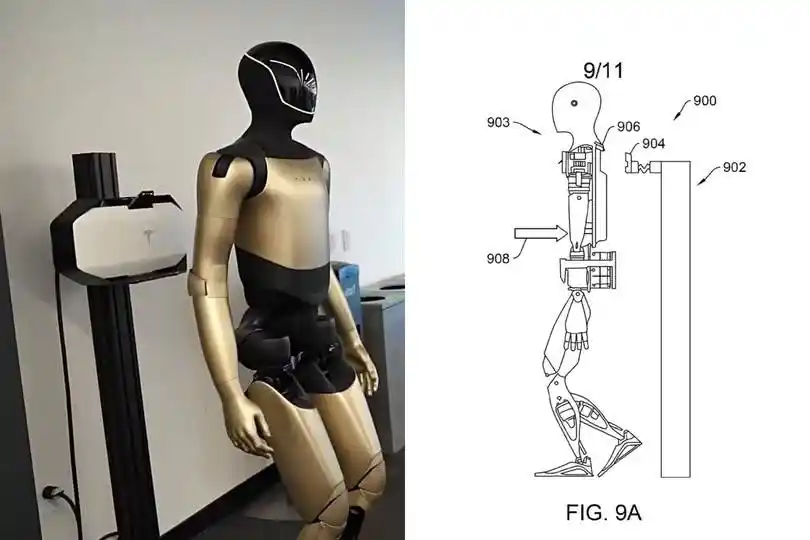
The charging camp calculates very precisely: minimal hardware complexity, smaller footprint, lower initial capital expenditure, and greater interoperability. Their bet is on continuous battery performance improvement combined with fragmented task intervals—enough to cover replenishment needs.
The second camp is the "Battery Swapping Camp," represented by Ubtech.
In July 2025, Walker S2 became the world’s first humanoid robot to feature hot-swappable autonomous battery swapping with dual redundancy. The robot autonomously moves to the rack, performs the swap itself—completed in just three minutes. By the end of last year, they had successfully scaled to thousands of units in mass production.
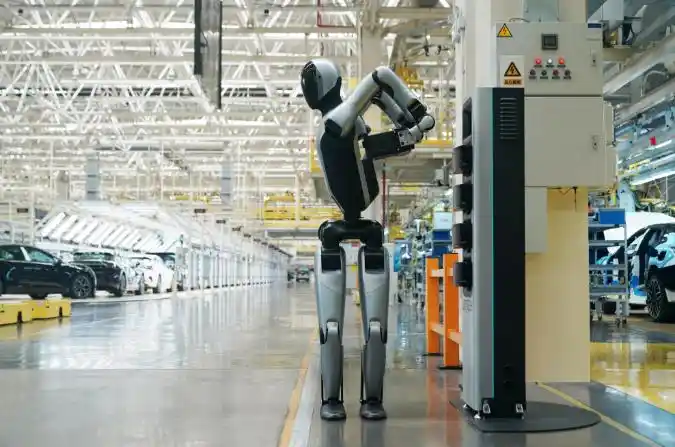
The swapping camp doesn’t believe in “task gaps.” In 7×24 continuous operation scenarios, uptime equals revenue—any downtime due to charging is a direct loss on the P&L statement.
The third camp is the "Large Battery Chassis Camp," exemplified by Kuawei Intelligent.
Their W1 model directly mounts a 20kg massive battery onto a wheeled chassis, achieving an 8-hour runtime through brute force. This approach is the most straightforward: trading chassis load capacity for endurance—but sacrificing the universal adaptability of bipedal form in complex terrains.
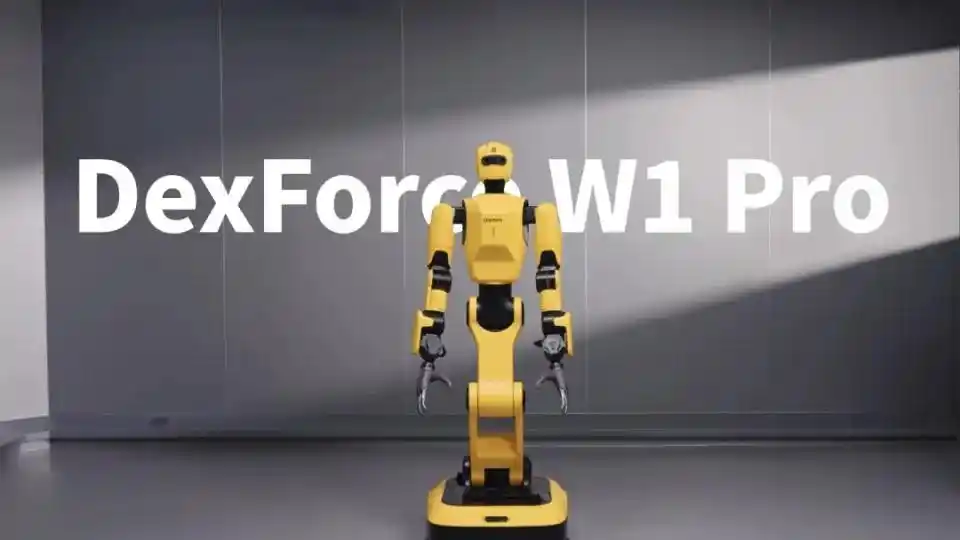
If we zoom out, this battle is far from novel. In the warehouse logistics sector, automated forklifts and AMRs have long solved this puzzle via “automatic charging + manual swapping.” Today’s humanoid robots are simply tackling the “hard mode”: cramming batteries into space-constrained humanoid bodies, while requiring robots to “swap their own batteries.”
My judgment: these three camps won’t eliminate each other. Instead, they will physically segment by use case. Single-shift operations with natural task gaps belong to the charging camp; 7×24 continuous heavy industry applications suit the swapping camp; flat-surface material handling favors the chassis camp.
Among them, the swapping path harbors the most disruptive variable: it physically decouples energy from the robot body, transforming it into a standalone “asset layer.”
Let’s compare with NIO’s battery swapping model: the construction cost of NIO’s swap stations has dropped from ~¥3 million per first-gen station to ~¥1.5 million per third-gen station (excluding batteries). A fully equipped station with 21 batteries involves a one-time investment of ¥3–5 million, where the bulk of equipment cost lies in precision actuation systems for lifting, alignment, and locking.
But when transferring this logic to robotics, a fundamental misalignment emerges: NIO’s expensive automation systems become costless in robotics, because the robot itself is the actuator. It walks to the rack, reaches out, and swaps the battery autonomously.
What remains is a simple setup: a charging rack plus a pool of batteries. The total asset cost per scenario is ~¥1 million, with batteries accounting for 70–90%. This asset structure implies that robot battery swapping is no longer about “equipment operations”—it’s pure “battery asset management.”
It’s highly likely that the future will replicate NIO’s “Battery as a Service” model: battery banks own the batteries, fleets rent them monthly and pay per cycle, while OEMs return to core body manufacturing.
Final Thoughts
Beyond the above calculations, there are several latent variables not yet captured in research reports or investment ROI models. I summarize them into two hidden reefs and one gold mine:
Reef One: Fire Safety Compliance and Insurance Gaps.
A battery swapping bay for 100 robots effectively concentrates hundreds of lithium-ion batteries indoors for charging—currently falling into a regulatory gray zone. Spray-painting or hazardous chemical factories may outright abandon robot deployment plans. Property insurers may increase premiums or refuse coverage due to “indoor concentrated charging.” Insurance is both a new organ in the robot aftermarket—and possibly the first veto gate for swap bays.
Reef Two: The “Demand Charge” Loophole in Policy Gaps.
Current transmission and distribution pricing rules exempt centralized charging and swapping facilities under the two-part tariff system from demand (capacity) charges before 2030. However, indoor robot swap bays are currently billed as standard industrial loads and miss out on this ~¥100,000 annual exemption. This is tangible cost—and also a window into policy trends.
Gold Mine: The Most Compliant “Virtual Power Plant.”
Factories dread shutdowns during peak summer demand, but robot energy replenishment can be naturally shifted. If all 1,200 kWh of daily charging from 100 robots were rescheduled to off-peak hours, with a ¥0.6/kWh peak-to-valley price difference, one scenario could save ~¥260,000 annually—effectively creating a built-in ROI channel. If integrated into a virtual power plant (VPP), robots aren’t a grid burden—they become the most compliant flexible load within the factory.
This is fundamentally an IoT platform orchestration problem. Whoever controls a scheduling platform capable of synchronizing “electricity price curves, battery state-of-health, and production schedules” holds the operational gateway to the robot fleet.
In the age of robotics, the game-changing “gas station” is unlikely to look flashy. It’s probably just a row of charging racks in a corner of the workshop, a pool of batteries billed per cycle, and a set of invisible AIoT scheduling software.
This article comes from WeChat Official Account “IoT Think Tank” (ID: iot101), author: Peng Zhao
Source: IoT Think Tank
Disclaimer: Contains third-party opinions, does not constitute financial advice


U.S. School District Spends $58,000 to Hire a Bionic Robot as Teaching Assistant
4 days ago
31-Year-Old Hong Kong STEM Prodigy Launches a Robot IPO
8 days ago
46 Billion Injected into Robotics: Which Type of Founder Do Automakers Prefer?
8 days ago
Xiaoyu Intelligence has entered into a strategic partnership with Digua Robotics, deploying the "One Brain, Multiple Forms" AI core onto the Sunrise S600 platform
06-15MINT-4B Multimodal VLA Model Launches in Collaboration with Cai Panpan's Team
06-04Nosh One Kitchen Robot Launches Crowdfunding, Powered by NoshOS System with Support for 500 Dishes
05-24Google I/O 2026 Dialogues Stage Focuses on AI, Quantum Computing, and the Future of Robotics
05-22

