Can 3D Data Save Robots? Sudu Technology Achieves a 98% Grasping Success Rate
Can 3D Data Save Robots? Sudu Technology Achieves a 98% Grasping Success Rate

At the 2026 World Artificial Intelligence Conference (WAIC), Sudo Technology, less than a year old, made its first systematic domestic debut, demonstrating over ten skills on-site, covering dual-arm manipulation, flexible object handling, precision assembly, mobile grasping, and an "Easter egg" considered a pivotal direction for embodied intelligence: operation while in motion.
Enabling robots to manipulate objects in the real world increases difficulty by two to three orders of magnitude compared to mere motion control, as the robot must first comprehend the physical world before "handling" anything. This is precisely the challenge Sudo Technology aims to conquer. Co-founder and Chairman Su Hao is one of the core authors of ImageNet and studied under Fei-Fei Li. The company has taken a different path from Silicon Valley’s mainstream “pure brain black-box large models”: hardware-software co-design with a layered architecture—upper layer handles task planning and environmental understanding, lower layer manages specific object operations; Sim-to-Real serves as the core training paradigm, allowing robots to undergo millions of years of evolution in virtual environments before being transferred to reality.
This approach has already yielded results: in the April demo released this year, the robot achieved a zero-shot general grasping success rate of 98% per attempt. The over ten skills demonstrated at WAIC were not developed in isolation—they share the same Sim-to-Real technical framework. Once the underlying system is validated, the marginal cost of adding new skills rapidly declines, ultimately forming a reusable, scalable robotic system capable of continuously generating new capabilities.
In this episode of Silicon Valley 101, we invited Han Zheng, co-founder and CEO of Sudo Technology, to discuss where 3D data for robots comes from? Can the Sim-to-Real pathway truly be viable? What are the technological trajectories of major players in the global robotics race, and who will truly emerge victorious? Han Zheng predicts that more Silicon Valley companies will return to the "top-down layered" approach in the coming period. Among the many prominent startups in Silicon Valley, the combination of DeepMind and Boston Dynamics may be the most noteworthy contender on this path.
Below is a curated selection of the conversation:

Hongjun: I see your robots are very popular now—I’ve seen news reports saying investors struggle to secure shares in your funding round. There are now many robot companies. I initially categorize them into two layers: those building “brains,” like PI and Skild in Silicon Valley; and those building “bodies,” such as Optimus and Unitree. So, at the beginning, could you briefly explain Sudo Technology’s positioning—what stage of the value chain are you focusing on?
Han Zheng: We build both the brain and the body. Many robot companies today emphasize this full-stack approach—developing the entire system. Our team began using machine learning methods to drive robots around ten years ago, primarily software-focused, conducting exploration and experimentation. It wasn’t until 2022, when we started preparing for commercialization, that we formally decided to develop our own hardware body.
After years of accumulated experience, we realized that without touching the physical body, the brain’s capabilities cannot fully manifest or be iterated and validated effectively.
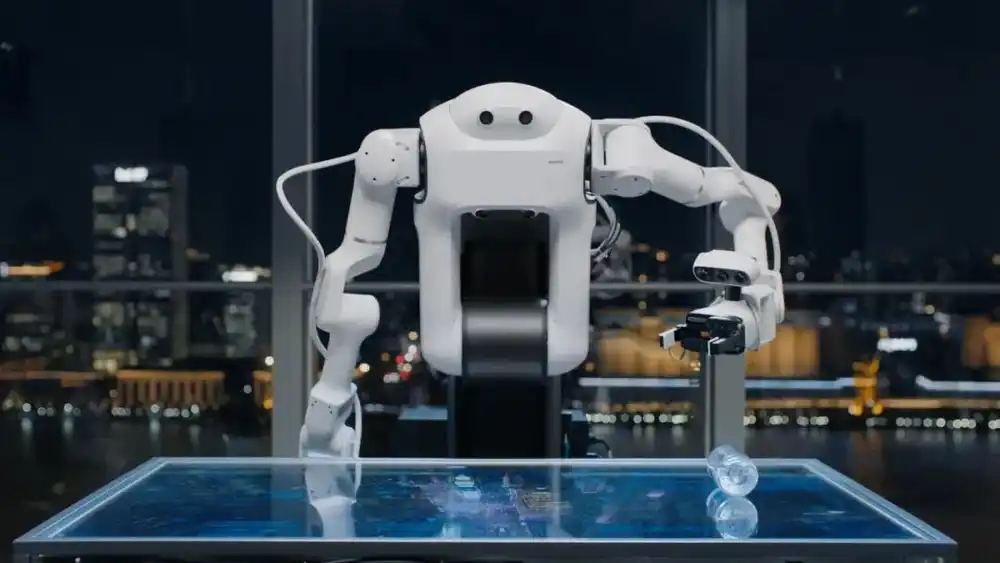
SUDO R1 Robot | Source: Sudo Technology
Hongjun: If we want to compare your work to a well-known Silicon Valley robot company, which one do you think your current efforts align most closely with?
Han Zheng: I believe Silicon Valley robot companies—whether Optimus, Boston Dynamics’ earlier generation, Figure, or 1X—are all combining body and model. However, compared to Physical Intelligence and Skild, these companies’ model-side capabilities are relatively weaker and less focused.
Hongjun: I think to understand each company's robot development philosophy, we need to trace back to their histories. I know your co-founder Su Hao was a student of Fei-Fei Li. Li’s defining moment was ImageNet—she manually annotated millions of images, enabling machines to finally perceive a sufficiently rich world. Su Hao was one of the core authors of ImageNet. Later, he applied this idea to 3D. This lineage directly connects to Sudo Technology’s current trajectory. Could you briefly introduce ImageNet and why it became the spark for the AI boom?
Han Zheng: During his PhD journey, Su Hao actually completed two PhDs. For nearly four years, he worked in Fei-Fei Li’s lab at Princeton and later at Stanford. The core project he led was essentially the ImageNet initiative. He once told me that Li’s vision and architectural design for ImageNet were remarkably foresighted.
The core idea behind ImageNet was systematically pairing typical 2D images of objects in the world with corresponding textual descriptions using a structured approach. For example, to describe almost every cup on a table, we needed a series of representative images, but for the same cup design, one or two images might suffice.
This concept was carried into 3D during 2012–2013 when Su Hao joined his second PhD advisor, Leo Guibas, at Stanford. That’s when he began constructing a large-scale 3D dataset called ShapeNet. Its biggest challenge lies in the fact that unlike ImageNet, where you can organize nearly all internet images and their associated text descriptions and titles through crowdsourcing, 3D models are severely lacking.
Hongjun: Translating this approach to the 3D domain—imagine, in 2D, recognizing a cup only requires one label. In 3D, the annotation dimensions multiply significantly. How do you handle spatial physical relationships and even force feedback in textual annotations? This seems much harder.
Han Zheng: Indeed, the work involved is far more complex. Thus, fewer people are willing to invest in 3D large datasets compared to 2D or language-based ones. We have several key projects in this space. First is ShapeNet—the core work during Su Hao’s time at Stanford, now containing hundreds of thousands of 3D data points. But it still falls far short of covering all possible objects and models globally, as ImageNet did.
These 3D models contain only basic geometry and surface textures. We can roughly estimate material properties. But going further, the same object may consist of different parts and components—e.g., a drink bottle splits into body and cap. Sometimes, you even need to annotate which part is the base. By the time we reach PartNet, only tens of thousands of objects remain.
Going even further, for a bottle, whether the cap should be turned left or right, and whether it can be unscrewed after turning—this involves dynamic constraints. The dataset is called PartNet-Mobility. To my knowledge, it remains the largest open-source dataset with part-level and dynamic constraint annotations. Yet, it contains fewer than 3,000 annotated objects. This severely limits synthetic data generation for robotics training, especially for video generation requiring continuous spatial and physical consistency.
Hongjun: Collecting 3D data is extremely labor-intensive due to annotation costs. When considering large model and robot training methods—say, training directly on ShapeNet’s open dataset versus training on thousands of open-world videos from video platforms—what’s the core difference?
Han Zheng: In our view, the core difference lies in the fact that while 2D images and videos contain 3D information, it’s incomplete and inaccurate. For applications like autonomous driving navigation, ~10 cm accuracy is acceptable. But for robotic manipulation, a 10 cm error is utterly unacceptable. Take this recorder in front of us—we need to plug cables into precise holes, requiring sub-millimeter accuracy. For our Sim-to-Real path, we demand robots have highly accurate understanding of physical objects and environments, including geometric precision at millimeter or even sub-millimeter levels.

Hongjun: What do you think is the most valuable asset Sudo Technology has inherited from Su Hao’s work on ShapeNet and now applying to Sudo Robots?
Han Zheng: Pursuing the Sim-to-Real path resembles Boeing building aircraft—a complex systems engineering endeavor. How to assemble a team capable of building such a complex system is our team’s most critical accumulation. Team members in our core groups have collaborated for seven to eight years, both within Su Hao’s lab and after company formation. People and their accumulated experience and methodologies represent an unparalleled advantage.
On data, for instance, our simulation platform has deep ties with leading industry simulators like Isaac and MuJoCo, and even newer startups—all interconnected with our ecosystem.
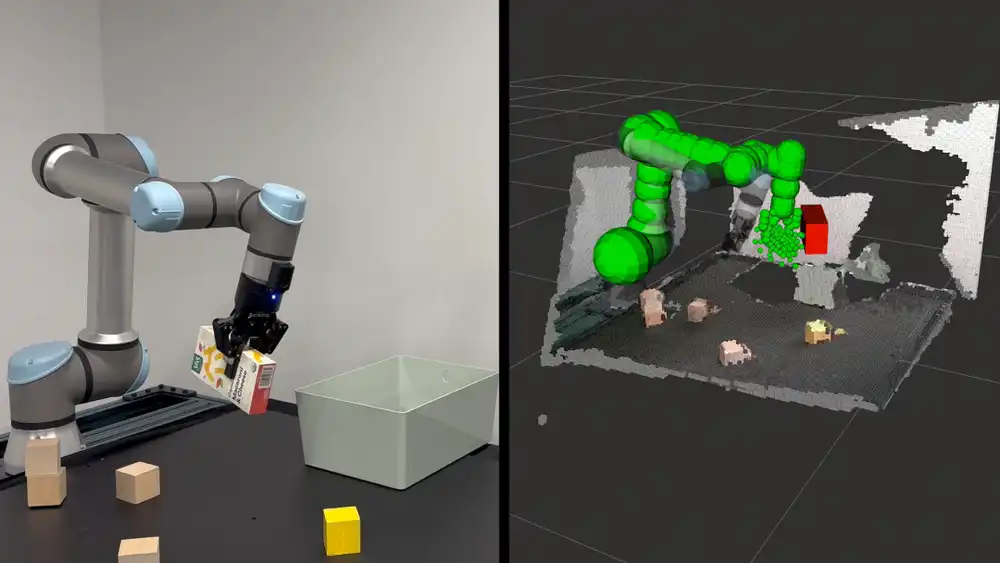
NVIDIA Isaac Sim presents the same grasp task simultaneously in physical and simulated worlds | Source: NVIDIA
Hongjun: Let me clarify Sim-to-Real for listeners. Literally, it means “from simulation to reality”—robots train in a computer-simulated virtual world, then transfer their learned skills to real-world hardware. Note: the focus isn’t just on “simulation,” but on whether the “transfer” works seamlessly in reality. This is the central challenge in this technical path. NVIDIA’s Isaac simulator is one of the biggest drivers of this approach. The alternative path is Real-World Data—directly training on data collected from real-world interactions, such as human demonstrations via teleoperation or motion capture suits.
I recall Su Hao had already begun exploring robots and 3D datasets quite early. When exactly was that?
Han Zheng: Around 2012–2013. After ImageNet’s release, he envisioned creating a neural network-like architecture. But at the time, he lacked sufficient collaborators. The sudden emergence of AlexNet in the ImageNet challenge deeply impacted him—he felt he had missed a crucial opportunity. So he pondered: what would be the next big frontier? He wanted to bring the data-driven + neural network methodology into the physical world. After completing his first PhD, he began building a new 3D learning team under Professor Leo Guibas.
Hongjun: Between then and now, robot and AI technologies have undergone numerous iterations. Back in 2012–2013, even earlier, many believed investing in robotics was unprofitable—or outright failure. At that time, Silicon Valley hosted many promising robotics projects, like Covariant.
Han Zheng: In our early days, we were influenced by that previous wave. From 2012–2013 to 2015–2016, after Andy Rubin, the “father of Android,” joined Google and led the X division, Google acquired numerous robotics companies—most notably Boston Dynamics, which changed hands multiple times. Others like Vicarious, Intrinsic, and Everyday Robots (whose hardware arm was later shuttered) still exist within Google. At the time, people still aimed to advance via machine learning, but the necessary ingredients weren’t yet fully in place.
In 2022, when Su Hao decided to build a foundational operational model company for robots, our main discussion centered on what fundamentally differentiates today’s opportunity from seven or eight years ago. One key reason we identified was the emergence of DALL·E (OpenAI’s text-to-image model), which made us realize that elevating from 2D to 3D was feasible. The simple idea: if a simulator can reconstruct the entire world’s objects and environment, it’s theoretically achievable.
Hongjun: We’ve kept mentioning your Sim-to-Real route. Underlying it, I assume, is what we now call a world model or 3D large model.
Han Zheng: To some extent, yes. Actually, simulation work with Sapien and ManiSkill began around 2018–2019—for example, in aerospace and automotive manufacturing, we perform fluid dynamics simulations. For robots, we simulate mechanics and physics to make them as close as possible to real aircraft, cars, or robots.
But new robot simulators take a different approach: they don’t require infinite approximation of the real environment on massive clusters. Instead, we run tens of thousands—even millions—of parallel environments on a single GPU. They don’t need high visual fidelity—resolution can be very low. The primary requirement is physical consistency, though not necessarily perfect realism. This demands extensive trade-offs between realism and efficiency.
Hongjun: So you prioritize fundamental physical laws in the simulator, sacrificing visual quality and resolution.
Han Zheng: Exactly. We embed classical Newtonian mechanics and countless physical formulas humans have derived into the simulator. At the same time, we provide vast open-world 3D object and task data, enabling robots to perform reinforcement learning within it.
Hongjun: Right, so your Sim-to-Real path and simulator design—every environment is built specifically for robots. You’re not just teaching robots to unscrew a water bottle cap, but aiming for robots to operate on any visible object in the real world. Is that correct?
Han Zheng: Yes. Simply put, we aim to replicate the entire evolutionary process of human and biological interaction with the environment and objects—millions of years of adaptation—within the simulator, letting robots re-experience this full evolutionary journey.
Hongjun: In robot training, is high-quality data more critical, or is larger-scale data—despite lower quality—more important? How do you balance these?
Han Zheng: This is an excellent question. There’s no definitive answer—always a balance between quality and scale. But scale must reach a certain threshold.
My intuitive judgment: to cover typical objects, their combinations, environments, and tasks, we need a structured description. This structure hasn’t appeared in machine learning history—neither in 2D vision, natural language, nor autonomous driving.
Thus, building a structured dataset in the simulator is crucial. Yet we also recognize we don’t need infinite precision. For a single beverage bottle, does the exact material description or label text need to be 100% accurate? Not really. But achieving this balance varies across teams.
Hongjun: So what’s the quality level of your dataset?
Han Zheng: Our structured understanding is among the best in the field. But we also know what’s missing beneath structure—especially dynamic constraint data for how to turn a bottle cap, which remains the most scarce in the industry.

There are debates in the robotics community: one faction supports Sim-to-Real, another favors Real-World Data. Critics of Sim-to-Real argue that transferring simulated behaviors to reality often fails. You do have a robot body and have already begun operations—can you share your execution results?
Han Zheng: Real-world data collection methods include: robot teleoperation (teleoperation), UMI motion-capture devices (using grippers or full-body suits), and ego-view data—commonly known as first-person perspective. These methods are simpler than Sim-to-Real but struggle to ensure generalization across diverse open-world tasks.
What does this mean? A foundational model’s standard definition: given an arbitrary object never seen in pre-training or post-training, can it successfully complete the task at a high rate?
We previously mentioned that such videos and images lack sufficient geometric understanding and precision. In our simulator, the core goal is reconstructing 3D ground truth information for objects and environments. Without sufficient scale, Sim-to-Real’s advantages and capabilities cannot be demonstrated.
In April, we released a result—our Sudo R1, an internal result from last year. In our view, this marks the first time in robotics that the Sim-to-Real gap was closed for a zero-shot, open-world task using this approach.
The video shows one hour of continuous operation: we tested over 100 objects, performing more than 200 actions. Crucially, none of these objects appeared in our training data. Even when grasping failed, we didn’t add post-training data. This represents the first zero-shot, high-success-rate general grasping capability. We varied lighting, environment, and objects throughout.
After one hour, we performed 240 pick-and-place operations. Single-operation success rate approached 98%. After the first failure, it used a closed-loop control method to rapidly adjust strategy and achieved 100% success.
After the result’s release, some researchers questioned: “You must have carefully controlled variables—were these objects or environments seen in training?” In fact, we hadn’t.
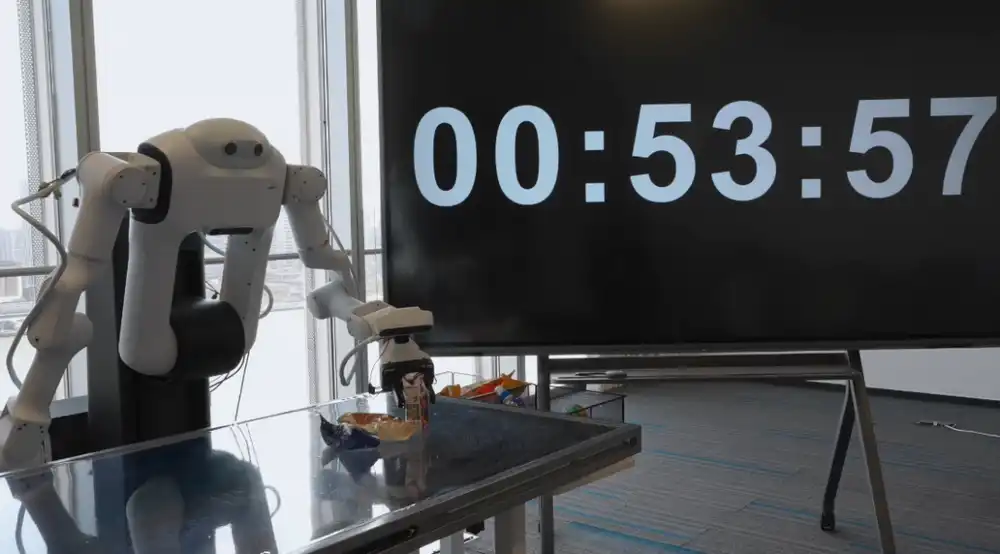
SUDO R1 60-minute continuous unedited test | Source: Sudo Technology
Hongjun: Let me briefly explain—since viewers can’t see the video—your first demo shows a robot standing at a workstation grabbing various objects. These include beverage bottles and small snacks—some oval, some conical—requiring the robot’s hand to grasp different parts to lift them. The video runs 60 minutes continuously, showing 240 total grasps. Some question whether you saw the data beforehand—but you didn’t.
Han Zheng: Yes. So we decided to publicly demonstrate it. In early June, we brought the robot to the ICRA (International Conference on Robotics and Automation) in Vienna, presenting it to researchers. Over several days, nearly 1,000 attendees came to our booth, testing with their own randomly chosen objects—conference badges, phones, earphones, small toys. Yesterday, we just returned from CVPR (one of the top three computer vision conferences), where we set up a booth for random testing in an unpredictable environment.
Previously, no one had achieved such a demonstration at academic conferences. The reason? There’s almost no time to prepare. For instance, some companies rent an Airbnb near the venue months in advance, placing their robot there to collect massive data, possibly entering a month ahead, processing it, and repeatedly showcasing, like coffee-making tasks.
Hongjun: So they adapt and practice for single scenarios. You don’t.
Han Zheng: We don’t need to. The distinction lies in our focus on foundational operations—frequent, short-duration actions, i.e., zero-shot successful single actions.
Hongjun: I understand coffee-making is a continuous action.
Han Zheng: Yes, it’s equivalent to remote-controlling the robot to execute a sequence of actions—these sequences must appear many times. If you switch to a different coffee machine or environment, success rates drop significantly. Then, most robot model companies must gather more data to fit.
Hongjun: Between a single one-time grasping task and a long-haul task involving complex action decomposition, each step continuous—which is harder?
Han Zheng: If you ask the true robotics and manipulation community, zero-shot is undoubtedly more central and critical. If your short skills are stable and reliable with high generalization, you can combine them into various long-haul operations. This is exactly the core philosophy behind ManiSkill’s overall framework.
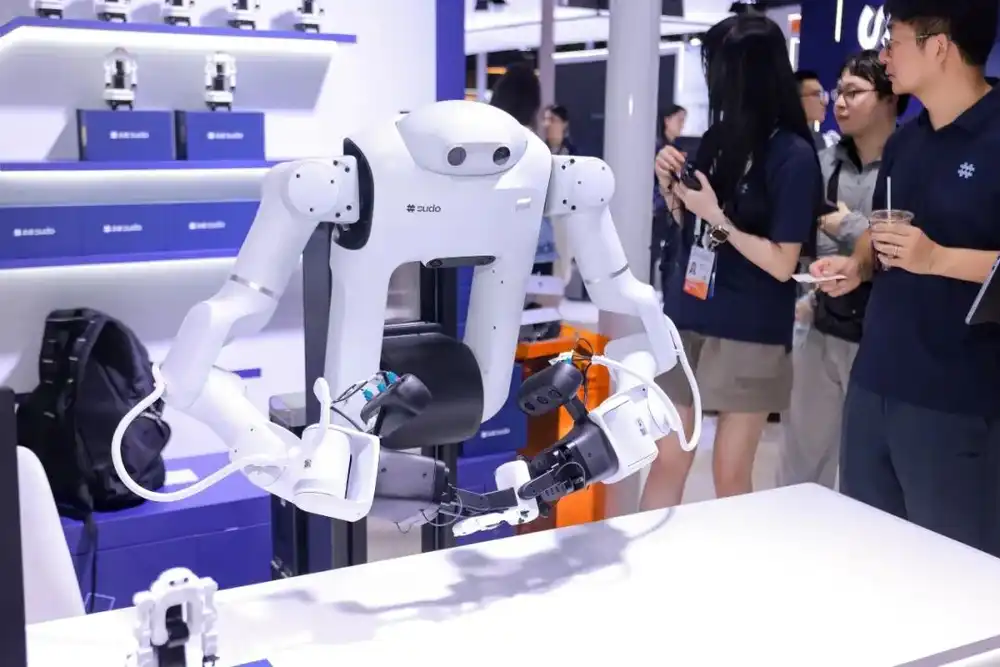
At WAIC, Sudo Technology showcased over ten robot skills extending from strong generalization grasping, covering dual-arm manipulation, flexible object handling, precision assembly, mobile grasping, and multi-robot collaboration | Source: Sudo Technology
Hongjun: So I understand the hardest part is the open world—not whether it’s short or long. If you can succeed in short tasks in the open world, long-haul tasks are just a matter of time.
Han Zheng: Yes, simply put. But there are still many core challenges—like stitching short skills into long ones. This is akin to a “chain-of-thought” method. Chain-of-Thought emerged around 2023. We concurrently developed a similar work called Chain of Thought Predictive Control (CoTPC)—a framework specifically designed to link short tasks into long-haul operations, analogous to chain-of-thought reasoning.

Hongjun: On commercialization, although I know you have a broader vision, are you considering deploying in vertical application scenarios?
Han Zheng: We believe there are tens of thousands of robot applications across industries. No single company can cover them all—each vertical should be driven by teams deeply familiar with that domain.
Our positioning is to master foundational skills (e.g., grasping), providing developers with combinatorial power. They might use it for cosmetic snack sorting, factory part loading/unloading, or household chores like clearing tables.
We aim to deliver a stable, reliable foundational model for short skills, offering robust APIs and enabling developers to compose various long-haul tasks. The requirement? Developers should be able to create agents—similar to large language models—where we introduce a new concept: “Adapt.”
Hongjun: So what are people buying from you? The robot body plus model, plus API call credits?
Han Zheng: Simply put, it’s the body plus our software support. Upper-layer applications are developed by third-party developers, whom we can also help redistribute. We see the robotics business model resembling smartphones: companies provide hardware and operating systems—like iPhone or Android—with full SDKs. Developers build various apps on top—branded or not—but more importantly, someone builds Uber, DoorDash, Instagram, Xiaohongshu, etc.
Hongjun: If you’re an Android OS, that’s underselling it—because phones can be self-made. But I understand you’re selling complete robot systems—you must sell hardware and software together, because robot hardware and software function as an integrated whole. You can’t just buy software and plug it into a new robot.
Han Zheng: Exactly. This responds to your earlier question about bridging the Sim-to-Real gap—core is hardware-software co-design. Our simulator’s robot has two requirements:
First, the simulator isn’t omnipotent. Some configurations or components aren’t perfectly simulated yet—or haven’t been processed. So when selecting robot hardware and configuration, we choose designs compatible with the simulator’s strengths.
Second, hardware itself has variations and noise. Even within our own designs, each robot differs slightly. Each startup produces slightly different behavior—impossible to eliminate entirely. The simulator must incorporate some noise and variation, but not excessively so.
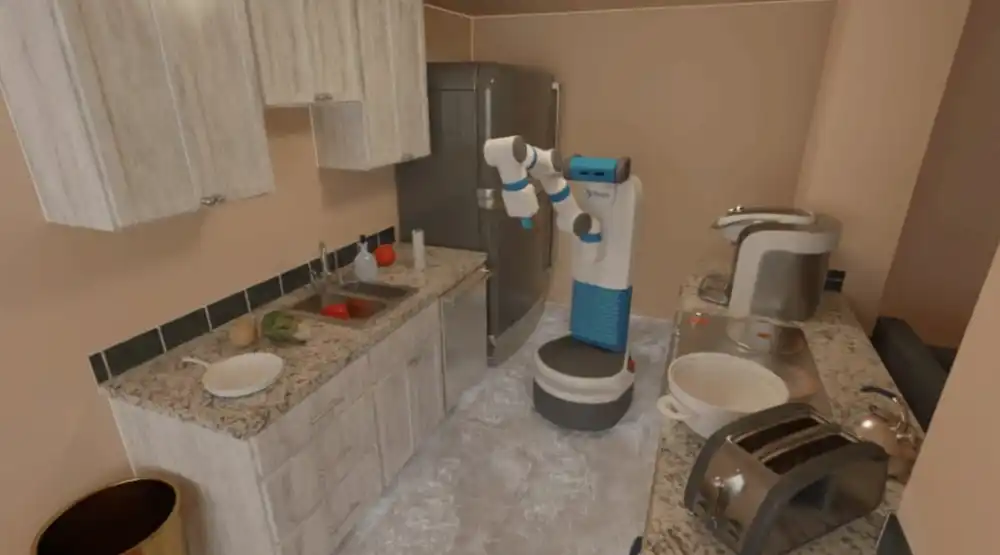
Sapien/ManiSkill simulator teaser image led by Su Hao’s team | Source: maniskill.ai
Hongjun: So I understand the Sim-to-Real path must be tightly coupled with the robot’s body.
Han Zheng: Yes, we consider it strongly coupled. Before founding our company, we open-sourced Sapien and ManiSkill—like Isaac—emphasizing support for various robot configurations. But we argue: these open-source methods are research-oriented and heavily simplified. For example, importing robots into simulators uses URDF format, with significant simplifications to geometry and dynamics. It rarely considers motor noise, response curve hysteresis, or startup differences. Researchers can’t address all these details. To build a robot stable and reliable in open-world settings—truly closing the Sim-to-Real gap—it must be treated as an integrated system.
Hongjun: So hardware integration is one path to bridge the gap. Are there other solutions at the software level?
Han Zheng: All methods must be organically combined. For example, scaling data and structuring it, improving simulation efficiency—should we use real-world data for training? We do. In simulation, we let robots observe humans performing tasks to determine which method is more efficient.
Take the bottle cap example: in robot reinforcement learning, if you want it to unscrew a cap, you’ll find it initially touches the label or bottom of the bottle, or even pushes upward slightly. These early explorations are random. But if it observes a human performing the task, its reinforcement learning efficiency improves. These are all part of reinforcement learning framework design—especially Model-Based RL—where the hardest part is designing effective feedback, ideally automatable at scale.
Hongjun: Also, the difficulty of screwing a bottle cap in the physical world differs drastically from simulation—tiny differences in angle or control variables make huge differences.
Han Zheng: This is a core point. Reinforcement learning in simulation and Sim-to-Real has been fully validated in locomotion control for humanoid robots like Boston Dynamics and quadruped dogs like Unitree. NVIDIA’s Isaac includes some reinforcement learning engines contributed by our team members early on—everyone participated. But manipulating objects poses a difficulty two to three orders of magnitude higher.
Because if you only care about your own movements, you don’t need to understand the world. You don’t need to know the object’s shape, material, or how to move near it and adjust upon contact.
For object manipulation, the difficulty lies in first building a structured dataset—a problem absent in locomotion, which focuses solely on the robot’s own state. Second, it requires environmental understanding and what we now call a World Model, particularly robot perception and reasoning/prediction of the physical world—something locomotion doesn’t require.

Hongjun: So does your robot truly understand the physical world—or is it just trained on massive data, outputting answers without knowing why?
Han Zheng: Our model differs from others. For example, Physical Intelligence’s narrow VLA emphasizes imitation of human actions—a pure end-to-end model. Our model has strong understanding and strong prediction of physical objects, environments, and future changes—it’s not a black box.
Hongjun: You mentioned it’s not a black box. But I understand Silicon Valley’s hottest companies like Physical Intelligence and Skild—building “brains,” purely software/model layer—still aim to construct a black box. They follow the current generative AI trend: more data, smarter machine, betting on future universal and open-scenario intelligence.
I’ve spoken with some robot experts: why haven’t white-box models taken off? Because human-predictable scenarios are finite, and edge cases are hard to solve. So, white-box vs. black-box—how do you decide? And how will future evaluation proceed?
Han Zheng: Our model features a hierarchical structure during pre-training. Pre-training covers the brain and software layer. During pre-training, we require robots to predict future states of their environment, objects, and operations—necessitating some reasoning and cognition. But at deployment, it’s still an end-to-end model.
For example, in simulation, the robot must know an object’s geometric position, estimate material and weight, distinguish cap from body, and determine the rotation direction—these involve understanding and inference, describable via implicit representation.
But most Silicon Valley and domestic robot companies, following imitation learning, don’t need to know an object’s precise location or geometric info in the environment. Their proximity and operation are due to prior human teleoperation or motion-capture suit demonstrations—pure mechanical mimicry without true understanding.
Hongjun: So you’re building understanding?
Han Zheng: Yes, we need understanding during pre-training. But when humans twist a bottle cap, they don’t consciously think “I need to turn counterclockwise”—it’s common sense, ingrained in muscle memory.
But if a child tries for the first time, he might try clockwise, then counterclockwise—random attempts. Meanwhile, he observes parents doing it—possibly developing theoretical insights.
Some motor abilities are genetically encoded. From birth, children explore all objects—grabbing, biting, twisting, pulling. We’re essentially re-enacting the entire evolutionary process within the simulator.
Hongjun: You’re replicating human evolution in the simulator? That’s fascinating.
Han Zheng: When Su Hao named the simulator “Sapien,” it was inspired by Yuval Harari’s “Sapiens”—the evolution of Homo sapiens from apes. The core reason we chose this evolutionary strategy is that robot data construction differs fundamentally from autonomous driving, 2D images/videos, or natural language: there’s insufficient data. Tesla began selling cars decades ago, with millions of drivers on highways daily.
Hongjun: So you don’t have to stick to one paradigm. When data is scarce, use a hybrid white-box + black-box approach; once data scales, shift your tech.
Han Zheng: Yes, but robots are hard to deploy en masse—without functionality—to offices, homes, factories—while a worker remotely controls it. Especially at home, we can’t imagine buying a robot needing a motion-capture suit just to cook scrambled eggs.
This explains why NVIDIA insists on Sim-to-Real—this path is unavoidable. Robot cold-start data needs millions, even tens of millions, collected across all open environments.
Hongjun: So I understand your core reason for choosing layered models over Silicon Valley’s dominant end-to-end approach: given the current robotics data shortage, layering allows robots to get running quickly, boosting zero-shot open-scenario operation ability. Your business model—selling to many developers—means you can evolve your training paradigm later.
Han Zheng: A quick insider note: before Physical Intelligence’s founding, its core team was at Google Robotics, including Generalist members. Many key personnel had worked there. At the time, everyone likely favored end-to-end models. But earlier, there was a tacit agreement: a stable, reliable foundational operation capability at the base, then upper layers for environmental understanding and task decomposition.
But when companies launched in 2023–2024, they chose familiar paths—so they stopped talking about layering. But we have a bold claim: starting from this half-year, the top-down layered structure will return to mainstream—and may become the ultimate commercial solution.
Hongjun: Can you briefly summarize what “layered” means here?
Han Zheng: For example, taking a bottle from the fridge, unscrewing the cap, filling both cups in front of us.
The upper layer means: our cups are empty; we need to refill them. The robot must understand its current environment—where the fridge is, whether it has water, which step to take: walk to the fridge, open the door, grab the bottle, move here, unscrew the cap, pour water into both cups, then screw the cap back on. These are decomposed steps and reasoning processes.
The lower layer, in our view, is the operational level: how to walk to the fridge, open the door, grab the bottle, move here, unscrew the cap, pour water into cups. Each specific object manipulation step is our lower-level operation.
Hongjun: So you think all Silicon Valley companies will adopt this layered approach this year?
Han Zheng: Hard to say this year, but it will return to the spotlight. In recent weeks, after our on-site demos and discussions with academia and industry, some have recognized this might be a new direction.
Hongjun: So I understand now—Silicon Valley companies like PI, Generalist, etc.—they still directly use large models to control the operation layer. But the growing realization proves current control isn’t as good or as successful as imagined.
Han Zheng: Personally, I believe so—not necessarily a company-wide consensus. I think Physical Intelligence, Generalist, Google, and others are better at upper-layer reasoning. But for object manipulation, relying on limited human real-world data—maybe tens of thousands of hours—is far from sufficient for stable, reliable open-environment, open-object operations.
Hongjun: So can I understand it this way: upper layer is Silicon Valley’s strength, while lower layer—operation—requires hardware integration, making it China’s advantage?
Han Zheng: Or rather, Silicon Valley robotics companies, big tech, Chinese model giants, and many embodied AI startups have greater opportunities in upper-layer reasoning. Of course, many embodied and robotics companies focus on one or two vertical applications—similar to how large models target one or two agents.
But for lower-level operation—performing a specific task on any object in a random environment—we believe only a hardware-software-integrated company can achieve this. But is such a company necessarily Chinese? Not necessarily.

Hongjun: This year, I noticed a major trend: Skild AI, valued at $14 billion, raised $1.4 billion in its latest round, pushing post-money valuation to $140–150 billion. Just seven months ago, it was $4.5 billion. It’s building a general robot foundation model—Skild Brain. Compared to Physical Intelligence, it’s a representative Silicon Valley software brain company, valued at $5.6 billion. Are you familiar with this company? Why such massive funding?
Han Zheng: Valuation growth is widespread. If I’m not mistaken, Physical Intelligence’s latest valuation is also in the $12–14 billion range, not fully public, but they’re raising new funds. These companies—Skild, Physical Intelligence, Generalist—are quite similar, all building brains.
Skild is special: founders Deepak and Abhinav discussed extensively with Su Hao. They were initially skeptical of simulation but pitched it as their primary fundraising theme. According to our understanding, their actual business might be sensitive. In the US, the first-tier players in embodied foundation models are likely Physical Intelligence, Generalist, and emerging startups like Sunday (Chinese-origin) and Dyna, all exploring this space.
Hongjun: Recently, Figure AI seems to be regaining favor. Earlier, its funding and valuation were high, but investors doubted its demos were heavily edited. Why the renewed optimism?
Han Zheng: Recent attention emerged a few weeks ago, when they live-streamed object sorting on a production line for several days. While they show some progress, under our standards: first, their object generalization is low—only two types: boxes and soft packaging, nearly identical in color and weight. Second, the robot stayed on their internal test line—never ventured out.
Thus, using teleoperation for VLA has a major constraint: extreme sensitivity to lighting and environmental changes. Any change causes success rate to plummet.
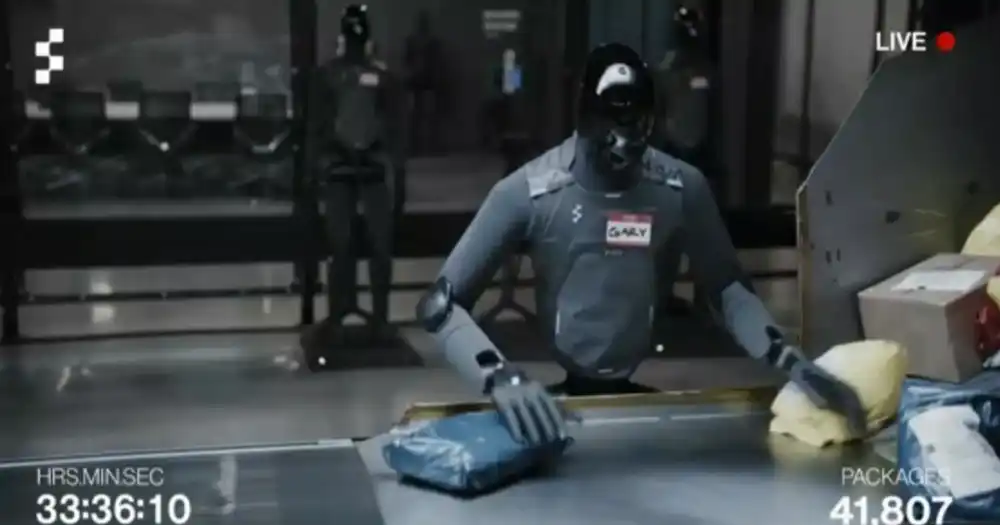
Figure 03 robot live-streaming package sorting | Source: Figure
Hongjun: I see many robot companies entering deployment this year—Musk plans to deploy Optimus in Fremont’s factory, having it perform tasks. He says he’s deploying Optimus mainly for training data, not actual work. As a professional industry entrepreneur, how do you view Musk’s deployment?
Han Zheng: Before our main team relocated back to China in 2025, we had some collaboration with Tesla’s automation team. At the time, their automation setup certainly wasn’t ready for robots to perform tasks. They were only doing fixed-position actions—like picking batteries.
Looking ahead, Optimus will undoubtedly be the biggest driver in the US robotics industry due to its strong core hardware and manufacturing capabilities. For the model, I believe Tesla and Elon Musk’s style is to wait for a solid solution before filling gaps—probably timely enough. But we heard a faction within Tesla suggesting Elon once proposed building a series of robots for external developers to build models.
Hongjun: Similar to your thinking.
Han Zheng: Kind of. But his approach feels closer to many robot hardware teams—give you excellent hardware, you develop the model yourself. We provide both hardware and hard-to-handle lower-level capabilities.
Hongjun: Then I see Boston Dynamics’ electric Atlas is now shipping. Is this a notable development?
Han Zheng: Extremely notable. Internally, we define the most promising and potential partner as Boston Dynamics’ electric Atlas combined with Google’s DeepMind. If you watched Demis Hassabis’s interviews or documentaries from last year, and his actions, Google appears to be the most committed big tech player in physical-world AI.
Last year, a major signal: first, they switched hardware platforms from Apptronik and another machine to electric Atlas; second, DeepMind recruited core personnel from Boston Dynamics’ hardware team. So if we pursue self-built hardware and self-developed low-level models, could Google retrace Android’s path—using Boston Dynamics hardware and Hyundai Group’s mass production support? Plus, they acquired the MuJoCo simulator team years ago and keep improving it.
Hongjun: Google also has its own world model Genie 3.
Han Zheng: Yes, they have nearly unlimited compute, the world’s best talent gathered, and they’re determined. Unlike Anthropic, OpenAI, Meta, or Chinese giants, Google is the only one with a team lead so deeply committed to robotics. We feel they firmly believe in the Sim-to-Real path.
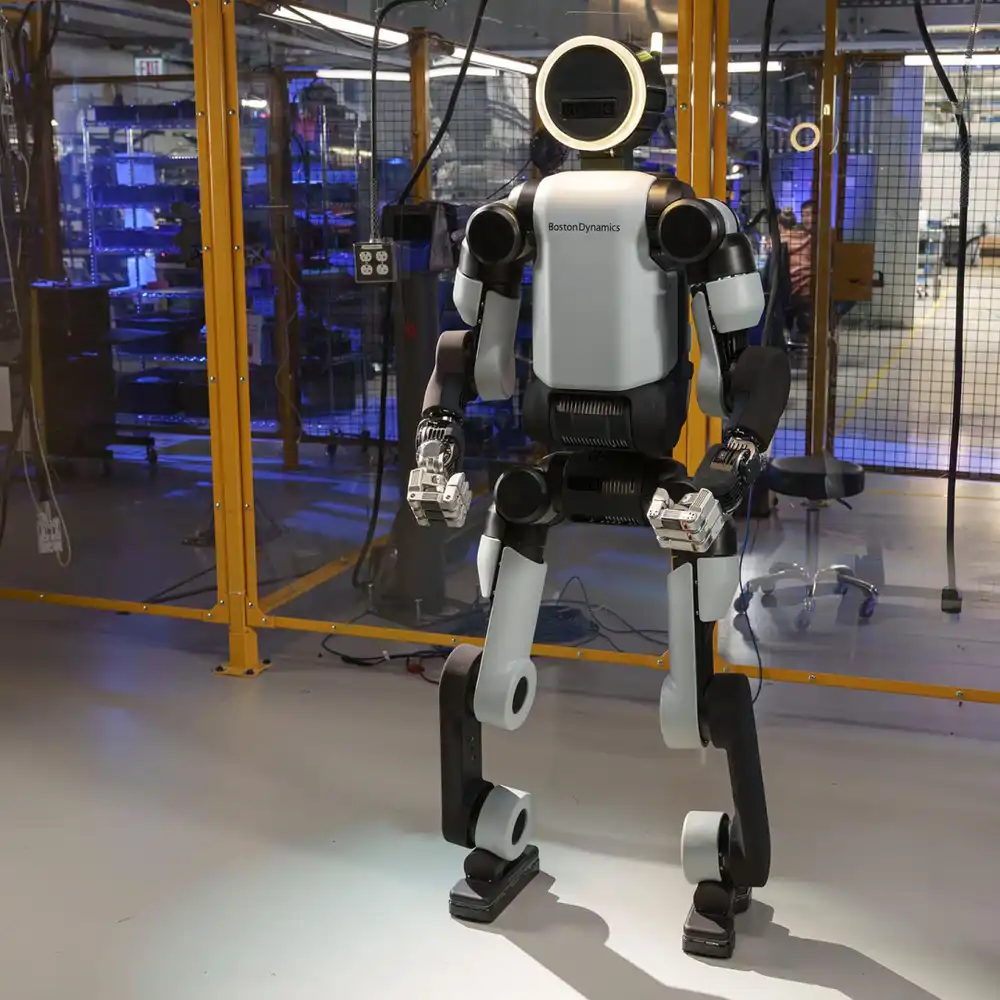
Electric Atlas | Source: Boston Dynamics official blog
Hongjun: I know Su Hao’s team has frequent exchanges with DeepMind—do you collaborate?
Han Zheng: Our collaborations with Google Robotics were extensive. Many team members were Su Hao’s juniors or former PhD students—including core members of the PI founding team. But DeepMind’s recent move—aggregating top talent in London, integrating model and hardware teams—is crucial. It reminds us of Steve Jobs’ insistence on co-location—no remote offices, no exceptions. Same principle.
Hongjun: Among all robot companies, you’re most optimistic about DeepMind + Boston Dynamics?
Han Zheng: Yes. This may surprise many. In the next two to three years, we believe the strongest competitor in terms of operational and comprehensive capabilities will be DeepMind + Boston Dynamics.
Hongjun: Let’s talk about Amazon. Last year, in the All-In podcast, they mentioned a company worth watching—Amazon. Reason: this year, Amazon’s robot deployments may exceed its employees. With warehouse sorting as a natural application scenario, and acquisitions like Covariant, how do you view Amazon’s robotics strategy?
Han Zheng: Amazon has consistently invested the most among big tech companies in robotics. In quantity, it’s still focused on warehousing logistics—AGVs (Automated Guided Vehicles), Kiva (now Amazon Robotics, famous for mobile robot warehousing systems), various robotic arms, and companies like Agility (humanoid) and Covariant (operation model). Previously, others were also tried. Amazon provides some scenarios, but ultimately either acquires these companies or develops in-house. Covariant once considered Amazon a core client.

Hongjun: Discussing Silicon Valley and Chinese robot companies’ development, I’d summarize: Silicon Valley still prioritizes robot generalization and brain-level advancements—market leaders are concentrated here. China has strong hardware foundations, but many companies now aim for generalization—yet commercial pressure pushes them back to single scenarios. How do you interpret this phenomenon—idealistic ambitions ending in vertical niches?
Han Zheng: My core argument remains consistent with past cycles—like early vision models (“AI Four Dragons”), or later language models like iFLYTEK. If there’s no clear idea on building foundational models, just trying and adjusting along the way, it’s hard to succeed—commercial pressures inevitably lead to compromises.
Our team, after seven to eight years of collaboration, has developed clear intuition and cognition. We expect first-stage results within 12–24 months—this is critical. Not “let’s start with small models, pile data, maybe it’ll work.” “Maybe” hardly appears in our team’s vocabulary. But other teams are exploring, facing internal team, investor, and commercial pressures—so they choose vertical scenarios. Client demands often diverge from foundational model training strategies.
Hongjun: Building general artificial intelligence is a longer, harder path. How do you keep your company alive in the middle? As CEO, do you feel this pressure?
Han Zheng: Definitely, but relatively manageable. Given the rise of large models and infrastructure, we feel this wave will propel robotics to the next phase. We won’t bet on a single vertical scenario—but instead provide hardware and foundational models for others to experiment.
We hope that among the 1,000 developers we serve, 100 will find niche deployment scenarios. Among those 100, 5–10 might build super-applications, deploying thousands of robots across diverse scenes.
We won’t bet on a single scene. Our team’s strength isn’t in factory deployment or integration testing. The developer community has integrators and automation teams with their own strengths. We aim to provide new foundational toolchains.
Hongjun: Should we invest more in long-term R&D, or allocate some effort to distributing a hardware-software integrated platform for developers? Which is your current priority? How do you allocate resources?
Han Zheng: Our core mission is providing reliable, stable hardware and foundational models—from a single grasping skill to three to five common skills—and building robust tools for developers to experiment with different applications. This is our top priority for the next several years.
But to validate that developers can use our tools for vertical industry applications, we will select one or two scenarios and closely collaborate with one or two developers to refine our development tools.
Hongjun: Looking back in ten years, do you hope Sudo Technology is remembered for creating a general robot product—or proving the Sim-to-Real path is valid?
Han Zheng: Validating Sim-to-Real is a side effect. We hope that in ten years, when people reflect on this moment, they’ll see it as akin to the iPhone plus iOS operating system—when new Uber, DiDi, Meituan-style applications emerge. We want our hardware and foundational system/software to be part of what people use.
This article comes from the WeChat Official Account: Silicon Valley 101, interview by Hongjun, visuals by Zhu Jie, original title: “Did Robots Go Off Track? Talking with Han Zheng of Sudo on Embodied Intelligence’s 3D Data, Path Divisions, and the Silicon Valley Race”, header image generated by AI
Source: Silicon Valley 101
Disclaimer: Contains third-party opinions, does not constitute financial advice


U.S. School District Spends $58,000 to Hire a Bionic Robot as Teaching Assistant
4 days ago
31-Year-Old Hong Kong STEM Prodigy Launches a Robot IPO
8 days ago
46 Billion Injected into Robotics: Which Type of Founder Do Automakers Prefer?
8 days ago
Xiaoyu Intelligence has entered into a strategic partnership with Digua Robotics, deploying the "One Brain, Multiple Forms" AI core onto the Sunrise S600 platform
06-15MINT-4B Multimodal VLA Model Launches in Collaboration with Cai Panpan's Team
06-04Nosh One Kitchen Robot Launches Crowdfunding, Powered by NoshOS System with Support for 500 Dishes
05-24Google I/O 2026 Dialogues Stage Focuses on AI, Quantum Computing, and the Future of Robotics
05-22

