VLA Robots Take the Direct Route, Up to 5.83x Faster
VLA Robots Take the Direct Route, Up to 5.83x Faster

Introduction VLA models can already perform tasks, but real robots remain slow! PolicyTrim is an optimization method for enhancing VLA robot execution efficiency without retraining. By extending reliable action sequences and eliminating redundant steps, it enables robots to complete tasks more directly, significantly improving overall speed.
Vision-Language-Action (VLA) models unify visual observations, natural language instructions, and robotic actions into a single policy framework, allowing robots to execute complex manipulation tasks based on human-like language commands.
From OpenVLA, OpenVLA-OFT to π0.5, GR00T, these models are emerging as a pivotal technical pathway in embodied intelligence.
However, when VLA models are deployed onto physical robots, a critical bottleneck immediately surfaces: total task completion time depends not only on inference latency per step but also on the number of forward inference calls and actual physical actions required by the policy.
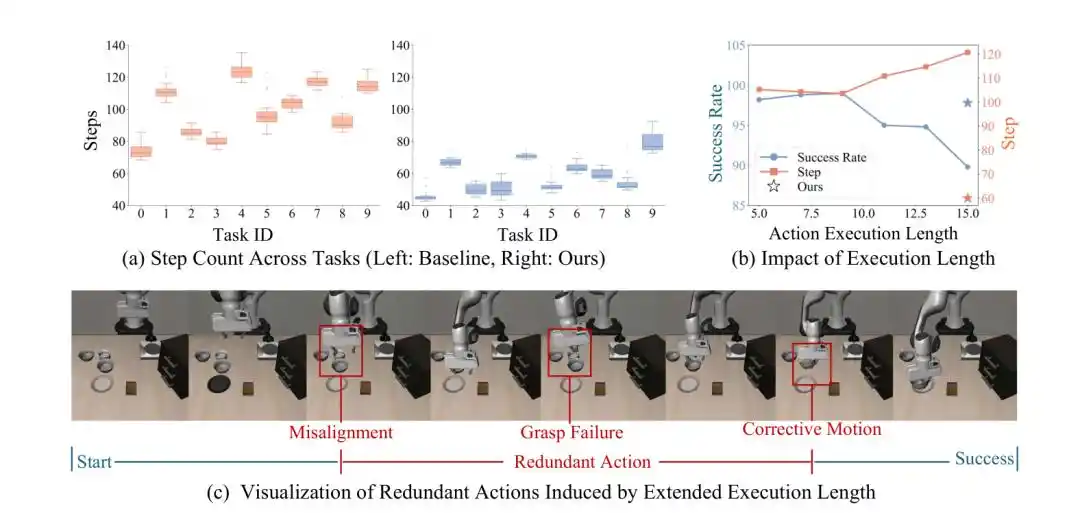
In multiple rollouts of the same task, VLA models exhibit significant variance in execution steps, indicating that shorter, more direct successful trajectories are achievable—but current policies often find them only by chance.
Unreliable action chunk tails: Models predict multiple actions at once, but later actions are prone to error accumulation, forcing frequent replanning. Artificially extending execution length increases failure rates and physical steps.
Severe physical action redundancy: Even when tasks succeed, trajectories may contain excessive correction, backtracking, and repeated motions.
Thus, VLA deployment efficiency must be assessed not just by per-step inference latency, but by policy efficiency: how many actions within a single prediction can be safely executed? How many real physical steps are truly needed to complete the task?
Existing methods primarily focus on computational acceleration—such as visual token pruning, quantization, KV-cache reuse, distillation, or inference engine optimization. While these reduce per-inference delay, if the policy still requires numerous redundant physical steps, real-world task duration remains long.
Simply fixing longer action chunks is unreliable.
Experimental results in the paper show that increasing forced action execution length leads to declining success rates and higher physical step counts—indicating that low-quality tail predictions introduce errors into the physical world, requiring additional correction actions.
Key question: Can we enable existing VLA policies to automatically learn "fewer detours" via post-training, reducing physical steps without sacrificing task success rate?
A team led by Professor Lei Yinjie from Sichuan University proposes PolicyTrim—a two-stage reinforcement learning post-training framework targeting policy efficiency. It preserves the original VLA architecture and requires no new expert data collection; instead, it further optimizes real-world robotic behavior on top of pre-trained policies.
Project Homepage: https://inceptionwang.github.io/PolicyTrim/
Paper Link: https://arxiv.org/abs/2606.22540
Code Link: https://github.com/INCEPTIONwang/PolicyTrim
Model Link: https://huggingface.co/INCEPTIONwang/PolicyTrim
New method achieves:
3× action chunk utilization, enabling longer horizon reliable execution;
51.4% reduction in physical steps, compressing redundant corrective actions;
5.83× end-to-end maximum acceleration on LIBERO Object / π0.5;
From “Faster Computation” to “Faster Execution”
PolicyTrim’s core objective is not to replace computational acceleration, but to address another overlooked dimension: reducing the number of forward inference calls required to complete a task. It decomposes policy efficiency into two optimizable objectives: first, extend reliable action chunks; second, compress redundant physical steps.
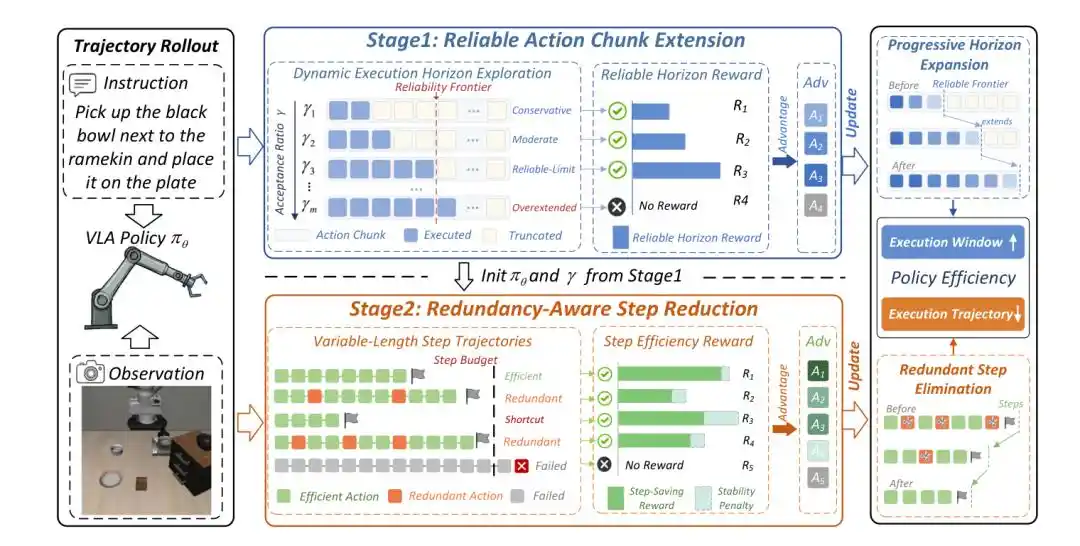
1. Reliable Action Chunk Extension
Many current VLA policies output action sequences in chunk form, yet during deployment, only the initial steps are typically trusted. PolicyTrim’s first stage employs dynamic execution horizon exploration: assigning different acceptance ratios across a set of rollouts allows the model to parallelize exploration of reliable boundaries across short, medium, and long windows.
Trajectories that successfully complete tasks with longer execution windows receive higher rewards, encouraging the model to make previously unreliable tail actions more usable.
Horizon reward activates only when successful trajectories exist within a group, preventing the model from blindly pursuing longer chunks in failure cases.
2. Redundancy-Aware Step Reduction
After expanding the reliable horizon, the second stage further reduces total physical steps. PolicyTrim introduces a step-saving reward: the fewer steps a successful trajectory takes, the higher the reward.
This step-saving reward directly embeds “shorter, more direct successful trajectories” into the optimization objective.
Group-anchored regularization suppresses non-reproducible shortcut strategies, avoiding trade-offs between path length and success rate.
The sequential two-stage optimization avoids interference between “extending chunk length” and “reducing step count,” ultimately minimizing the number of forward inference calls required to complete a task.
Experimental Results
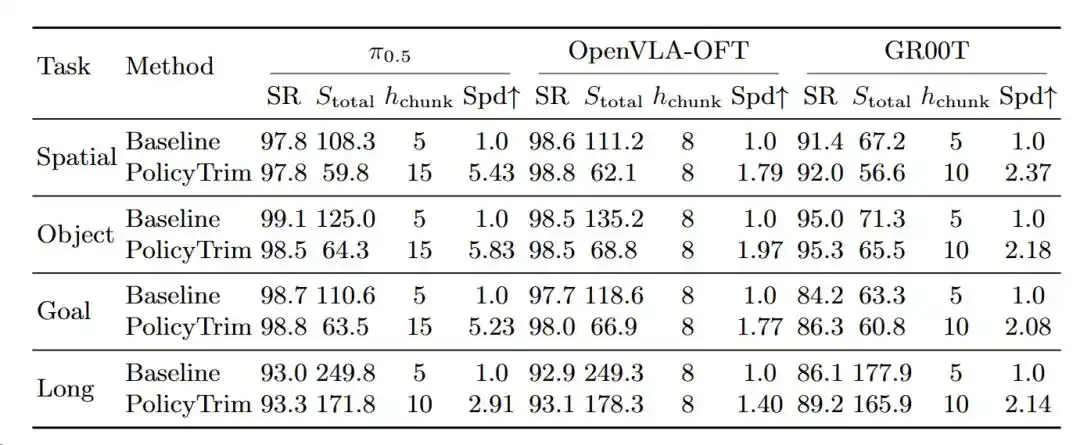
The paper evaluates PolicyTrim across LIBERO, ManiSkill, Meta-World, and real-robot tasks, covering diverse VLA architectures including π0.5, OpenVLA-OFT, and GR00T. Overall results demonstrate that PolicyTrim significantly improves execution efficiency while maintaining stable task success rates.
In LIBERO, π0.5 achieves up to 5.83× end-to-end acceleration, with success rates sustained above 98%.
Cross-benchmark results show PolicyTrim reaches up to 2.36× acceleration on ManiSkill and 2.52× on Meta-World.
Cross-architecture results indicate that retrained OpenVLA-OFT using the full two-stage pipeline achieves 2.97× acceleration; even OpenVLA using only the second stage attains 1.41× acceleration.
Qualitative Comparison: Fewer Detours, More Direct Trajectories
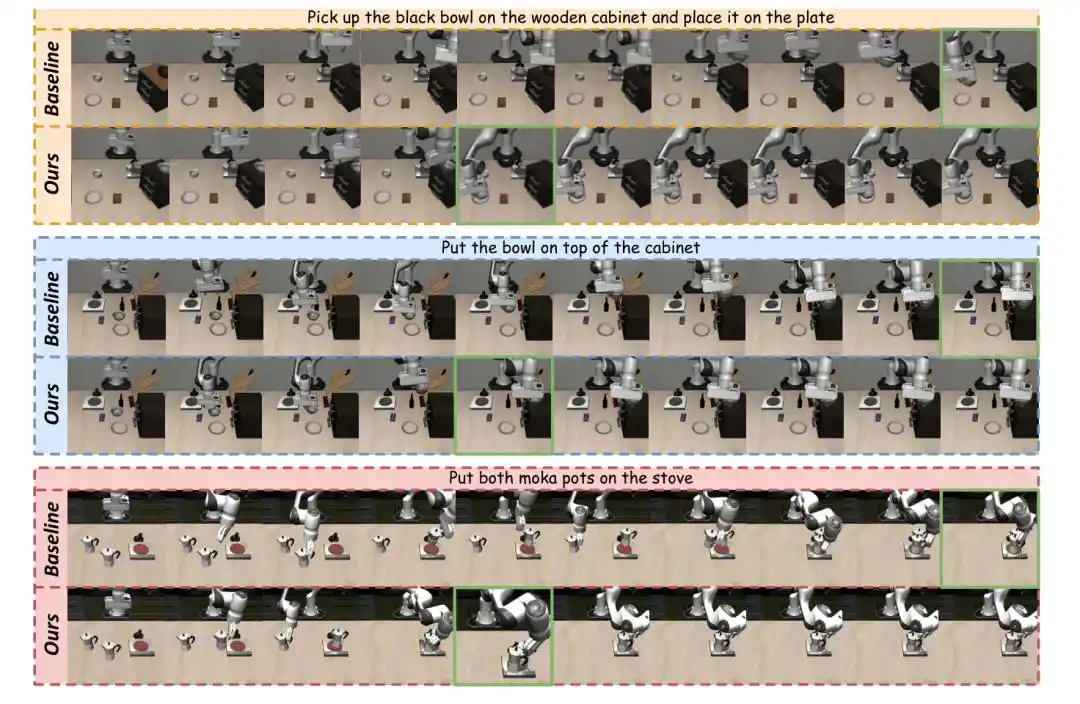
In randomly sampled LIBERO tasks, Baselines often exhibit redundant correction actions and hesitation/jittering near targets; PolicyTrim trajectories are smoother and more direct, completing the same task with fewer physical steps—typically compressing steps to about half the original count.
Real-Robot Deployment: Efficiency Gains from Simulation Transfer to Physical World
The paper further validates PolicyTrim on a real robot setup using two Intel RealSense D435i cameras mounted on an Agilex Piper manipulator, testing three tasks: FlipMug, HangMug, and TapeBox. Experiments cover both fixed-target standard settings and dynamic settings with random target perturbations during grasping.
PolicyTrim maintains or improves success rates under both standard and dynamic disturbance conditions, while significantly reducing real-world execution time. Under standard real-robot settings, average end-to-end acceleration reaches 1.86×.
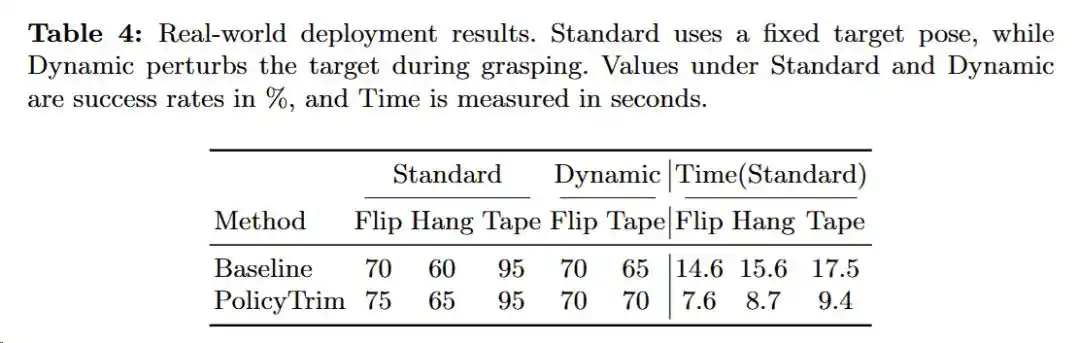
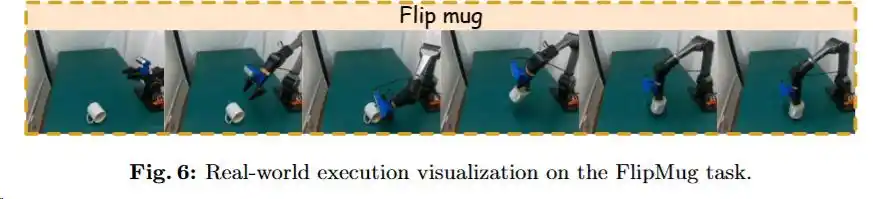
From experimental results, PolicyTrim is not merely optimizing benchmark metrics: on physical robots, task completion time is reduced to roughly half of baseline levels, while maintaining robustness under dynamic disturbances.
Why Does PolicyTrim Work?
• Efficiency focused on policy behavior: It reduces redundant actions and unnecessary replanning, not just per-inference latency.
• No need for retraining from scratch: As a post-training framework, it can optimize existing VLA models, lowering data collection and training costs.
• Balances speed and success rate: Reliable horizon extension prevents blind chunk elongation; stability constraints prevent shortcut exploitation.
• Compatible with computational acceleration: PolicyTrim reduces forward inference calls; methods like VLA-Cache optimize per-call latency—these orthogonal paths generate compounded acceleration.
PolicyTrim’s core insight: For VLA robots, deployment efficiency stems not only from faster model inference but also from more efficient policy behavior. Enabling robots to "avoid detours" yields substantial acceleration gains.
References: https://arxiv.org/abs/2606.22540
This article comes from WeChat Official Account “NewAI”, author: NewAI; editor: LRST
Source: NewAI
Disclaimer: Contains third-party opinions, does not constitute financial advice


a16z: 80% of AI Budget is Idle
4 days ago
U.S. School District Spends $58,000 to Hire a Bionic Robot as Teaching Assistant
4 days ago
OpenAI Former CTO Unveils 975B Open-Source Champion
5 days ago
DeepSeek Races for Sci-Tech Innovation Board Listing: Valuation Reaches $71 Billion
6 days ago
26 People Sue Meta: Will AI Fire You for Taking Maternity or Sick Leave?
6 days ago
Liáng Wénfēng Becomes the New Richest Man in AI, 36 People Get Rich Overnight from Large Models
7 days ago
31-Year-Old Hong Kong STEM Prodigy Launches a Robot IPO
8 days ago


