1.6T backordered by 30%, the true bottleneck is InP
1.6T backordered by 30%, the true bottleneck is InP

By: Rita
Trend Insight
Jefferies delivered a key assessment during its optical experts teleconference on July 15: optical module demand is surging too rapidly for supply to keep pace. Shortages stand at 10% for 800G and 30% for 1.6T, with the total market size projected to triple by 2027 compared to 2025.
The underlying cause of the shortage lies in U.S. companies controlling upstream chips, while China holds advantages in passive components and indium phosphide (InP) substrates. Although the optical module market will triple, the flow of capital differs significantly depending on where value is captured.
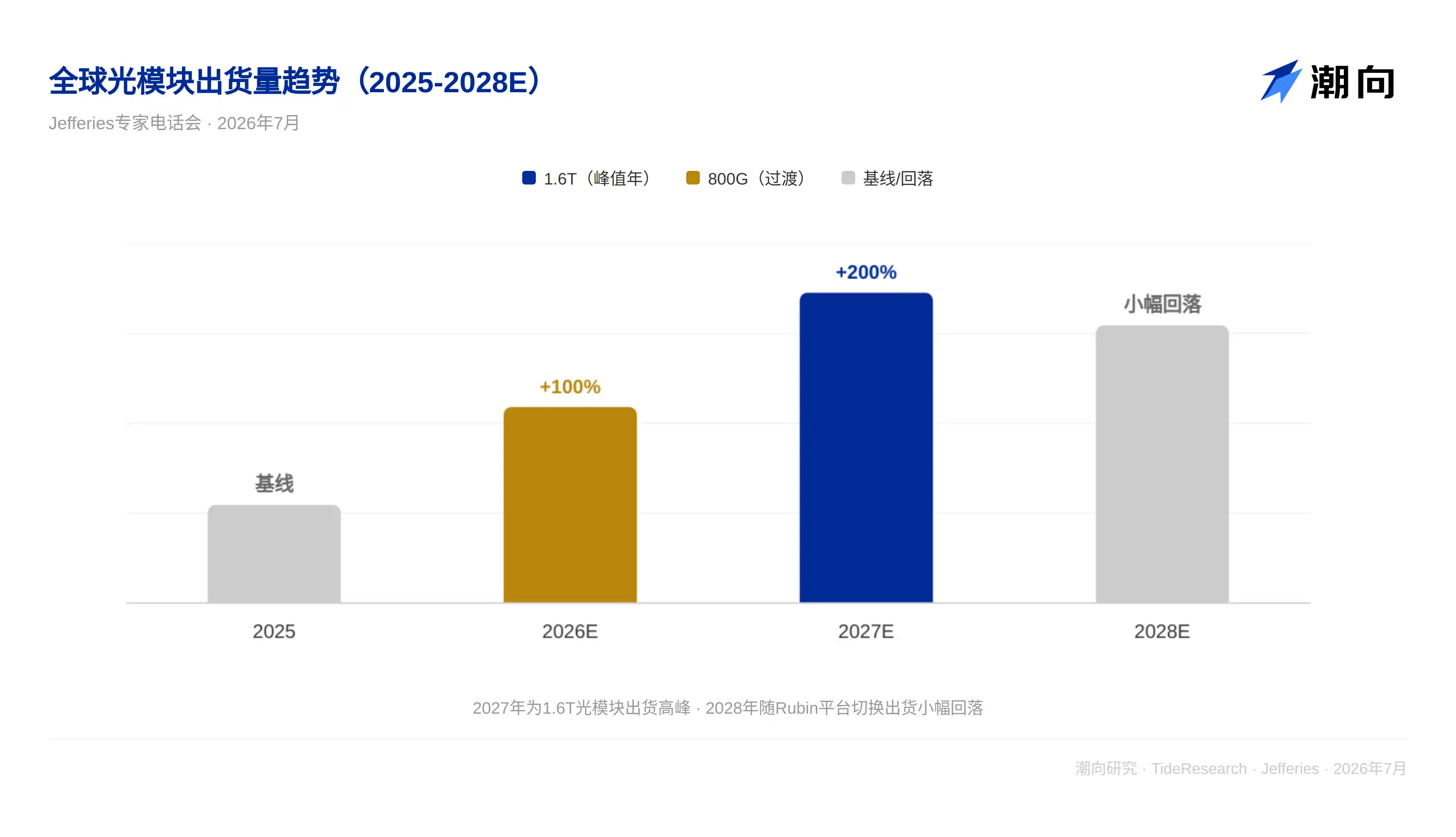
Optical Module Market Triples, 1.6T Still Short by 30%
Demand is clear. 800G optical modules are expected to ship around 40–42 million units in 2026, exceeding demand of over 45 million—resulting in a 10% shortfall. Shipments are projected to reach 80 million units in 2027 before a slight dip in 2028.
The gap is wider for 1.6T. In 2026, shipments are estimated at 18 million units against demand of ~26 million—shortfall of 30%. By 2027, shipments are forecasted at 55 million units, but demand exceeds 75 million, maintaining a 30% deficit.
3.2T samples are expected to ship in Q4 2026, with small-scale commercial deployment anticipated only in Q4 2027. In 2028, 1.6T shipments could surge to 100 million units, while 3.2T begins at around 2.5 million units.
At this pace, the optical module market in 2027 will be three times that of 2025.
DSP and 200G EML Are Under U.S. Control
The upstream bottlenecks in optical modules lie in DSP and 200G EML.
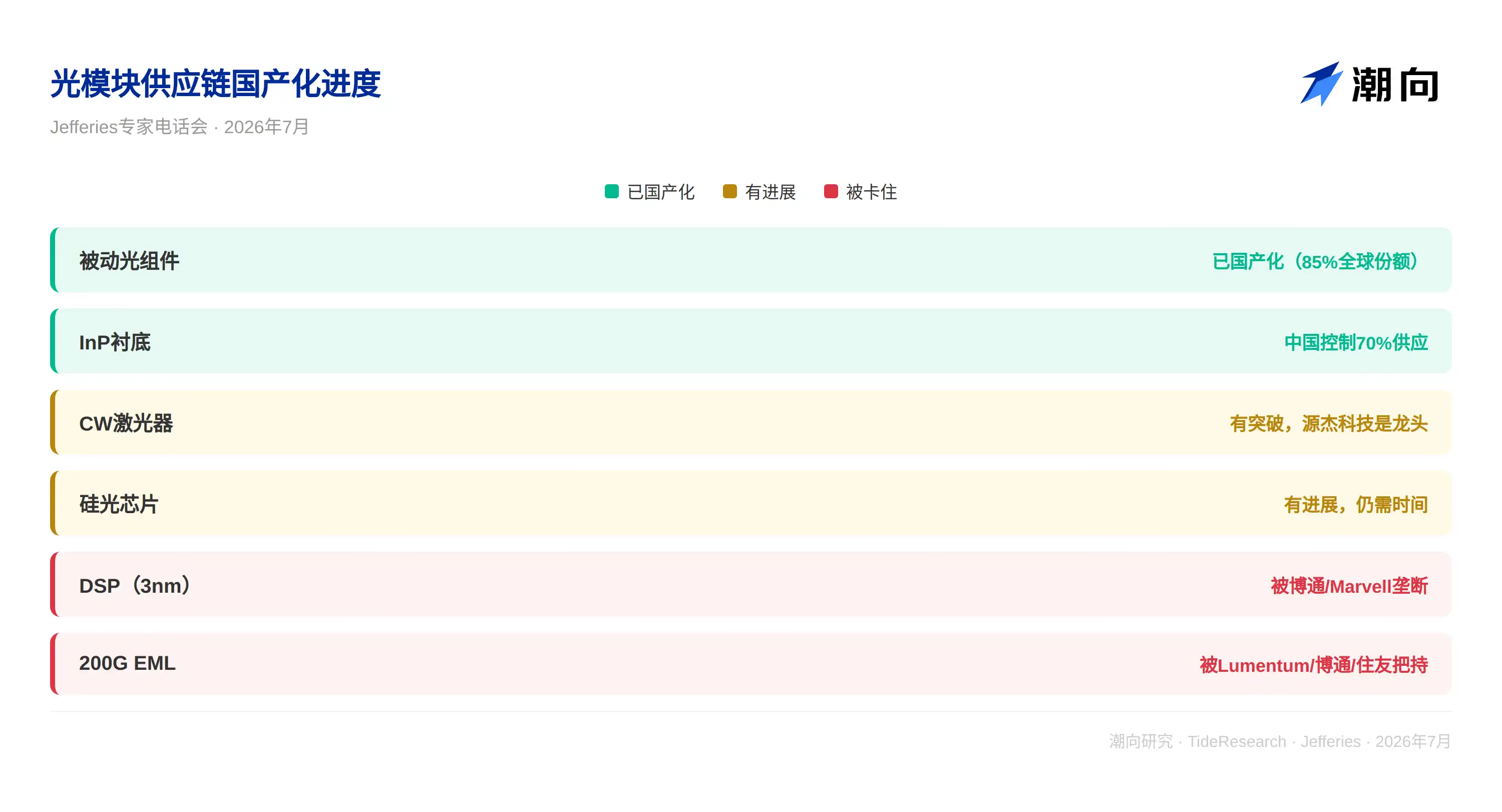
The 3nm DSP chips used in 1.6T modules are monopolized by Broadcom and Marvell. 200G EML is dominated by Lumentum, Broadcom, and Sumitomo Electric. China currently lacks mature 200G EML suppliers, with Desai Battery expected to begin mass production only in second half of 2026.
China’s domesticization progress varies. Passive optical components—including isolators, filters, lenses, and AWGs—now account for 85% of global market share. For CW lasers, Yuanjie Technology leads, supported by four other players. Progress in electronic chips and silicon photonics is underway, but further time is needed.
In the complete optical module assembly segment, major players include Zhongji Xuchuang, Xin Yisheng, Guangxun Technology, and Tianfu Communication.
Decisive Factor in Material Roadmaps: InP Is Irreplaceable
In the 800G era, EML dominates. At 1.6T, silicon photonics is expected to capture over 60% of the market—offering 15% lower power consumption, lower cost (requiring only 2–4 CW lasers vs. 8 in EML), and higher integration. However, at 3.2T, EML will regain dominance due to silicon photonics’ insufficient frequency capability.
More critically, regardless of the chosen technical path, indium phosphide (InP) remains unavoidable. EML requires InP substrates, and both silicon photonics and CPO solutions rely on InP-based CW lasers. China controls approximately 70% of global InP supply, with Yunnan Germanium Industry being the core player.
Thin-film lithium niobate may emerge as a new modulator material in the 3.2T era, but it only handles modulation functions—the light source still depends on InP-based CW lasers. Thus, InP remains irreplaceable in data center optical interconnect solutions.
Trend Perspective
Optical module demand is certain, but profit distribution hinges on upstream supply dynamics. U.S. firms control DSP and high-end EML; Chinese firms dominate InP substrates and passive components. Where the tripling revenue flows depends on who controls the indispensable segments.
For investors, two critical areas deserve close attention: first, the InP supply chain (70% of global supply located in China); second, progress in China’s 200G EML breakthroughs—Desai Battery’s mass production starting in second half of 2026 marks a pivotal milestone.
Disclaimer
This article is a compilation and interpretation of a third-party brokerage research report (Jefferies, July 16, 2026). The ratings, target prices, earnings forecasts, and related judgments cited herein reflect the views of the broker’s analysts and represent only the stance of their affiliated institution, not those of Trend Insight Research, nor do they constitute any investment advice.
Markets carry risk; decisions must be made independently. This article should not serve as the basis for buying or selling any securities.
Source: DeepChao TechFlow
Disclaimer: Contains third-party opinions, does not constitute financial advice


$230 Mini Hardware Just Released, OpenAI Sued by Apple Immediately
5 days ago
DeepSeek Races for Sci-Tech Innovation Board Listing: Valuation Reaches $71 Billion
5 days ago
Why Did A-Share Memory Stocks All Drop Right Before Changxin's IPO?
5 days ago
Liáng Wénfēng Becomes the New Richest Man in AI, 36 People Get Rich Overnight from Large Models
6 days ago
31-Year-Old Hong Kong STEM Prodigy Launches a Robot IPO
8 days ago
46 Billion Injected into Robotics: Which Type of Founder Do Automakers Prefer?
8 days ago
Claude Fable and Internal Codex Continuously Uncover Three-Dimensional Counterexamples to the Jacobian Conjecture
10 mins ago


