Will AI Browsers Survive After Atlas Shut Down in Less Than a Year?
Will AI Browsers Survive After Atlas Shut Down in Less Than a Year?

OpenAI has abandoned its AI browser.
According to OpenAI's official documentation, Atlas will cease operations on August 9, 2026. Users are required to migrate any data they wish to preserve—including bookmarks, open tabs, and browsing history—manually, as no automatic transfer will occur.

The browser launched in October 2025, and with a lifespan of less than one year from launch to shutdown, it represents a brief experiment.
Yet Atlas was not an exercise in futility. During its existence, it explored a crucial direction: when AI evolves from answering questions to executing tasks, can the browser serve as the operational environment through which an Agent interacts with the real internet?
OpenAI ultimately abandoned Atlas as a standalone entry point, but retained the capabilities it helped unlock.
Officially, the company stated that by integrating "browser-based agent capabilities into ChatGPT and Codex," it will discontinue Atlas, leveraging insights gained from Atlas to deliver a more powerful browser experience within ChatGPT.
Atlas died at the hands of ChatGPT. OpenAI has realized that AI browsers were never destined for long-term viability.
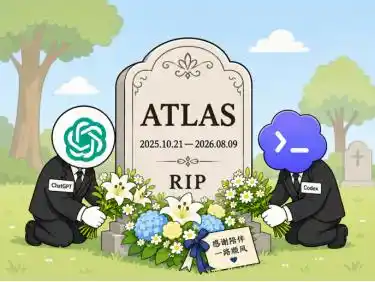
Atlas, Killed by ChatGPT
Last October, when Atlas debuted, there was ample justification for the emergence of an AI browser.
When OpenAI introduced ChatGPT Atlas, it defined it as "a brand-new web browser built around ChatGPT as its core."
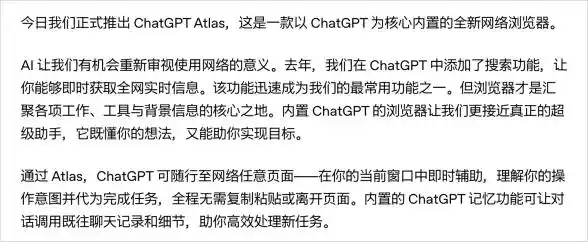
At the time, ChatGPT had already enabled users to retrieve information, with search becoming one of its most frequently used functions.
But OpenAI believed search was only the first step. The browser, they argued, was the central hub where workflows, tools, and contextual information converged.
Early chatbots could answer questions, but still maintained a gap between themselves and the real internet. If users wanted AI to fetch up-to-date information, read multiple pages, compare sources, or even perform actions on websites, AI needed a live environment connected to the internet.
And the browser—possessing page content, tabs, login states, and user interface—was already the most mature access point to the internet.
Thus, a natural idea emerged: if AI is to someday complete tasks on behalf of users, the browser might become the workspace where Agents enter the internet.
Atlas explored precisely this direction, embedding ChatGPT directly into the browser. When users opened a webpage, ChatGPT could understand the current context and assist based on user intent; for complex tasks, ChatGPT could participate—or even replace—the user entirely.
This direction made perfect sense at the time. After all, a true Agent capable of acting on a user’s behalf must not only know the answer, but also interact with the real world—and the browser remains the most mature human-machine interface of the internet era.
This insight was not unique to OpenAI. In fact, OpenAI arrived relatively late to the game.
Early in 2025, The Browser Company launched Dia, an AI browser that integrated AI capabilities directly into the browsing workflow. Users could instruct AI to comprehend current tab content, summarize information, generate text, and complete tasks based on browsing context.
By mid-2025, Fellou entered public view, further betting on the AI browser vision by aiming to enable AI not just to read webpages, but also to plan tasks, execute cross-site operations, transforming the browser from an information viewer into a task execution environment.
Subsequently, in July 2025, Perplexity launched Comet, attempting to fuse AI-powered search, web understanding, and Agent capabilities into a single browser. One of Comet’s core selling points was enabling an AI assistant to accompany users while browsing, summarizing content, managing pages, and performing partial operations on their behalf.
Collectively, these AI browser products shared a common assumption: in the past, browsers were the human gateway to the internet; in the future, they might become the AI gateway.
This premise itself may not have been flawed—but within less than a year, OpenAI changed course.
OpenAI’s retention of the capabilities pioneered by Atlas confirms that the value of browser-based Agents remains intact.
At the same time, another shift is underway: AI is reshaping the traffic distribution model established during the search era.
According to Search Engine Land, citing Previsible’s AI Traffic Study, researchers analyzed 6.77 million LLM-driven website visits and found that by May 2026, monthly traffic driven by LLMs reached 644,000 visits—a 9.9x increase from earlier levels. Of this, ChatGPT accounted for 92.4% of AI-referral traffic.
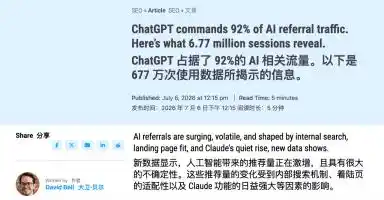
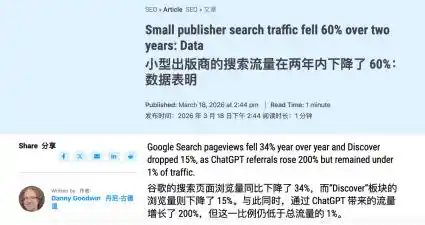
Meanwhile, Search Engine Land references Chartbeat Analytics data showing that over the past two years, referral traffic from search engines dropped 60% for small publishers and 47% for mid-sized publishers; during the same period, Google Search-driven pageviews declined by 34%, while ChatGPT referral traffic grew over 200%.
Although ChatGPT referral traffic currently accounts for less than 1% of total site traffic, these trends signal that AI is emerging as a new traffic gateway.
To illustrate with personal experience: for a period, I used Perplexity’s Comet as my default browser.
I often relied on it to search for news coverage on specific events—especially to locate original sources. For me, AI hallucinations posed a serious risk: AI frequently fabricated data, cited non-existent sources, or provided links mismatched to content. I had to verify each source manually before feeling confident.
But as ChatGPT’s search capabilities improved, I stopped using Comet altogether, reverting my default browser back to Chrome (after all, I don’t always need to ask AI about everything).
Comet didn’t deteriorate—it simply failed to keep pace with what I valued most: more accurate search results, more reliable source citations, tighter link-content alignment, and seamless handling of complex document compilation—all now possible directly within a chatbot conversation.
In other words, tasks once requiring an AI browser can now be completed directly inside a chatbot.
Similarly, in China, many users increasingly turn to Douba and DeepSeek (with smart search enabled) instead of defaulting to “Baidu it” as they once did.
Atlas died because of ChatGPT. The cause of death was not the concept of a browser Agent, but rather the underlying assumption:
Do users need to first open an AI browser before letting AI help them navigate the internet?
As AI gradually gains the ability to independently perform search, comprehend web pages, and execute tasks, OpenAI’s answer is clearly no.
AI Browsers Have No Future, But Browsers Will Not Be Without AI
OpenAI’s decision to discontinue Atlas aligns with the company’s broader strategic direction.
Initially, Atlas aimed to serve as ChatGPT’s entry point into the internet. But today, OpenAI is pushing to make ChatGPT a unified super-entry point. Search, document processing, code execution, task management, and browser Agent capabilities are all being integrated into ChatGPT. Under this vision, maintaining a separate Atlas would not add a new gateway—it would instead fragment user attention.
In short, OpenAI wants a super assistant, not a super assistant accompanied by a browser.
Nevertheless, Atlas’s shutdown inevitably prompts the market to reevaluate the future of AI browsers.
Before diving deeper, we must clarify a commonly confused distinction: AI browser versus browser + AI.
They appear similar but represent fundamentally different paths.
An AI browser seeks to create a new entry point, transforming the browser from a mere webpage viewer into an Agent capable of understanding goals, invoking web pages, and executing tasks—requiring users to abandon their long-established browser in favor of a new product.
In contrast, browser + AI doesn’t demand a change in entry point. Instead, it enhances existing browsers with AI capabilities. This evolution feels more natural to users, as browsers already hold irreplaceable assets: bookmarks, browsing history, saved passwords, extensions, login states, and ingrained usage habits.
These two concepts are often lumped together under the umbrella term “AI browser,” but they represent distinct product categories.
Taking domestic examples: Meituan’s Tabbit closely resembles Perplexity’s Comet (and OpenAI’s soon-to-be-shut-down Atlas), qualifying as a native “AI browser,” thus inherently overlapping with general-purpose Agents.
On the other hand, Tencent’s QQ Browser, Alibaba’s Kuakua Browser, and 360 Browser—though all branding themselves as “AI browsers”—are essentially implementations of “browser + AI.” They already existed as browsers and merely added AI features, rather than creating a completely AI-driven new entry point.
The “browser + AI” approach is exemplified by Google. Its logic is straightforward: Chrome is already the gateway for billions of users accessing the internet. There’s no incentive for Google to discard its accumulated dominance and rebuild a new entry point.
In 2025, Google began progressively integrating Gemini capabilities into Chrome, including AI Mode, page comprehension, cross-tab assistance, browsing history Q&A, and context-aware task support.
These features aren’t meant to simply replace search—they aim to let AI seamlessly enter the user’s ongoing internet workflow. In other words, users don’t need to switch browsers; Chrome becomes smarter by default.
We might consider the AI browser as a transitional product form.
Because AI needing a browser is not the same as users needing an AI browser.
Over the past year, developments in ChatGPT, Claude, and similar systems have proven one thing: search, web comprehension, information aggregation, and task execution are becoming foundational capabilities of general-purpose Agents.
Users no longer need to enter a browser first to invoke AI. AI itself can now handle more and more information work that previously required browser interaction.
What truly matters isn’t the “AI browser” product form—but the browser capabilities themselves.
Enabling AI to understand web pages and execute tasks within a web environment is now an indispensable capability for Agents. Yet this capability doesn’t necessarily require a standalone browser. It can be embedded directly into browsers, chatbots, or even temporary browser environments launched dynamically by an Agent to complete specific tasks—users may not even realize a browser is running behind the scenes.
As long as an Agent can access page content, login state, and controlled operation permissions, there’s no need for users to install a new “AI browser.”
Atlas Is Shut Down, But Browsers Live On
The loss of value in “AI browsers” does not imply the demise of browsers themselves.
As noted earlier, AI is changing how traffic is distributed in the search era. This raises a key question:
If future Agents can search webpages, read content, and even act on users’ behalf, is the browser still necessary?
The answer is yes.
AI is altering the browser’s role as a search gateway—but not its value as an internet distribution infrastructure.
Historically, browsers and search engines jointly formed the backbone of internet information distribution: users opened browsers, used search engines to find information, then visited websites to consume content.
Search engines distributed traffic; websites hosted content and services.
Now, AI is disrupting this model. Users no longer need to visit dozens of pages; they can ask AI to search, read, and synthesize information from multiple sources, generating answers directly. Increasingly, information needs bypass search result pages altogether.
But search is only one part of internet distribution. The internet itself won’t disappear. Countless services still run on web platforms: e-commerce, enterprise software, financial services, content sites, databases, and countless online tools.
Even under ideal conditions—where most information retrieval is handled by AI—users still need to access various internet-based services.
Advertising is no exception. Future AI may transform ad formats: users may encounter commercial content not through keyword searches, but via AI recommendations, shopping decisions, or task execution. Yet ads themselves won’t vanish, as the commercial world still requires connecting with consumers.
Moreover, AI itself depends on these services, the internet, and browsers.
In a way, the browser for knowledge work Agents is akin to the terminal for programming Agents.
Codex and Claude Code require a terminal environment—not because we need an AI terminal, but because terminals provide code, files, runtime environments, and project state.
Symmetrically, the browser provides pages, accounts, services, UI interfaces, and—most valuable in the AI era—context.
What article is the user currently reading? Which tabs are open? What did they search for? Which websites are they actively using? These pieces collectively define the user’s real-world working state.
For Agents, this context is critical.
Therefore, companies with traditional internet gateways haven’t abandoned browsers due to AI’s rise—they’re upgrading them with AI.
The fundamental value of the browser as an internet distribution infrastructure endures. It is not merely a webpage viewer; it is the connective layer between users, content, services, and commerce in the AI era.
The battle for browsers in the AI era is no longer just about capturing search entry points. It’s about controlling the context of users’ internet activities, cross-site task execution permissions, the highest-frequency interface between AI and users, and the future distribution rights for search, shopping, advertising, and transactions.
Original article from WeChat Official Account "Letter AI", author: Yuan Xinyue
Source: Letter AI
Disclaimer: Contains third-party opinions, does not constitute financial advice


a16z: 80% of AI Budget is Idle
3 days ago
OpenAI Former CTO Unveils 975B Open-Source Champion
5 days ago
DeepSeek Races for Sci-Tech Innovation Board Listing: Valuation Reaches $71 Billion
5 days ago
26 People Sue Meta: Will AI Fire You for Taking Maternity or Sick Leave?
5 days ago
Liáng Wénfēng Becomes the New Richest Man in AI, 36 People Get Rich Overnight from Large Models
6 days ago
Today's Leaderboard for Large Model Token Usage
05-08
Doubao Launches Paid Model: Can AI Subscriptions Work?
05-06


